Temple of Ephesian Artemis: A Sanctuary at Ancient Ephesus
Site at a Glance
- Popularity
- Very High
- Country
- Turkey
- Primary era
- Classical
- Eras represented
- Classical
- Civilizations
- Ancient Greek
- Site type
- Religious
- Remains
- Temple
On this page15 sections
History
The Temple of Ephesian Artemis stood near ancient Ephesus, close to present-day Selçuk in Turkey. Dedicated to a distinctive local form of Artemis, the Greek goddess associated with hunting and childbirth, it was counted among the Seven Wonders of the Ancient World. Romans identified Artemis with Diana, while the Ephesian goddess belonged to an older local tradition. The best-known temple was begun around 550 BC and completed around 380 BC.
Early sanctuary
The sacred site was used long before the major temple of the sixth century BC. Evidence points to Bronze Age occupation, and successive sanctuaries were built at the location. Callimachus attributed the sanctuary’s beginnings to the legendary Amazons. Pausanias instead considered it older than both the Amazons and the Ionian migration, when Greek-speaking Ionians settled along the coast of Asia Minor. Excavations have not confirmed the Amazon tradition.
The earliest identifiable temple was built in the second half of the eighth century BC and was destroyed by a flood in the seventh century BC. The sanctuary continued to be used despite repeated flooding and the buildup of sediment, preserving its location as a focus of worship.
Rebuilding and civic life
A larger temple was started around 550 BC under the Greek architects Chersiphron and his son Metagenes, with at least some funding from Croesus, king of Lydia. Demetrius and Paeonius completed the project around 380 BC. After Persian rule replaced Lydian rule, the Ephesians played down Croesus’s contribution. Persian authorities removed some cult objects to Sardis and brought Persian priests into the Ephesian cult, prompting resentment.
In 356 BC, fire destroyed the temple. Tradition blamed Herostratus, who was said to have sought lasting fame through the act. The Ephesians sentenced him to death and ordered that his name be forgotten, but the historian Theopompus preserved it. His responsibility and motive remain uncertain. Starting a fire would have required access to the guarded wooden roof, and another proposed explanation is that sanctuary administrators arranged it because religious restrictions prevented moving the sanctuary from its established location. The fire was traditionally linked to the birth of Alexander the Great around July 20 or 21 that year.
Alexander offered to pay for a replacement, but the Ephesians declined, reasoning that it was unsuitable for one god to build a temple to another. They began rebuilding after his death in 323 BC and financed the work themselves. The resulting temple was larger than its predecessor and became the sanctuary’s final major form.
The sanctuary also served civic and economic purposes. A college of priests administered it independently of the city authorities, and it functioned as a financial and commercial center as well as a place of worship. People seeking refuge from persecution or punishment came there, while merchants, rulers, and other visitors made offerings. The Ephesian philosopher Heraclitus was associated with placing his writings in the temple.
The sanctuary and its festivals helped express Ephesus’s political and cultural identity. The annual Artemisia grew into a major event in the Greek festival calendar, with games, contests, theatrical performances, and processions. It attracted young people seeking marriage partners and contributed to the region’s economic life. In 162 AD, a Roman edict extended the celebration from several holy days in March and April to a full month. Emperor Commodus later lent his name to the games and may also have sponsored them. Pliny described the procession as a major attraction, and Apelles depicted it in a painting.
Roman period and the temple’s later history
The New Testament presents early Christian missionary work in Ephesus as prompting fears that the temple would be dishonored. A different account appears in the second-century Acts of John, an apocryphal Christian text. It tells how the apostle prayed in the temple, after which its altar broke apart and half the building fell. This is a religious narrative, not a historical account of the temple’s destruction.
In 268 AD, Goths led by Respa, Veduc, and Thurar raided Ephesus and burned the temple. The extent of the damage is uncertain, and the building may have been repaired and used again. Artemis may have continued to be worshipped there until about 401. The temple’s closure during the late Roman persecution of pagans has been proposed for a date as early as 407 and no later than the middle of the fifth century; when it was finally destroyed is unknown. Later, Artemis’s name appears to have been erased from inscriptions across Ephesus.
Stone from the abandoned sanctuary was reused in other buildings. A late medieval story that columns in Hagia Sophia came from the temple is unfounded. Cyril of Alexandria credited John Chrysostom with destroying it, while Proclus later connected John with the removal of temple art; the latter claim has little supporting evidence.
John Turtle Wood located the temple in 1869 after six years of searching, during an expedition sponsored by the British Museum. Excavations continued until 1874. David George Hogarth led further work in 1904–1906, and excavations before the First World War helped identify successive temple buildings. Work in 1987–1988 examined early occupation and sanctuary finds. The temple remains part of the UNESCO World Heritage property of Ephesus, inscribed in 2015.
Remains
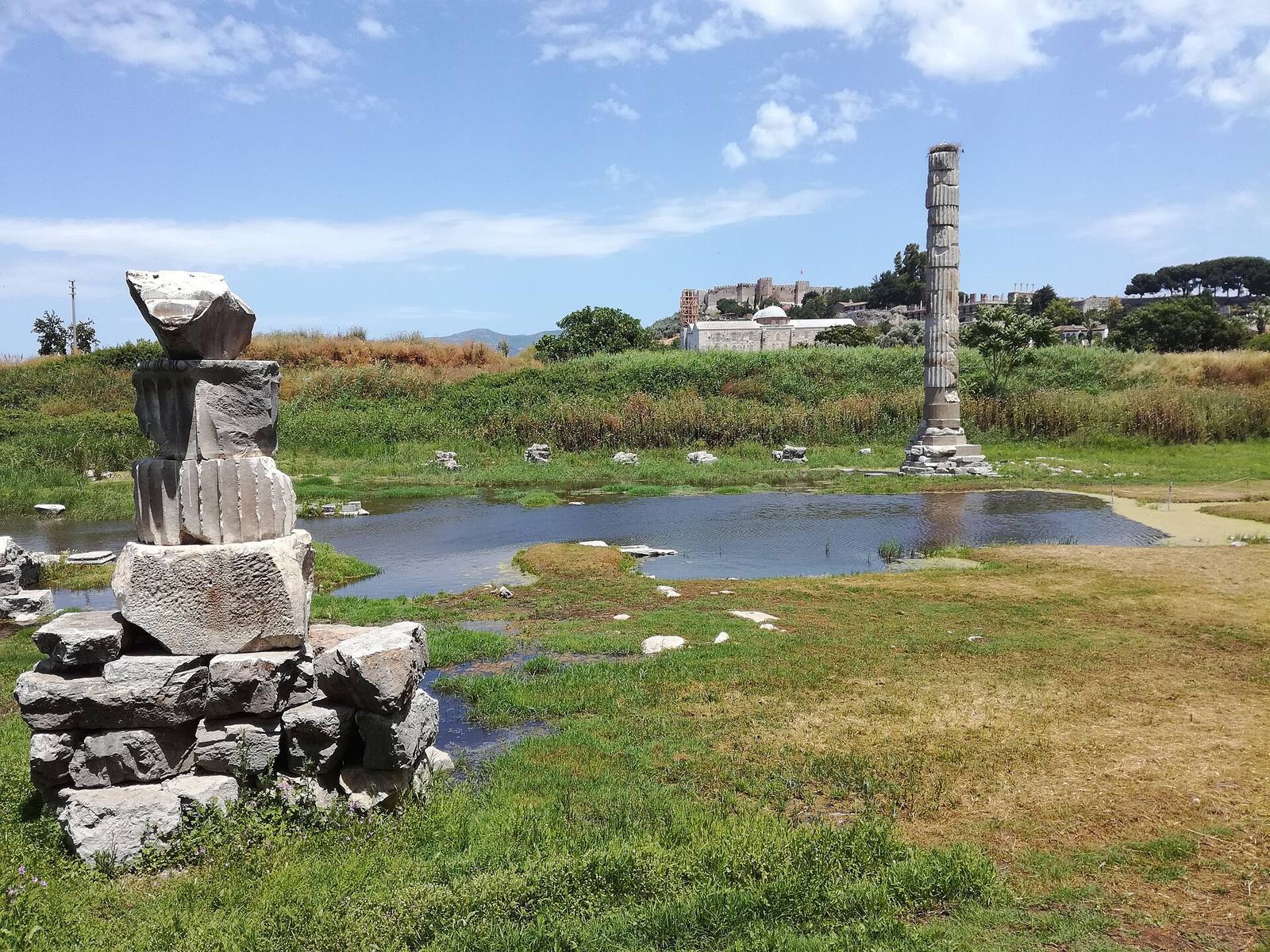
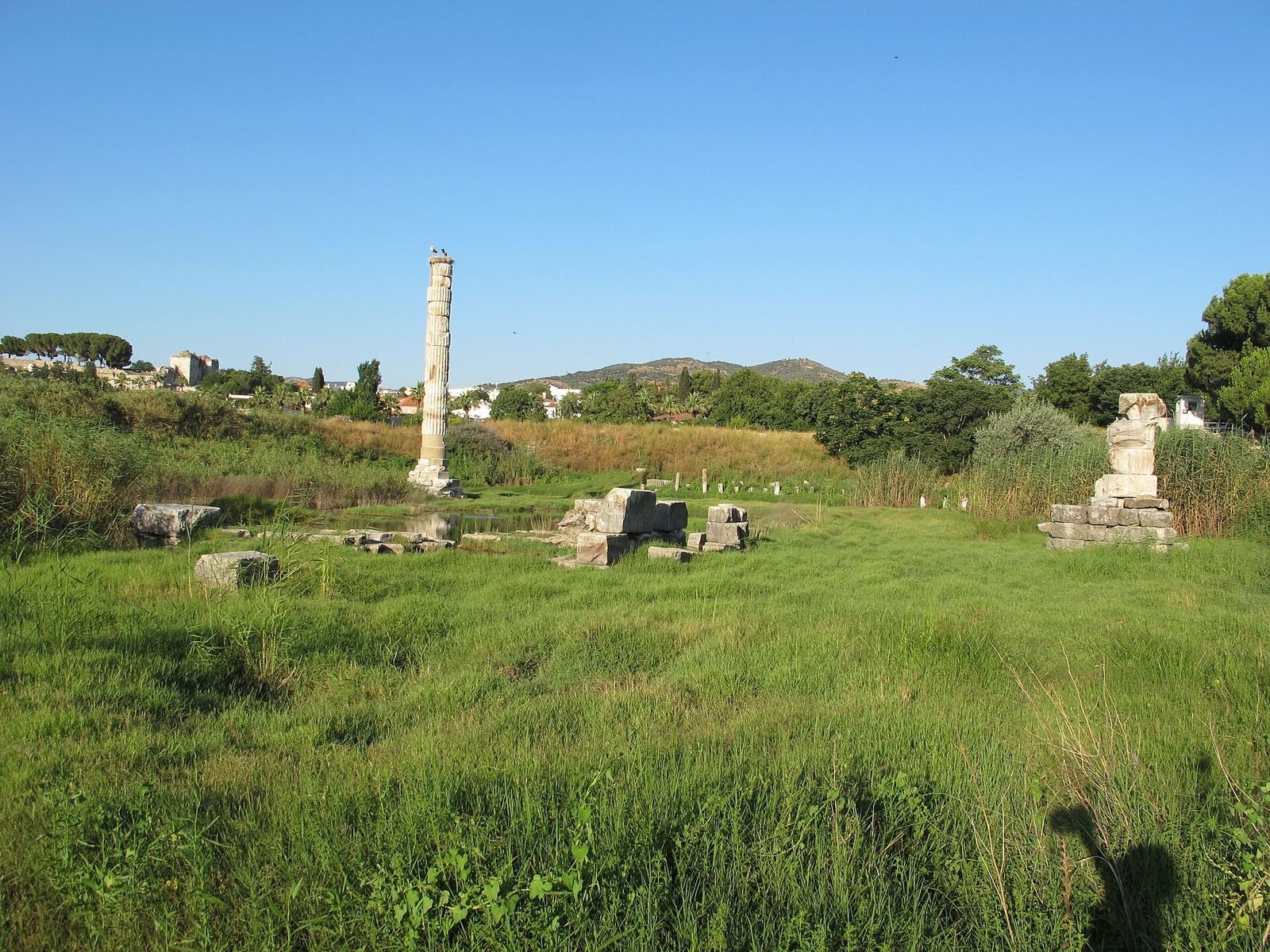
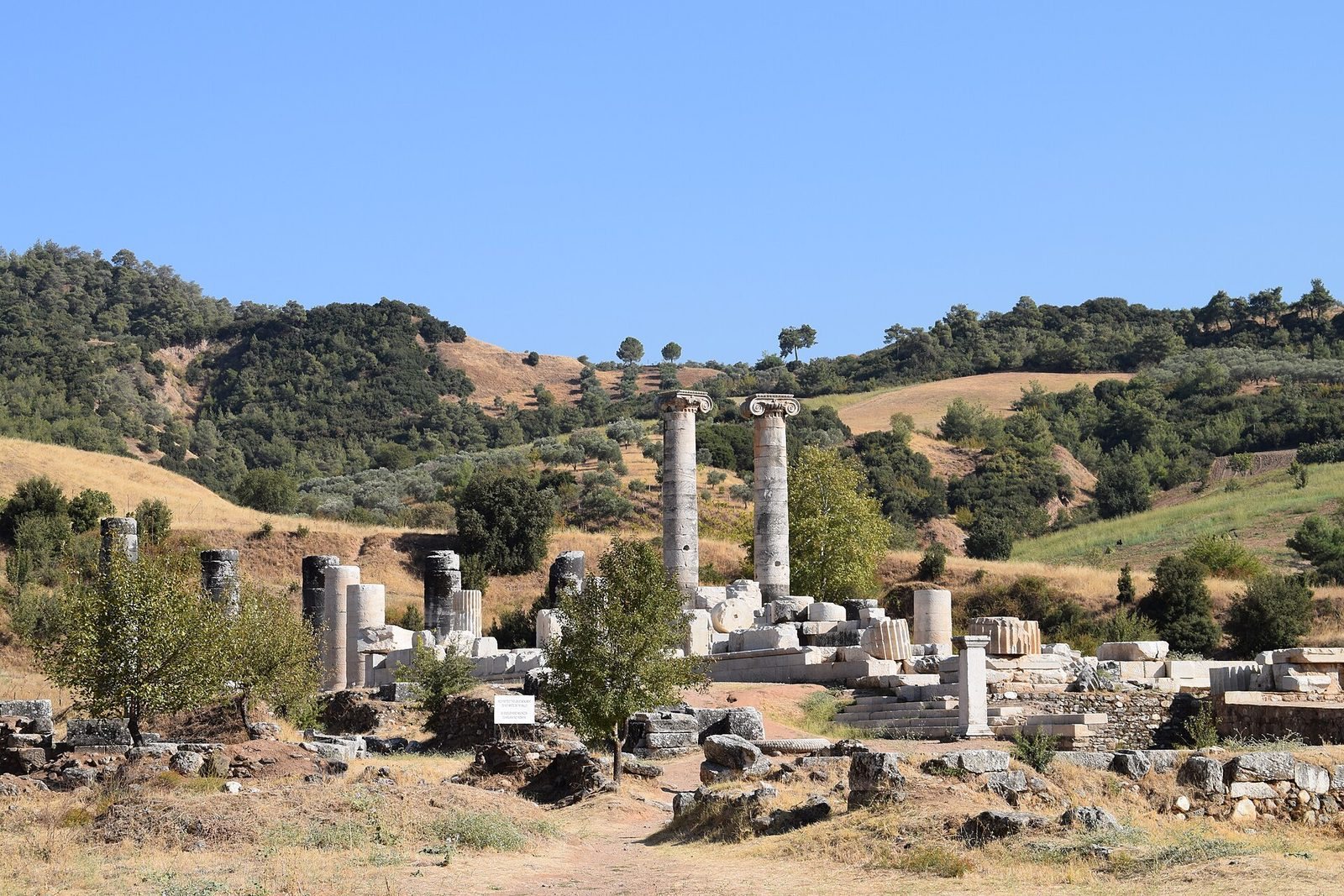
The sanctuary developed through successive temple plans, from early buildings with surrounding columns to larger structures raised on stepped bases. Its principal remains include foundations and fragments of the final temple, while a single column has been reconstructed from pieces found at the site.
Archaic sanctuaries
Early temple plans
Excavations distinguish three successive early sanctuaries, associated with the eighth century BC, the middle of the seventh century BC, and a smaller building measuring 16 by 31 metres. The smaller temple had two columns in front of its entrance. The earliest identifiable building had a hard-packed clay floor and rows of columns surrounding all four sides. It may have been the earliest Greek temple of this kind and is an early example of the design on the coast of Asia Minor.
Flood deposits and buried floors
A flood in the seventh century BC covered the earliest temple’s clay floor with more than half a metre of sand and debris. Finds in the flood deposits included a carved plaque, apparently ivory, showing a griffin and the Tree of Life and probably originating in North Syria. Drilled amber drops with elliptical cross-sections may have belonged to the wooden cult image. Sediment raised the sanctuary level by about two metres between the eighth and sixth centuries BC and by another 2.4 metres between the sixth and fourth centuries BC.
The temple begun under Croesus
Building and colonnade
This temple measured 115 metres long and 46 metres wide. It was reportedly the first Greek temple built of marble. Its columns, about 13 metres high, stood in double rows around the enclosed central room, forming a broad ceremonial passage. Pliny the Elder reported that 36 columns carried carved reliefs. Relief fragments on the lowest column drums indicate that columns from an earlier temple were reused. Pliny also attributed the marshy location and lower foundation layers of fleece and pounded charcoal to measures against earthquakes.
Cult image and foundation deposit
A dark wooden cult statue, described as ebony or blackened grape wood, was made by Endoios for this temple. A small shrine east of the open-air altar housed the image. A rich foundation deposit, called the Artemision deposit, contained more than a thousand objects. Among them were electrum coins, made from a naturally occurring gold-and-silver alloy. Coins dated to about 625–600 BC bear the name of Phanes or an inscription interpreted as “I am the badge of Phanes.” The meaning is disputed: Phanes may have been a person, perhaps a merchant, or the name may refer to an epithet of Apollo.
The final major temple
Stepped base and columned plan
The final temple measured 137 metres long, 69 metres wide, and 18 metres high. Its higher, stepped base supported 127 columns arranged in nine rows beneath the roof. A tradition held that each column had been given by a king.
Altar, sculpture, and decoration
An altar was dedicated to Artemis Protothronia, with a gallery of images above it. The gallery included an ancient figure of Nyx, the goddess of night, attributed to the sculptor Rhoecus. Sculptures of Amazons were attributed to Scopas. The temple was also decorated with paintings and columns gilded with gold and silver, and it contained works by Praxiteles, Polyclitus, Pheidias, Cresilas, and Phradmon.
Cult image and painted portrait
The image of Artemis associated with this temple was attributed by Athenagoras to Endoios, although that attribution has been questioned. The Ephesian goddess was represented as an archaic wooden figure adorned with jewelry. Depictions show her body and legs enclosed in a tapering, pillar-like form, with her feet projecting below; on Ephesian coins, she wears a mural crown shaped to resemble a city’s walls. The original wooden image has not survived.
Oval objects covering the upper part of the familiar image have traditionally been read as breasts symbolizing fertility, an interpretation found in Christian writing of the third and fourth centuries AD. Scholars have questioned it since the 1970s. The objects have no nipples and in some depictions differ in color from the figure’s body. They may instead represent ceremonial ornaments, perhaps the testicles of sacrificed bulls, or amber jewelry. Gourd-shaped amber drops recovered in 1987–1988 may have been attached to the wooden image. Apelles also painted Alexander for the temple, showing him holding a lightning bolt like Zeus. The projecting hand was praised for its apparent depth, and Apelles was paid 25 gold talents for the work.
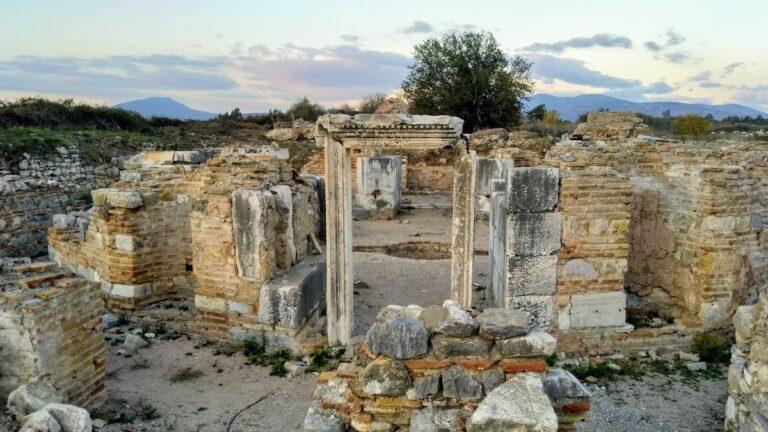
Today, the site retains foundations and fragments of the final temple, alongside the reconstructed column. Sculptural pieces from the fourth-century rebuilding and some earlier phases, as well as other finds, are held at the British Museum.