Coventry Cathedral: The Seat of the Diocese and a Memorial to Reconciliation
Site at a Glance
- Popularity
- Very High
- Country
- United Kingdom
- Primary era
- Modern
- Eras represented
- Medieval, Modern
- Civilizations
- British, English
- Site type
- Religious
- Remains
- Cathedral
On this page24 sections
History
Coventry Cathedral, the Church of England’s Cathedral Church of Saint Michael, stands on Priory Street in Coventry, United Kingdom. Its site brings together the remains of a medieval cathedral and the later church built beside them. The present cathedral is the seat of the Bishop of Coventry and the Church of England’s Diocese of Coventry, a church district overseen by a bishop.
St Mary’s and the medieval cathedrals
Coventry has had three cathedrals. The earliest was St Mary’s Priory, a religious house governed by a prior. By 1095 it was a small Benedictine monastery, following the rule of the order founded by the sixth-century monk Benedict of Nursia. Leofric, Earl of Mercia, and his wife Godiva endowed the monastery in 1043. Between 1095 and 1102, Bishop Robert de Limesey transferred his jurisdiction from Lichfield to Coventry, and St Mary’s became a cathedral. Rebuilding began soon after 1095. The church eventually reached 130 metres in length and had substantial associated buildings.
St Mary’s remained a cathedral until 1539, when Henry VIII dissolved the monastery during the Reformation, the sixteenth-century religious and political upheaval that led to the closure of England’s monasteries. The church was later demolished. It is identified as the only medieval cathedral demolished during the Reformation. Leofric was probably buried in Coventry’s earlier Saxon church. Godiva was reportedly buried at Evesham Abbey, while Gerard la Pucelle, Bishop of Coventry from 1183 to 1184, is named among the cathedral’s burials.
The second cathedral grew out of St Michael’s parish church, built mainly from the late fourteenth to the early fifteenth century. It was one of England’s largest parish churches and became a cathedral in 1918, when the Diocese of Coventry was established.
The bombing and the postwar cathedral
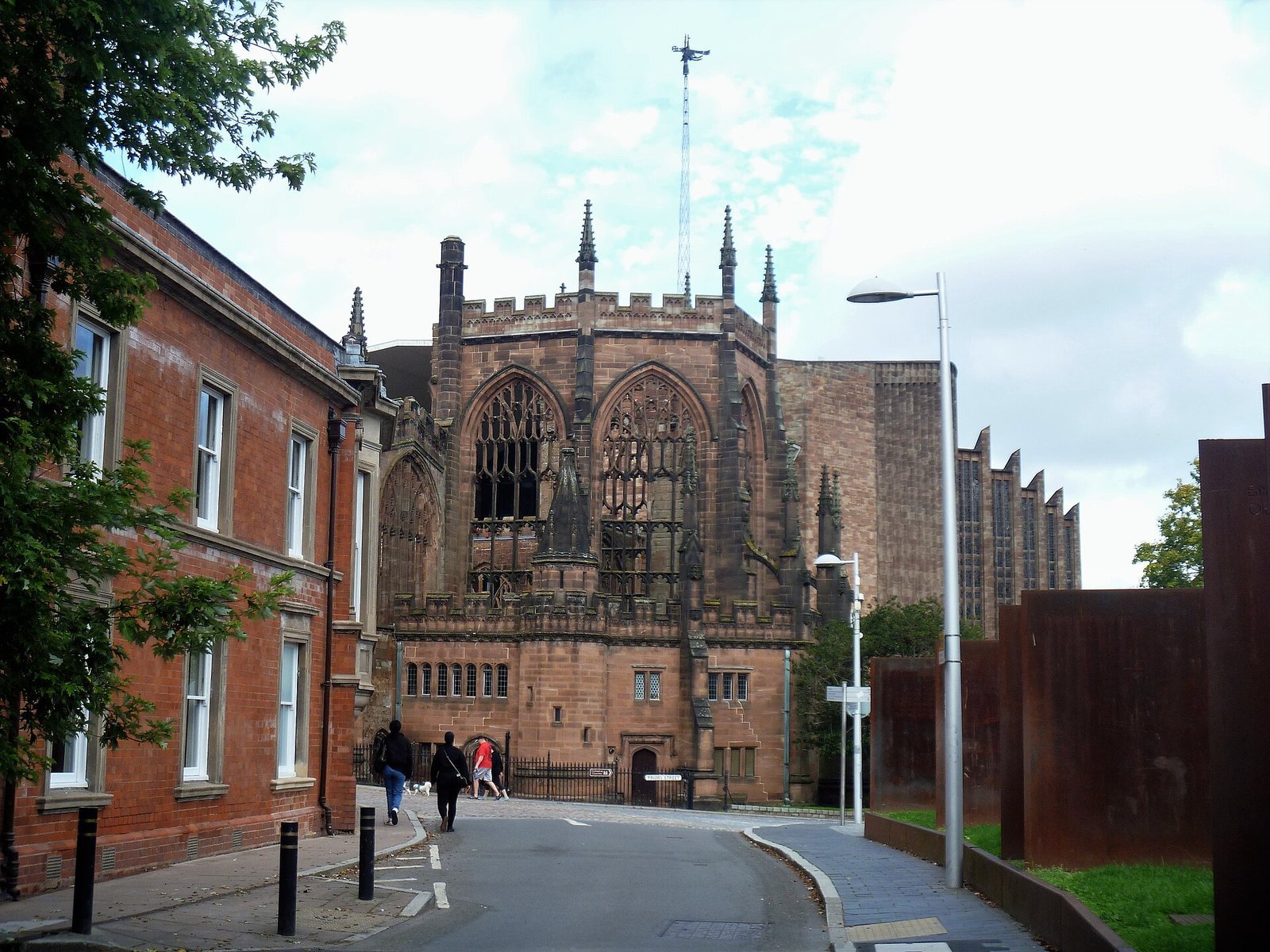
On 14 November 1940, German air force bombers attacked Coventry during the Second World War in the raid known as the Coventry Blitz. St Michael’s was almost entirely destroyed. Provost Richard Howard, the senior cleric leading the cathedral community, responded with a plea for forgiveness. The surviving structure was kept as hallowed ground rather than cleared for rebuilding.
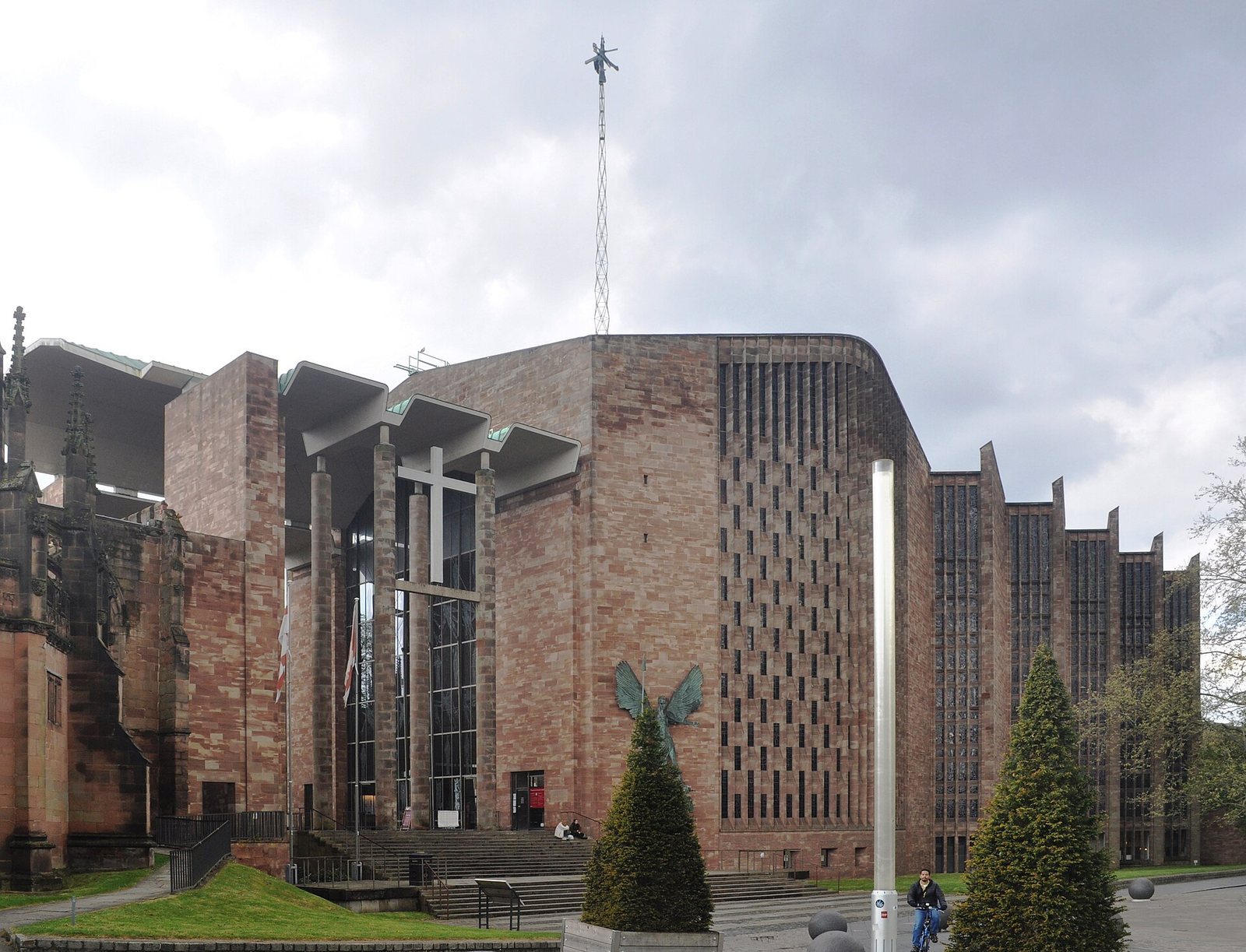
In 1950, architect Basil Spence won a design competition with more than 200 entries. He proposed preserving the ruin as a garden of remembrance and placing a new cathedral alongside it, with the two serving together as one church. Queen Elizabeth II laid the new building’s foundation stone on 23 March 1956. Built from 1956 to 1962 to designs by Spence and the engineering and design consultancy Arup, it was constructed by John Laing. In April 1962, Wing Commander John Dowling used a helicopter to raise the roof spire into position.
Bishop Cuthbert Bardsley consecrated the new cathedral on 25 May 1962. Benjamin Britten’s War Requiem, a musical setting of Christian prayers for the dead, was composed for the occasion and first performed there on 30 May. The paired ruins and new building came to represent both the destruction of war and the pursuit of peace and reconciliation.
Reconciliation and community mission
The postwar cathedral’s mission emphasized resurrection and reconciliation, priorities established by Howard in the aftermath of the bombing. The Cross of Nails began when Howard, following a suggestion from the Reverend Arthur Philip Wales, made a cross from three nails recovered from the old cathedral’s roof. It became an international emblem of reconciliation. More than 330 centres have copies, and when nails from the ruins were no longer available, a prison in Germany supplied replacements. The International Centre for Reconciliation coordinates the centres.
A Cross of Nails also travelled aboard successive Royal Navy ships named HMS Coventry. Divers recovered the cross from the Type 42 destroyer after enemy action sank the ship in the 1982 Falklands War, the conflict between the United Kingdom and Argentina. The ship’s captain and colleagues presented it to the cathedral. It was carried by another HMS Coventry from 1988 until that ship’s decommissioning in 2002, then presented to HMS Diamond at a commissioning ceremony in 2011.
H. C. N. “Bill” Williams, the first provost of the new cathedral, took up his post in 1958. He brought from South Africa the phrase “Christians heal the wounds of history.” His ministry reached poorer parts of Coventry and engaged with different faith communities and industry, while building international relationships through the Community of the Cross of Nails. Later deans gave the cathedral’s work distinct emphases. John Petty developed its healing ministry; John Irvine, dean from 2001 to 2012, focused on Bible teaching and evangelism; and John Witcombe, dean from 2013, renewed the emphasis on reconciliation through initiatives including the arts and a Canon for Arts and Reconciliation.
Justin Welby, then a member of the cathedral’s clergy, established a day for bereaved parents after his daughter died. The cathedral now holds an annual service remembering children who have died, and families may request that a child’s name be entered in a book kept there.
Remains
The site combines the surviving shell of medieval St Michael’s with the postwar cathedral beside it, while only a few ruins remain of St Mary’s. Red sandstone in the older building is echoed by the Hollington sandstone of the new one. The newer cathedral’s modern architecture has a regional character, and its artworks were planned as part of the building’s design.
The medieval remains
St Mary’s Priory and Cathedral
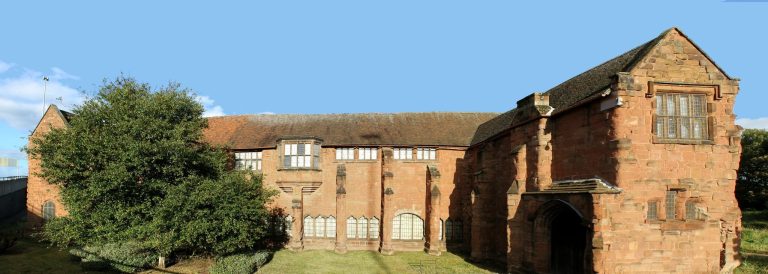
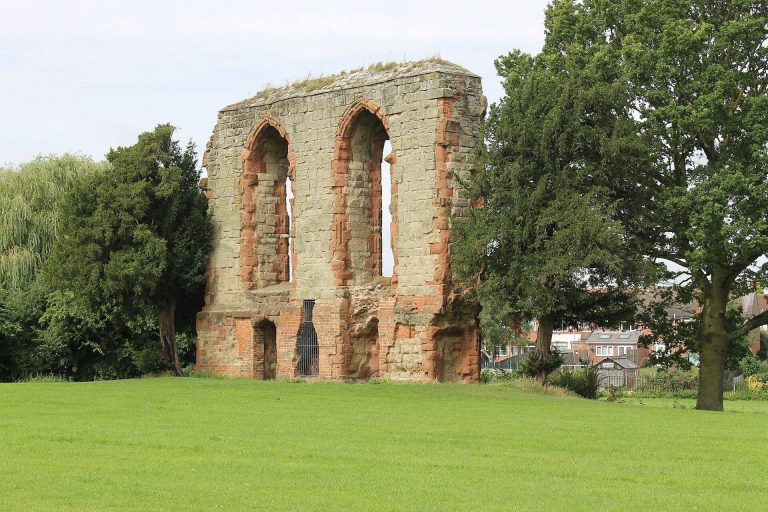
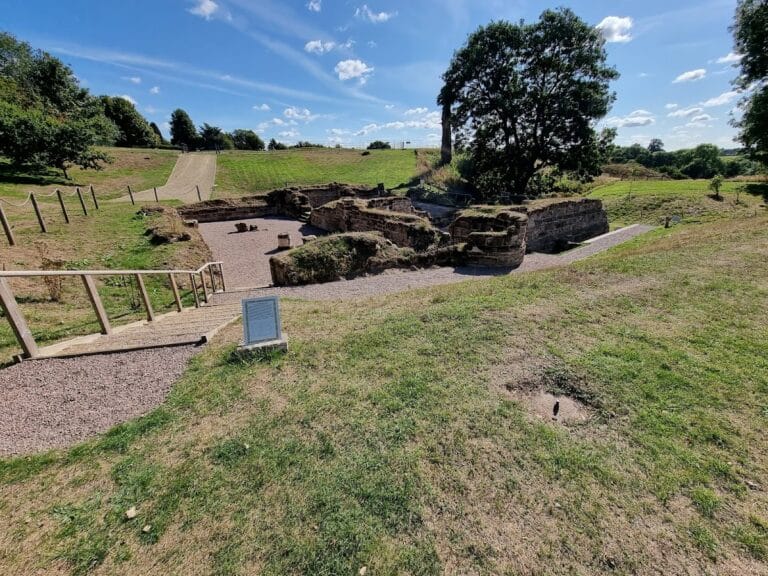
Only a few ruins survive from St Mary’s. They are the visible remains of the earlier religious house and cathedral, whose church once measured 130 metres in length.
St Michael’s shell and tower
The old cathedral’s red-sandstone shell survives with its outer walls, tower and spire. The tower still serves as a bell tower. The spire reaches 87 metres to the base of its weather vane and 88 metres including the vane. It is Coventry’s tallest structure and England’s third-tallest cathedral spire, after Salisbury and Norwich. Behind the altar, the wall bears the words “Father Forgive.” The bronze memorial figure and tomb of Huyshe Yeatman-Biggs, Coventry’s first bishop, also survived the bombing.
Other surviving works
Fifteenth-century stained-glass windows made by John Thornton were taken out before the bombing and survived. The Charred Cross originated when cathedral stonemason Jock Forbes bound together two wooden beams that had fallen in a cross shape. The original is kept on the stairs connecting the cathedral with St Michael’s Hall. A 1964 replica stands on an altar made of rubble in the old ruins.
The old cathedral’s nave, or main body of the church, also contains the bronze cast of Josefina de Vasconcellos’s Reconciliation. The original sculpture was made in 1977 as Reunion and given to the University of Bradford’s Peace Studies department. Coventry received a copy in 1994. After repair and renaming, the bronze cast was presented in 1995 to mark the fiftieth anniversary of the end of the Second World War.
The postwar cathedral
Building and roof
The new cathedral’s flat roof is topped by a 24-metre spire, a slender structure rising from the roof. Geoffrey Clarke’s bronze sculpture of a winged cross crowns it. The use of Hollington sandstone links the building’s materials with the red sandstone of the old cathedral.
The Great West Window
At the entrance, John Hutton’s Screen of Saints and Angels, also called the Great West Window, combines the roles of wall and window. Its 66 saints and angels are engraved directly into the glass in an expressionist style. The transparent screen allows the old cathedral ruins to be seen from inside. It is at the church’s liturgical west, meaning the entrance end, opposite the altar at the north end.
The tapestry in the Lady Chapel
Graham Sutherland’s Christ in Glory in the Tetramorph hangs on the altar-facing wall of the Lady Chapel, a chapel dedicated to the Virgin Mary. Measuring 23 metres high by 12 metres wide, it shows the risen Christ within a mandorla, an oval or almond-shaped frame, surrounded by symbols of the four Gospel writers. The single piece of wool was hand-woven at Aubusson in France on a loom made from two tree trunks and described as 500 years old. Commissioned in 1951, the tapestry took about ten years to design and make and was installed in 1962. It was once regarded as the world’s largest tapestry.
The baptistry window
John Piper designed the floor-to-ceiling window for the baptistry, the space used for baptism, with glassmaker Patrick Reyntiens. It measures 21.9 by 18 metres and contains 198 stained-glass panes in a convex checkerboard frame of concrete. The abstract design forms a yellow sunburst, with mainly blue glass above and green below. Commissioned in 1955, the window was made between 1958 and 1961.
The nave windows
Ten stained-glass windows by Lawrence Lee, Keith New and Geoffrey Clarke angle toward the altar and away from the congregation. Spence conceived them as paired sequences from birth through old age to heavenly glory, with one side representing human life and the other the divine. New designed the green windows of youth, Lee the red and gold windows of early manhood, and Clarke the purple windows of wisdom and old age. Each artist made three windows, and all three collaborated on the tenth.
Stone carvings and the baptismal font
Ralph Beyer carved ten irregularly lettered stone panels, the Tablets of the Word, directly into the nave walls. Their lettering draws on early Christian inscriptions, particularly those in Roman burial chambers. Beyer also carved the foundation stone, a greeting set into the nave floor and the baptismal font, which is made from a boulder sourced in Bethlehem.
Sculpture on the exterior
Jacob Epstein’s bronze St Michael’s Victory over the Devil is fixed to the exterior east wall. More than seven metres high, with wings spanning the same width, it depicts the Archangel Michael triumphant over a bound Satan. Epstein completed it shortly before his death in 1959, and it was unveiled at the cathedral’s 1962 consecration.
Chapels and worship furnishings
The altar cross and Cross of Nails
Geoffrey Clarke’s bronze High Altar Cross has an organic form resembling a tree or bird, with the Cross of Nails set at its centre. Clarke also made a bronze Crown of Thorns that hangs above the altar in the Chapel of Christ the Servant. The crown recalls the suffering of Jesus before his crucifixion.
The Lady Chapel
John Bridgeman’s sculpture of Mary grieving for Christ, made in 1970, is in the Lady Chapel. Its Swedish windows were made by Einar Forseth, given by the people of Sweden and installed in 1961.
The Chapel of Unity
Margaret Traherne’s stained-glass windows in the Chapel of Unity use thick pieces of coloured glass set in a matrix. Narrow openings between the pieces send coloured light across the chapel’s concrete surfaces. Forseth designed the chapel’s mosaic floor.
The Chapel of Christ in Gethsemane
Steven Sykes’s mosaic in the Chapel of Christ in Gethsemane depicts the Angel of Agony, the angel who in Christian tradition comforted Jesus during his prayer there. A wrought-iron screen designed by Spence takes the form of a Crown of Thorns. The mosaic can first be seen from outside the chapel through the screen.
Other furnishings and images
Elisabeth Frink’s bronze lectern bookrest takes the form of an eagle. She modelled it directly in plaster and used ordinary kindling wood to create the appearance of feathers. Frink also designed the canopy over the bishop’s throne.
A copy of the Stalingrad Madonna is displayed in the cathedral. German artist and Lutheran pastor Kurt Reuber drew the image in Stalingrad in 1942. Copies are also displayed in Berlin and Volgograd as signs of reconciliation between countries that had been enemies.
The pipe organ
The cathedral’s Harrison & Harrison pipe organ dates from 1962. It has 76 stops, controls that select groups of pipes, four keyboards with 61 notes each, and a pedalboard with 32 notes. The instrument has electric action. Harrison & Harrison repaired it in 1987; around the turn of the century, David Wells cleaned, retuned and repaired it after a fire.