Roman Bridge: A 1st-Century Road Bridge in Vaison-la-Romaine



Site at a Glance
- Rating
- 4.6
- Popularity
- Medium
- Country
- France
- Primary era
- Classical
- External website
- Open
- Eras represented
- Classical
- Civilizations
- Roman
- Site type
- Infrastructure
- Remains
- Bridge
On this page5 sections
History
The Roman Bridge is a 1st-century Roman road bridge in Vaison-la-Romaine, France, and it remains in use today. Built during the Roman period, it crosses the Ouvèze and has continued to link the settlement’s two riverbanks for nearly 2,000 years.
Roman construction and later use
In antiquity, the bridge stood above wooden dikes supported by piles. Those structures have since disappeared, while the stone bridge continued to serve as a route across the river.
A flood on 15 August 1616 swept away the parapets. Their original date and form are uncertain, so the flood cannot be used to establish whether they belonged to the Roman construction.
Wartime damage and preservation
Near the end of the Second World War, German troops attempted to destroy the bridge by blasting it. The damage led to restoration of the vault and replacement of several wedge-shaped arch stones, called voussoirs, in 1953.
The bridge survived the major Ouvèze flood of 22 September 1992. The flood devastated the region and caused 37 deaths, while damage to the bridge was confined to its parapet. The structure was listed as a French historic monument in 1840, a legal heritage designation protecting places recognized for historical or architectural importance.
Remains
Stone bridge and arch
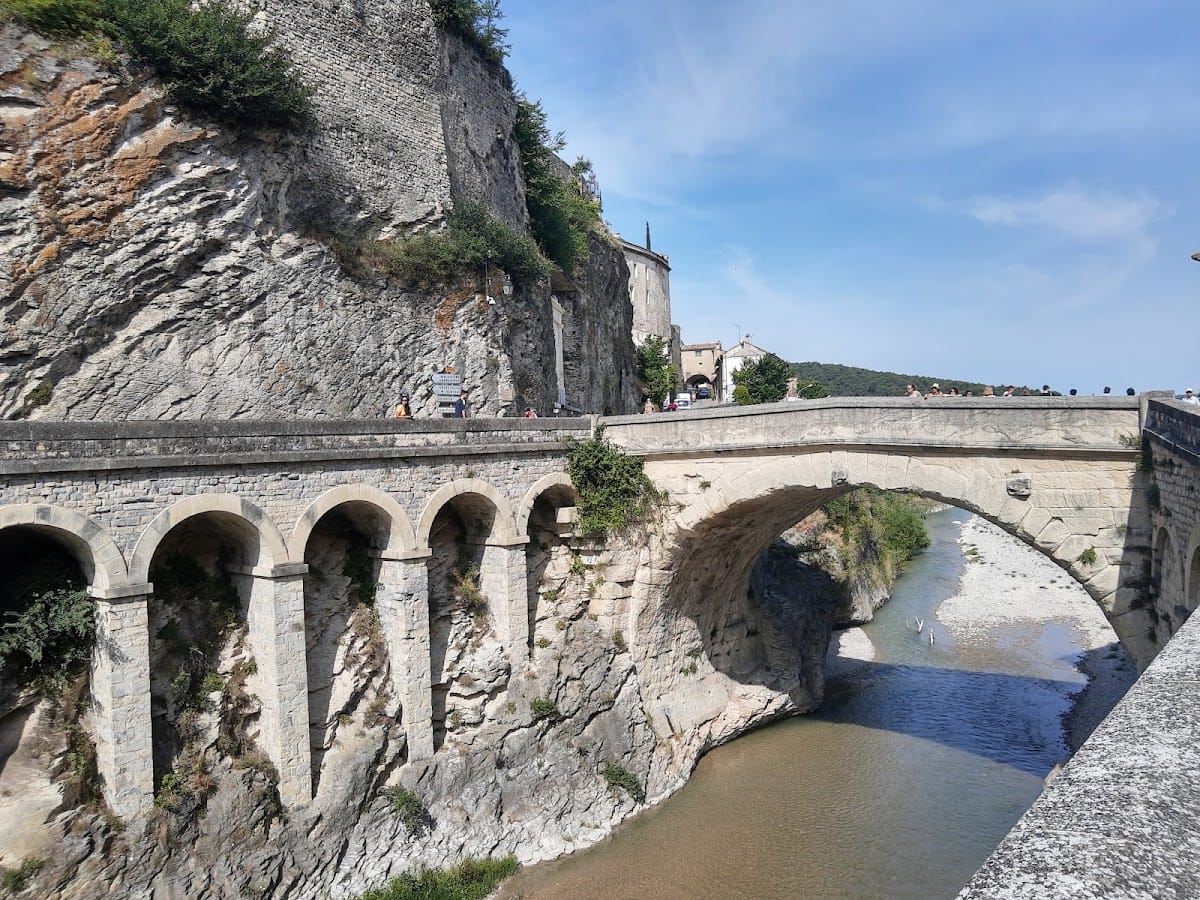
The bridge crosses the Ouvèze where the river narrows to approximately 9.5 metres. One end is anchored in the rock of Sus-Auze hill, while the other rests on the rock of the castle. Its position connects the modern centre of Vaison-la-Romaine and the former ancient quarters on the river’s right bank with the medieval Haute-Ville on the left bank.
A single semicircular arch spans 17.20 metres, and the bridge is approximately 9 metres wide. Including the parapets, it rises 12.55 metres above the river. The upper part of the arch consists of five parallel semicircular arches that form the bridge’s width. They are connected only at the crown, the central upper part where the arch’s forces meet, and each arch contains eleven voussoirs. The bridge remains substantially intact, although its parapets and some vault stones have undergone damage and repair.