Bhimbetka Rock Shelters: Prehistoric Caves and Rock Art in India
Site at a Glance
- Rating
- 4.6
- Popularity
- Medium
- Country
- India
- Primary era
- Stone Age
- External website
- Open
- Eras represented
- Stone Age, Classical, Medieval
- Civilizations
- Mauryan
- Site type
- Civic
- Remains
- Rock Art
On this page15 sections
History
Bhimbetka rock shelters are an archaeological site in the Raisen district of Madhya Pradesh, India, where people lived from the Paleolithic, or Old Stone Age, through the historic period. Some shelters were occupied more than 100,000 years ago, and the site preserves a long transition from mobile hunting and gathering to agriculture, exchange, and more developed religious expression.
Stone Age occupation
Archaeological evidence indicates successive occupation from the Acheulean, an early Stone Age tradition associated with large tools such as hand axes and cleavers, through later Stone Age phases, the late Mesolithic, and the 2nd century BCE. Excavated tools and other objects, pigments in deposits, painted rock surfaces, and accumulated occupation layers reveal changing patterns of life over this long period.
The Mesolithic, or Middle Stone Age, followed the Paleolithic and is associated with smaller tools and changing hunting and gathering practices. At Bhimbetka, Mesolithic paintings also suggest contact and exchange between shelter communities and agricultural communities living on the Malwa plains. The later evidence reflects a broader cultural transition that included agriculture and new forms of ritual and symbolic activity.
Recognition and interpretation
W. Kincaid, an official of British India, mentioned Bhimbetka in a scholarly paper published in 1888. Drawing on information gathered from local tribal communities near Bhojpur Lake, he interpreted the place as an ancient Buddhist site. Its prehistoric importance became clearer after the archaeologist V. S. Wakankar noticed similarities between its rock formations and formations he had seen in Spain and France. He visited Bhimbetka with a team of archaeologists in 1957 and reported numerous prehistoric shelters.
The extent of the complex emerged more fully during the 1970s. More than 700 shelters have since been identified, and approximately 400 contain prehistoric paintings. The Bhimbetka group includes 243 shelters, while the nearby Lakha Juar group includes 178. A local tradition connects the name with Bhima, one of the five Pandava brothers in the Mahabharata, a major Sanskrit epic of South Asian tradition. The interpretation of the name as “Bhima’s resting place” or “Bhima’s seat” is a traditional etymology rather than an archaeological explanation.
Protection and historical importance
Bhimbetka covers approximately 1,893 hectares and lies within the Ratapani Wildlife Sanctuary. The Archaeological Survey of India was assigned management in 1990, and UNESCO inscribed the site as a Cultural World Heritage Site in 2003 under criteria (iii) and (v). The paintings are used to trace changes in subsistence, technology, social life, warfare, and symbolic expression from prehistoric communities to later historic societies.
Paintings in at least 100 shelters have been estimated to have been eroded or lost. Weathering, pollution, and careless visitor activity have threatened the surviving works, leading the Archaeological Survey of India and UNESCO to undertake conservation measures. An earlier identification of Dickinsonia fossils at Bhimbetka was later rejected when the material was reinterpreted as decayed remains of a beehive.
Remains
The shelter landscape
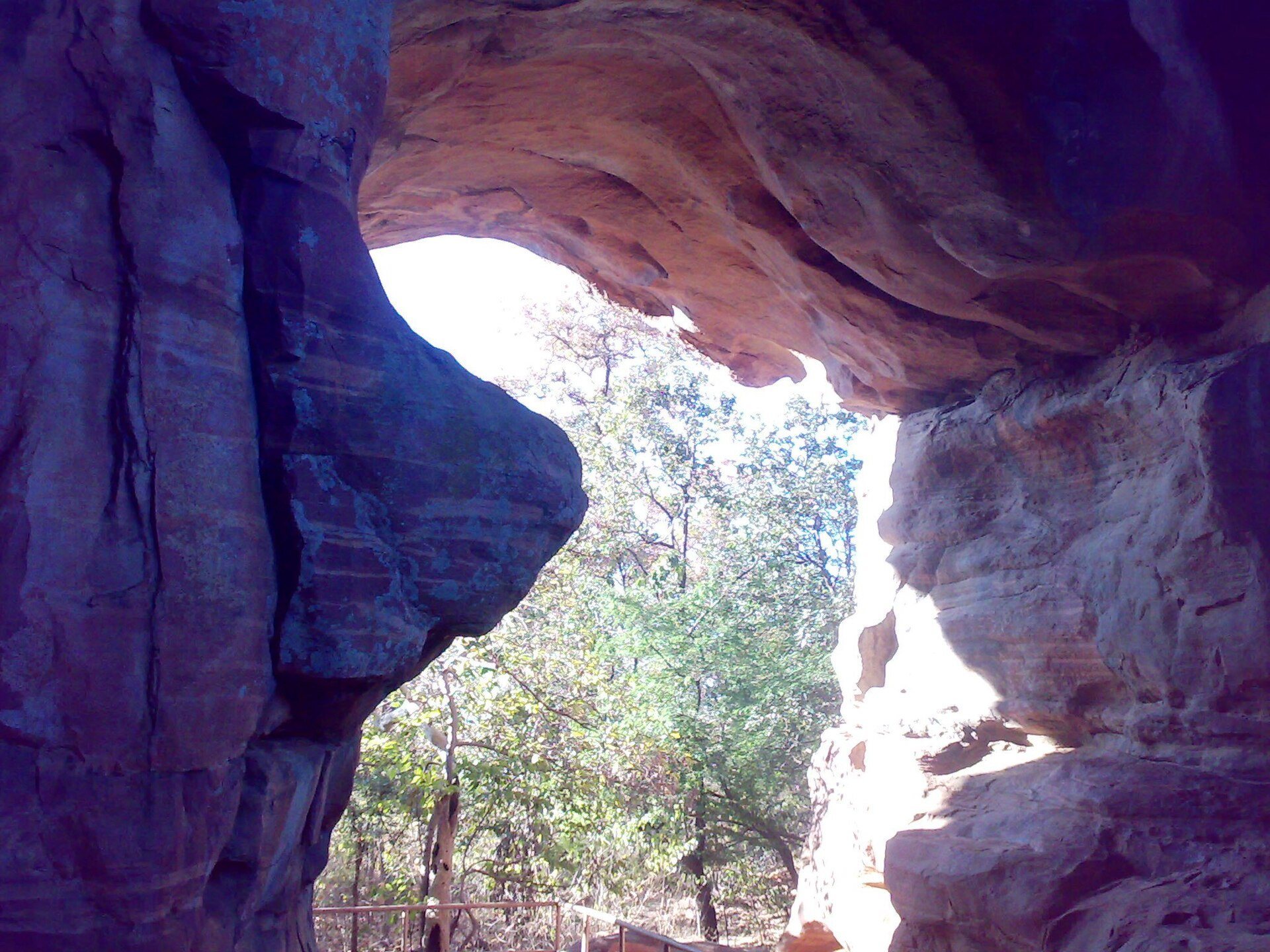
The complex extends for about 10 kilometres across seven hills: Vinayaka, Bhonrawali, Bhimbetka, Lakha Juar East, Lakha Juar West, Jhondra, and Muni Babaki Pahari. More than 750 shelters and caves are distributed through this landscape, including 754 numbered shelters and nearly 500 locations with rock paintings. The shelters are set in sandstone at the foot of the Vindhya hills, among quartzite formations and towers.
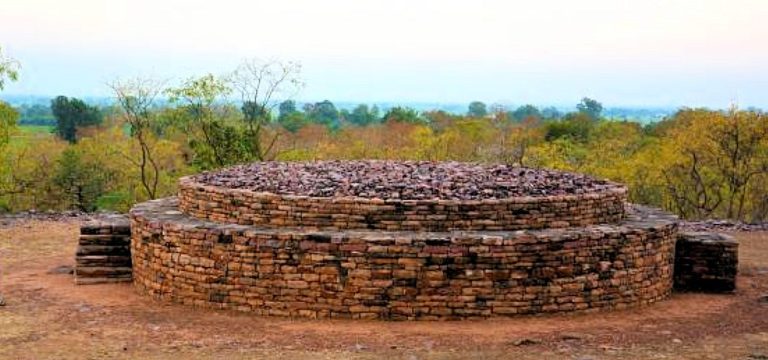
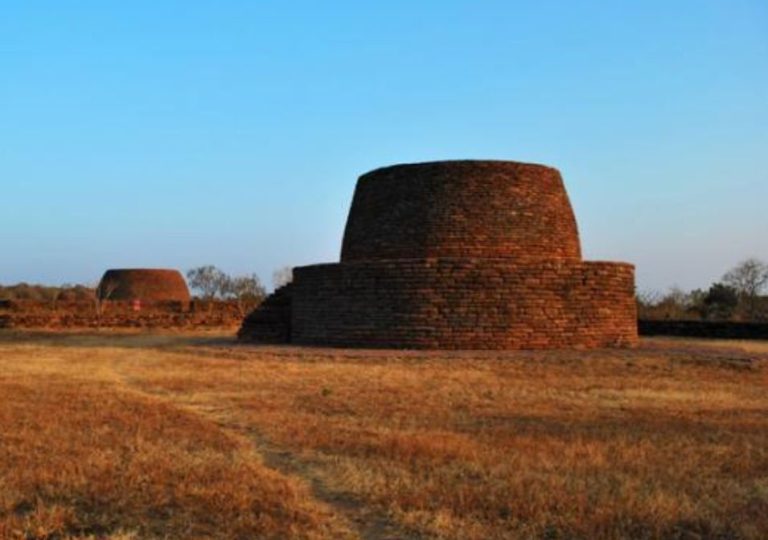
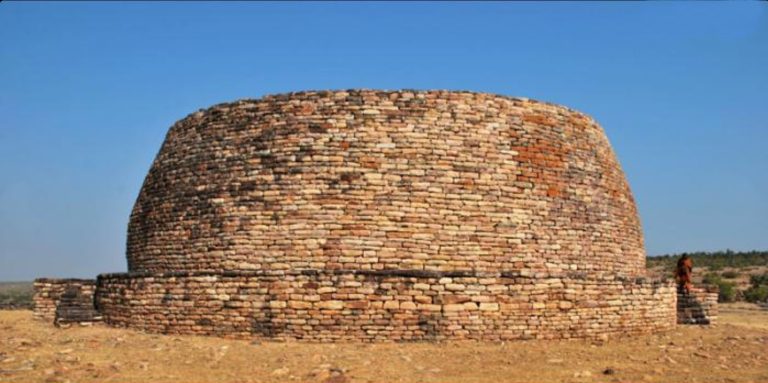
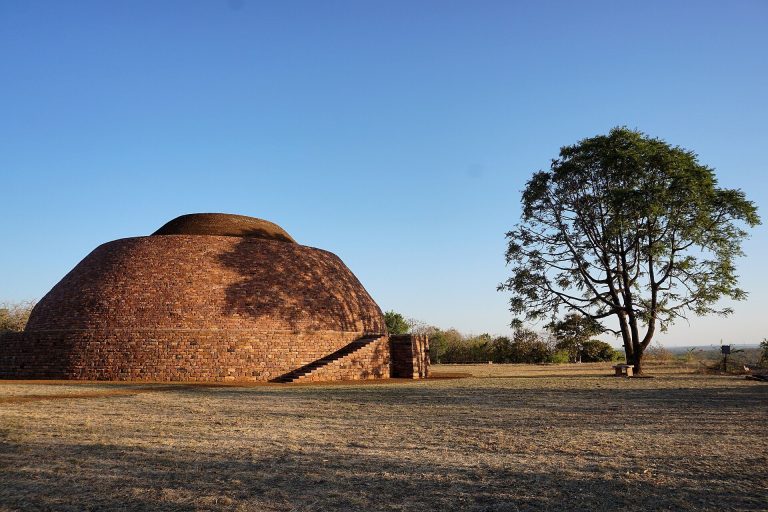
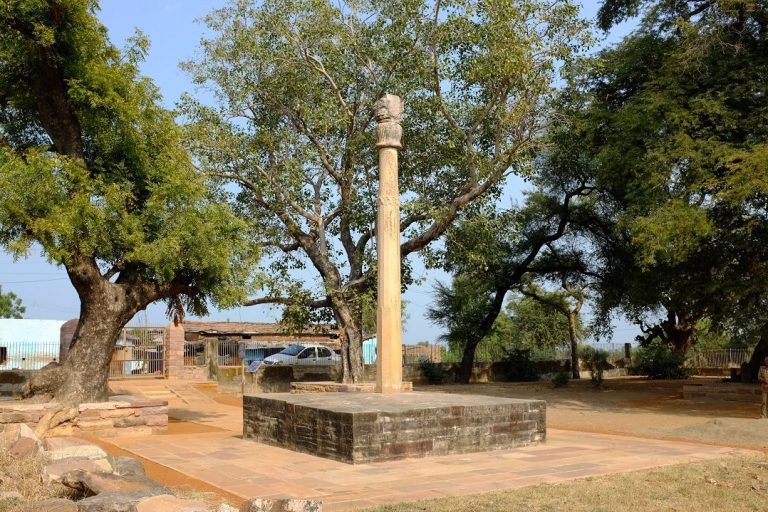
Stone walls, constructed steps, levelled rock surfaces used as floors, and other modified features occur in parts of the complex. Some of the stone walls and floors are among the oldest known examples of their kind. Certain excavated monoliths and other stone remains used material traced to the Barkheda area. Small stupas, walls, and other carved or constructed forms also occur around parts of the Bhonrawali, Vinayaka, and Lakha Juar areas.
Major rock formations
Auditorium Cave
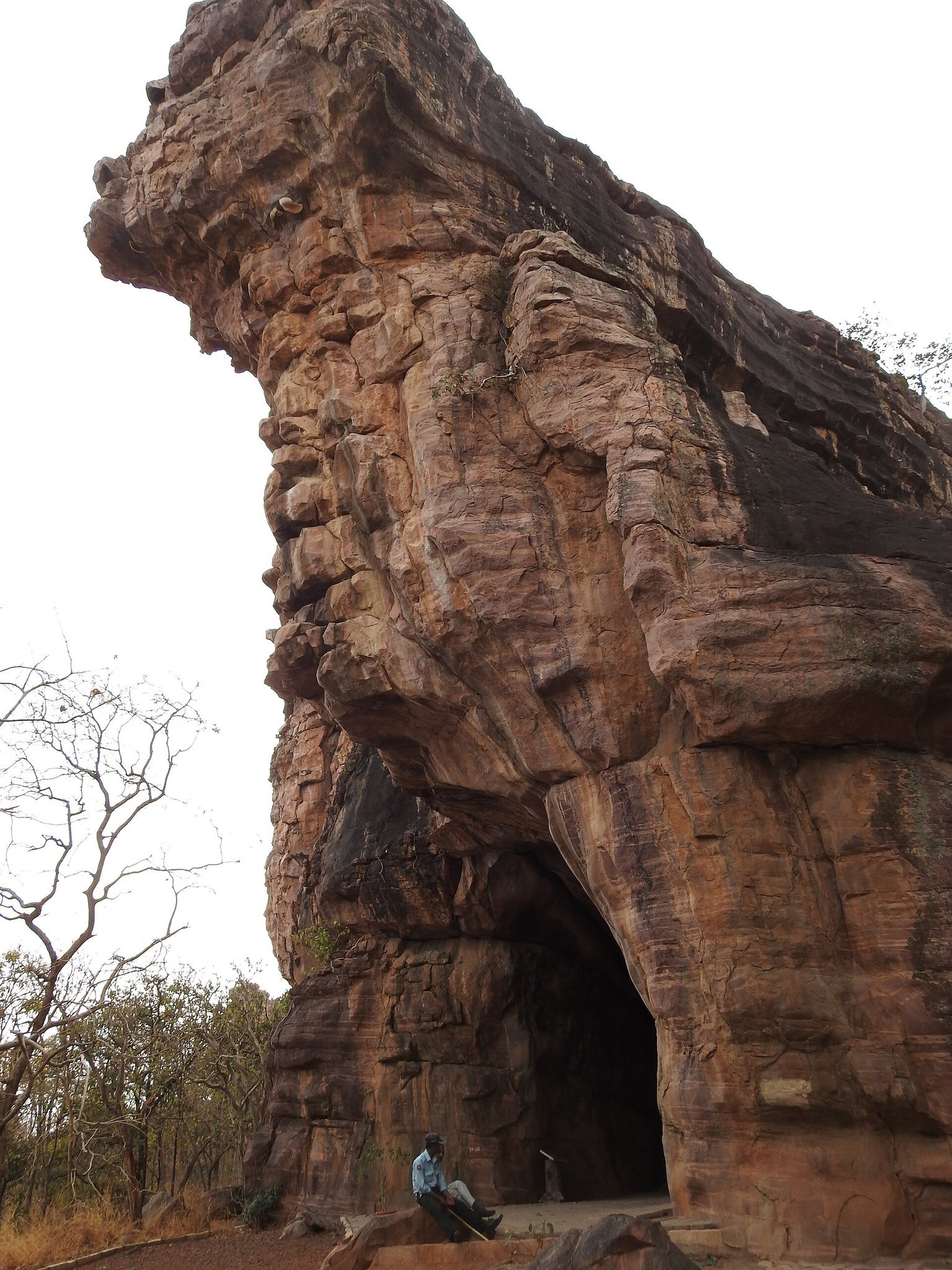
The Auditorium Cave is the largest and one of the most important shelters in the complex. Quartzite towers surround it and can be seen from several kilometres away. Its interior has lofty spaces and forms resembling Gothic arches, giving the shelter a cathedral-like appearance. The plan is shaped like a right-angled cross, with four branches directed toward the four cardinal directions, and its principal entrance faces east.
Chief’s Rock
At the end of the eastern passage stands a large boulder with an almost vertical panel. It is visible from a distance and from several directions. Archaeological literature calls it “Chief’s Rock” or “King’s Rock,” but its ancient function and any relationship to a chief or king remain unknown. The Auditorium Cave and this boulder occupy a central position among shelters extending for several kilometres on either side.
Rock depressions and constructed features
Near an entrance, semicircular depressions were carved into the rock. Their purpose is uncertain, with possible interpretations including ritual, mathematical, symbolic, or practical use. The wider complex also contains stone walls, steps, levelled surfaces, and other modifications that help show how natural shelters and rock formations were adapted over time.
Painted shelters
Early and Mesolithic imagery
Paintings occur mainly on interior walls and in deep recesses, where natural pigments were applied to the rock. Some surfaces were painted repeatedly, with one receiving about ten successive layers. The earliest images include linear figures in green and dark red, including wild cattle, tigers, and rhinoceroses. Estimates for the paintings range from around 10,000 BCE to approximately 40,000 years ago, while other descriptions place some works at more than 30,000 years old.
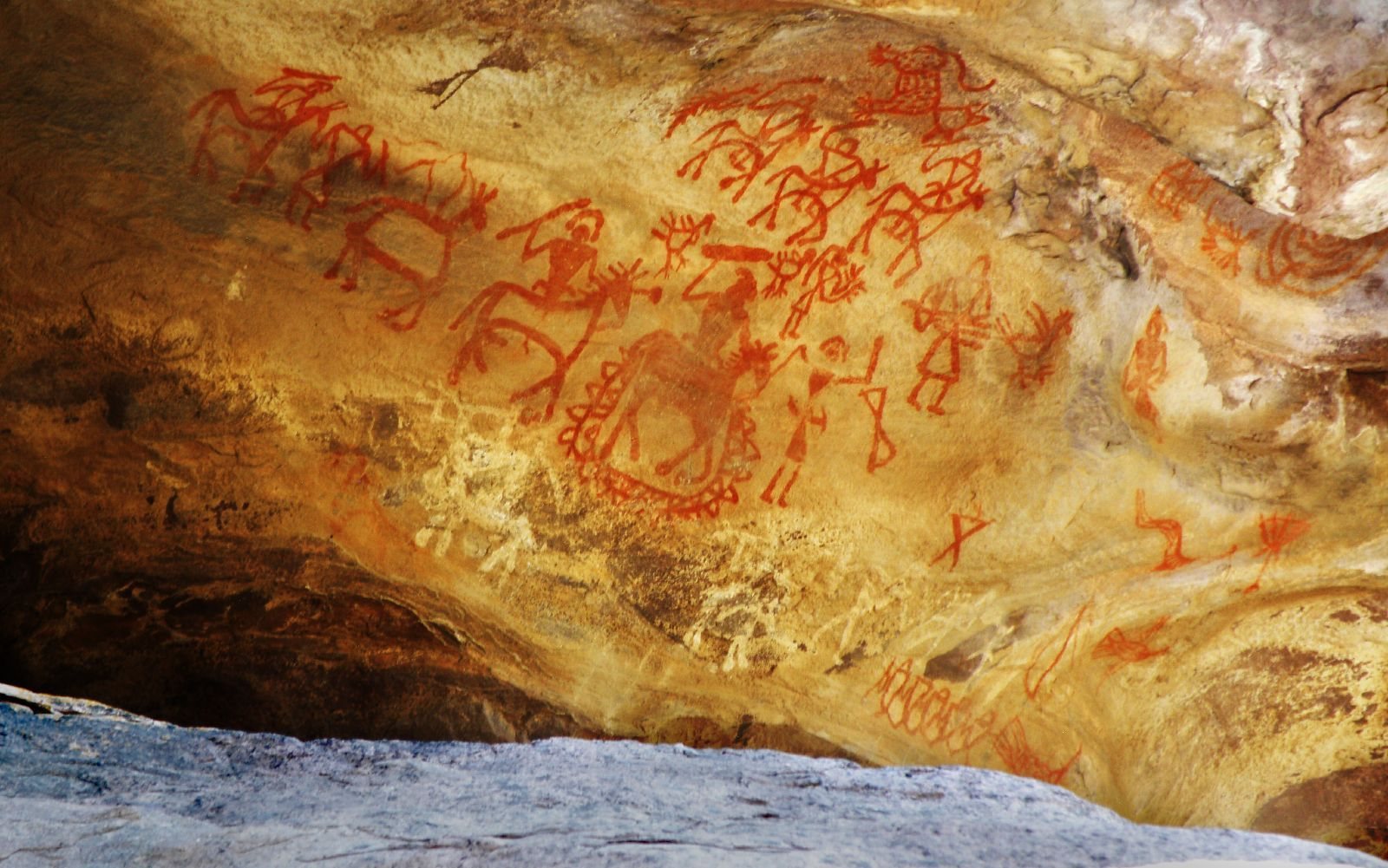
Mesolithic paintings are generally smaller and more stylized. They show people and animals, hunting, body decoration, communal dances, birds, musical instruments, pregnant women, mothers and children, people carrying dead animals, burials, and drinking. Hunting scenes include barbed spears, pointed sticks, bows, arrows, swords, and shields. Some hunters pursue deer, antelopes, rhinoceroses, or other animals; another scene shows a wild bovine chasing a person while two companions stand nearby.
Animals and named painted rocks
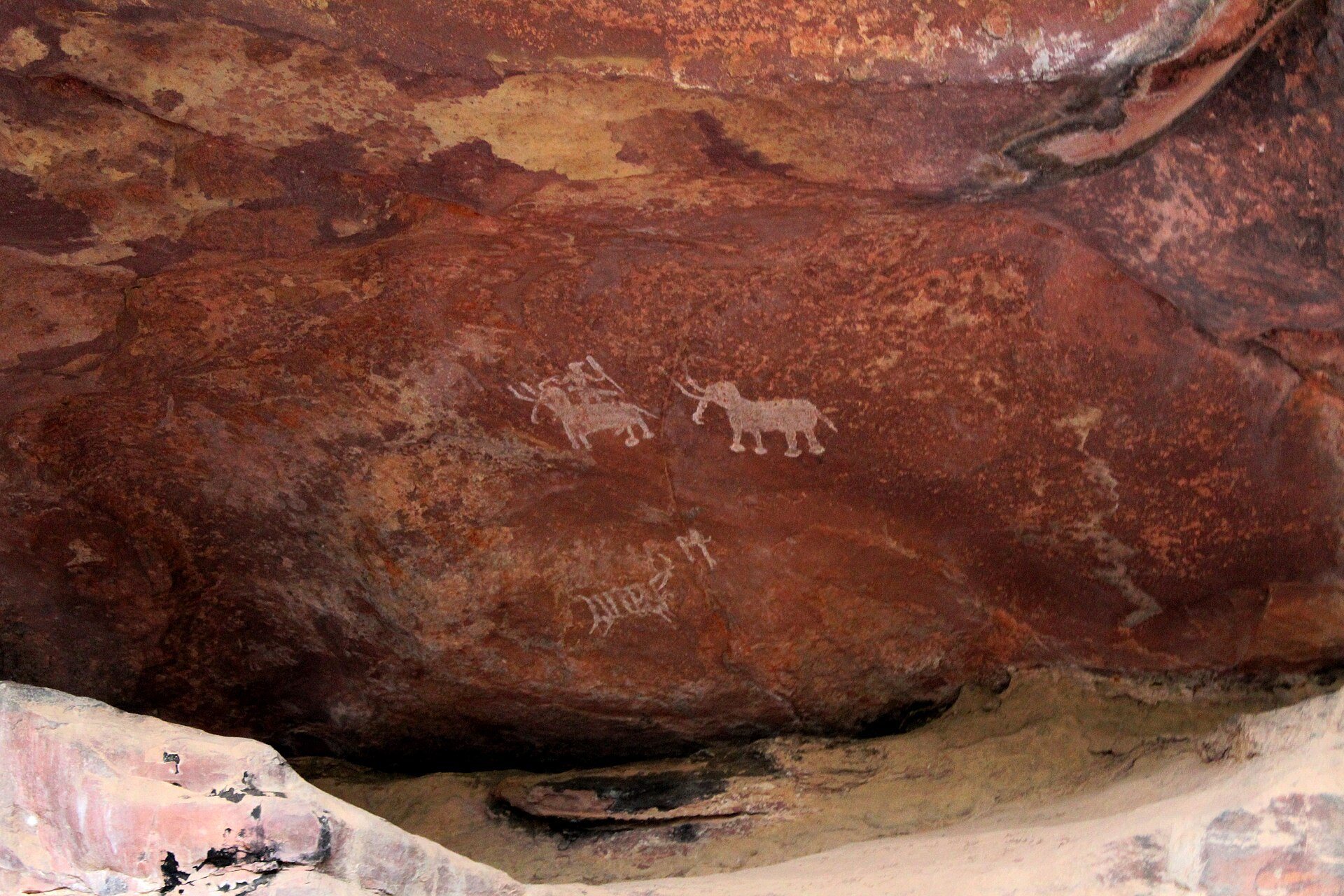
The painted animals include elephants, barasingha or swamp deer, wild cattle or bison, deer, peacocks, snakes, rhinoceroses, bears, wolves, hyenas, monkeys, hares, fish, turtles, birds, and a domesticated dog. A large rock popularly called “Zoo Rock” shows elephants, barasingha, wild cattle, and deer. Another rock depicts a peacock, snake, deer, and the sun, while a further surface shows two tusked elephants.
One painting shows horsemen and archers, while other scenes depict fighters riding horses or elephants and carrying metal weapons. These images are generally associated with later historic periods rather than the prehistoric scenes of hunters and food gatherers.
Historic and medieval imagery
The paintings are commonly divided into seven periods: Upper Paleolithic, Mesolithic, Chalcolithic, Early Historic periods IV and V, and Medieval periods VI and VII. The Chalcolithic, or Copper Age, combined continued stone-tool use with copper objects and expanding agricultural and exchange networks. Geometric designs continued into the medieval period.
Early Historic paintings are mainly red, white, and yellow. They include schematic and decorative figures, riders, religious symbols, tunic-like clothing, and examples of writing. Some paintings and inscriptions are associated with the Mauryan and Shunga periods, and examples of shell script, an ancient Indian writing form with shell-like letter shapes, are recorded. Later imagery includes yakshas, supernatural beings associated with nature, fertility, wealth, or particular places, as well as tree deities, sky chariots, and other religious subjects.
Medieval paintings are more geometric, linear, and schematic. Their pigments included black manganese oxide, red hematite, an iron oxide mineral that produces red pigment, and charcoal. A painting of a dancing figure holding a trident-like staff was nicknamed “Nataraja” by V. S. Wakankar. The nickname and interpretation belong to Wakankar, while the figure’s original identity and meaning remain unestablished. The painting has become heavily eroded and is now nearly invisible.
Pigments and preservation
The artists used mineral, earthen, plant-based, and charcoal colors. Red, white, yellow, and green are prominent, with some pigments prepared from manganese oxide, hematite, and charcoal. Some pigments may have been mixed with animal fat or plant pulp. The painted surfaces have survived unevenly: some remain clear, while others have been damaged or erased by weathering and other deterioration.