Serabit el-Khadim: Ancient Egyptian Mining and Religious Complex
Site at a Glance
- Rating
- 4.4
- Popularity
- Very Low
- Country
- Egypt
- Primary era
- Bronze Age
- Eras represented
- Bronze Age
- Civilizations
- Egyptian
- Site type
- Economic
- Remains
- Mine
On this page7 sections
History
Serabit el-Khadim is an ancient Egyptian mining and religious complex on a high sandstone plateau in the southwestern Sinai Peninsula of Egypt, near Abu Zenima. It was worked especially during the Middle and New Kingdoms, when copper, turquoise, malachite, and other valuable stones were extracted from the surrounding landscape. The site also became an important center of worship, royal commemoration, and written records connected with expeditions to the mines.
Mining and the Temple of Hathor
The mines were worked mainly by Egyptians and, according to archaeological interpretation, by prisoners of war from southwestern Asia who probably spoke a Northwest Semitic language. The earliest sacred focus was a cave cut into the mountain. During the Middle Kingdom, under Senusret I, this religious center was developed as a temple to Hathor, an Egyptian goddess associated with protection, healing, femininity, and royal power. At Serabit el-Khadim, she was especially connected with the desert and turquoise mining.
Amenemhat I is credited with restoring or rebuilding the temple after the discovery of gold, turquoise, and other valuable resources in Sinai. Senusret I later constructed or expanded a temple dedicated to Hathor. The sanctuary supported royal mining expeditions and commemorated their achievements, linking resource extraction with religious observance and royal authority.
Royal Expansion and Records
The temple grew through successive building phases. Amenhotep I repaired damaged sections, Amenemhat II added further elements, and Amenemhat III and Amenemhat IV built structures dedicated to Hathor and another deity. Thutmose III and Hatshepsut added halls before the sanctuary, further halls were built under Amenhotep II, and six chambers were added under Amenhotep III.
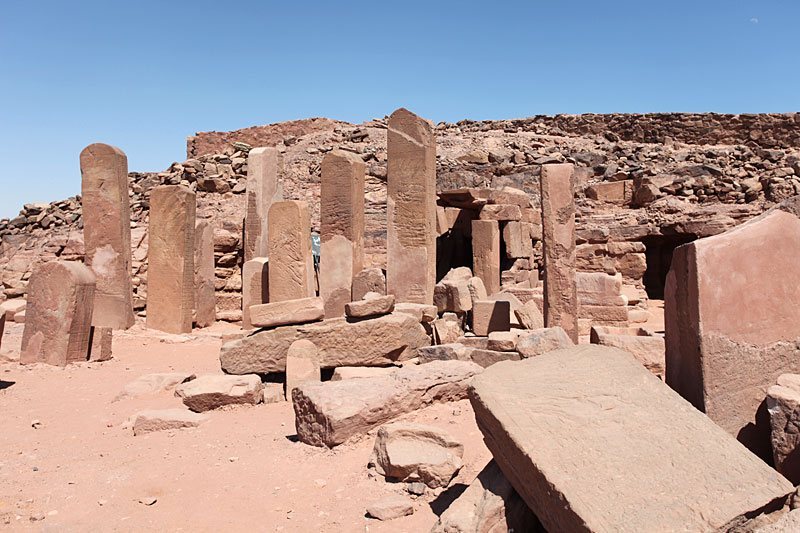
Royal attention remained strong during the Eighteenth Dynasty and continued under Thutmose III, Hatshepsut, Amenhotep III, Seti I, Ramesses II, and Ramesses VI. The site preserves royal names and records associated with expeditions, including the names of expedition leaders and senior officials. Religious activity is also reflected in votive stelae, upright stone slabs dedicated as offerings or appeals to a deity. These were placed along approach routes, inside the temple, and in nearby caves, while mining and expedition groups erected commemorative stelae.
Inscriptions and Later History
About 387 inscriptions from Serabit el-Khadim are known, dating mainly from the Middle and New Kingdoms. Additional texts in the mines commonly name the reigning king, the expedition leader, and senior officials. Excavation began under the British archaeologist Sir Flinders Petrie in 1904. In 1905, he discovered previously unknown inscriptions in the temple and nearby turquoise mines. Later expeditions brought the number of these texts to about 30.
These inscriptions, known as Proto-Sinaitic or early Sinaitic, date to the beginning of the sixteenth century BC and are among the earliest known examples of alphabetic writing. Proto-Sinaitic used a smaller group of signs primarily to represent consonantal sounds, rather than the more complex system of Egyptian hieroglyphs. Its forms combine influences from Egyptian hieroglyphic signs with features associated with Northwest Semitic writing. The system is considered an important precursor to the Phoenician alphabet and, through it, to the Greek and Latin alphabets, although the inscriptions are not fully deciphered.
The temple and wider site suffered extensive damage, particularly during the period of Israeli occupation of the Sinai. Architectural elements, inscribed and painted panels, and statues were removed to Israel. Serabit el-Khadim was placed on Egypt’s UNESCO World Heritage tentative list in 1994.
Remains
Temple of Hathor
The Temple of Hathor occupies part of the elevated sandstone plateau near the turquoise mines and caves. It measures approximately 80 metres in length and 35 metres in width. Its name is associated with the tall inscribed columns that once stood around it and has been interpreted as meaning “Columns of the Slave.” The earliest sacred space was a mountain cave regarded as the sanctuary, or most holy area. A later chamber dedicated to Hathor was built in front of it, and the temple also included a separate chamber for Sopdu.
Three entrances connected the temple with different valleys. The main entrance approached from the meadow or pasture of al-Air, while the others came from Wadi al-Khasif and Wadi al-Talihah. Two decorated stelae stood at the principal entrance, one dating to the reign of Ramesses II and the other to the reign of Setnakhte, the first ruler of Egypt’s Twentieth Dynasty.
Beyond the main entrance stood a pylon built under Thutmose III, followed by courtyards and chambers. Some rooms had no consistent overall temple plan and contained royal names, expedition leaders’ names, and references to temple deities. Halls added under Thutmose III and Hatshepsut stood before the sanctuary, further halls belonged to the reign of Amenhotep II, and six chambers were added under Amenhotep III. The temple is now extensively ruined, with its surviving architectural elements, stelae, paintings, inscriptions, and statues reflecting repeated construction, alteration, damage, and removal.
Mines, Caves, and Workers’ Houses
Ancient mining remains are spread across the broad plateau, while turquoise mines and caves near the temple contain rock inscriptions, royal and private stelae, offerings, and early Sinaitic texts. Other remains include statues bearing the name of Sneferu, references to Mentuhotep III and Mentuhotep IV, and an inscription naming Senusret I together with his father Amenemhat I.
West of the temple are circular workers’ houses built mainly from local stone. Everyday objects were found within these dwellings, providing material evidence of the communities that accompanied mining activity on the plateau.