Cahuachi: A Nasca Ceremonial Center in Peru
Site at a Glance
- Rating
- 4.6
- Popularity
- Low
- Country
- Peru
- Primary era
- Classical
- Eras represented
- Classical
- Civilizations
- Unclassified
- Site type
- Religious
- Remains
- Sanctuary
On this page16 sections
History
Cahuachi is a major ceremonial center of the Nasca culture in the Nazca Valley of Peru. It flourished mainly from about 1 to 500 CE, during the Nasca 3 phase of the Early Intermediate Period, although activity began earlier, possibly in the fourth century BCE. The site became the principal ceremonial focus of communities in the Río Grande de Nazca drainage system, where monumental construction, pilgrimage, offerings, feasting, burial, and exchange brought people and goods together.
Formation of a Nasca ceremonial center
Cahuachi was once understood as the capital of a Nasca state or as an urban settlement. Archaeological work instead indicates that it was primarily a non-urban religious center with a small permanent population that expanded during major ceremonies. Its architecture may have expressed shared religious traditions, ancestry, political cooperation, and group identity, although the form of political authority exercised at the site remains uncertain.
The site’s main architectural development corresponds to Nasca 3, a chronological phase identified especially through pottery styles. Earlier Nasca 1 and Nasca 2 materials also occur at Cahuachi. Later Nasca 4 through Nasca 7 pottery is particularly associated with continuing ritual activity and burials, showing that the site retained religious importance after its principal period of construction.
Ceremonies included communal feasting, offerings, burials, textile production, and probably the drinking of hallucinogenic beverages. Surrounding communities brought food, animals, pottery, and other portable goods to the center. This pattern points to pilgrimage-related exchange rather than intensive local farming or large-scale permanent craft production. Llamas, guinea pigs, bird plumage, fine pottery, panpipes, maize, huarango pods, Spondylus shell, and blue-painted chili peppers formed part of the material associated with ritual activity.
Decline and changing use
During Nasca 4, large-scale ceremonial activity and production declined while burial use increased. Giuseppe Orefici’s research places abandonment around 450 to 500 CE, following severe drought, mudslides, and earthquakes. The exact causes and sequence of the decline remain uncertain, but Cahuachi’s architecture and deposits continued to receive burials and ritual attention after its main period of florescence.
Trophy-head practices were also connected with Nasca ritual life. Whether these heads resulted from warfare, ritual combat, or other practices is unresolved. Their presence, together with elaborate offerings and funerary deposits, reflects the complex religious practices associated with Cahuachi and the wider Nasca tradition.
Archaeological investigation and preservation
Cahuachi was first acknowledged and excavated in 1922. Alfred Kroeber, Julio C. Tello, Doering, William Duncan Strong, Robinson, Helaine Silverman, Giuseppe Orefici, and other researchers subsequently investigated the site. Strong’s excavations in 1952 and 1953 identified temples, cemeteries, and mound structures, initially encouraging an urban interpretation.
Excavations by Silverman and Orefici from the early 1980s onward found little evidence for extensive permanent domestic occupation and instead supported the interpretation of Cahuachi as a ceremonial center. Orefici’s long-running work revealed ceremonial architecture, burials, pottery, and evidence of ceramic production, including an oven. Silverman’s excavations and analyses further examined Cahuachi’s place in Nasca religion, society, state formation, and regional exchange.
The dry climate has preserved perishable materials as well as pottery and architecture. A deposit of about 200 patterned textile garments was discovered in 1998. Remote-sensing work in 2008, using high-resolution infrared and multispectral satellite imagery, identified a pyramid covering more than 9,000 square meters in a test area beside the Río Grande de Nazca. Looting, especially in previously undocumented cemeteries around Cahuachi, remains the site’s most serious modern threat. Archaeological material from the site is exhibited at the Antonini Archaeological Museum in Nasca, and Cahuachi is recognized as a cultural heritage site of Peru.
Remains
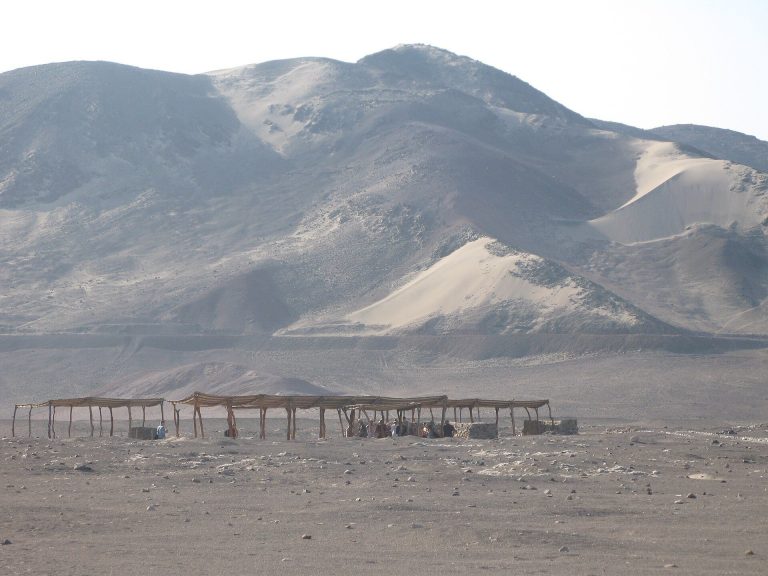
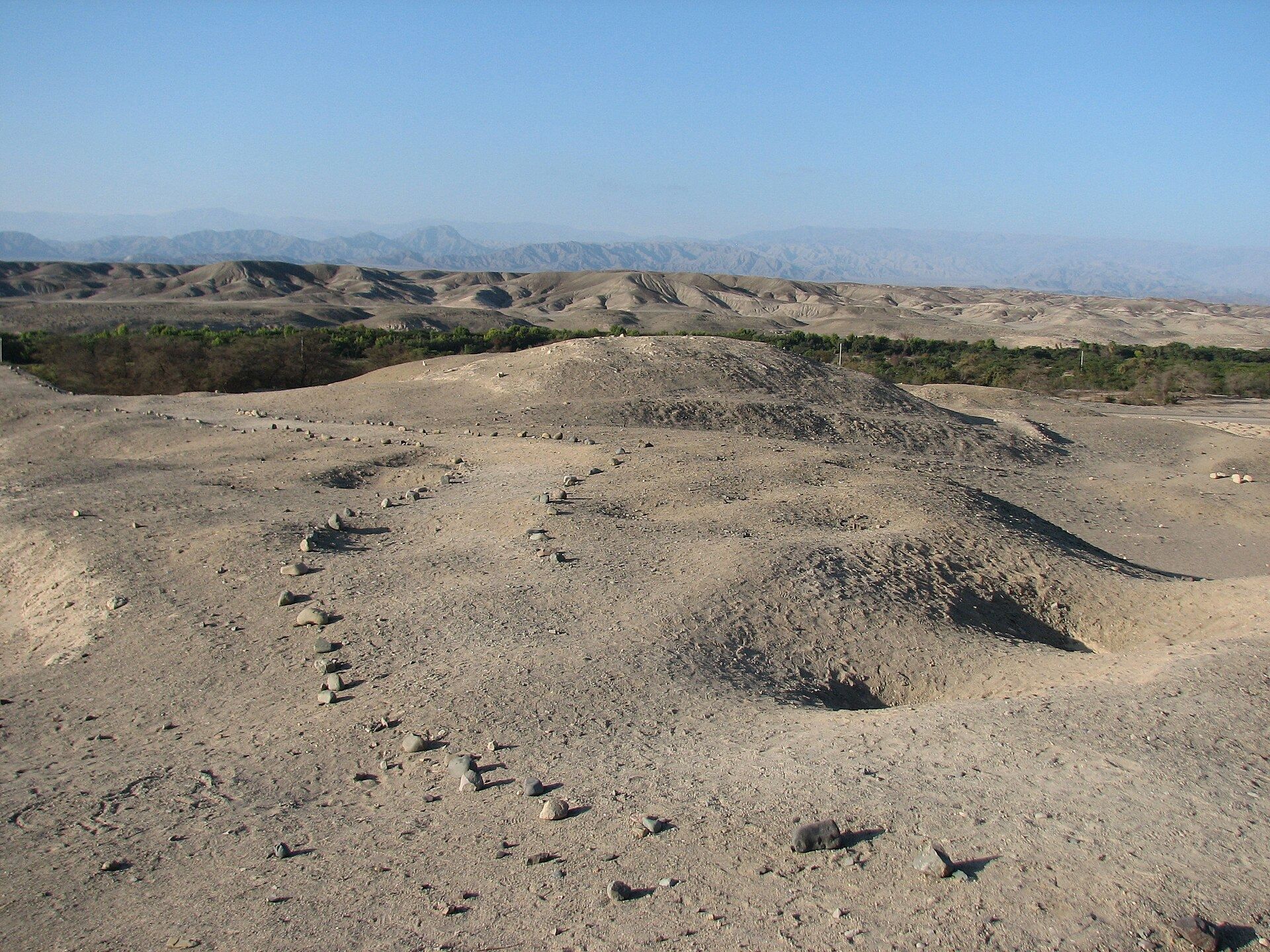
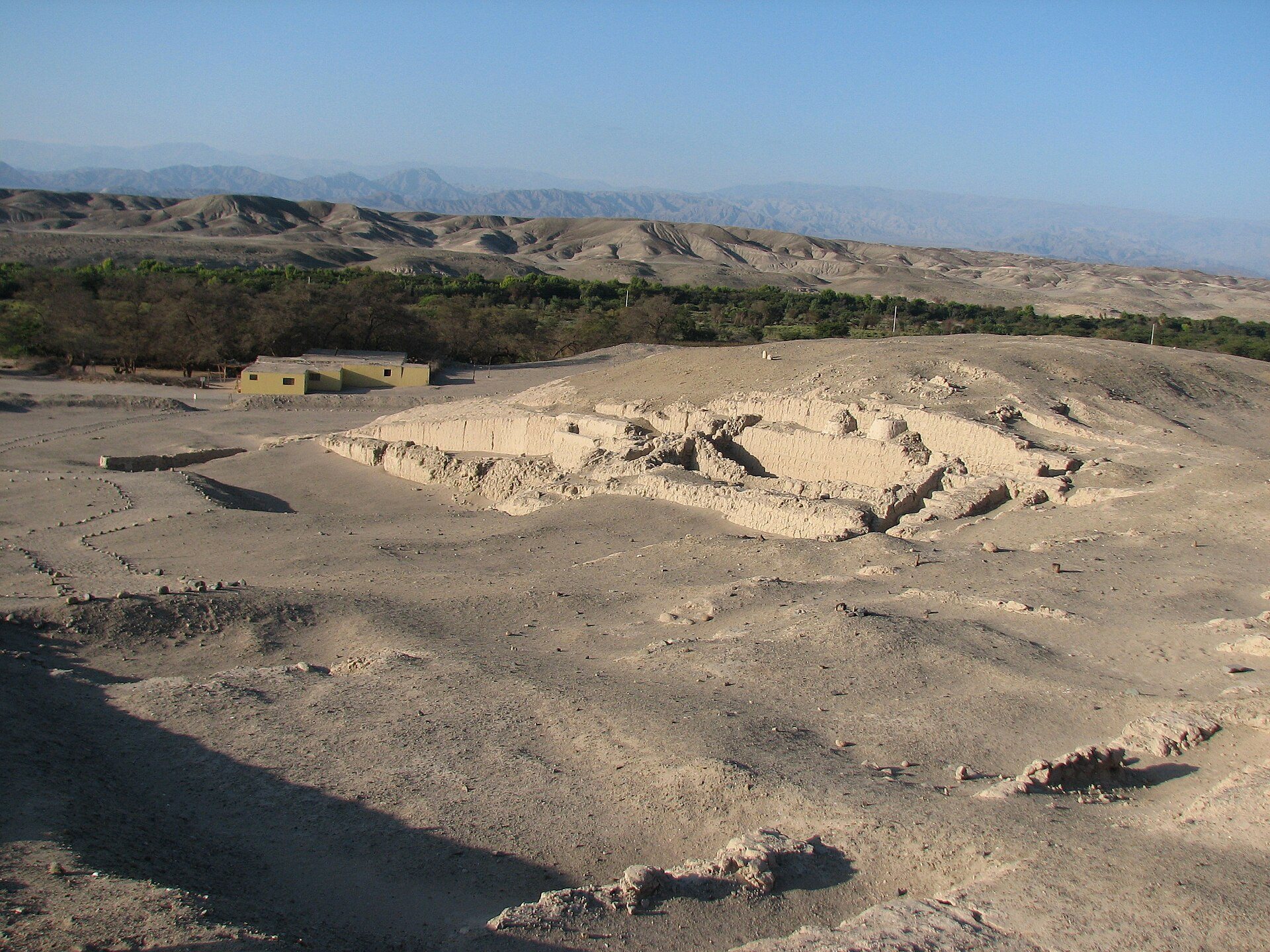
Cahuachi covers approximately 1.5 square kilometers on brown, barren river terraces and modified hills above the valley floor, at about 365 meters above sea level. It lies on the southern side of the Nazca River within the Río Grande de Nazca drainage system, beneath the Pampa de Atarco and near the Pampa de San José, where the Nasca geoglyphs are located. More than 40 principal mounds occupy the site. Many were created by reshaping natural hills with layers of earth, stone, adobe, plant fibers, and refuse.
The settlement follows a mound-kancha arrangement. Kanchas are bounded open spaces comparable to courtyards, patios, or walled fields, although their precise functions varied. Mounds and open areas follow the natural topography, and Cahuachi did not have a continuous wall or moat restricting entry. Some mounds supported rooms or ceremonial structures, while others served as burial places. Most were not habitation mounds.
Platforms and ceremonial architecture
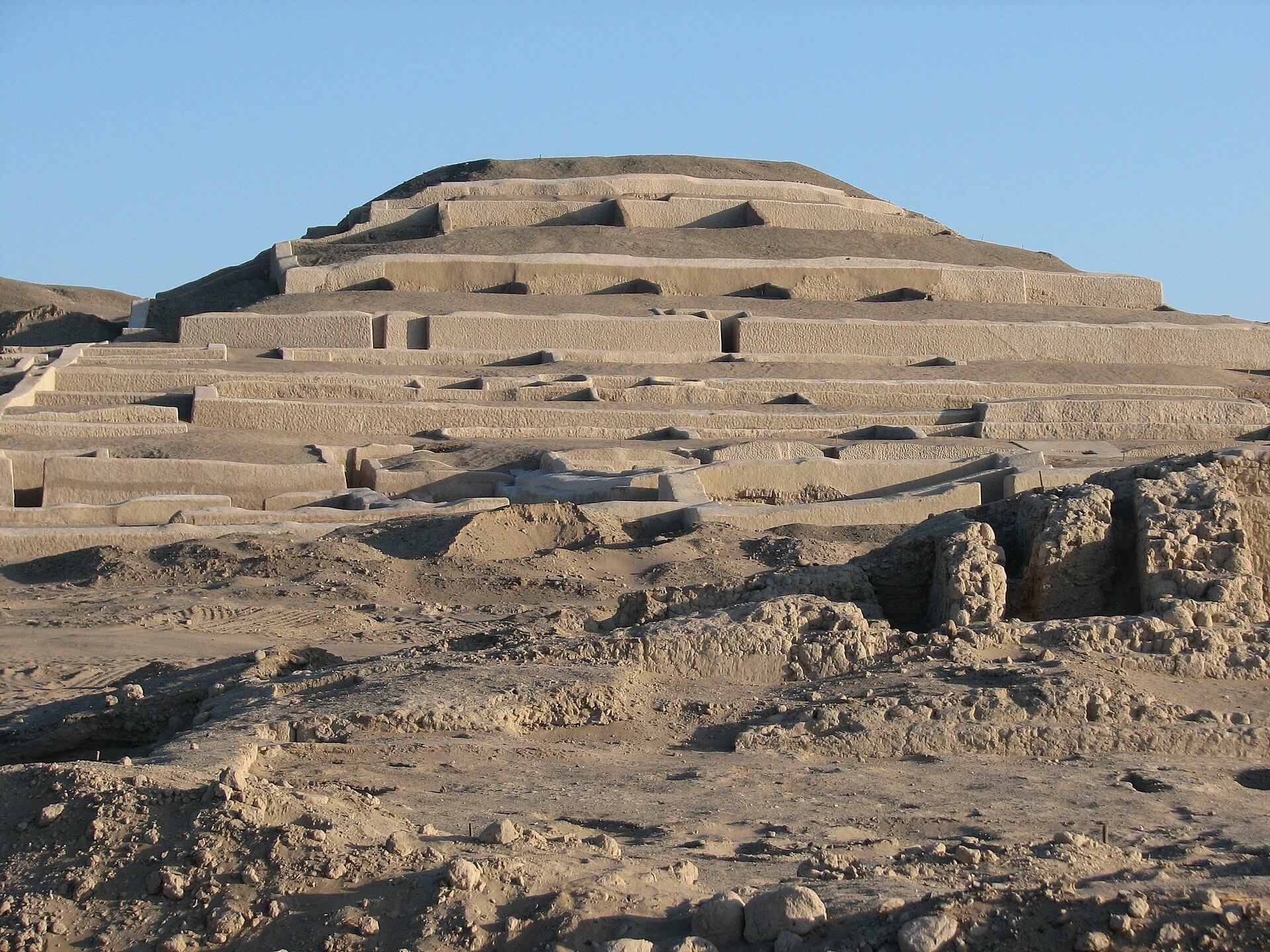
Terraced mounds
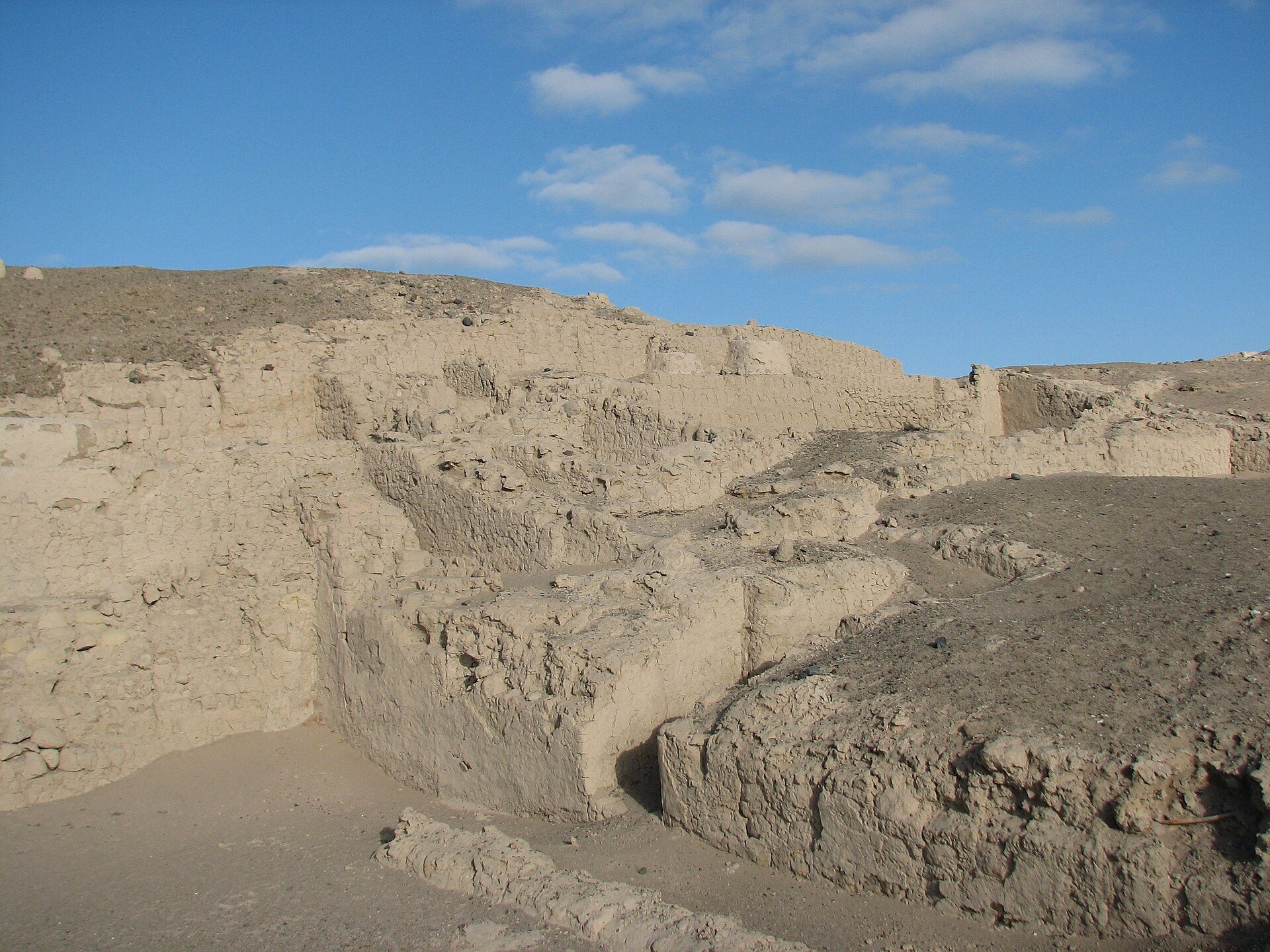
The Nasca reshaped and terraced hills to create monumental platforms. At Unit 5, a natural hill was enlarged with alternating layers of plant material and earth. Adobe retaining walls stood on a sand foundation, and material associated with the mound dates no earlier than Nasca 3. Unit 6 contained adobe retaining walls over an earlier wattle-and-daub occupation, in which a framework of sticks or reeds was covered with earth or clay. A later phase at Unit 6 had a non-domestic function, indicated by the absence of ordinary habitation refuse.
Unit 7
Unit 7 was once interpreted as residential, but its unusually large quantity of decorated pottery and special objects gives it a different character. Finds included an obsidian knife, embroidered fringed textile borders, a comb made from cactus spines and cane, and a finely engraved gourd. The unit may have been used by priests, although that interpretation remains uncertain.
Great Temple and stepped pyramid
The Great Temple was a major ceremonial mound or structure, although it is uncertain whether this name refers to one unique building. Excavations recovered abundant Nasca 3 pottery, fragments of panpipes, llama remains, bird plumage, and other offerings. Another large stepped pyramid has seven levels and stands approximately 28 meters high. Its reported length varies, so its horizontal dimensions cannot be stated with certainty.
Stepped Temple
The Stepped Temple includes a wall about 5 meters high and 25 meters long. Its surface carries inscriptions and friezes. Cahuachi has little or no other archaeological evidence for writing, making this reported feature an unusual element within the site’s remains.
Rooms, deposits, and construction
Room of the Posts
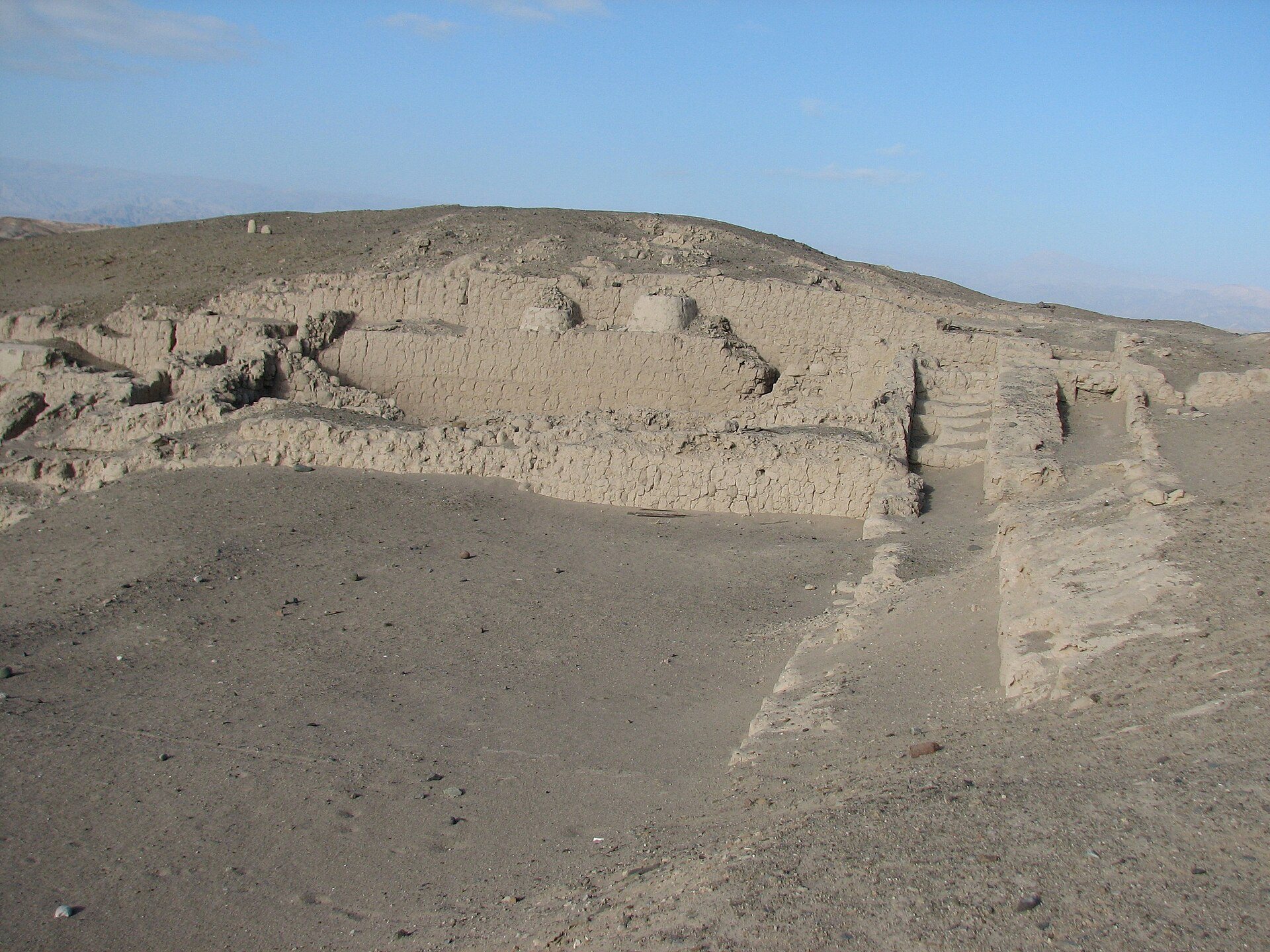
The Room of the Posts is a ceremonial structure with carefully made adobe walls, niches, circular depressions, and a low square clay platform resembling an altar. A round depression lies at the platform’s center. Painted images of panpipes and rayed faces decorated the walls.
Upright huarango posts stood within the room. They varied in height and orientation, and one group was arranged in three rows of three. A carved post represents a human face playing a flute. Some posts may have been reused or installed at different times. Huarango, a native woody plant of Peru’s coastal region, was widely used structurally at Cahuachi and may also have carried ancestral associations.
Offerings and food deposits
A niche in the Room of the Posts contained two small depressions with Spondylus shell, a vividly colored marine shell with ritual importance in the ancient Andes. Other deposits included maize, huarango pods, blue-painted chili peppers, pottery, gourd rattles, plain gourd containers, four portable looms, and hundreds of pottery sherds. Sixteen complete vessels and these associated deposits were interpreted as offerings.
Circular depressions, cylindrical shafts, cache pits, underground storage jars, corridors, passageways, and bounded open spaces occur across the site. Some depressions and niches contained offerings or food-related deposits. Excavated food remains include potato, sweet potato, manioc, beans, squash, achira, peanuts, huarango fruit, pacae, guava, shellfish, fish, an echinoderm, guinea pig, and llama.
Adobe buildings and roofing
Adobe, made from sun-dried earth or mud, was the principal building material. Walls used beige, yellow, or gray adobe, often on sand foundations, and usually received a final mud coating. Many walls were thick and survive to less than one meter in height. Huarango posts were incorporated into rooms and walls.
Major walls were laid in regular adobe courses and finished with two layers of mud plaster and a whitewashed surface. Some were painted with ceremonial imagery. Huarango supported roofs, doors, and windows, while roofs were formed from interwoven cane tied with cords made from llama hair and cotton.
Pottery, textiles, and musical instruments
Pottery is abundant throughout Cahuachi. Fine ware predominates over plain ware by approximately 70 to 30. Fine vessels were especially associated with ritual activity and burials, while plain vessels served mainly for small-scale storage, food service, and some burials. Forms include double-spout-and-bridge bottles, bowls, dishes, basket vessels, modeled vessels, neckless and necked ollas, handled bottles, vases, and other decorated or plain containers.
Technologically complex panpipes and other musical instruments were also recovered. Nasca panpipes were groups of tuned pipes played by blowing across their openings, and their presence accords with the ceremonial scenes represented in pottery and wall paintings. Nasca imagery includes anthropomorphic beings, masked ritual performers, priests or chiefs, musicians, farmers, fishermen, llama tenders, trophy-head takers, and mythical figures. Some designs relate to ritual performance and agricultural fertility.
Textile remains include loose threads, spun and unspun fibers, spindle whorls, embroidered elements, and elaborate fabrics that may have served as funerary shrouds or clothing for priests and ritual participants. Craft areas may have existed in the plazas. The Great Cloth, a plain-weave textile excavated in 1952, retained a weft edge more than 5.5 meters long. Its original length was estimated at at least 50 to 60 meters. It was damaged during excavation and is held in four pieces in the Department of Anthropology at Columbia University.
The Great Cloth had been deliberately buried in the largest plaza, in an area free of refuse, indicating ritual importance. Producing it required an estimated nine million feet of cotton yarn.
Burials and human remains
Burials occur within and around Cahuachi in shallow graves, underground tombs, cylindrical shafts, and large vessel urns. Many tombs had roofs made from wooden canes covered with huarango logs, with upright cane markers projecting from the roof. Grave goods generally consisted of Nasca pottery, food remains, Spondylus shell, pigment, and textiles in varying quantities.
Bodies were usually placed in flexed positions, often on their sides or seated, with the head or body facing south. Woven or embroidered textiles in white, tan, black, red, and green accompanied many burials. Some carried iconographic decoration and may indicate differences in status, although the evidence does not establish a definitive social hierarchy.
Trophy heads came from cemeteries and tombs. Examples include a burial without its head, a group of three trophy heads, and a line of nine heads with plaited hair. One individual head had cranial deformation, preserved hair, deliberate cuts in the scalp, a removed tongue, lips sealed with huarango splints, and cheeks filled with plain-weave cotton. These remains provide evidence for practices associated with Nasca ritual life, while their precise social and military meaning remains uncertain.
Wind erosion, sporadic rain, flooding, mudslides, and earthquakes have affected Cahuachi’s architecture and deposits. The surrounding arid environment has nevertheless preserved substantial organic materials and textiles alongside the adobe platforms, ceremonial rooms, pottery, burials, and offerings.