Ha’amonga ‘a Maui: A Megalithic Trilithon in Tonga
Site at a Glance
- Rating
- 4.5
- Popularity
- Low
- Country
- Tonga
- Primary era
- Medieval
- Eras represented
- Medieval
- Civilizations
- Tongan
- Site type
- Civic
- Remains
- Monument
On this page7 sections
History
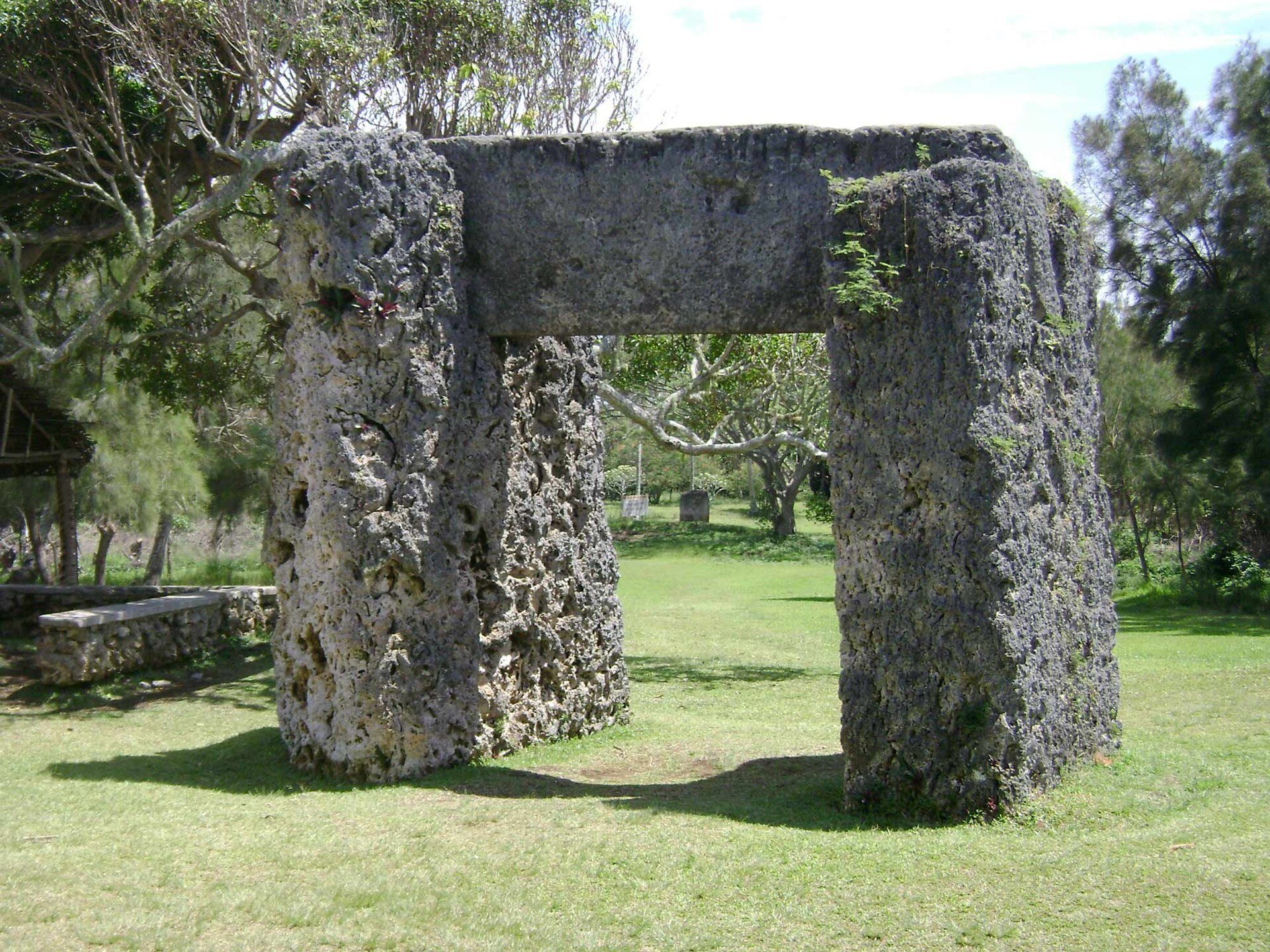
Ha’amonga ‘a Maui is a megalithic trilithon in the Heketā area near Niutoua on Tongatapu, Tonga, attributed to the reign of Tu’itātui, the eleventh Tu’i Tonga, around AD 1200. A trilithon is formed by two upright stones supporting a third stone placed horizontally across them. The monument is associated with the early thirteenth century and remains one of Tonga’s best-known ancient structures.
Origins and traditional interpretations
Tongan tradition attributes the monument to Maui, a Polynesian culture hero, who is said to have carried the stones from Uvea in a giant canoe. The name Ha’amonga ‘a Maui means “the burden of Maui,” referring to a shoulder-carried pole with loads at both ends. The story reflects the belief that the stones were too large for ordinary people to move.
Historical interpretation links the construction with Tu’itātui and his high chief Lo’au. One explanation holds that the two upright stones represented Tu’itātui’s sons, while the lintel symbolized the unbreakable bond between them. Another identifies the structure as an entrance to Heketā, an ancient royal compound or capital. Tamale of Haameniuli, a royal-family historian, related in the early twentieth century that someone passing through the arch and continuing about 100 metres into the royal territory would approach the royal throne known as ‘Esi Maka Fa’akinanga.
The monument’s original purpose remains uncertain. Proposed explanations include a symbolic device for reconciling Tu’itātui’s rival sons, a marker directed toward Pulotu, the supernatural realm of the dead and the gods in Tongan tradition, and an instrument for observing the Sun. In 1967, King Taufa’ahau Tupou IV proposed that it marked sunrise positions at the solstices and equinoxes. Tongan historian Tevita Fale supported this view by associating a V-shaped mark on the lintel with those positions, while astronomer C. F. Velt rejected it because he considered the mark too short to serve as a reliable directional indicator.
Oral history and protection
Tonga had no writing system during the monument’s historical period, so knowledge of its past was preserved orally by a designated family. The early twentieth-century account of its construction was transmitted by Tamale of Haameniuli, who held the position of royal historiographer.
King Taufa’ahau Tupou IV declared Ha’amonga ‘a Maui and its surrounding area a protected national park in 1972. The monument and its surrounding area were presented for inscription on the World Heritage List on 9 August 2007.
Remains
Stone construction and layout
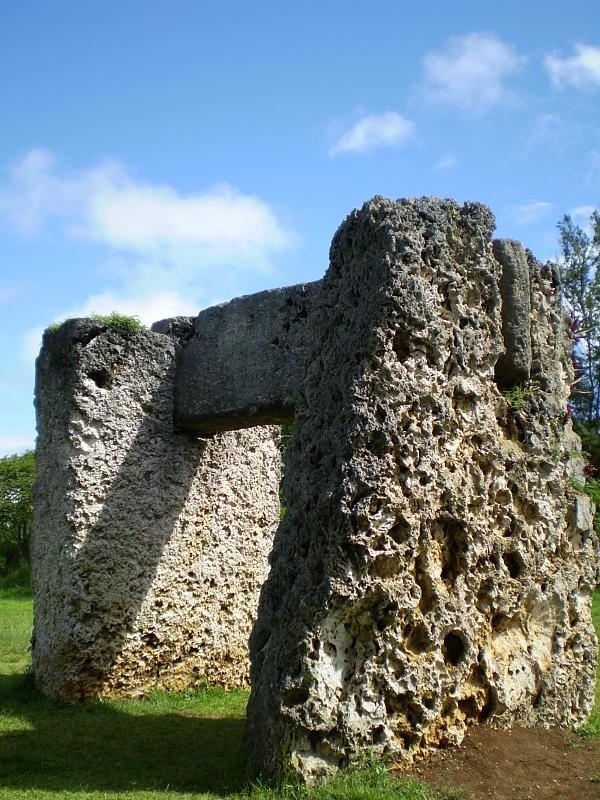
Ha’amonga ‘a Maui stands in the northern and eastern part of Tongatapu, in the Heketā area near Niutoua. It consists of three coral-limestone slabs arranged as an arch, with two upright stones carrying a horizontal lintel. The structure is approximately 5.2 metres high, 1.4 metres wide, and 5.8 metres long. Its form has led to the occasional nickname “the Stonehenge of the Pacific.”
The trilithon
The visible portion of each upright weighs approximately 30 to 40 tons. Deep grooves were cut into their upper surfaces to receive the lintel. The joints were carefully fitted, although they are not exact, and a gap of about 5 centimetres remains between the joined elements. The coral limestone is highly porous and could not be polished, but the slabs have flat surfaces and roughly perpendicular corners. The two uprights differ slightly in size.
The slabs were probably quarried at the nearest seashore, several hundred metres away. The limestone was relatively soft and easy to shape when freshly quarried, but became substantially harder after drying over several decades. A V-shaped mark is reported on the top of the lintel. An alternative interpretation describes it as an approximately 10-centimetre arrow or mark running along the lintel’s main axis, oriented roughly east-southeast.
‘Esi Maka Fa’akinanga
Near the trilithon is the stone throne ‘Esi Maka Fa’akinanga, whose surviving backrest contains recesses for the head, shoulders, and back. Its name means “stone to lean against.” Tradition associated the throne with protection for the seated king from attackers behind him and with the use of a long stick to strike enemies approaching from the front.