Caguana Indigenous Ceremonial Center: A Taíno Ceremonial Complex in Puerto Rico
Site at a Glance
- Rating
- 4.8
- Popularity
- Very Low
- Country
- United States
- Primary era
- Medieval
- Eras represented
- Medieval
- Civilizations
- Taíno
- Site type
- Religious
- Remains
- Sanctuary
On this page10 sections
History
Caguana Indigenous Ceremonial Center is a pre-Columbian Taíno ceremonial complex in Caguana, Utuado, Puerto Rico, United States, built during the thirteenth century, probably around AD 1270. Archaeological dating also places the complex broadly around AD 1200. The site served mainly for ceremonial dances, religious rites, ball games, and areitos, ritual performances combining song, dance, ceremony, and historical remembrance.
Taíno ceremonial use
The Taíno were an Indigenous Caribbean people who lived across Puerto Rico and other islands of the Greater Antilles and Bahamian region before and during early European colonization. At Caguana, the evidence points primarily to organized ceremonial activity rather than ordinary domestic life. The complex included plazas and ball courts where communal gatherings, sacred rites, performances, and games took place.
The site was also associated with nearby Cemí Mountain, which Taíno tradition regarded as the home of deities. This sacred landscape was considered a reason for establishing the ball courts in the area. The Spanish names later used locally for Caguana referred to “Indian corrals,” “Indian games,” or “ball game,” reflecting the corral-like outlines of its courts.
Archaeological investigation and preservation
Caguana was first visited and surveyed in 1914 and 1915 during early archaeological and ethnographic investigations connected with Franz Boas’s Scientific Survey of Puerto Rico and the Virgin Islands. James Alden Mason and Roberto T. Aitken carried out excavations in 1915. Further work followed, including Irvin Rouse’s investigations in 1938 and Ricardo E. Alegría’s excavations in 1949 and 1956.
The Institute of Puerto Rican Culture, founded in 1955, acquired the property in 1965. Renewed excavation, restoration, and interpretation then led to the creation of the Indigenous ceremonial park. Conservation work cleared monoliths and their carvings and returned stones to positions based on the original pattern. Complete elements were preserved, incomplete ones were restored, and heavily damaged walkways and paved areas around the plazas were left in their existing condition.
The Institute of Puerto Rican Culture continues to manage Caguana as a park. The complex was added to the U.S. National Register of Historic Places in 1992, recognized as a U.S. National Historic Landmark in 1993, and listed on the Puerto Rico Register of Historic Sites and Zones in 2001. The park also contains a museum with Taíno artifacts and archaeological exhibits, as well as a botanical garden presenting plants connected with Taíno food production and material culture.
Remains
Plazas and ball courts
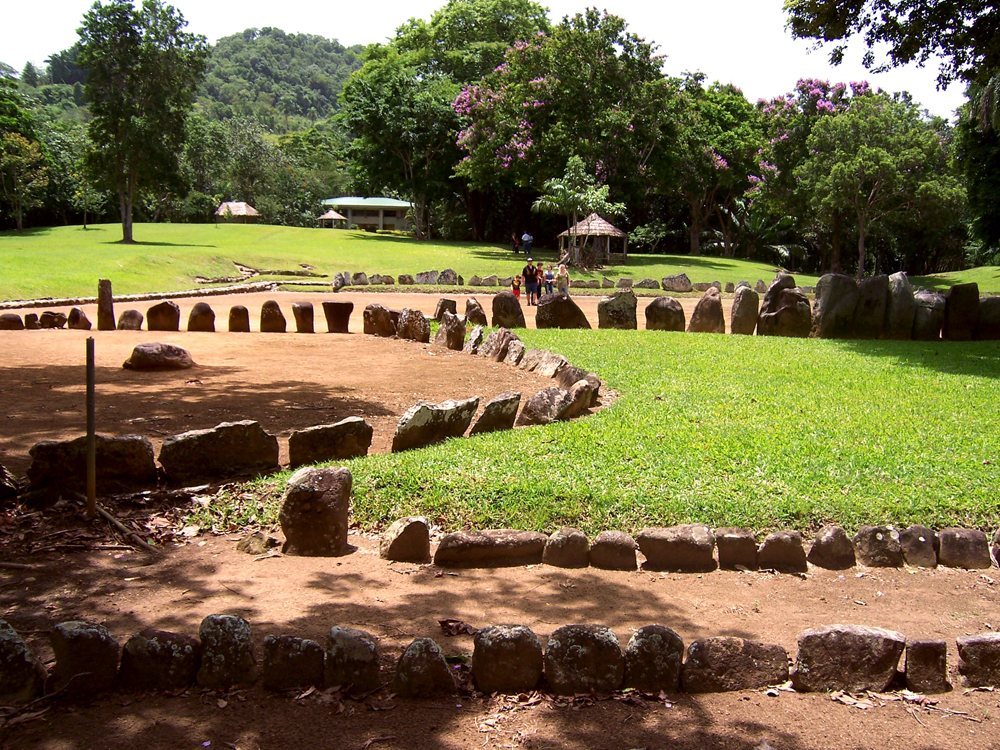
The archaeological complex is organized around multiple rectangular plazas and ball courts, at least one circular plaza, and several causeways. Approximately 13 bateyes, Taíno plazas or ball courts used for games, ceremonies, dances, and communal gatherings, have been identified. Many of the courts have been restored to their original condition, while the broader arrangement preserves the relationships between the ceremonial spaces.
Stone boundaries and causeways
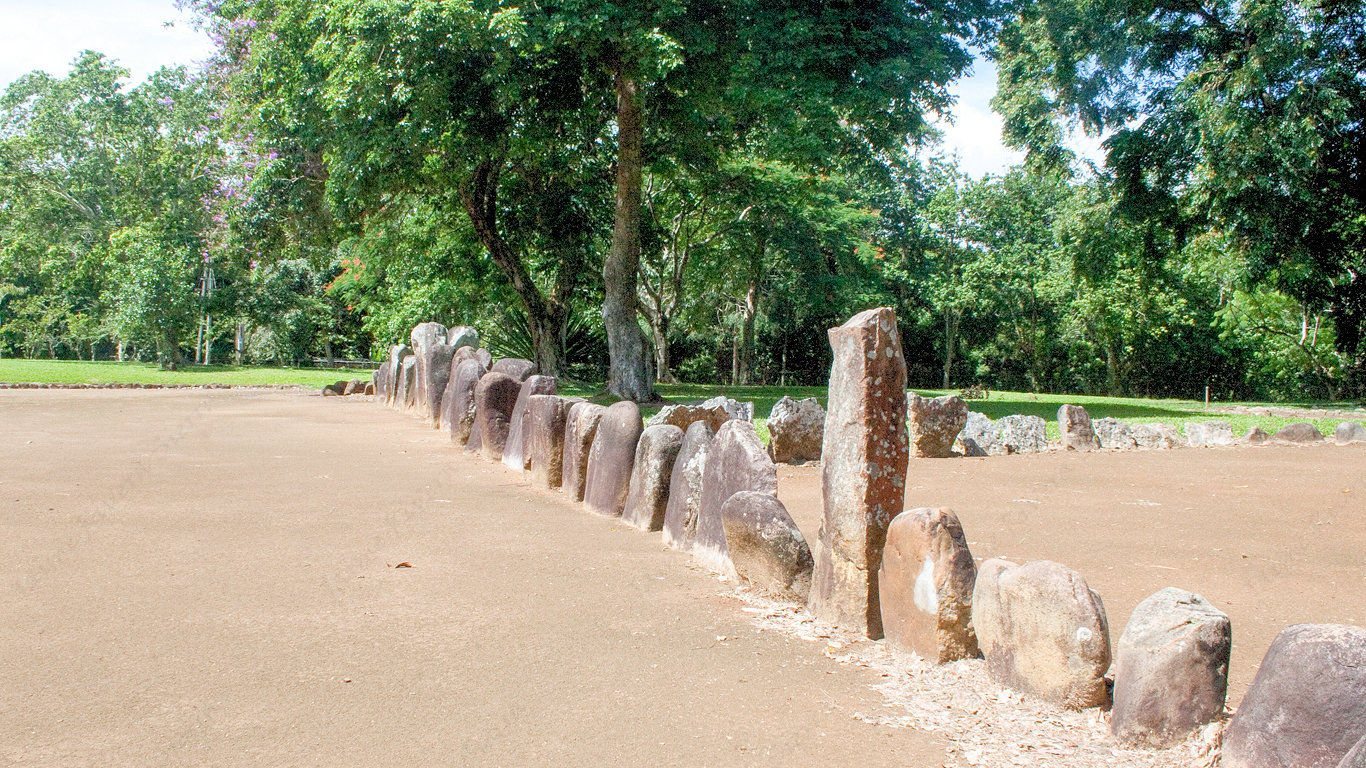
Stone monoliths enclose or border the courts and plazas. Some weigh more than one ton and were probably transported from the nearby Tanama River. Their placement defines the ceremonial spaces and contributes to the distinctive court outlines that gave rise to the Spanish names associated with Caguana.
Carved monoliths and astronomical alignments
Petroglyphs
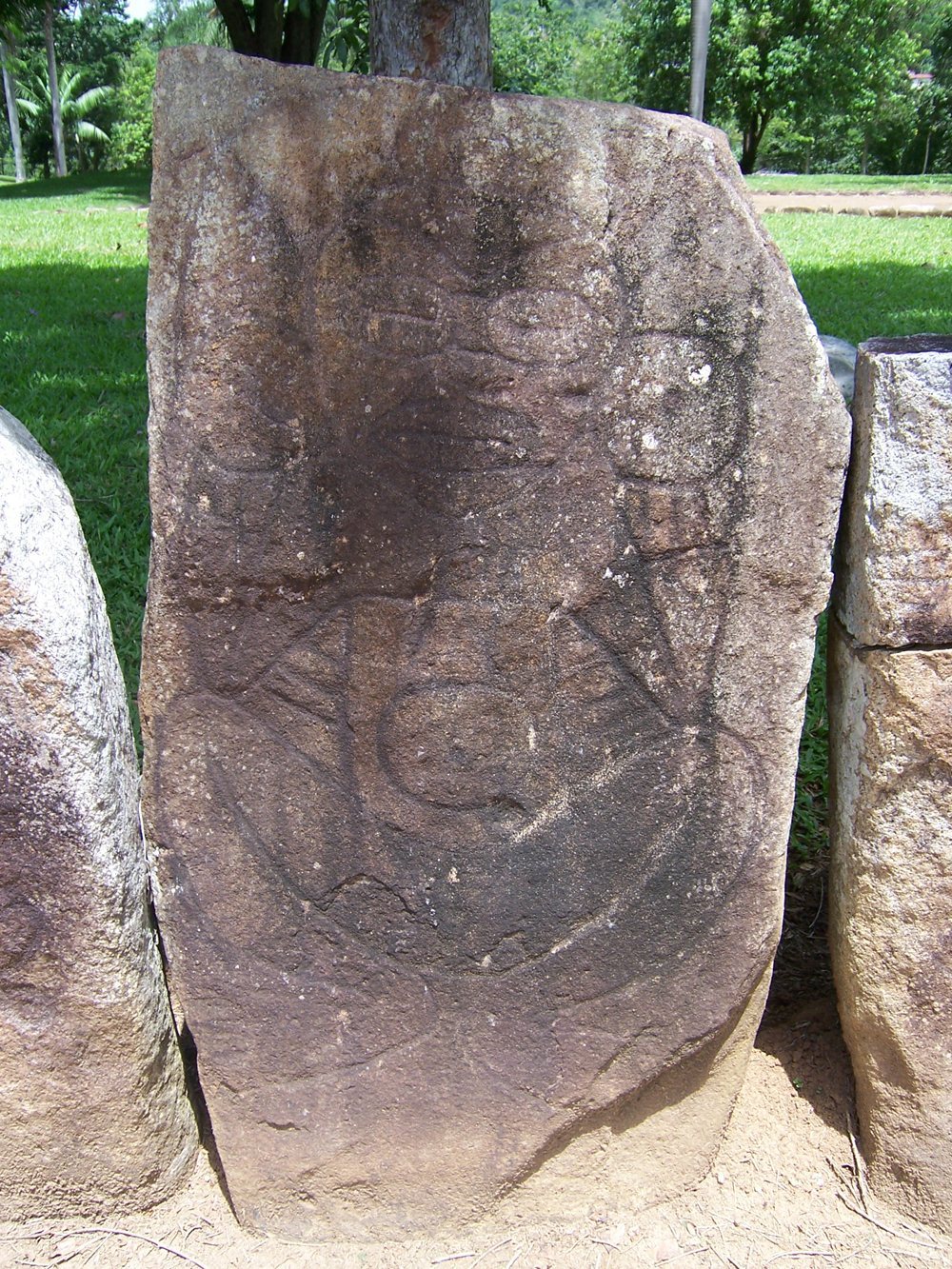
Many of the boundary stones bear Taíno petroglyphs, including a heron-like bird, human faces, celestial bodies, and the figure called the “Caguana woman.” This figure is identified with Atabey, a Taíno fertility deity. Caguana contains the largest concentration of petroglyphs in the Antilles, making the carved stones central to the interpretation of the complex.
Celestial orientation
The arrangement of the plazas and courts includes alignments with astronomical events. The complex may have supported observation or prediction of planetary and stellar transits, conjunctions, and alignments. Petroglyphs interpreted as representations of the Moon, stars, and planets add to the evidence for a relationship between the ceremonial layout and the sky.
River landscape and living displays
Caguana lies in the mountainous interior of Puerto Rico near the Tanama River. Its stone features are associated with the surrounding river landscape. Within the park, a botanical garden presents plants connected with Taíno food use, including sweet potatoes, cassava, corn, and yautía. It also includes trees historically used for construction and other purposes, such as mahogany, ceiba, ausubo, capá, tabonuco, royal palm, cedar, and María.
Bija and annatto trees are represented because Taíno people used them to obtain black and red body pigments. A traditional bohío, a house type associated with the Taíno, provides a physical representation of their domestic architecture alongside the ceremonial remains.