Unakoti: An Ancient Shaivite Rock-Art Site in Tripura
Site at a Glance
- Rating
- 4.5
- Popularity
- Medium
- Country
- India
- Primary era
- Medieval
- Eras represented
- Medieval
- Civilizations
- Unclassified
- Site type
- Religious
- Remains
- Sanctuary
On this page13 sections
History
Unakoti is an ancient Shaivite religious site in Gakulnagar, Tripura, India, whose rock art is stylistically attributed to the seventh to ninth centuries CE. Set in the Raghunandan hill range near Kailashahar, it is devoted primarily to Shiva and related Hindu imagery. Its creation is associated with patronage by the Deva Dynasty of Sribhumi in Samatata, before the later Manikya dynasty ruled Tripura.
Early religious setting
The site’s name, Unakoti, means “one less than one crore” in Hindi and Bengali. Shaivism is a major Hindu tradition centered on Shiva, and Unakoti developed as a place where images of Shiva, his attendants, and other Hindu deities were carved into the rocky landscape. The sculptures belong to a period before the rise of Manikya rule in Tripura.
Inscription and sacred traditions
A later inscription belongs to the eleventh or twelfth century CE. It mentions Sri Jayadeva, probably a pilgrim, and is associated with a Chaturmukhalinga, a linga, or an aniconic representation of Shiva, carved with four faces or aspects.
Hindu tradition explains the name through a story about Shiva’s journey to Kashi, the sacred city now known as Varanasi. Shiva is said to have stopped at the site for one night with 99,99,999 deities. When his companions failed to wake before sunrise, Shiva allegedly cursed them to become stone. Local tribal tradition gives a different explanation, attributing the sculptures to Kallu Gurjar, a devotee of Parvati. According to this account, Kallu wished to accompany Shiva and Parvati to Mount Kailash, but Shiva required him to make one crore images of Shiva in a single night. When one image remained unfinished at dawn, Shiva departed and left Kallu and the sculptures at Unakoti.
Neglect and heritage protection
Centuries of neglect damaged the carvings and caused the loss or degradation of substantial portions of the rock art. Conditions improved somewhat after the Archaeological Survey of India, the Indian government institution responsible for protecting and conserving nationally important archaeological sites, adopted Unakoti as a heritage site. Further excavation and related work remained necessary.
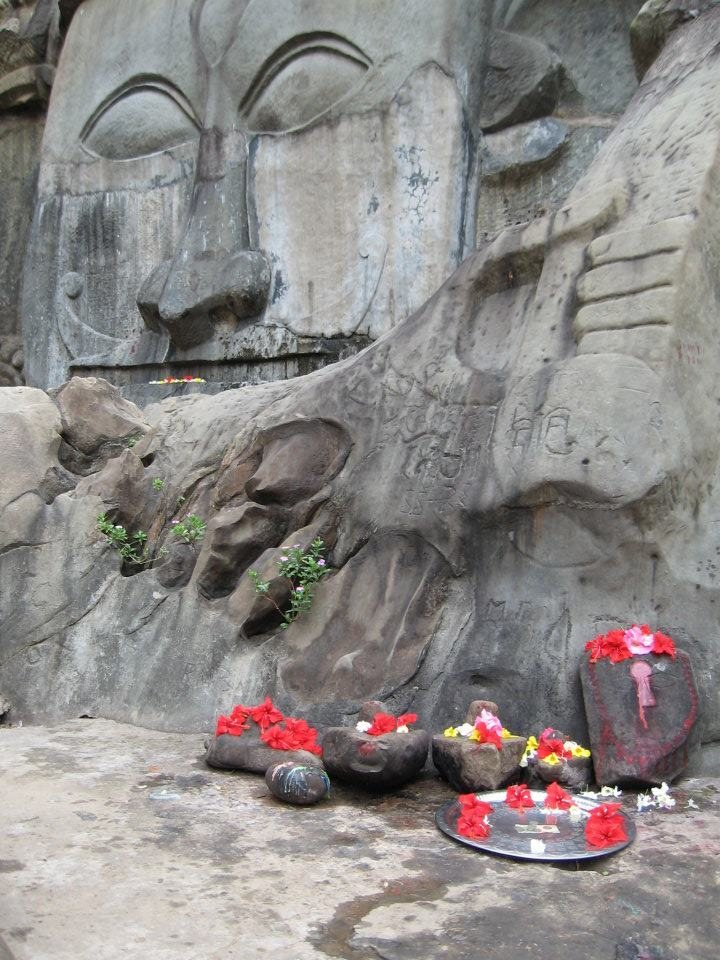
Unakoti continues to be associated with Hindu pilgrimage. The Ashokastami fair, a Hindu religious festival linked with pilgrimage and fairs, takes place every April and attracts thousands of pilgrims. A smaller festival is held in January. In December 2022, Unakoti was added to UNESCO’s World Heritage tentative list, which includes sites that a country may later nominate for World Heritage consideration.
Remains
Unakoti is organized across rock walls and a hill in the Raghunandan range. Its surviving imagery belongs to two principal groups: reliefs cut directly into the natural rock and freestanding stone images. The sculptures present Shiva and other Hindu deities in a landscape of carved walls, open stone figures, water, and partially buried images. Long-term neglect has left many carvings damaged or degraded.
Central rock-cut images
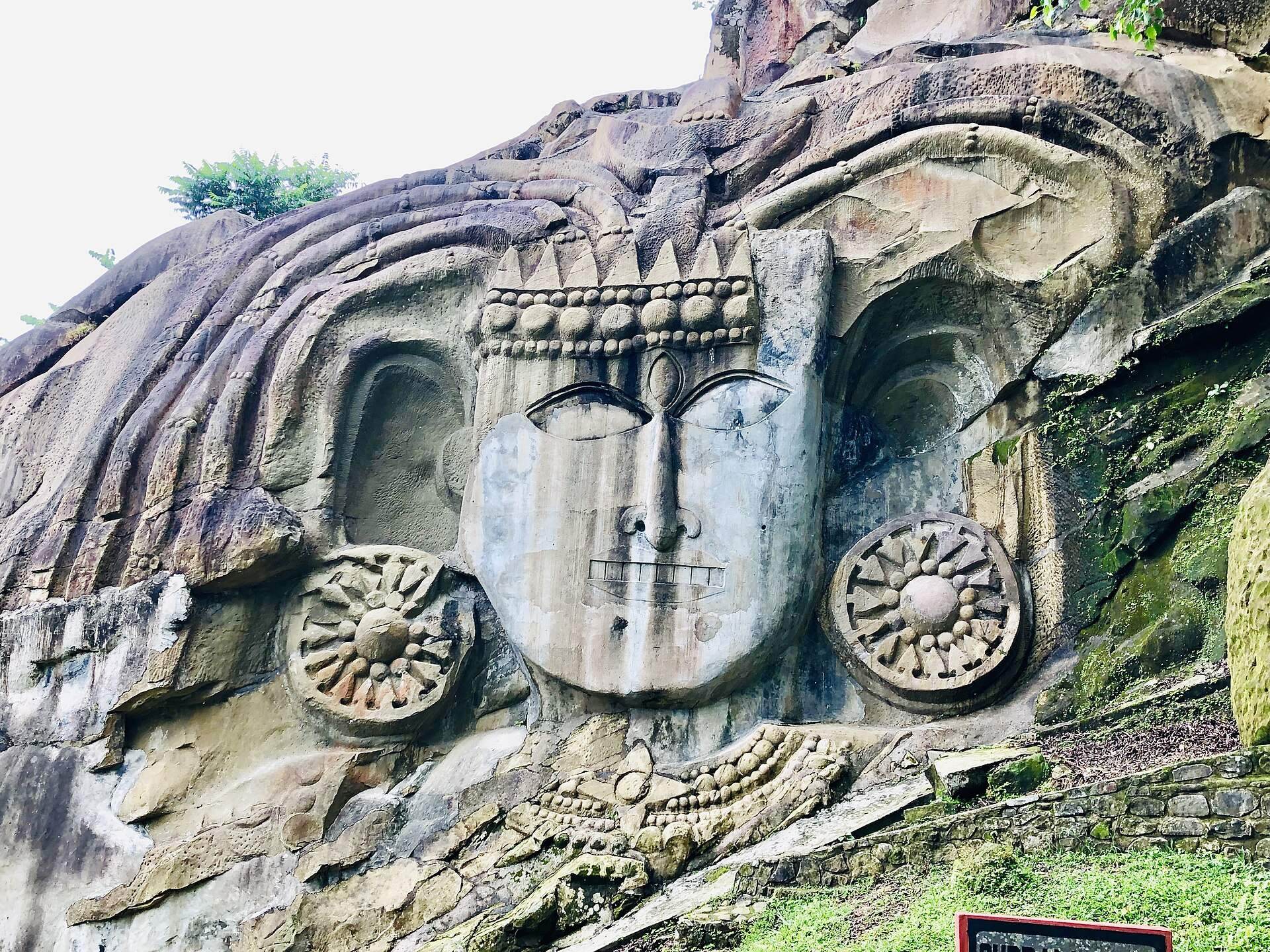
Unakotiswara Kal Bhairava
The central sculpture is the colossal head of Unakotiswara Kal Bhairava, a fierce form of Shiva. It rises about 30 feet, including an embroidered head-dress approximately 10 feet high. Two full-size female figures flank the head-dress. Durga stands on a lion on one side, while another female figure occupies the opposite side.
Nandi figures
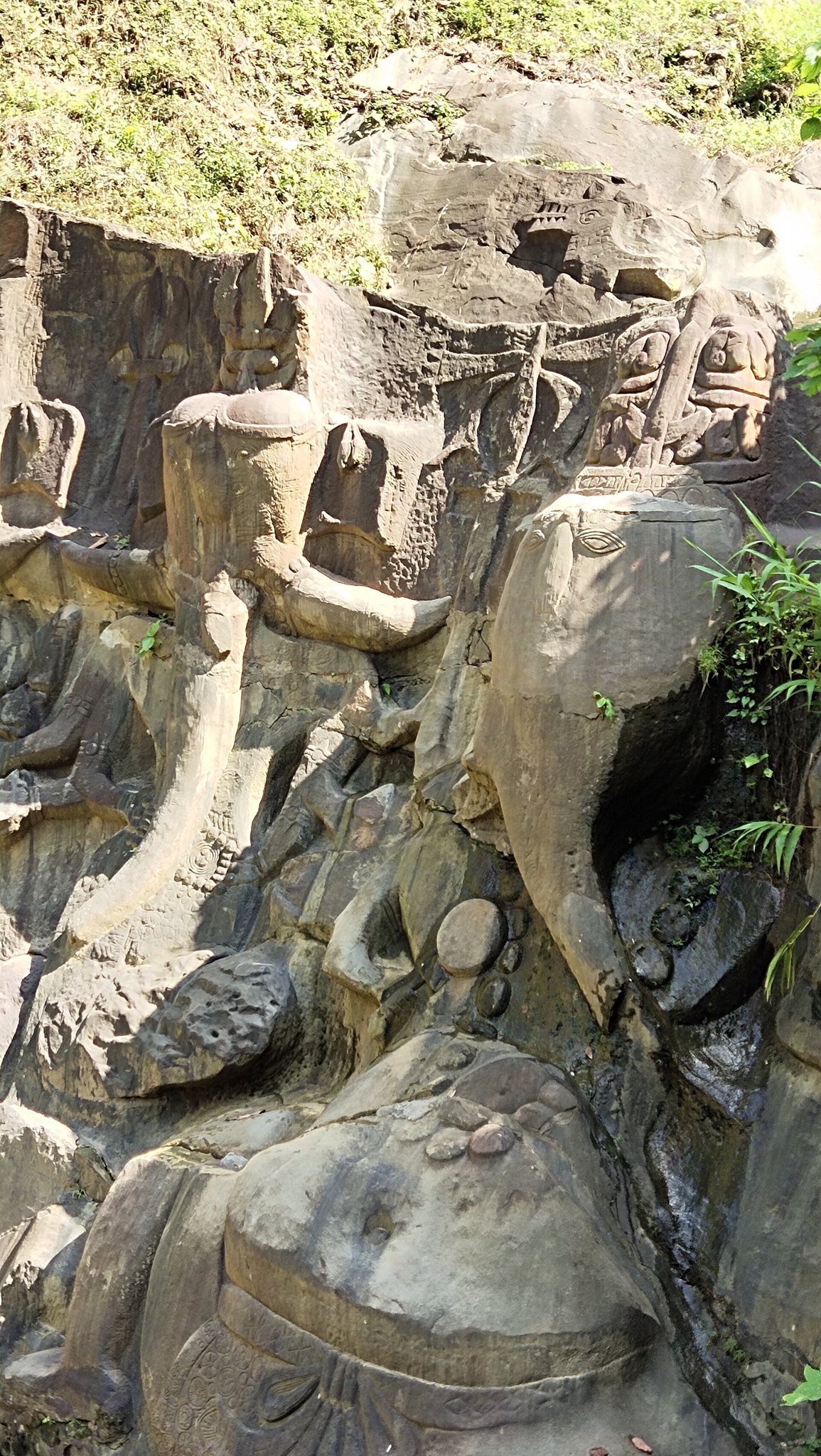
Three enormous images of Nandi, Shiva’s bull mount and attendant, are partly buried in the ground. Their position among the larger rock-cut sculptures contributes to the site’s concentration of imagery associated with Shiva.
Deity images and water feature
Ganesh Kunda
Ganesh Kunda is a major feature of the site. Three images of Ganesha are carved into the adjoining stone wall, and a four-armed figure of Vishnu appears to their right. A particularly large Ganesha is also among Unakoti’s prominent carvings.
Additional divine figures
Other rock-cut and freestanding images represent Ganesha, Durga, Vishnu, Rama, Ravana, Hanuman, and Nandi. Rock walls carry multiple reliefs and deity images, while a Shiva carving is associated with flowing water identified with the Ganga, the sacred river of Hindu tradition.
Inscribed sculpture
Chaturmukhalinga
The Chaturmukhalinga bears an inscription written in Bengali characters and dated to the eleventh or twelfth century CE. Its reference to Sri Jayadeva, probably a pilgrim, provides a later historical connection for the sculptural landscape and its continuing religious use.