Cango Caves: A Prehistoric and Heritage Cave System in South Africa
Site at a Glance
- Rating
- 4.6
- Popularity
- Medium
- Country
- South Africa
- Primary era
- Stone Age
- External website
- Open
- Eras represented
- Stone Age, Modern
- Civilizations
- Unclassified
- Site type
- Civic
On this page16 sections
History
Cango Caves are an extensive limestone cave system near Oudtshoorn in South Africa’s Western Cape, at the foothills of the Swartberg range. Formed in Precambrian limestone, the caves were used during the Middle and Later Stone Ages, when changing stone-tool technologies supported the activities of early human populations. Cave paintings and artefacts connect the system with this long period of prehistoric activity.
Prehistoric use and rediscovery
The caves entered modern historical records in 1780, when the local farmer Jacobus van Zyl was searching for stone for road construction. He was lowered into the first chamber discovered during this work, which was later named Van Zyl Hall. A second chamber was found in 1792, after which the caves became a popular destination for visitors.
The land around the entrance formed part of Kombuis Farm, which the state leased to Hermanus Steyn senior. Administration and ownership later passed to the Cape Province, the former administrative province of South Africa.
Petronella Sophia Camyn, daughter of civil commissioner and resident magistrate Anthony Alexander Faure, made the first recorded visit on 16 September 1808. Her group used candles and wooden ladders to reach the principal chamber. She described the mineral formations inside the caves and the difficult movement around numerous boulders.
Early exploration and public administration
On 14 October 1816, Reverend George Thorn of the London Missionary Society explored the caves. The organization was a Protestant missionary body active internationally from the late eighteenth century onward. Thorn recorded Van Zyl Hall, the Register, and Botha’s Hall, and measured other chambers.
Governor Lord Charles Somerset granted Kombuis Farm to Pieter van der Westhuizen on 10 January 1820, while permanently reserving the caves for the British Crown. Regulations intended to preserve them were approved on 8 August 1821. By 1868, the known chambers included Van Zyl Hall, the Register, Icicle Room, and Thompson’s Hall.
In 1890, Lieutenant-General Henry Augustus Smyth ordered an iron staircase to be installed in the caves. It was later replaced by a concrete staircase. Further chambers were found in 1895, including spaces containing curtains of stalactites. In January 1897, the chief guide Johnny van Wassenaar discovered thirty more chambers in seven days.
A rough survey made in 1897 mapped the first 26 chambers. A tradition associated with Van Wassenaar, the caves’ first official guide, holds that he spent 29 hours exploring in 1898 in an attempt to reach their end. He reportedly calculated that he had travelled 25 kilometres from the entrance and descended 275 metres while following an underground river. Later discoveries of additional passages have been considered consistent with the tradition, which remains an unconfirmed account.
Scientific investigation and expansion
Dr Andrew Smith visited the caves in 1829. In 1930, A.J.H. Goodwin of the University of Cape Town carried out test excavations that produced stone artefacts and other cultural material. These investigations added archaeological evidence to the earlier record of prehistoric use.
In 1956, the South African Spelaeological Association was commissioned to prepare an accurate survey and search for alternative entrances. A spelaeological association is an organization devoted to cave exploration, surveying, and scientific study. This work established the Cango I section and contributed to the later exploration of Cango II and Cango III.
James Craig-Smith, Luther Terblanche, and Dart Ruiters widened an obstructed passage in 1972 and discovered Cango II. In August 1975, an exploration team led by Hans Oosthuizen, Luther Terblanche, Michael Schultz, Digby Ellis, Jean Paul Matisse, Bob Mann, Florus Koper, and Peter Breedt drained most of the water from a chamber and crossed a former underwater passage. This led to the discovery of Cango III. Further extensions were found in December 1977 and June 1978, and the expanded passages were surveyed in August 1978.
Administration, segregation, and heritage protection
Administration of the caves passed to the Oudtshoorn municipality in 1921. Electricity was introduced in 1928 through a diesel generator housed in a machine building. The building was demolished in the 1960s after the caves were connected to the national electricity grid.
During apartheid, South Africa’s legally enforced system of racial segregation and discrimination, access to the caves was segregated by race from 1952. An artificial entrance for Black visitors was constructed in 1961 and completed and approved by the Historical Monuments Commission in 1964. Black visitors were directed to separate parking, stairways, restaurant, and ticket facilities, while white visitors used the natural entrance and different facilities. The arrangement drew criticism from national and international media.
Archaeologist Francis Thackeray recorded badly weathered prehistoric rock paintings in Fern Room in 1984. The identifiable images included part of an elephant, a long-horned antelope, and elongated human figures. The caves are administered day to day by the Oudtshoorn municipality and are designated as a provincial heritage site. They are also described as a South African National Monument, with legal authority assigned through heritage legislation to the relevant governmental authorities.
Remains
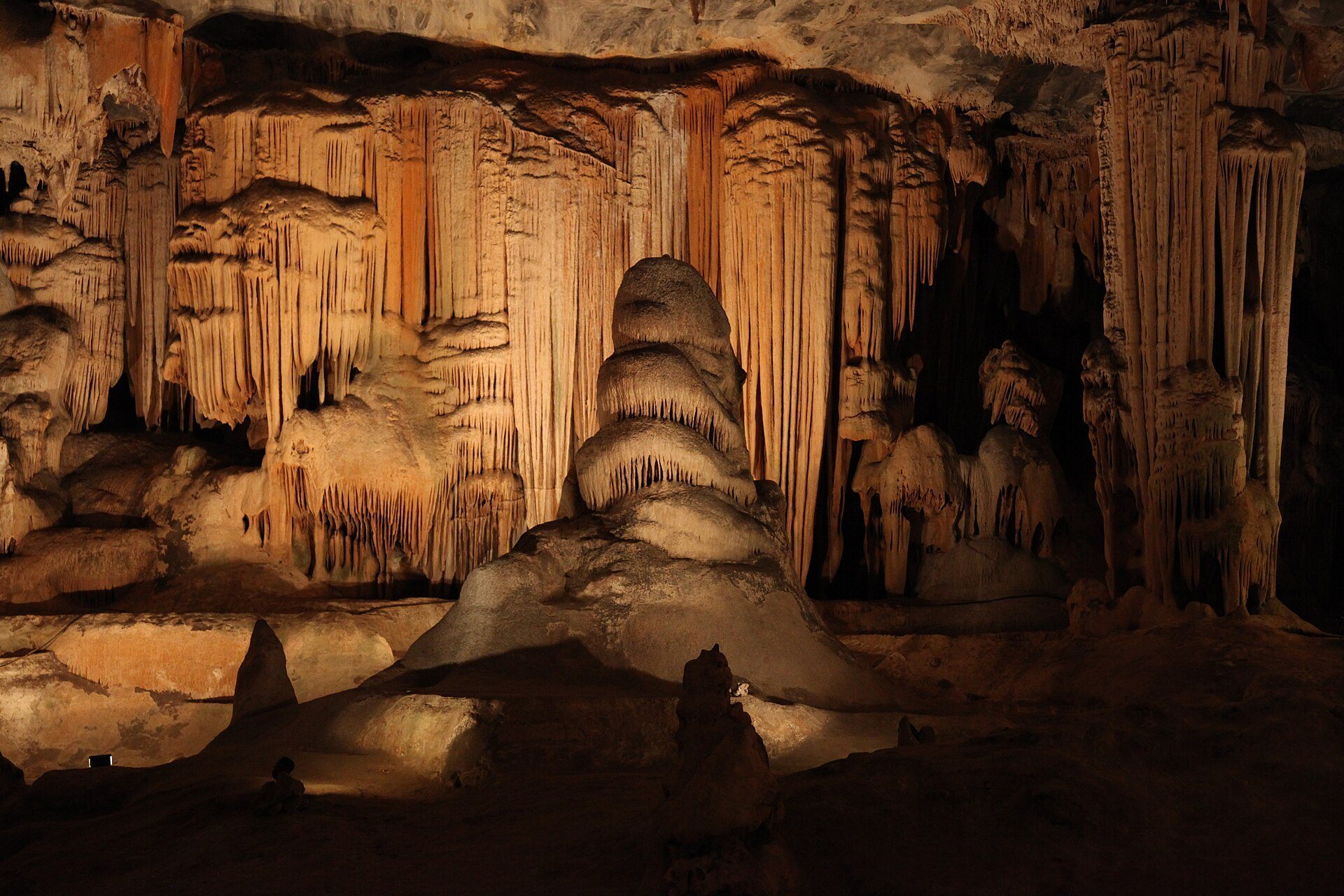
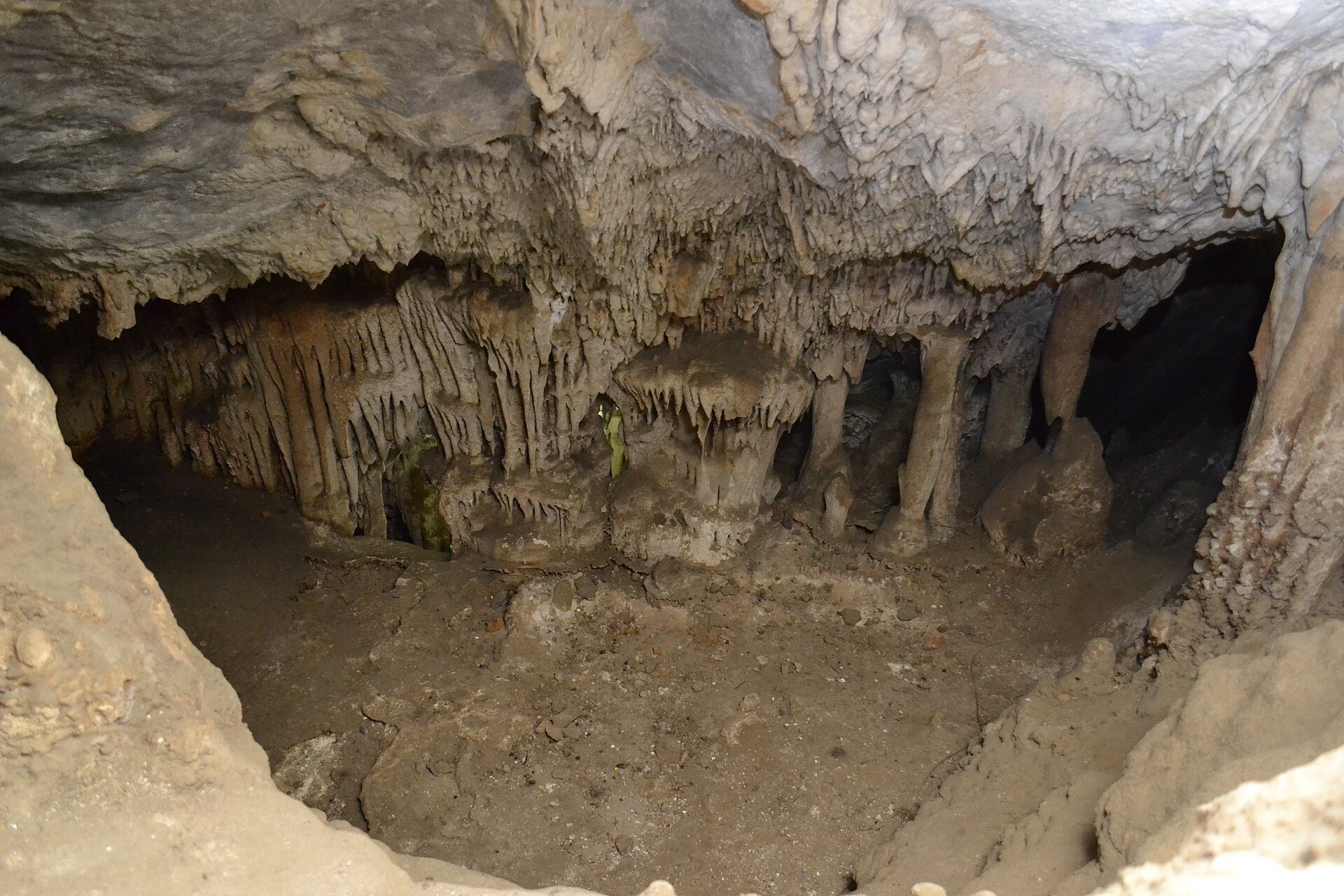
The cave system lies at an entrance elevation of about 600 metres above sea level and extends through Precambrian limestone. Its reported total length is 5,214 metres, while broader descriptions place the extensive system at more than 4 kilometres. Internal temperatures range from 20 to 21 degrees Celsius. The natural entrance leads into a connected arrangement of halls, narrow passages, boulder-filled areas, and chambers containing stalactites and other speleothems, mineral deposits formed inside caves.
Chambers and mineral formations
Van Zyl Hall
Van Zyl Hall is the principal chamber and measures approximately 107 metres long, 54 metres wide, and 17 metres high. Its name commemorates Jacobus van Zyl, who was lowered into the chamber during the 1780 rediscovery. The hall forms part of the system of large chambers and passages reached from the natural entrance.
Named chambers
Other named areas include the Register, Botha’s Hall, the Throne Room, Rainbow Room, Drum Room, Grand Hall, Bridal Chamber, Bathroom, and Lumbago Walk. Earlier names included Icicle Room and Thompson’s Hall. The caves contain curtains of stalactites alongside other limestone formations, as well as illuminated passages used on guided routes.
Surveyed cave sections
Cango I
Cango I extends 775 metres in a single line and varies in height by no more than 16 metres. Its point nearest the surface lies above the shaft in Devil’s Kitchen, 52.6 metres above the floor. The section forms the surveyed part of the cave system established through the mid-twentieth-century mapping work.
Cango II
Cango II continues for 270 metres beyond the end of Devil’s Kitchen. At its far end, a shaft descends 20 metres to a chamber filled with water. The water flowed in the direction of Cango I, linking the later-discovered section to the drainage pattern of the earlier explored area.
Cango III
Cango III extends for approximately 1,000 metres in total. Its largest chamber is about 300 metres long. A crawlway discovered in December 1977 added 290 metres to the known passages, while a further 90 metres was added in June 1978. Cango I, Cango II, and Cango III are survey designations for sections identified during successive mapping and exploration work.
Entrances and archaeological evidence
Natural and artificial entrances
The caves have a natural entrance and an artificial entrance constructed during the apartheid period. The artificial entrance was connected to separate access routes and visitor facilities created for Black visitors. During its construction in 1961, workers found the complete skeleton of a large antelope embedded in solid clay and calcium carbonate. The skeleton was not studied.
Fern Room paintings
Fern Room contains badly weathered prehistoric rock paintings. The recognizable images include an elephant’s head and forelegs, a long-horned antelope, and elongated human figures. Together with the stone artefacts and other cultural material recovered during the 1930 excavations, these paintings provide physical evidence for prehistoric activity within the caves.
The cave routes include narrow passages and steep rock surfaces. The most restrictive passage at the exit is slightly less than 15 centimetres wide. These passages, the large chambers, mineral formations, and successive surveyed sections preserve the physical record of exploration that began with the rediscovery in 1780 and continued through the twentieth century.