Fort Walton Mound: A Pensacola Culture Ceremonial Center
Site at a Glance
- Rating
- 4.5
- Popularity
- Low
- Country
- United States
- Primary era
- Medieval
- External website
- Open
- Eras represented
- Medieval
- Civilizations
- Unclassified
- Site type
- Religious
- Remains
- Sanctuary
On this page13 sections
History
Pensacola Culture and Indigenous Use
Fort Walton Mound is a Pensacola culture platform mound in Fort Walton Beach, Florida, United States, constructed around 800–850 CE as part of the Mississippian cultural tradition. The Mississippian tradition comprised complex Indigenous societies of eastern North America that practiced agriculture, maintained ranked social systems, and built platform mounds for ceremonial and political purposes. The Pensacola culture was a regional expression of this wider tradition.
The mound stood at the center of a chiefdom and probably supported the residence of its chief. It also served as a burial place for elite members of the community. Successive leaders were buried there, and additional layers were added over time. The society that built the mound cultivated crops including corn, beans, and squash, supporting the political and ceremonial organization centered on the site.
The date of construction remains debated. A general placement around 800–850 CE is associated with the mound’s development, while archaeologist Charles H. Fairbanks proposed a much later date, between 1500 and 1650, based on pottery recovered from it. The mound was abandoned by the late seventeenth century at the latest, although the precise date and cause are uncertain. An association with the arrival of European settlers has been proposed, but Spanish explorers found the sites already abandoned.
Camp Walton and Early Excavations
In 1861, during the American Civil War, Confederate soldiers established Camp Walton at the mound’s base to guard Santa Rosa Sound and Choctawhatchee Bay. The Walton Guard became the first group known to excavate the mound. John Love McKinnon later described human remains uncovered by the soldiers, including the bones of large individuals that showed damage consistent with hacking and blunt-force trauma. He suggested that the excavated area may have been a charnel house, a place where human remains were temporarily or collectively deposited during funerary rites.
Repeated digging by curiosity seekers had disturbed the mound by the time S. T. Walker reported on an 1883 excavation undertaken for the Smithsonian Institution. Walker also noted that S. S. Forbes had previously excavated the site and had found bones and clay effigies, which Forbes later donated to the Smithsonian. Clarence Bloomfield Moore excavated the mound in 1901, bringing additional ceramic vessels and burial items to light.
Twentieth-Century Investigation
Gordon Willey and Richard Woodbury reexamined Fort Walton Mound and other sites in 1940. Willey later discussed the work in Archaeology of the Florida Gulf Coast, contributing to the interpretation of the mound within the archaeology of the region.
At the city’s request, Charles H. Fairbanks excavated the mound in 1960 to investigate its original size, shape, construction method, and chronology. The Indian Temple Mound Museum opened in 1962, and museum staff continued excavations during the 1960s and 1970s under William and Yulee Lazarus. Yulee Lazarus was the museum’s first curator.
Excavations from 1971 to 1973, directed by Robert J. Fornaro, sought post holes and ceramic material that might correspond to vessels recovered during earlier work. Nina Thanz’s 1976 excavation examined the proposed temple reconstruction and sought to prevent construction from disturbing human remains or artifacts. Her work identified post holes from several structures and evidence interpreted as a charnel house. The post holes also helped establish the dimensions of the structure now standing on the mound.
Preservation and Interpretation
Fort Walton Mound was designated a National Historic Landmark in 1964 and added to the U.S. National Register of Historic Places in 1966. It is protected within Fort Walton Beach Heritage Park and Cultural Center. The Indian Temple Mound Museum has occupied its current location since 1972 and displays pre-Columbian artifacts from the mound and material from other sites. The surrounding heritage complex also includes the Camp Walton Schoolhouse Museum, the Garnier Post Office Museum, and a Civil War Exhibits Building.
The reconstructed temple on the summit was designed as an interpretive aid rather than an exact replica. Its purpose was to help explain how Indigenous people used the mound, drawing on the post holes and other archaeological evidence identified during excavations.
Remains
Mound Form and Village Setting
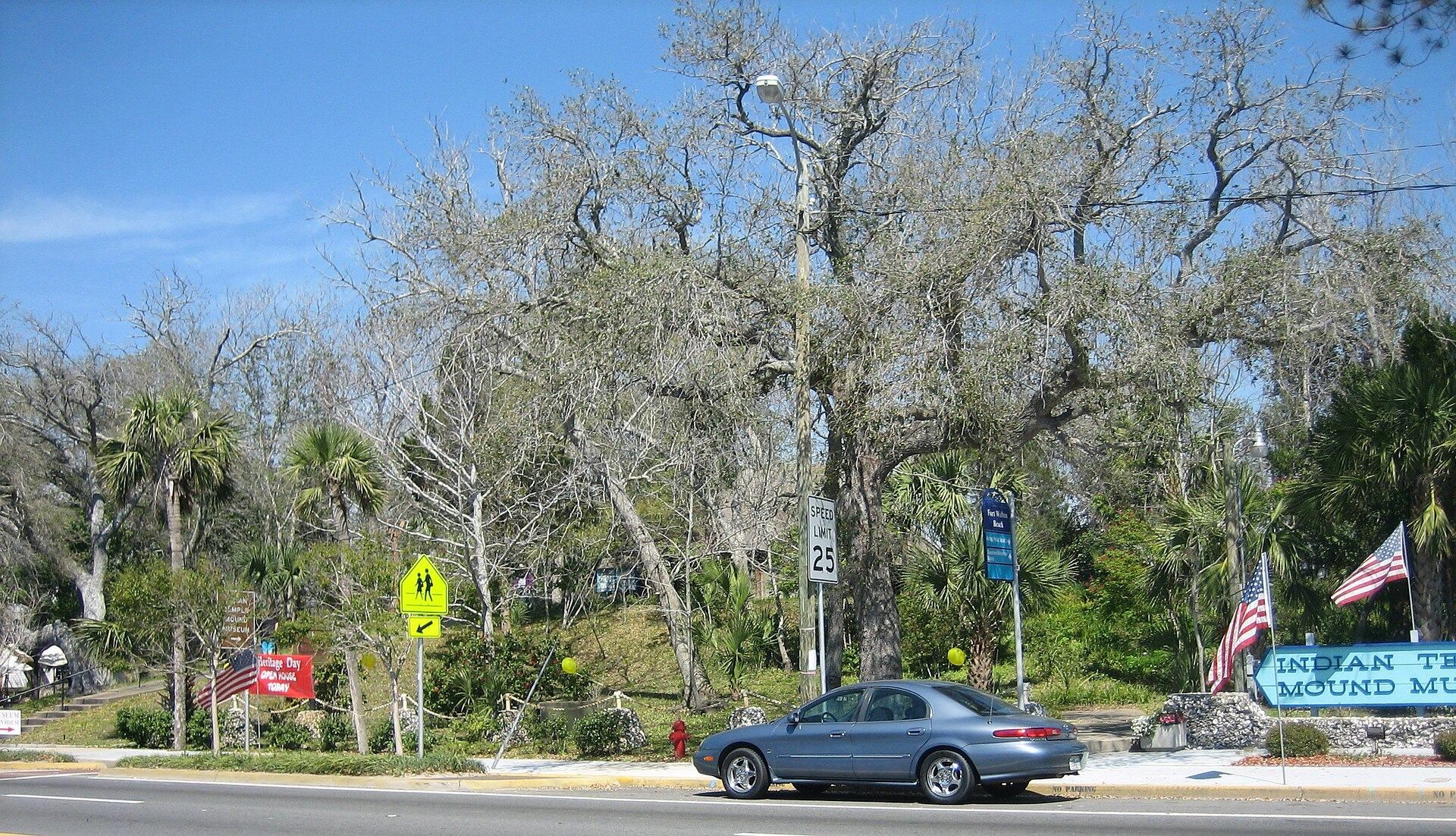
Fort Walton Mound is a large platform mound with a pyramidal base and a level, truncated summit. A platform mound is an earthen monument with a flat top used for ceremonial buildings, temples, residences, or other structures associated with social elites. Erosion and reduction have lowered the mound, which now measures approximately 12 feet, or 3.7 meters, in height and 223 feet, or 68 meters, across its base.
The mound formed the center of a village and its associated agricultural lands. Several buildings probably occupied the summit, possibly at different stages of the mound’s use. The flat upper surface provided space for ceremonies and for structures connected with the chief and other high-ranking members of the society.
Summit Structures and Burial Areas
Summit Structures
The summit buildings were probably constructed with wattle and daub, a method in which a woven framework is covered with clay or mud. Archaeological work identified post holes belonging to several structures. These traces provided evidence for the size and arrangement of buildings and contributed to the design of the reconstructed temple that now occupies the mound.
Burial Areas
Successive burial layers within the mound are associated with elite members of the society. Excavations also revealed human remains, burial items, and evidence interpreted as a charnel house. These remains reflect the mound’s use as a place for funerary practices as well as ceremonies and political activity.
Reconstruction and Material Finds
Reconstructed Temple
The temple reconstruction on the summit represents an interpretation of the structures that once stood there. It was not intended to reproduce an original building exactly. Instead, its form and dimensions were informed by the post holes identified during excavation and were designed to clarify the mound’s Indigenous use.
Ceramics and Other Objects
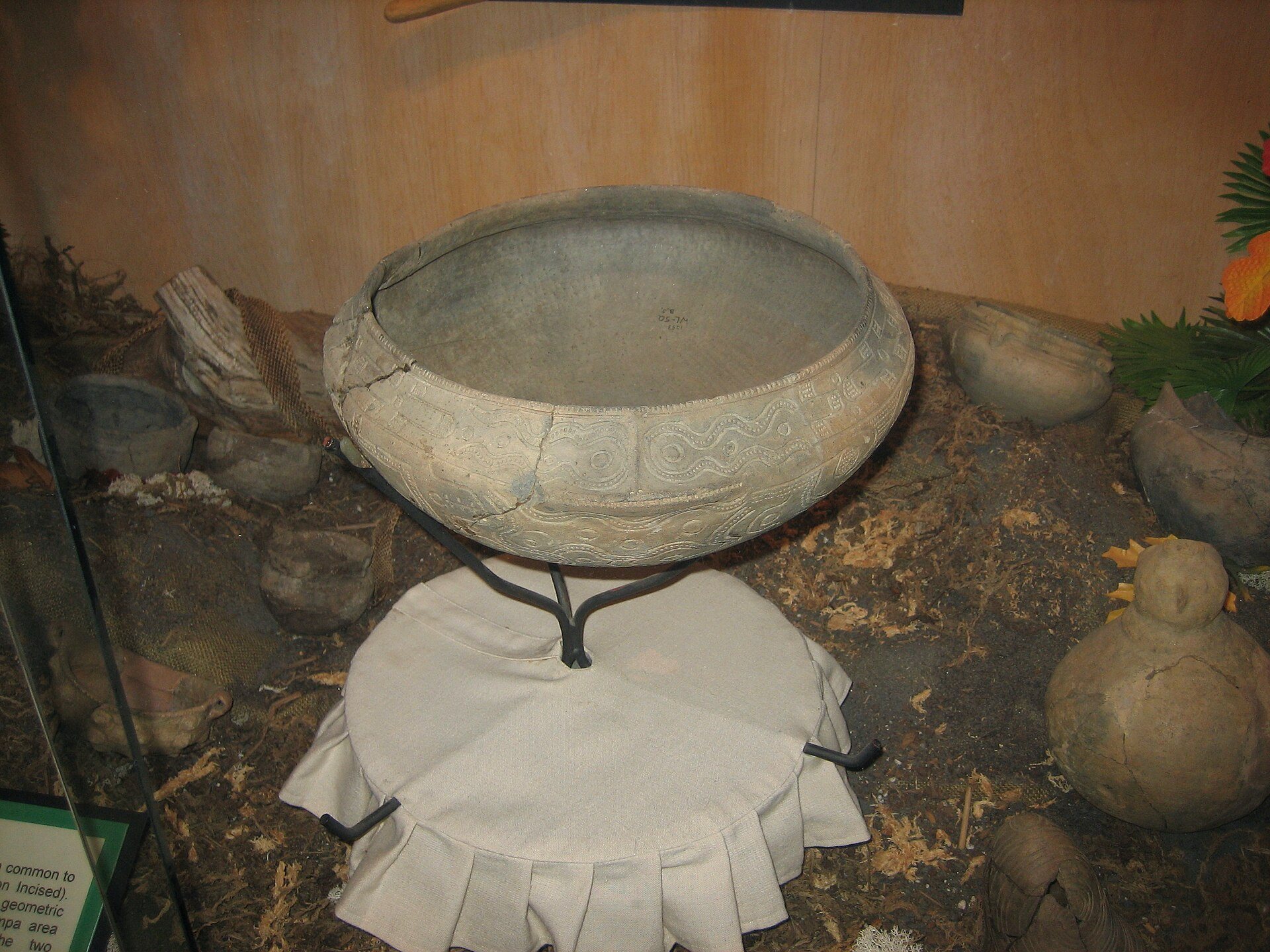
Excavations produced ceramic vessels, other ceramic material, clay effigies, bones, and burial objects. The pottery is associated with Pensacola cultural practices, including the use of shell temper. Fort Walton cultural pottery in the surrounding region used sand, grit, grog, or combinations of these materials. The mound complex is one of three surviving mound complexes in the Florida Panhandle, alongside Letchworth Mounds and Lake Jackson Mounds.