San Agustin Archaeological Park: A Funerary and Monumental Complex in Colombia
Site at a Glance
- Rating
- 4.8
- Popularity
- Medium
- Country
- Colombia
- Primary era
- Medieval
- External website
- Open
- Eras represented
- Classical, Medieval
- Civilizations
- Unclassified
- Site type
- Burial
- Remains
- Necropolis
On this page15 sections
History
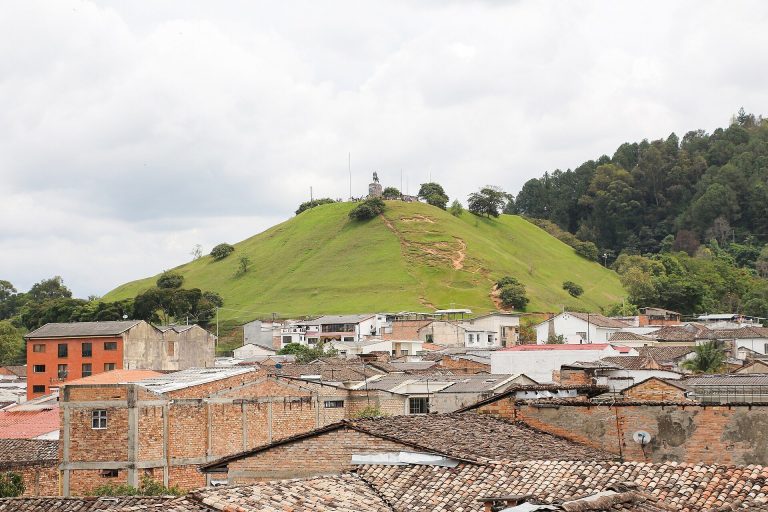
San Agustin Archaeological Park, in San Agustín, Huila, Colombia, is a funerary and monumental complex created by the San Agustin culture, whose statues are broadly dated between about AD 5 and 400. The park lies in the upper Magdalena River basin near the river’s headwaters and forms part of a wider archaeological landscape extending across more than 50 square kilometres. It is described as the world’s largest necropolis, a term for a large cemetery or funerary landscape, and contains one of Latin America’s largest collections of religious monuments and megalithic sculptures.
Early settlement and cultural development
The archaeological region developed through a sequence of periods. During the Archaic phase, approximately 3000–1000 BC, a hearth represents a pre-ceramic culture. The Upper Formative phase, approximately 1000–300 BC, brought pottery and agriculture. A later phase, dated approximately 200 BC–AD 300, preceded the Regional Classic period, which lasted from AD 300 to 800.
During the Regional Classic period, communities constructed funerary mounds, statuary, and wooden sarcophagi. In the Recent period, from AD 800 until the Spanish conquest, sculptors produced the last and more realistic statues, while people cultivated peanuts. This phase is associated with the decline and disappearance of the culture that created the monuments. The exact dates of individual statues remain uncertain, and the identity of the sculptors is unknown.
Early descriptions and nineteenth-century investigation
Fray Juan de Santa Gertrudis, a Franciscan missionary, passed through San Agustin in 1756 and described its sculptures in Maravillas de la Naturaleza. In 1797, the Colombian scientist and intellectual Francisco José de Caldas visited the area, publishing an account of his journey in 1808. These descriptions brought the monuments into a wider written record.
The Colombian Corographic Commission, a nineteenth-century government expedition that recorded the country’s landscapes, peoples, and material remains, began work in the region in 1850 under Agustín Codazzi. Codazzi and the draughtsman Manuel María Paz documented Las Mesas, while Paz made the first pictorial copies of the sculptures. Codazzi published detailed descriptions in 1857.
In 1859, quarrying entrepreneurs moved three anthropomorphic statues and a large stone canoe or sarcophagus to the town of San Agustin. In 1907, two statues were transferred to Bogotá during the government of Rafael Reyes Prieto and later placed in the city’s National Park. Luis María Gutiérrez de Alba described the archaeological area in 1892 and proposed government support for exploration, conservation, and dissemination. The proposal was not adopted. General Carlos Cuervo Márquez produced early academic studies between 1892 and 1893.
Twentieth-century archaeology and protection
Konrad Theodor Preuss, a German ethnologist and archaeologist, visited the region between late 1913 and early 1914 as an envoy of Berlin’s American section of the Anthropological Museum. He took the first photographs of the statues, identified mounds that had been looted or disturbed, and photographed 120 sculptures. During his 1913 archaeological work, he removed 21 smaller sculptures, which reached Berlin in 1919 and entered the collections of the Ethnological Museum. In 2022, the Colombian government formally announced its intention to seek their return from the Humboldt Forum, the museum complex that succeeded that institution.
The archaeological park was officially founded on 20 November 1935 during the first administration of Colombian president Alfonso López Pumarejo. It forms part of the San Agustín–Tierradentro archaeological corridor. Gregorio Hernández de Alba began excavations in 1936 and published La cultura arqueológica de San Agustín, a foundational work in Colombian archaeology. José Pérez de Barradas conducted further excavations in 1937 with the draughtsman Luis Alfonso Sánchez Valderrama, and their findings appeared in 1943 as Arqueología agustiniana.
Further interpretation developed through the work of Justus W. Schottelius, who published a comparative study in 1940, and Gerardo Reichel-Dolmatoff, who excavated at San Agustin in 1966. Luis Duque Gómez directed the park and carried out extensive research from the 1960s through the 1990s. The Colombian Institute of Anthropology and History also conducted research in the region.
In 1995, the park and its archaeological remains were inscribed on the UNESCO World Heritage List under criterion (iii). This criterion recognizes exceptional testimony to a living or vanished cultural tradition or civilization. The property has UNESCO reference 744 and is also recognized nationally as a monument.
Remains
Funerary landscape and construction
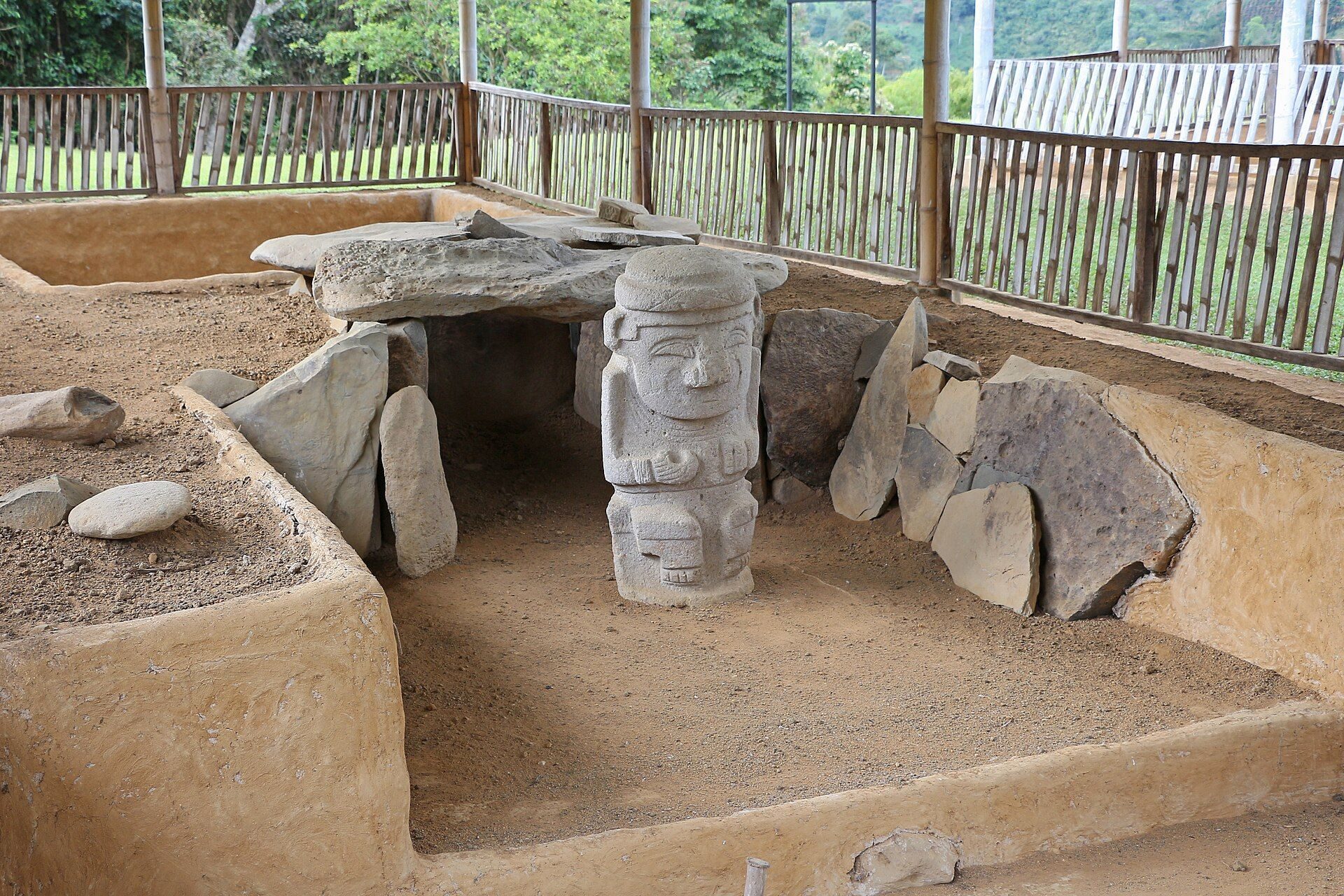
The remains form a funerary landscape arranged across terraces and earthworks on elevated plateaus beside the canyon of the upper Magdalena. The formal park stands at approximately 1,730 metres above sea level and contains four areas known as mesitas, the Archaeological Museum of San Agustin, and the Bosque de las Estatuas. Its principal archaeological features include funerary mounds, tombs, monolithic sarcophagi, statuary, and wooden sarcophagi. Volcanic tuff and andesite lava are the principal stone materials.
Several megalithic sculptures express a funerary cult. Some tombs have a dolmen-like form, using large stones that include upright supports and a covering slab. Guardian and shaman figures were positioned to protect sarcophagi or burial chambers. Many statues remain in situ, at or near their original find locations, and a high proportion face east.
Monumental statuary
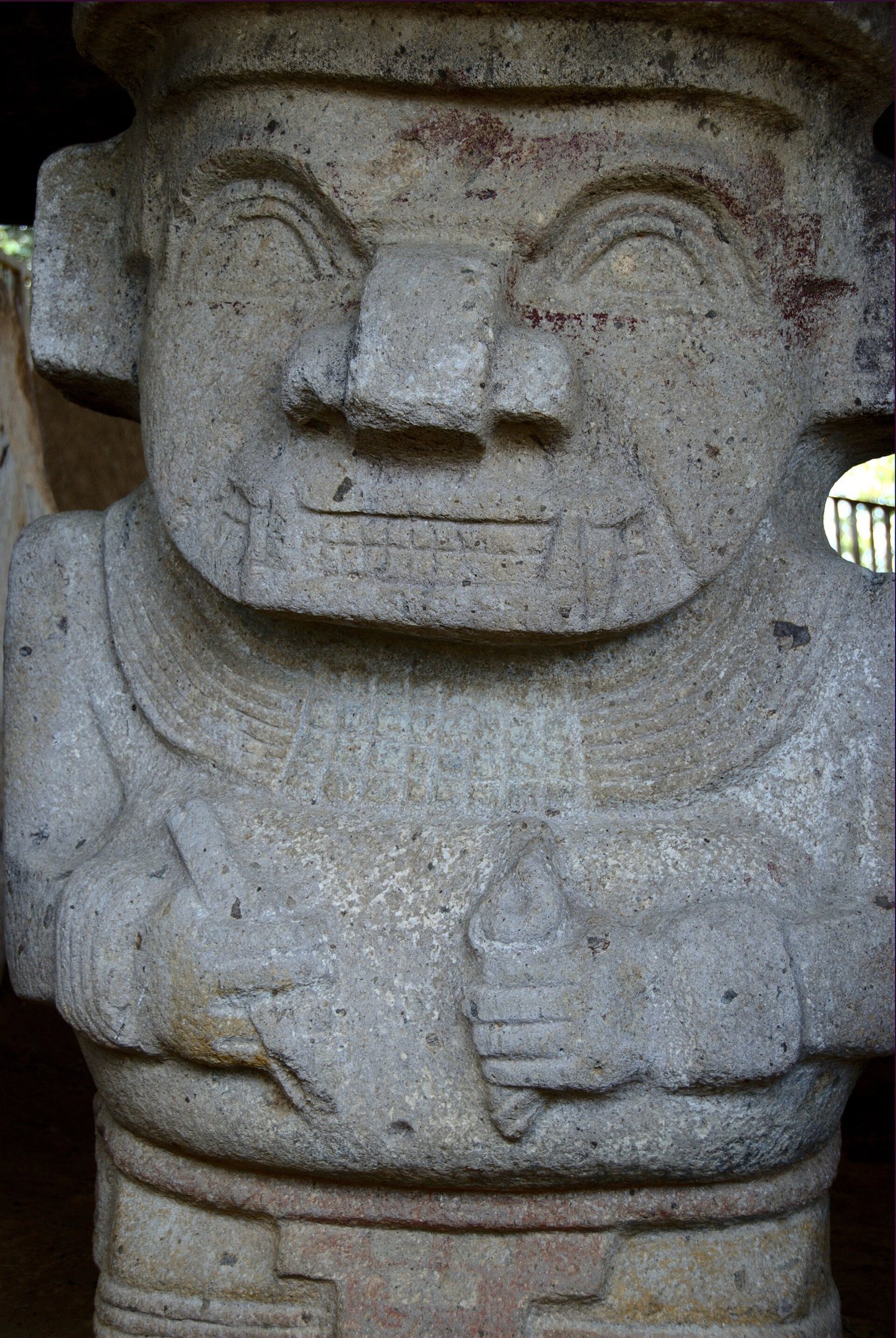
The park is associated with more than 500 statues, while approximately 300 statues are also reported from the archaeological area. Their heights vary, with the tallest reported at about 7 metres. Many have planimetric designs, with imagery carved mainly onto the front of a flat surface rather than fully sculpted around the sides. Human and animal features frequently combine in mask-like ceremonial forms.
The statuary includes anthropomorphic and zoomorphic figures, including representations or proposed representations of crocodiles, bats, jaguars, snakes, frogs, and birds. Some sculptures probably served as funerary guardians beside burial mounds. Others have been interpreted as figures associated with male solar and female lunar deities. The statues were formerly painted bright yellow, red, black, and white, and a small number retain visible coloration.
Cara triangular
Cara triangular is an inverted-pyramid-shaped triangular face. Some researchers have suggested that its form represents a maize grain.
El cura
El cura was described in 1756 as the image of a priest whose right arm had been cut off to deprive it of the riches that adorned it.
Ave y reptil
Ave y reptil probably represents an eagle or owl carrying a snake in its beak.
Water, museum, and forest features
Fuente de Lavapatas
Fuente de Lavapatas is a system of channels cut into stone and decorated with human, amphibian, and reptilian figures. José Pérez de Barradas and Gregorio Hernández de Alba discovered it in 1937. Its approximate date falls between the first and ninth centuries AD.
Archaeological Museum of San Agustin
The Archaeological Museum of San Agustin contains exhibition rooms with statues removed from their original locations, pottery vessels, tools, inscriptions, and historical documents relating to earlier archaeological investigations.
Bosque de las Estatuas
The Bosque de las Estatuas is a circuit of ecological paths where regional vegetation surrounds 35 funerary statues found in the surrounding area.
Associated archaeological parks
Alto de los Idolos and Alto de las Piedras are independent archaeological parks in the municipality of Isnos, several kilometres from San Agustin. They belong to the wider archaeological complex associated with the region but not to the formal San Agustin Archaeological Park. Alto de los Idolos contains the tallest statue in the wider group, measuring approximately 7 metres. Alto de las Piedras contains the statue known as Doble Yo.