Reting Monastery: A Tibetan Buddhist Seat of the Kadam and Gelug Traditions
Site at a Glance
- Rating
- 4.4
- Popularity
- Very Low
- Country
- China
- Primary era
- Medieval
- Eras represented
- Medieval
- Civilizations
- Tibetan
- Site type
- Religious
- Remains
- Monastery
On this page20 sections
History
Reting Monastery, also known as Radreng, is a Tibetan Buddhist monastery in Lhünzhub County, Lhasa, Tibet, China. It was founded by Dromtön, the principal Tibetan disciple of the Indian Buddhist master Atisha, in 1056–1057, with the foundation also specifically dated to 1057. The monastery became the first and principal seat of the Kadam tradition, a Tibetan Buddhist school based on teachings transmitted by Atisha and his disciples.
Foundation and Kadam teaching
Reting’s foundation tradition identifies the site as a sacred place foretold by Shakyamuni and Atisha. Dromtön brought part of Atisha’s relics to the valley and placed them in a silver reliquary stupa. The monastery’s name was interpreted as referring to a Dharma path that removes spiritual defilements and continues until liberation from cyclic existence.
Dromtön built the Upper Reting Monastery and its residential hall in 1056, then added an upper two-column hall in 1057. After his death in 1064, the abbacy passed to Nangchok Chenpo, another disciple of Atisha. Nangchok Chenpo expanded the monastery, and he was followed by Kumbawa Wangchuk Jangchub and then by Potowa, a disciple of Dromtön.
Reting’s educational system followed Atisha’s Lamp for the Path to Enlightenment, emphasizing monastic discipline and a graduated approach to spiritual practice. Its curriculum included the Six Treatises of the Kadam tradition and later the Five Treatises of Maitreya. The monastery retained substantial Kadam doctrine even after it became affiliated with the Gelug tradition, the school established through the reforms of Tsongkhapa.
Gelug affiliation and institutional development
During the rise of the Gelug tradition in the fifteenth century, Reting changed its affiliation and became subordinate to the Jé College of Sera Monastery. The Reting reincarnate-lama institution was established after this change. A Rinpoche is a revered Tibetan Buddhist teacher associated with a recognized reincarnation lineage, while Hutuktu was a rank historically granted to certain high-ranking incarnate lamas. The fully developed Reting reincarnation system is described as beginning during the period of the Seventh Dalai Lama.
Reting became the seat of the Reting Rinpoches, but its institutional organization differed from that of many other Gelug monasteries. It had no monastic colleges or regional monk residences of the usual type. Instead, the Reting Rinpoche traditionally directed religious and administrative affairs through a single appointed abbot.
The internal administration included an abbot acting for the Reting Rinpoche, a financial officer, a disciplinarian, a steward responsible for supplies and property, and an officer who served tea to the monks. The associated Reting estate maintained separate offices in Reting and Lhasa. Its officials handled regency, revenue, property, the lama’s household, offerings, ritual implements, and religious activities.
The monastery began with only fifty or sixty residents. It later controlled thirty-three dependent estates, seven subsidiary monasteries, and three pastures, and had approximately 500 monks. The subsidiary monasteries included Qusang, Gangan, Jianglong Quding, Juetan, Sangdanlin, Zinie, and Yanggun. Around 2006, Reting had approximately 102 monks.
Religious status and the Reting lineage
In the nineteenth century, the Qing government bestowed Reting Monastery on the Reting Hutuktu lineage. A record of major sacred sites in Central Tibet from 1840 placed Reting first in its list, reflecting the monastery’s high religious status.
The Fifth Reting Rinpoche, Thubden Jampal Yeshe Tenpai Gyaltsen, served as regent of the Tibetan Kashag government during the 1930s and 1940s. The Kashag was Tibet’s central governmental council, and a regent governed on behalf of a Dalai Lama who had not yet assumed full authority. In 1947, the Fifth Reting Rinpoche was arrested on accusations that included alignment with the central government and plotting against the succeeding regent, Taktra Rinpoche.
When Tibetan government troops arrived at Reting to arrest him, monks resisted and killed sixteen soldiers. Many monks and local residents were subsequently detained, punished, or exiled. The Reting estate administration was sealed, and officials connected with it were persecuted. The monastery suffered severe damage, while religious images and other valuable objects were destroyed or stolen.
The Fifth Reting Rinpoche died in prison in Lhasa on 7 May 1947. The official explanation differed from a widespread allegation that he had been poisoned. After his death, the Kashag withdrew the Hutuktu title and privileges from the Reting incarnation.
In 1950, representatives of the monastery and supporters of the Reting Rinpoche searched for the Fifth Reting Rinpoche’s reincarnation. Following prescribed divination and lake-observation rituals, a three-year-old boy was identified and approved by the Dalai Lama. He was enthroned at the Reting estate in 1951 as the Sixth Reting Rinpoche, and the Hutuktu title and former rights of the Reting estate were restored.
Earthquakes, conflict, and destruction
An earthquake struck the Reting area in 1951. A government work team later visited the monastery, provided relief supplies to the affected population, and presented the Sixth Reting Rinpoche with political gifts and publications. On 18 August 1952, the Sangxiong earthquake partly destroyed Reting. About 200 reliquary stupas collapsed, while many halls, chapels, and monks’ residences also fell. The damage was given as a total of 774 rooms.
After military operations in the Reting region in 1959, the twelve-year-old Sixth Reting Rinpoche and officials of the monastery estate received Chinese military personnel. In early 1960, the monastery gathered 105 firearms that had been dispersed among monks in the region and delivered them to the military authorities. An armed group later entered the monastery, killed a monk, and abducted three estate officials. They survived after senior monastery administrators intervened.
During the democratic reform period, Reting underwent severe political disruption but was protected as a cultural monument of the Tibet Autonomous Region. It still had thirty monks in 1966. During the Cultural Revolution, its buildings were destroyed and the site became a ruin.
Restoration and later lineage history
Reting was gradually repaired after the reform period, and the Lhasa municipal government approved its restoration and reopening in 1983. The monastery was designated a protected cultural monument of the Tibet Autonomous Region in 1962 and is formally classified as a historic building dating to the Song period.
The Sixth Reting Rinpoche died in 1997. The monastery and the Reting Rinpoche institution have also been connected with searches for incarnations of major Tibetan Buddhist leaders, including the Fourteenth Dalai Lama. The Chinese government announced the selection of a Seventh Reting Rinpoche in the early 2000s, and he was enthroned at the monastery with government approval. The Dalai Lama did not recognize that incarnation.
Reting’s religious practice includes annual offerings, scripture recitation, ritual dances, circumambulation, and the Pabangtang festival. The festival is associated with a large stone near the monastery and with a tradition that many female deities descend to the nearby grassland to bless worshippers.
Remains
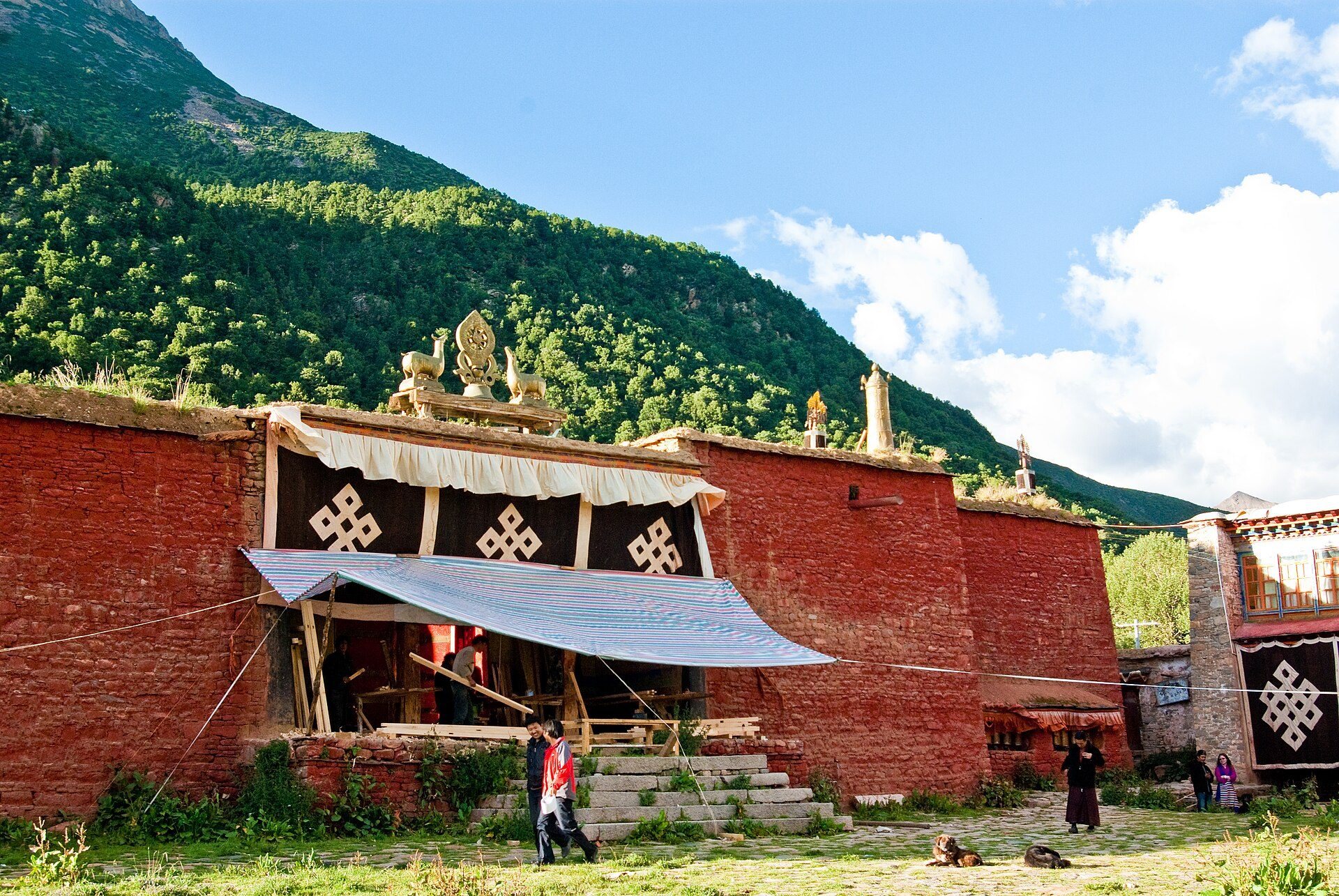
Reting Monastery stands beside the Reting River at the foot of Puyang Gangqin Mountain, at an elevation of approximately 4,230 metres. Its grounds cover about 25 traditional mu, or approximately 1,667.5 square metres. The surviving complex has been partly restored in a Tibetan architectural style and incorporates traditions associated with the earlier monastery. Its principal buildings are the Tsokchen Assembly Hall and the Reting estate residence.
Main monastery complex
Tsokchen Assembly Hall
The Tsokchen Assembly Hall occupies about one traditional mu, or approximately 666.7 square metres. It consists of a chapel and scripture halls, with the principal assembly hall forming the lowest building in the complex. The hall is oriented with its back to the north and its entrance toward the south. It served as the main setting for monastic religious activities and is surrounded by smaller scripture halls.
Principal chapel
The main chapel contains the principal image of Jampel Dorje, identified as Atisha’s tutelary deity and also known as Guhyasamaja, a major tantric Buddhist deity and meditation system. It also holds a rare image of Atisha with a tilted head and images of White Tara. The chapel contains reliquary stupas associated with Atisha, Dromtön, and Serlingpa, the tenth-century Indian master who taught Atisha.
The principal image of Jampel Dorje is traditionally said to have been made from the “great wisdom drop” of the male and female forms of Vajradhara. A religious record attributes miraculous efficacy to prayer before the image. Reting contains 108 reliquary stupas associated with Atisha and other eminent monks. A reliquary stupa is a monument or container that enshrines bodily relics or other sacred remains.
Scripture halls
The large and small scripture halls contain Buddhist images and scriptures. The principal hall has double walls. Shelving for the Kangyur, the collection regarded as the Buddha’s teachings, and the Tengyur, which contains Indian commentaries and scholastic works, is set into the inner wall, while the outer wall is built of stone.
Numerous thangkas decorate the scripture hall. A thangka is a painted or embroidered Tibetan Buddhist religious image. Among the works is a newly painted panoramic representation of the monastery during its period of greatest prosperity.
Senkang and associated rooms
Behind the principal assembly hall stands the Senkang, a second-storey building whose rooms were traditionally used to accommodate the Dalai Lama, regents, and other high-ranking visitors passing through Reting. Chapels and storage rooms form additional parts of the complex.
Reting estate residence and monastic housing
Estate residence
The Reting estate residence stands west of the Tsokchen Assembly Hall. It is a three-storey building occupying slightly more than one traditional mu. Storage areas filled the first floor, the estate administrator and steward used the second floor, and the third floor contained the residential and scripture rooms of the Reting Rinpoche.
Monk residences
Monk residences extend along the east, west, and north sides of the estate residence, forming a semicircular enclosure around it. In front of the monastery beside the Reting River is the courtyard of the Seventh Reting Rinpoche. This courtyard formerly served as the summer residence of the Sixth Reting Rinpoche.
Mountain, sacred objects, and festival ground
Juniper groves and reliquary stupas
Numerous large, ancient juniper trees grow on the mountain, with reliquary stupas situated among them. A separate tradition attributes the origin of the mountain’s junipers to sacred acts associated with the Tibetan king Songtsen Gampo and gives the trees several auspicious names.
Reting Pabangtang and the festival ground
A large stone known as Reting Pabangtang stands among 108 stones in the area around the monastery. The Pabangtang festival takes place on the adjoining grassland and includes offerings, scripture recitation, horse racing, shooting activities, and cham dancing beside a carved mani wall and a broad slope. Cham is a Tibetan Buddhist ritual dance performed by monks in ceremonial costumes and masks. A mani wall is a wall decorated with inscribed Buddhist stones.
Upper residential hall
The rebuilt upper residential hall contains newly made images representing the former image of Jampel Dorje and other earlier statues. It also holds a self-arisen sacred object, a carved mani stone traditionally attributed to Dromtön, and a spring associated with eight auspicious qualities.
Shide Monastery ruins
The related Shide Monastery and the residence of the Reting Hutuktu were burned and looted during the conflicts of 1911–1912 and destroyed during the Cultural Revolution. Restoration work begun in 2016 repaired cracked walls and reconstructed structurally unsafe sections in the original style using archival documentation. Specialists also protected the murals.