Grand Village of the Natchez: An Indigenous Ceremonial Center in Mississippi
Site at a Glance
- Rating
- 4.5
- Popularity
- Low
- Country
- United States
- Primary era
- Medieval
- External website
- Open
- Eras represented
- Medieval, Early Modern
- Civilizations
- Unclassified
- Site type
- Religious
- Remains
- Sanctuary
On this page10 sections
History
Grand Village of the Natchez is an Indigenous archaeological site in present-day Natchez, Mississippi, United States, built first by people of the Plaquemine culture beginning around 1200 CE. The Plaquemine culture was a regional tradition of the Lower Mississippi Valley known for settled communities, platform mounds, and ceremonial centers. The village complex underwent another major construction phase during the mid-15th century.
Plaquemine and Natchez ceremonial center
In the late 17th and early 18th centuries, the Grand Village became the principal political and religious ceremonial center of the Natchez people, taking the place of Emerald Mound, another major prehistoric platform-mound site in present-day Mississippi. Between 1682 and 1729, its three mounds supported important religious and political ceremonies.
During the early 18th century, the Natchez expanded two of the mounds. The Great Sun, the paramount chief of the Natchez, lived on Mound B, while Mound C supported the Sun Temple and a charnel house, a structure used for the treatment or storage of human remains before or after burial. By the time of European contact, Mound A was no longer in use. Most Natchez people lived in dispersed villages, farming, building permanent homes, and gathering at the Grand Village for special occasions.
Conflict with French settlement
Growing French settlement encroached on Natchez territory and placed increasing pressure on the resources on which the Natchez depended. Violence in 1716 and 1723 deepened the conflict, despite concessions of land to the French. The death of the Great Sun in 1728 added to political instability. His successor, the Young Sun, was more hostile toward the French, while French and British competition for regional trade further intensified tensions.
In 1729, a pro-British faction among the Natchez attacked French settlements at Fort Rosalie, a French colonial settlement in the Natchez region. The French responded with allied Indigenous forces and defeated the Natchez around 1730. The Natchez were compelled to abandon the Grand Village and leave the area. Some survivors sought refuge with the Creek and Cherokee, while the French sold about 300 Natchez into slavery in the West Indies. The Natchez subsequently ceased to exist as a distinct cultural group.
Plantation ownership and archaeological identification
During the early 19th century, the site became part of the privately owned Fatherland Plantation, whose owners cultivated sections of the property. Researchers later identified the mound group with the Grand Village described in French colonial documents. The name Grand Village of the Natchez was adopted to emphasize the site’s connection with Natchez history, while Fatherland Site remains another name for the property.
Investigations under the Mississippi Department of Archives and History took place in 1930, 1962, and 1972. Later work involved the National Park Service, the University of Alabama, the University of North Carolina at Chapel Hill, and Harvard University’s Lower Mississippi Survey. These investigations led to the reconstruction of Mounds B and C to their original dimensions. The site became a National Historic Landmark in 1964, joined the National Register of Historic Places in 1966, and was designated a Mississippi Landmark in 1985. It is also included on the Mississippi Mound Trail and is managed by the state of Mississippi.
Remains
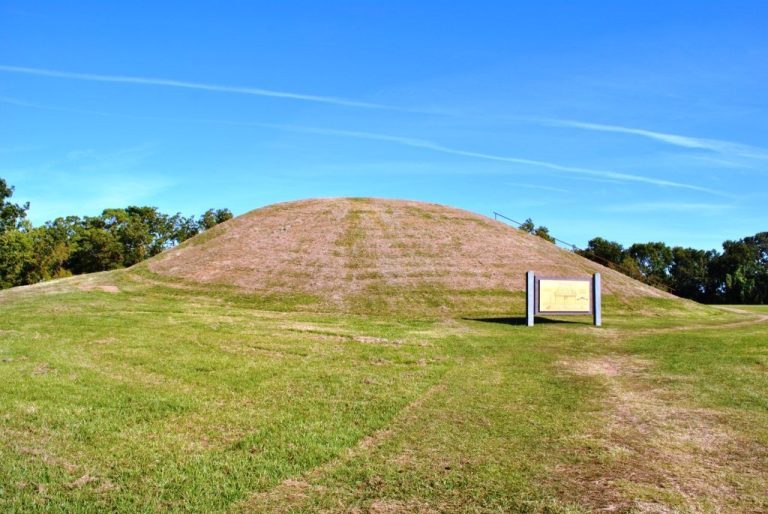
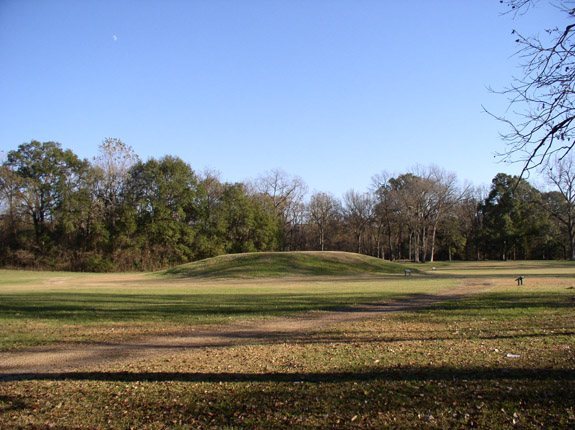
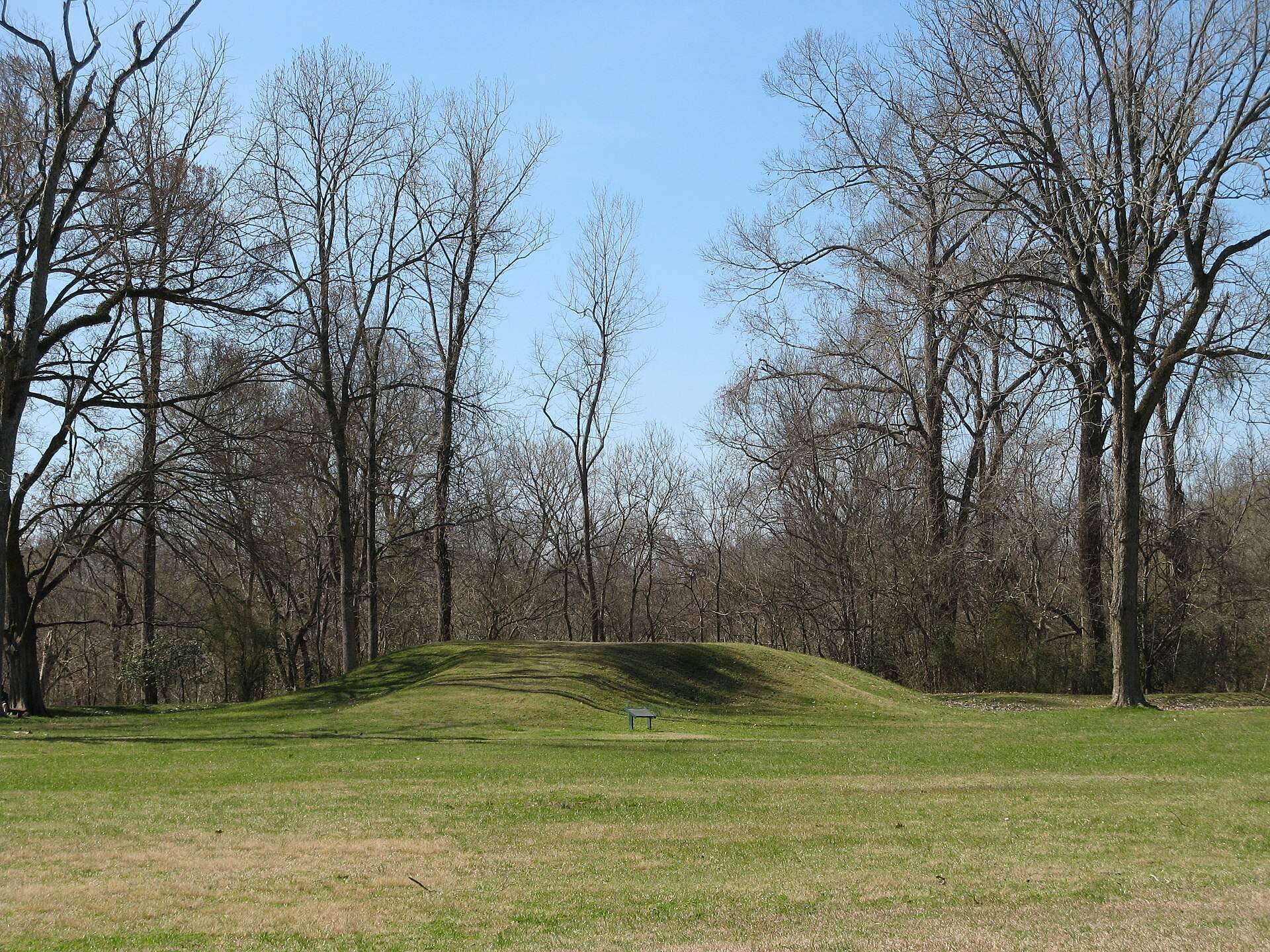
The archaeological site covers approximately 128.1 acres, or about 52 hectares, and is organized around a prehistoric village complex with three platform mounds. A platform mound is an earthen monument with a level upper surface, commonly used for a residence, temple, or other important structure. The mounds were built by hand, probably with earth carried in woven baskets. Builders used different soils to strengthen and stabilize the earthworks. Loess, a fine wind-deposited sediment, partly covered the mounds, while St. Catherine’s Creek caused only slight erosion. The mound area has been partially restored.
Platform mounds
Abandoned Mound
Mound A is now called Abandoned Mound. It had fallen out of use by the period of European contact and forms one part of the three-mound ceremonial complex.
Sun Mound
Mound B, now known as Sun Mound, supported the residence of the Great Sun during the early 18th century. The mound has been excavated and reconstructed to its original dimensions.
Temple Mound
Mound C, now called Temple Mound, supported the Sun Temple and its charnel house. The mound has been excavated and reconstructed to its original dimensions. The temple served as a major religious building, while the charnel house was associated with the treatment or storage of Natchez elite remains.
Archaeological collections and reconstructed features
The state-managed property includes a museum holding numerous artifacts excavated from the site. Its collections also include baskets made by area tribes and Native and European grave goods associated with Natchez elites. These materials provide archaeological evidence for the site’s ceremonial use and its connections with both Indigenous traditions and the colonial period.
A reconstructed Natchez house stands on the property, based on historical and archaeological evidence. The site also includes a picnic pavilion and nature trails within the managed archaeological landscape.