Wari Willka: A Wari and Huanca Sanctuary in Peru
Site at a Glance
- Rating
- 4.2
- Popularity
- Low
- Country
- Peru
- Primary era
- Medieval
- Eras represented
- Medieval
- Civilizations
- Inca, Wari
- Site type
- Religious
- Remains
- Sanctuary
On this page11 sections
History
Wari Willka is a pre-Hispanic archaeological sanctuary and administrative center in Huancan District, Peru’s Mantaro Valley, about 5 to 6 km south of Huancayo. It emerged under Wari influence during the Middle Horizon, an Andean period when the Wari state extended its power across much of the central Andes, and probably became a provincial center during the eighth century. Its principal construction belongs broadly to the period from about AD 800 to 1200.
Wari and Huanca periods
After the Wari state declined, Wari Willka became one of the main centers of the Huancas, an Andean people who formed a regional polity in the Mantaro Valley during the Late Intermediate Period. This era, conventionally dated to about AD 1000 to 1450, followed the weakening of Wari and Tiwanaku political influence and saw the rise of regional states. The name Wari Willka is generally explained through Quechua roots associated with antiquity and a sanctuary or shrine.
Huanca tradition later described the sanctuary as a pacarina, a sacred place of ancestral emergence. According to this tradition, the first Huanca couple originated there. The legendary man was Inapucarancápia, and the first woman was Uruchumbe. The sanctuary was dedicated to Huamani, a Huanca deity represented by a black stone idol set partly into the ground. Worshippers brought offerings and consulted the idol as an oracle, seeking divine guidance or predictions.
Inca and Spanish transformations
After the Inca conquest of the region, the Incas ordered the construction of a major temple dedicated to the Sun while permitting the older Wari Willka sanctuary to continue functioning. The complex was rebuilt using a combination of Inca and Huanca architectural traditions, preserving its local ritual importance within the new political order.
When the Spanish reached the Mantaro Valley in 1534, the priest Vicente de Valverde destroyed the Huamani idol, interpreting it through a Christian understanding as an image of the devil. The sanctuary was then abandoned and became overgrown. Pedro Cieza de León encountered it in that condition when he passed through the area around 1545. He was the first recorded writer to describe the sanctuary and its traditional connection with the origin of the Huanca people.
Sixteenth-century campaigns against indigenous idol worship formally closed the sanctuary, although local people continued to perform pre-Hispanic rituals there in secret. The spring retained ritual importance, and a later tradition held that an unfaithful partner who drank its water together with their spouse would die.
Rediscovery and continuing protection
Federico Gálvez Durán identified the site in 1931 and established a museum in the settlement of Huari. He also reported features related to Tiwanaku at Wari Willka and elsewhere in the Mantaro Valley. Isabel Flores Espinoza described the sanctuary in 1959 and published reproductions of its pottery, which showed clear connections between Tiwanaku and Wari artistic traditions.
Wari Willka is recognized as Cultural Heritage of the Nation and has an on-site museum. In 2023, its two surviving molle trees were individually recognized as heritage trees. In February 2026, local residents and the president of the Huari population center reported erosion of the rear walls by rainfall and called for maintenance and preventive conservation by the Ministry of Culture.
Remains
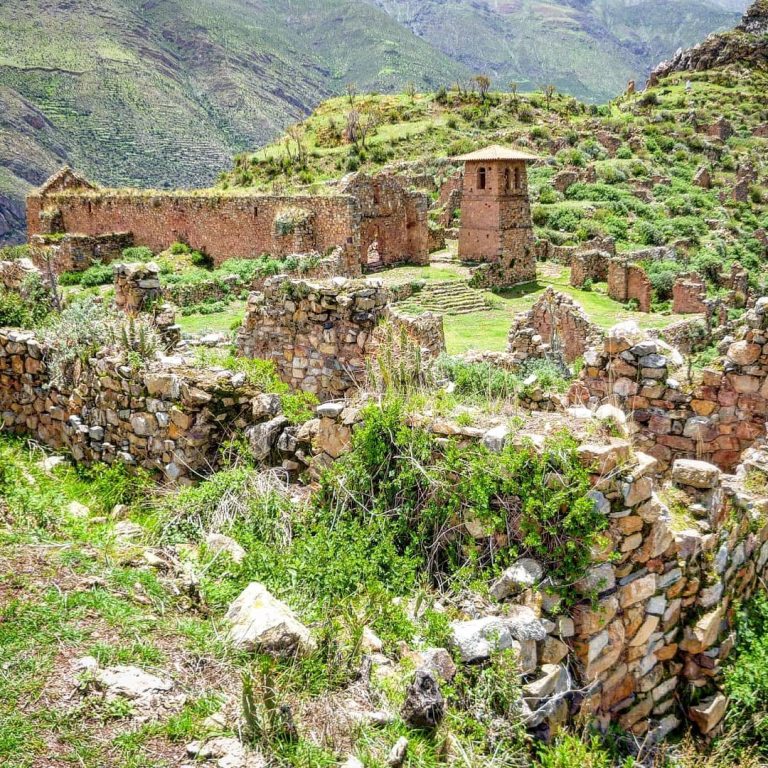
The surviving sanctuary has an irregular plan that tends toward a quadrilateral and appears to form only part of a much larger complex whose full extent remains undetermined. The remains extend from a plateau toward the bank of the Mantaro River. At the southern end, a substantial wall defines the complex, while the upper area forms a rectangular platform enclosed on its eastern and western sides by walls of similar construction.
Sanctuary walls and platform
Southern wall
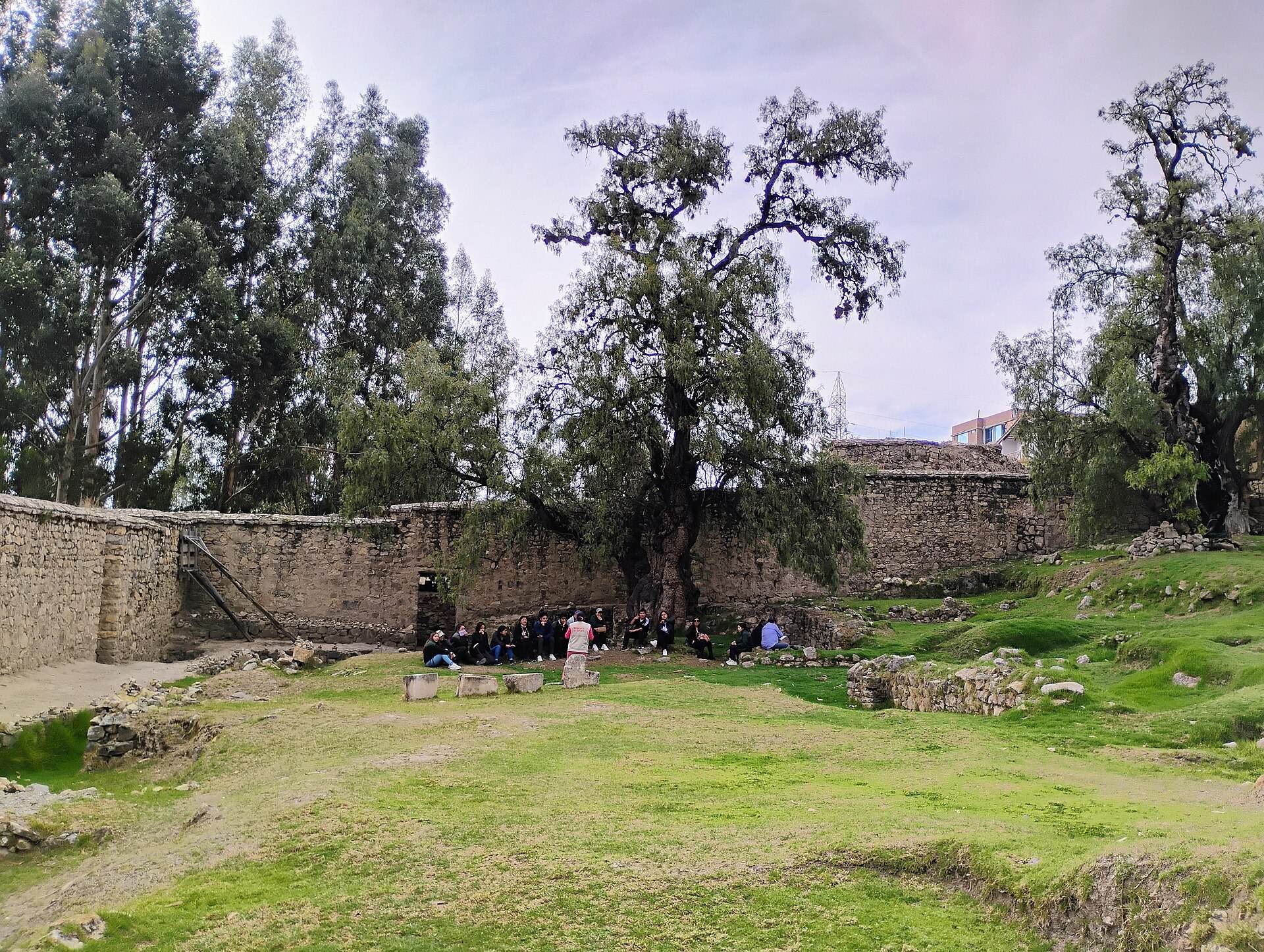
The southern wall measures approximately 46 m in length, about 5 m in thickness, and up to 5.30 m in height. Builders used dressed and irregular stones set in courses and bonded with mud mortar. Openings measuring about 0.30 m square appear in the lower section. Their depth is unknown, but they are thought to have provided access to an underground space.
Platform and cells
The rectangular platform in the upper part of the complex is bounded by eastern and western walls. These walls functioned as cells for people sacrificed to Huamani. A woman approximately 20 years old was found in this area, bound to a bird of prey. In 2009, archaeologists also found the remains of a child about eight years old beside bones that may have belonged to a baby llama or a dog. The discovery was made by the American archaeologist Steven Wirtz.
Pottery associated with the structures belongs to a clearly Huari style, linking the material remains to the artistic and political traditions of the Wari sphere. A purification pool was formerly located within the construction. A well-preserved stone staircase still runs beside the sanctuary and descends toward the spring on its southeastern side.
Sacred trees and spring
Molle trees
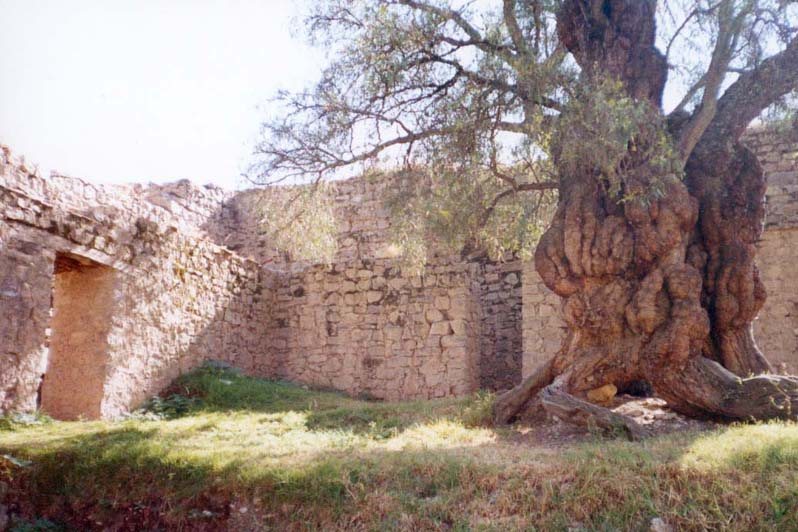
Two large molle trees, or Andean pepper trees known as Schinus molle, stand inside the sanctuary. The ancient Huancas regarded these trees as sacred, and the surviving specimens are at least 500 years old. Cieza de León described three or four sacred molles at Wari Willka. The two present trees are often identified with those he saw, although that identification remains uncertain.
One tree, known as the male molle, suffered serious fire damage at the beginning of 2011. A large branch was cut away to save it. The fire was thought to have resulted from candles or cigarettes left during ritual activities by Andean healers or shamans.
Sacred spring
The spring beside the southeastern side of the sanctuary was traditionally identified as the sacred water source, or pacarina, described by Cieza de León. It continues to supply water to residents of the Huari annex, retaining a practical role alongside its long-standing ritual associations.