Cangkuang: An Early Eighth-Century Shaivite Hindu Temple in West Java
Site at a Glance
- Rating
- 5
- Popularity
- Very Low
- Country
- Indonesia
- Primary era
- Medieval
- Eras represented
- Medieval, Early Modern
- Civilizations
- Unclassified
- Site type
- Religious
- Remains
- Temple
On this page9 sections
History
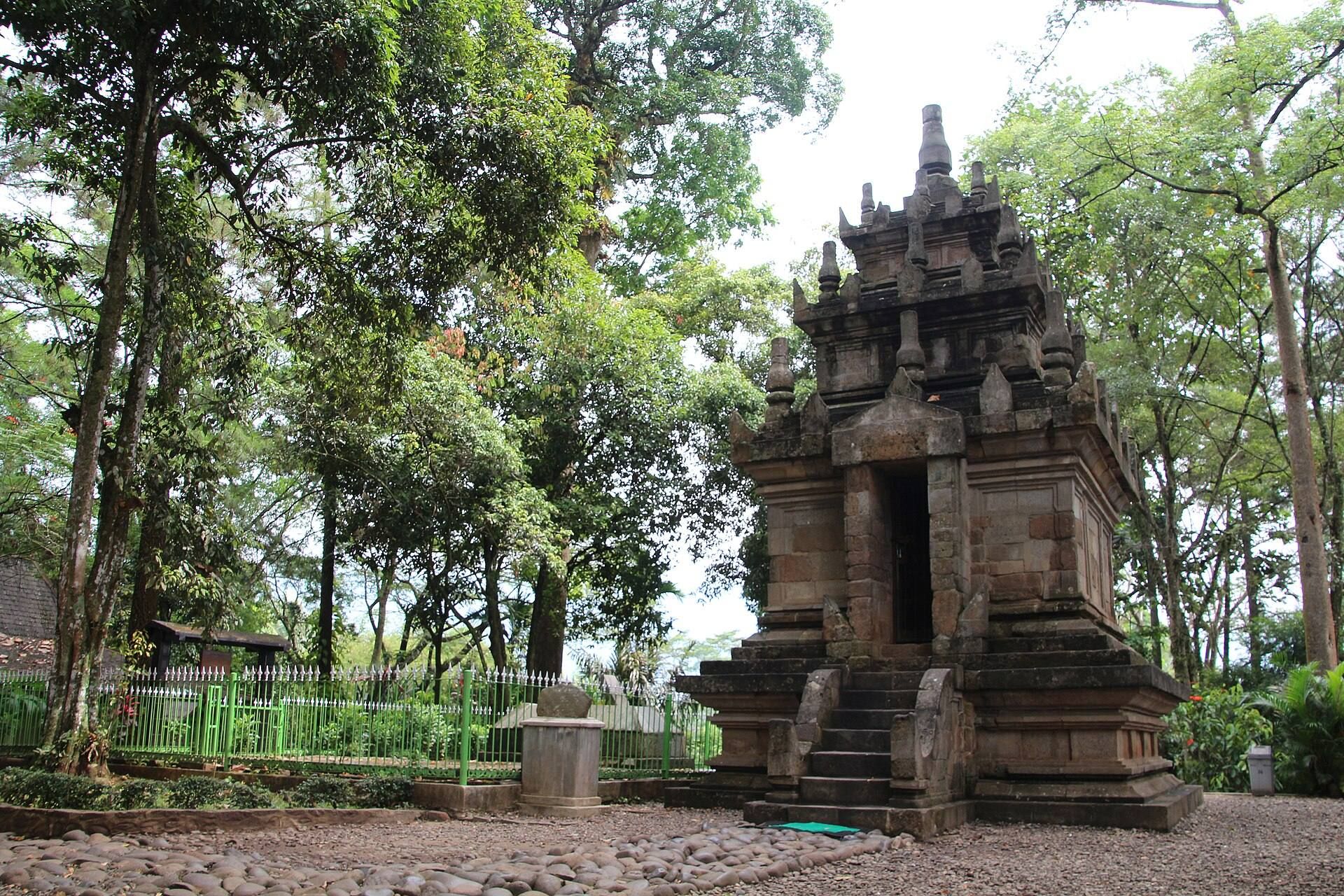
Cangkuang is a small Shaivite Hindu temple in Garut Regency, West Java, Indonesia, built in approximately the early eighth century in the early Central Javanese Hindu tradition. A candi, the Indonesian term for a Hindu or Buddhist temple or shrine, it is one of the very few Hindu-Buddhist temples found in West Java, the first discovered in the Tatar Sunda region, and the only surviving Hindu temple in Tatar Sunda.
Early Hindu Foundation
The temple’s date is inferred from the weathering of its stone and the simplicity of its design. It is considered roughly contemporary with the temples of Dieng and slightly earlier than monuments such as Prambanan in southern Central Java. Its association with Shiva places it within Shaivite worship, a Hindu tradition centered on Shiva, a major Hindu deity.
The name Cangkuang comes from the Sundanese name for Pandanus furcatus, a pandan species growing around the temple and Kampung Pulo. Its leaves can be made into hats, mats, and wrappers.
Discovery and Reconstruction
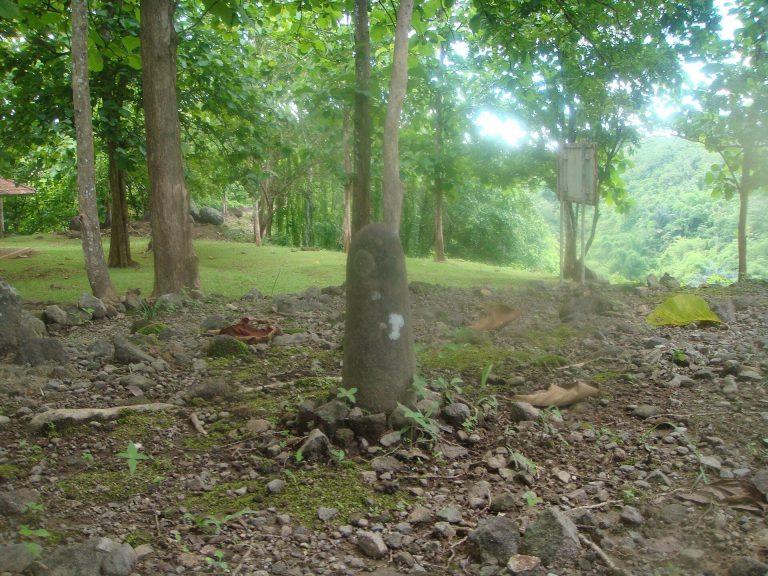
In 1893, Vorderman reported a damaged statue and an ancient tomb on Kampung Pulo hill. A research team led by Harsoyo and Uka Tjandrasasmita identified the site in 1966 and found the tomb, a Shiva statue, scattered andesite blocks from a ruined temple, knife fragments, and large stones thought possibly to belong to the megalithic period.
Excavations continued in 1967 and 1968, including an investigation of the tomb associated with Arief Muhammad. The temple was restored during 1974 and 1975, reconstructed in 1976, and formally inaugurated in 1978. This work was intended in part to fill a historical gap between the era of Purnawarman, an early ruler associated with the Tarumanagara kingdom in western Java, and the later Pajajaran period of Sundanese history.
About three metres south of the temple stands the ancient Islamic tomb of Embah Dalem Arief Muhammad. It is associated with elders who lived in the village during the Islamization of the Sundanese region in the seventeenth century. Local residents regard Arief Muhammad as an ancestor of Kampung Pulo. The temple, tomb, traditional settlement, island, lake, and surrounding land form a cultural and archaeological sanctuary.
Remains
Island Setting
Cangkuang occupies a small, elongated island of approximately 16.5 hectares in Situ Cangkuang, a lake. The island lies in a fertile valley about 600 metres above sea level, surrounded by the mountains and hills of the Garut region, including Mount Haruman, Mount Kaledong, Mount Mandalawangi, Mount Guntur, Mount Malang, Pasir Kadaleman, and Pasir Gadung.
The island was originally surrounded entirely by water. Its southern part has since been reclaimed and converted into paddy fields, while water remains mainly to the north. A traditional Sundanese Kampung Pulo settlement lies nearby on the island, placing the temple within a landscape that also preserves later religious and community history.
Temple Structure
Exterior Form
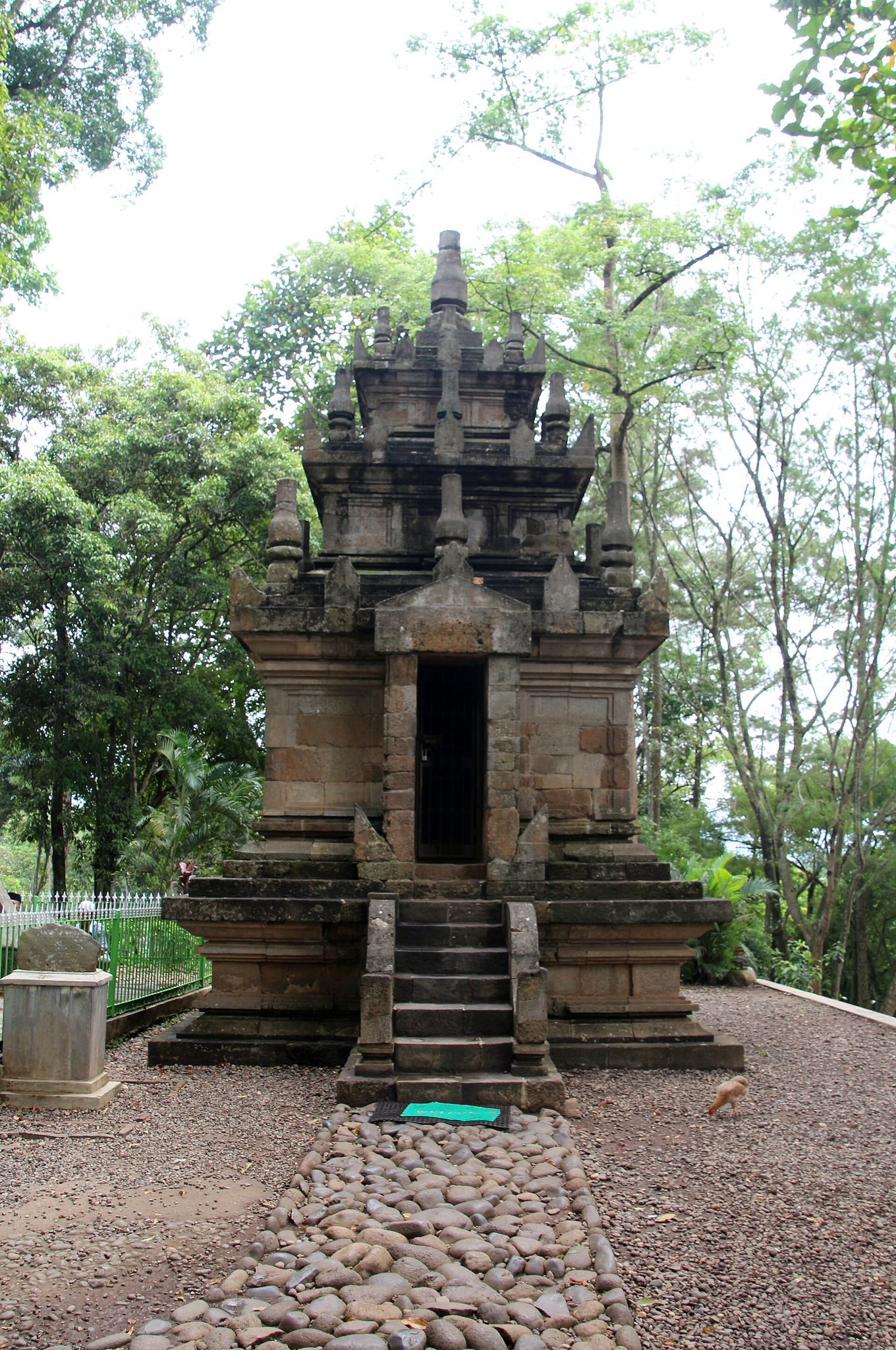
The temple is built of andesite stone and stands on a square platform measuring 4.7 by 4.7 metres and 30 centimetres high. Its principal base measures 4.5 by 4.5 metres, while the temple foot rises 1.37 metres and includes mouldings described as padma, kumuda, and pasagi. The complete structure is approximately 8.5 metres high.
Cangkuang faces east. An eastern entrance projection with steps measures 1.5 metres long and 1.26 metres wide. The square temple body measures 4.22 by 4.22 metres and 2.49 metres high, with a recorded doorway 1.56 metres high and 0.6 metres wide. Above it are two square levels, measuring 3.8 by 3.8 metres and 1.56 metres high, and 2.74 by 2.74 metres and 1.1 metres high. The roof has three receding tiers decorated with lingam-shaped pinnacles. A lingam is an abstract Hindu symbol associated with Shiva, commonly shown as an upright form.
Inner Sanctum and Shiva Statue
The small inner sanctum measures 2.18 by 2.24 metres and is 2.55 metres high. A square depression at its base measures 0.4 by 0.4 metres and is recorded as 7 metres deep. The chamber contains a stone statue of Shiva 62 centimetres high.
The statue is seated cross-legged on a double lotus pedestal and has a separate base beneath the right foot. Its ornaments remain visible on the abdomen, chest, and ears, while both hands are broken away and the face is heavily eroded. A carving of Nandi’s head appears on the pedestal. Nandi, commonly represented as a bull, is traditionally associated with Shiva and helps identify the figure. The statue is also described as dating to the 1800s.
The temple is architecturally simple and has little ornamentation. Its design resembles early Central Javanese Hindu temples, although its original appearance cannot be established with certainty because much of the original building material is missing. Only about 40 percent of the original temple stones were recovered. The reconstruction therefore used surviving stone for approximately 40 percent of the building and cement mortar, coral stone, sand, and iron for the remainder.
Associated Structures
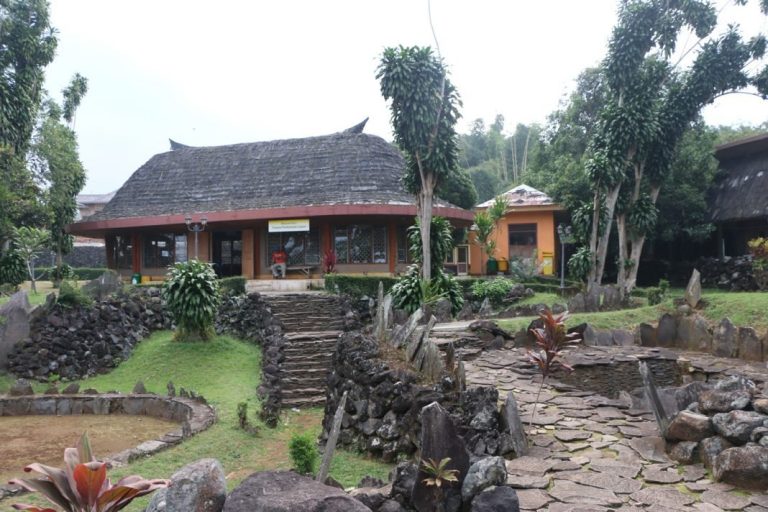
A joglo-style museum was constructed to store and inventory historical objects from Garut Regency. A joglo is a traditional Javanese and Sundanese roof form with a raised, tiered structure. Nearby, the tomb of Embah Dalem Arief Muhammad provides a physical reminder of the later Islamic history connected with the island and Kampung Pulo.