Nanwu Monastery: A Tibetan Buddhist Monastic Complex in Kangding
Site at a Glance
- Rating
- 4.9
- Popularity
- Very Low
- Country
- China
- Primary era
- Medieval
- Eras represented
- Medieval
- Civilizations
- Tibetan
- Site type
- Religious
- Remains
- Monastery
On this page8 sections
History
Nanwu Monastery is a Tibetan Buddhist monastery in Kangding, Sichuan, China, in the historical Tibetan region of Kham. It follows the Gelug school, a major Tibetan Buddhist tradition known for monastic scholarship and disciplined education, and was formerly associated with the Kagyu tradition, which places strong emphasis on meditation and teacher-to-disciple transmission. A foundation date of 750 is associated with the monastery, whose traditional architecture and religious history developed through several distinct phases.
Early foundations and changing identities
The monastery is also known as Namosi or Lhamotse. Its early history is connected with Paoma Temple, also called Paomashan, which is associated with the eleventh century. A temple building within the Paoma complex is dated to 867 and was known as Namutze. Lhamotse is also said to have been founded in 1127 by a lama whose name is not preserved here in a usable Latin-script form. These names and dates reflect the successive religious sites and identities connected with the monastery’s development.
The original Lhamotse site was regarded as the summit or principal place among eight sacred Lhamo sites in the Kangding area. The monastery was later moved to a position on the right side of a hill in Gangchu Valley, a location now also associated with the name Gendun Ri. Its institutional connections changed over time. It was formerly linked to the Kagyu tradition and later became affiliated with the Gelug school. The monastery’s monastic college traditionally sent monks mainly to Drepung, one of the major Gelug monastic universities of Tibetan Buddhism.
Qing-period destruction and rebuilding
Paoma Temple was burned during the reign of the Shunzhi Emperor, a Qing ruler. The monastery was rebuilt in 1677 through the patronage of the Kangxi Emperor and the Fifth Dalai Lama. The Kangxi Emperor was also involved in its restoration, while the Qianlong Emperor later presented it with an inscribed plaque. The Fifth Dalai Lama was the seventeenth-century Tibetan religious and political leader whose period saw the expansion of Gelug influence across much of Tibet.
Elders associate the later conversion of many monasteries around Kangding from the Kagyu tradition to the Gelug tradition with the period of the Fifth Dalai Lama. Nanwu Monastery formed part of this changing religious landscape. Several generations of abbots and eminent incarnate lamas, Tibetan Buddhist teachers regarded as the rebirths of earlier spiritual masters, are associated with the monastery. These figures, including the Tenth Panchen Lama, are said to have contributed sacred supports, ritual objects, and musical instruments.
Revival and religious life
Nanwu Monastery underwent a religious revival from 1982 onward through the efforts of Darje Rinpoche, an incarnate lama who is its principal present-day head. During this period, the interior and exterior of the complex were developed. The monastery has more than 30 monks, and another recorded figure places its monastic community at about 80. Its religious life continues through a broad annual cycle of ceremonies, retreats, teachings, and monthly assemblies.
The yearly cycle begins in the first month with a Lhamo life-ransom offering and an eight-day Great Prayer Festival. A Miyowa practice takes place in the third month. From the first to the sixteenth day of the fourth month, the monastery holds an eight-part Nyungne retreat in the Palmo tradition, a strict practice of fasting and devotional observance. A summer retreat runs from the fifteenth day of the sixth month to the first day of the eighth month.
Further observances include a seven-day Kunrig practice in the ninth month and a seven-day practice devoted to the thirteen-deity Vajrabhairava in the tenth month. Vajrabhairava is a major tantric Buddhist deity and meditation practice. The tenth-month cycle also includes a tsog offering on the fifth day, a communal tantric offering ritual. In the eleventh month, the monastery holds a seven-day great winter fulfillment offering. A major winter religious teaching assembly has also taken place at the monastery.
Remains
Complex and setting
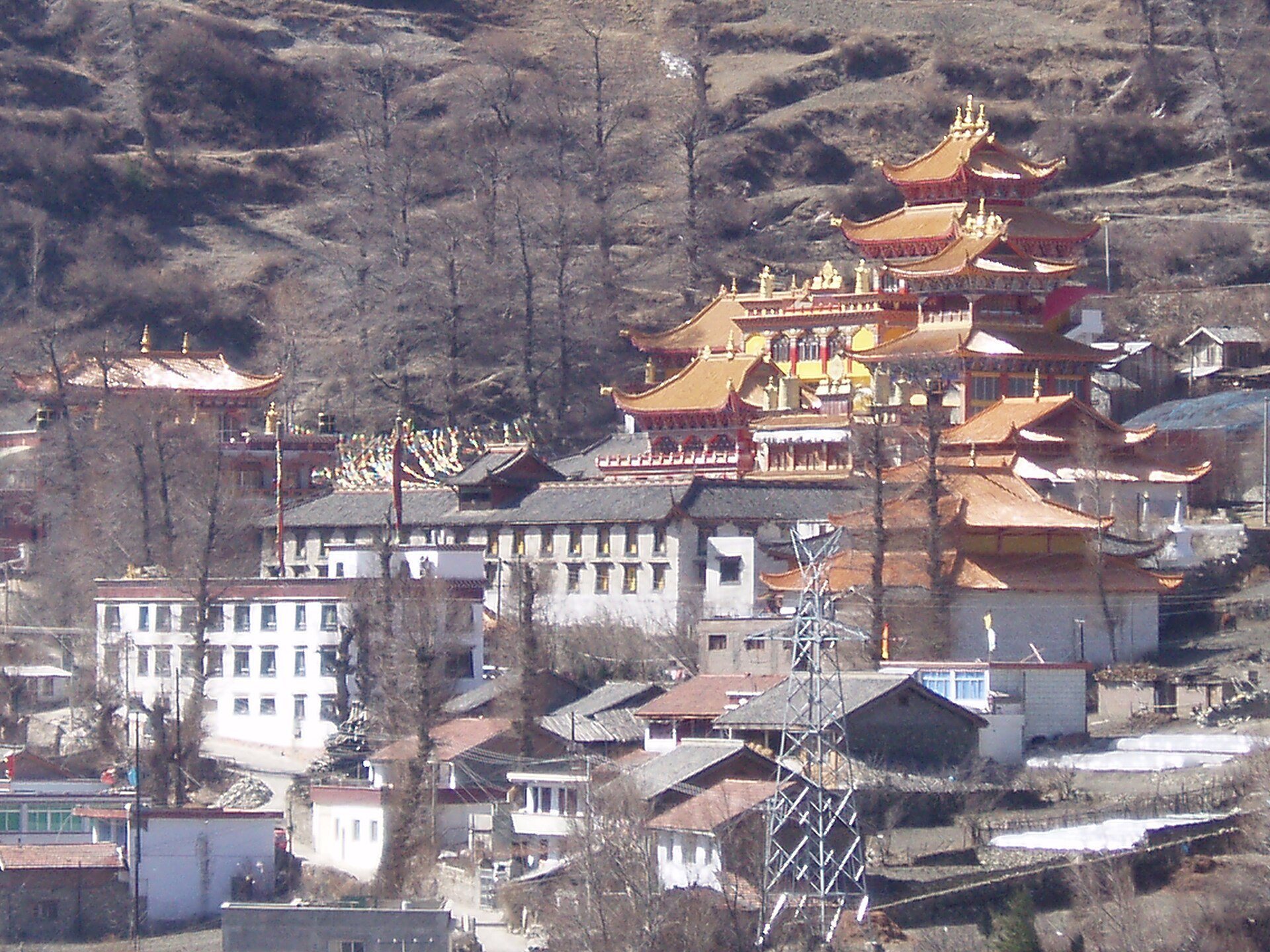
Nanwu Monastery is a traditional Tibetan Buddhist architectural complex near Kangding. It is described as west of the town and as approximately 2.5 kilometers south of Kangding’s center. The present site occupies the right side of a hill within Gangchu Valley and is associated with Gendun Ri. The complex includes a main temple, an assembly hall, a prayer-wheel hall, monks’ residences, and shrine halls belonging to different Buddhist schools. Its buildings form a connected religious center shaped by the monastery’s successive history and by development carried out from 1982 onward.
Sacred buildings and ritual furnishings
The monastery contains numerous sacred supports for body, speech, and mind, including several thousand gilded statues. Multiple stupas stand among its religious furnishings, together with ritual vessels and implements, musical instruments, and complete sets of offering and ceremonial utensils. These objects support the monastery’s continuing liturgical life and reflect the contributions associated with its abbots, incarnate lamas, and other religious figures.
Scriptures and religious collections
Nanwu Monastery preserves several sets of the Kangyur, the Tibetan Buddhist collection of texts regarded as the Buddha’s teachings, and several sets of the Tengyur, a related body of Indian and Tibetan commentaries and treatises. Its holdings also include the collected works of numerous lamas. Together with the statues, stupas, ritual equipment, and musical instruments, these scriptures and works constitute the monastery’s religious resources within the traditional architecture of Kham.