Bled Castle: A Historic Fortress and Castle Complex in Slovenia




Site at a Glance
- Rating
- 4.4
- Popularity
- Very High
- Country
- Slovenia
- Primary era
- Medieval
- External website
- Open
- Eras represented
- Medieval, Early Modern
- Civilizations
- Habsburg, Holy Roman Empire
- Site type
- Military
- Remains
- Castle
On this page17 sections
History
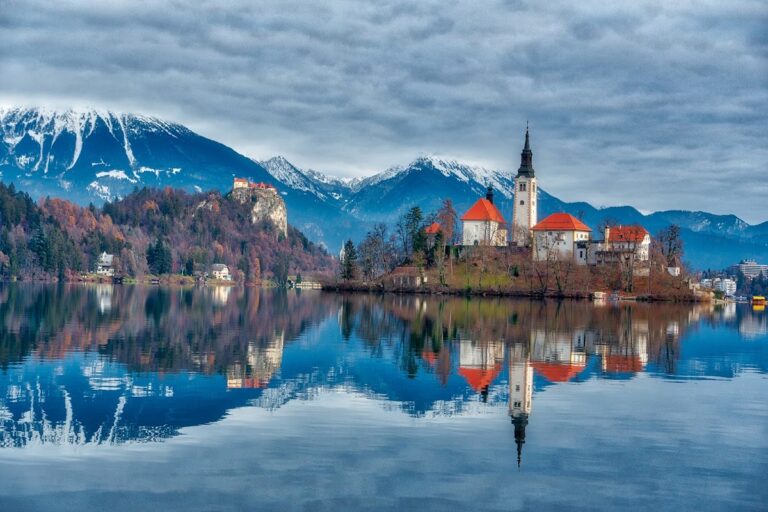
Bled Castle is a historic fortress and castle complex in Slovenia, standing beside Bled on a steep cliff above Lake Bled. Its earliest fortified installation was a Roman-style tower, while the medieval castle developed around it; a castle was present by 1004 and was first recorded in 1011 as castellum Veldes. The surviving complex incorporates Romanesque, Gothic, Renaissance, and Baroque elements.
Early grants and the Bishopric of Brixen
The cliff was settled before the introduction of Christianity. In 1004, the German king and later Holy Roman Emperor Henry II granted the Bled estate to Bishop Albuin of Brixen. A second grant in 1011 transferred the estate, including the castle and 30 royal farms, to the Bishopric of Brixen and Bishop Adalberon. The bishopric was an ecclesiastical principality whose bishops exercised both religious and territorial authority.
The Bishopric of Brixen retained the Bled estate for roughly 800 years. Its bishops rarely visited and did not reside at the castle, leaving administration and defence to local ministerials and castellans. Ministerials were medieval officials serving a lord, while castellans managed and defended castles on their lord’s behalf. The estate was later leased to local and regional holders, initially in large part to support its administration and the interests of local nobles.
Habsburg rule, leasing, and religious change
From 1278, Carniola, including Bled, came under Habsburg political rule. The Bishopric of Brixen continued to hold the estate, apart from the period of French rule, and leasing remained an important part of its administration. Konrad von Kreigh and his family held the estate from 1368 to 1558, almost 200 years, while their relatives, the Turn family, were also involved in its administration.
In 1515, peasants from Bled joined the wider Slovenian peasant revolt, which arose from restrictions on peasant rights and harsh treatment by leaseholders. An earthquake in 1511 and damage during the revolt affected the castle. Konrad von Kreigh’s successor Herbard Auersperg paid for repairs, partly because he intended to purchase the castle for his family.
Auersperg took over the lease in 1558 and, as a prominent supporter of Protestantism, helped make Bled a Protestant stronghold. Primož Trubar, the leading figure of the Slovene Reformation and author of the first book printed in Slovene, visited Bled in June 1561. Auersperg was forced to leave in 1574 and surrendered the lease to the Catholic nobleman Ivan Josip Lenkovič.
Later ecclesiastical administration
After 1597, the Bishops of Brixen temporarily appointed castellans directly. From 1615, the principal leaseholders included Prince Janez Eggenberg, Adam Pipian, Karel Weidmann, Engelbert Volf Auersperg, Janez Petschacher, Wilhelm Baltasar von Loewenfeldt, the Gallenfels barons, Anton Ignacij von Loewenegg, Janez Toman, Baron Indermauer, Franc Florijan Chrobath, Jožef Štefančič, and Ignac Novak. The leases and appointments changed repeatedly between 1615 and 1804. Castellans were generally nobles until the mid-eighteenth century, when townsmen and members of the middle class increasingly took their place.
A major earthquake in 1690 caused further damage. Repairs were carried out under the Gallenfels family, who were among the leaseholders of the estate during this period. The castle therefore continued to be altered and maintained while remaining within the long ecclesiastical administration of Brixen.
Nationalization and private ownership
Following the French takeover, the Bled estate was nationalized in 1803. During the Illyrian Provinces, territories administered by Napoleonic France from 1809 to 1813, it belonged to the French state, while its revenues were enjoyed by Governor-General Marshal Auguste Marmont. The Bishopric of Brixen recovered the confiscated property in 1838.
In 1858, the bishopric and cathedral chapter sold the Bled estate and the island provostship to Viktor Ruard, an industrial entrepreneur who owned the Jesenice ironworks. Ruard sold the extensive forests to the Carniolan Industrial Company in 1871 but retained the castle, the lake, and building land around the lake. The property passed to the merchant Adolf Muhr in 1882.
Hotel owner Ivan Kenda bought the castle, lake, and island in 1918, making the castle part of Slovenian-owned property for the first time. His plan to create a hotel failed, and debts led the Cooperative Economic Bank to seize the castle in 1937 and transfer it to a new owner. It subsequently passed to the Drava Banovina. After the dissolution of Austria-Hungary, the castle was associated with the Karageorgevich dynasty, the royal house that ruled the Kingdom of Yugoslavia, and it was later used as a summer residence by Josip Broz Tito, the communist leader of Yugoslavia.
War, restoration, and present status
During the Second World War, occupying German forces used Bled Castle as a military headquarters. After the war, it became state property. A fire in 1947 destroyed almost all of the roof and part of the upper-floor rooms, prompting archaeological excavations and a major restoration campaign.
From 1951 to 1961, the National Museum in Ljubljana directed restoration under the architect Tone Bitenc, a pupil of Jože Plečnik. Damaged sections were rebuilt and the complex was adapted for modern use. In 2008, the Bled Institute of Culture restored the historic interiors and the part of the castle containing the museum. Slovenia proclaimed Bled Castle an immovable monument of national importance on 6 October 1999. It is state-owned and administered by the Bled Institute of Culture, functioning as a museum and cultural site as well as a former fortress and castle complex.
Remains
Courtyards and defensive structure
Bled Castle occupies the summit of a steep rocky outcrop approximately 130 metres above Lake Bled. Its buildings form two courtyards arranged in levels. The lower courtyard was the service and economic area, while the upper courtyard was more strongly fortified and contained the residential zone. A staircase at the centre of a Baroque wing links the two parts.
Entrance and curtain wall
The approach to the castle leads along a cobbled route to a wooden drawbridge. The bridge controls access across the former defensive gap and reaches the two-level courtyard area. The later fortification system includes a sixteenth-century curtain wall, a defensive wall connecting towers. Cylindrical and square-plan towers reinforce it, while defensive openings and covered wall walks provide protected passages along the fortifications. The towers are built of stone and carry ornamental, conical red-tiled roofs. The walls are white and described as Romanesque in style, while the complex as a whole displays predominantly Renaissance characteristics.
Lower courtyard and well
The lower courtyard contains a fountain and was formerly bordered by staff accommodation, service buildings, and other economic structures. A 12-metre-deep well was cut into the rock inside the former guard building of the lower castle. The moat that once formed part of the medieval defensive arrangement was later covered and is no longer visible.
Upper castle and chapel
Residential wings
The upper fortified section contained rooms reserved for the lords. The residential buildings in this part date from the eighteenth century and occupy the upper courtyard alongside the chapel. Their surviving arrangement reflects the division between the castle’s administrative and service functions below and its residential and defensive functions above.
Chapel of Saints Albuin and Ingenuin
The upper courtyard contains a small late-Gothic chapel built in the sixteenth century and dedicated to Bishops Saint Albuin and Saint Ingenuin. After the earthquake of 1690, the chapel was enlarged and restored. Early Baroque altars and Baroque paintings were added, and frescoes showing Emperor Henry II and his wife Kunigund were placed beside the altar.
Museum and cultural features
Castle museum
Part of the former residential area houses the castle museum. Its displays present the historical development of the region around Lake Bled from the Bronze Age to the present, together with the results of restoration and archaeological work. The furnishings on display are not from Bled Castle itself, but illustrate domestic culture during the periods through which the castle passed.
More than 400 objects are exhibited, including sixteenth- to eighteenth-century weapons, knightly armour, jewellery, period furniture, household objects, tiled stoves formerly used for heating, historical clothing shown on figures, and archaeological finds. Some of the displayed objects are not original. A working wooden replica of a Gutenberg-period printing press is also displayed in operation.
Wine cellar, gardens, and memorial room
The castle includes an old wine cellar, a herb garden, and a medicinal-herb gallery. A memorial room commemorates Johann Augustin Pucher and the Swiss physician Arnold Rikli. It contains the bath Rikli used to treat patients and presents his therapeutic work at Bled, including the development of the settlement as a health resort.
Terrace
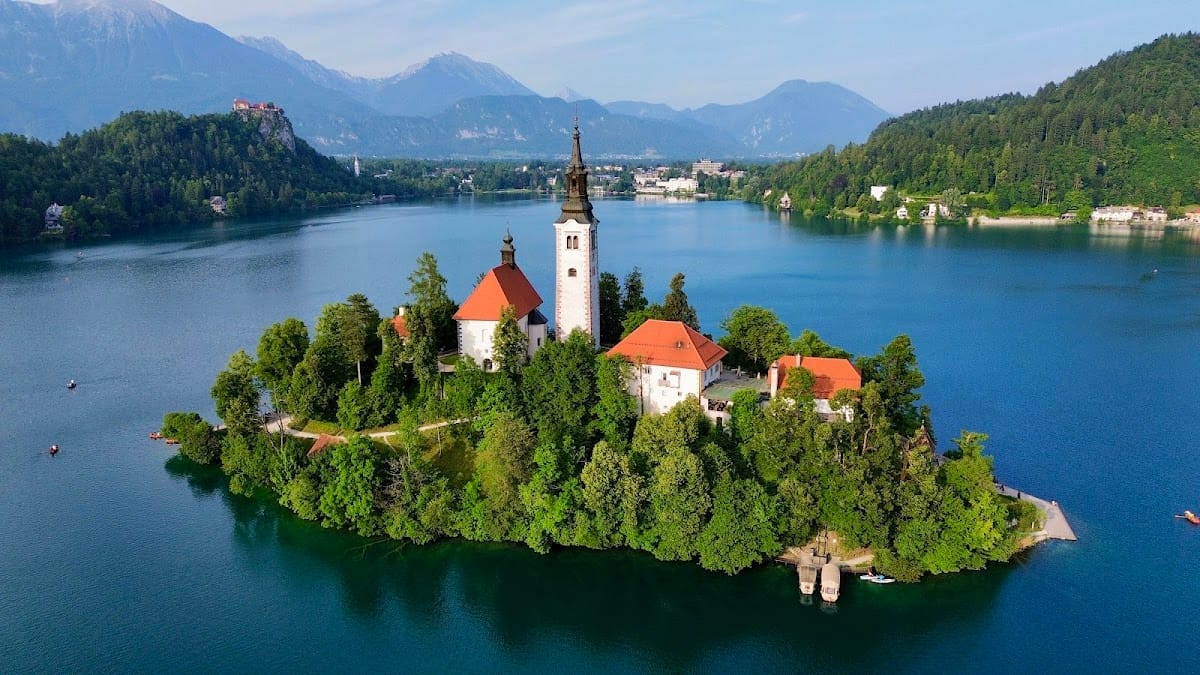
A terrace extends from the castle complex with views over Lake Bled, the island and its church, and the surrounding mountains and vegetation. In clear weather, the summit of Triglav can be seen from the upper castle.