Whitewater Shaker Settlement: An Ohio Shaker Community and Historic District
Site at a Glance
- Rating
- 4.9
- Popularity
- Very Low
- Country
- United States
- Primary era
- Modern
- External website
- Open
- Eras represented
- Modern
- Civilizations
- Unclassified
- Site type
- Religious
On this page8 sections
History
Founding and expansion
Whitewater Shaker Settlement, also known as White Water Shaker Village, is a former Shaker communal settlement in Harrison, Ohio, United States. It was established in 1824 by the Shakers, a Christian communal movement formally known as the United Society of Believers in Christ’s Second Appearing, and remained active until 1916. Shaker communities combined shared property, celibacy, religious worship, and agricultural and craft production.
A small group in southern Butler County began gathering as Shakers in 1822, or possibly earlier. In 1823, members of three prominent Butler County families joined them, and the unnamed community moved to a larger farm. Union Village trustees purchased Whitewater’s first land in 1824, while the Union Village ministry provided greater spiritual and material support. The early convert Miriam Agnew encouraged this assistance.
Whitewater also received members from Darby Plain, an abandoned Shaker settlement in central Ohio. Nathan Burlingame, formerly a New Light and Farnhamite preacher, was the first member of that group to arrive. The original land was forested and poorly suited to farming, so the Shakers purchased 215 acres of better land at a mill site on the Dry Fork of the Whitewater River in 1825. The community moved there, forming the North Family, and brethren from Union Village arrived in 1826 to help establish it.
The dissolution of West Union in 1827 brought more members to Whitewater. By 1835, the settlement had 42 females and 35 males, including children, despite recent defections. The community later added land and created a third family in the 1850s. After Millerites, also called Second Adventists, joined in 1846, Whitewater reached its greatest size. Millerites followed William Miller, a preacher who predicted the date of Christ’s Second Coming. After the prediction failed in 1844, Whitewater Shakers persuaded some followers that the Second Coming had already taken place in a spiritual sense.
Work, conflict, and decline
At its peak, Whitewater controlled 706 acres in Hamilton County and 190 acres in Butler County. About 200 Believers lived in two families and worked the large farm and its industries. The community operated a grist mill and sawmill, and it may also have operated a brewery. Members raised broom corn, made brooms, sold packaged garden seeds, and maintained apple orchards for applesauce and cider. Other products included sorghum molasses, honey, preserved currants, grapes, and strawberries. Silkworms supplied material for shawls, scarves, and handkerchiefs. In the settlement’s final years, members raised fish in two ponds and sold turkey eggs.
During the Civil War, Morgan’s Raiders passed through Whitewater in April 1863. A mill worker warned the community, enabling the Shakers to hide most of their horses. The raiders took only two, although Union cavalry arrived the following day and also seized horses.
Whitewater remained vigorous into the 1880s, then entered a long, gradual decline. After about three decades of decline and a change in leadership, the Union Village ministry leased the South, Center, and North Family farms in 1911. The remaining Shakers lived in the Office until the farms were sold. The final land sale occurred on December 4, 1916. Elder Andrew Barrett left for Hancock, the Shaker community near Pittsfield, Massachusetts, while Eldress Mary Gass went to Mount Lebanon, New York.
The South and Center farms continued in agricultural use. The North Family land was later divided, and its brick Meeting House and Dwelling House passed to separate owners. During its 94-year existence, the community owned a total of 2,764 acres, including 1,128 acres in Hamilton County, 664 acres in Butler County, and 972 acres in Clinton County.
Preservation
Whitewater Shaker Settlement was listed as a historic district on the U.S. National Register of Historic Places in 1974. The listed area covers 384 acres. In 1991, the Great Parks of Hamilton County District purchased much of the remaining land and buildings. In 2007, the Friends of White Water Shaker Village took control of the North Family’s eight acres and ten historic buildings through a long-term lease with the park district, beginning restoration and preservation work.
Remains
Families and surviving structures
The settlement developed as three separate communal units, the North, Center, and South Families. Together, the surviving buildings and agricultural structures form the largest collection of Shaker buildings in Ohio and one of the most intact Shaker village groups. The Great Parks of Hamilton County District owns 23 original structures built or used by the Shakers. A cemetery lies between the South and Center Families, and Crosby Township is responsible for its upkeep.
North Family
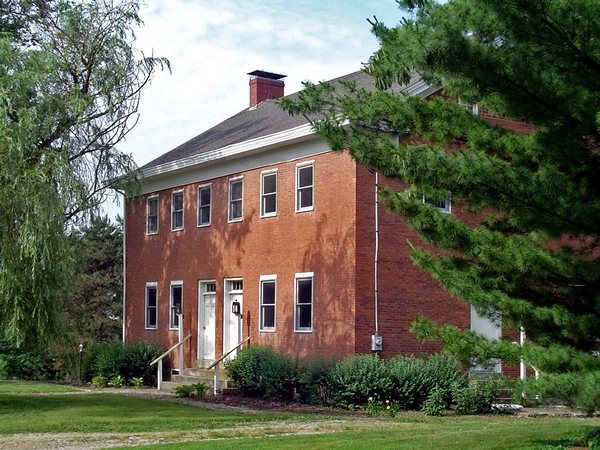
The North Family complex contains the 1827 Meeting House, a two-story brick building described as the only surviving brick Shaker meetinghouse. The complex also includes the Dwelling House, dated to 1832–1833, together with a smokehouse, woodshed, and seed house. Ten historic buildings stand on the eight acres held by the Friends of White Water Shaker Village under their long-term lease.
Center and South Families
On the east side of Oxford Road, the Center Family includes a brick Trustee’s Office bearing an 1855 date stone, a washhouse, and a broom shop. Other surviving elements of the settlement include a brick shop, a frame broom shop, numerous barns, and other farm outbuildings associated with agricultural and craft production. Two ponds made by the Shakers for fish raising also survive as part of the settlement’s later agricultural landscape.