Sechin Bajo: A Casma/Sechin Ceremonial and Administrative Center in Peru
Site at a Glance
- Rating
- 4.5
- Popularity
- Very Low
- Country
- Peru
- Primary era
- Bronze Age
- Eras represented
- Bronze Age
- Civilizations
- Unclassified
- Site type
- City
On this page9 sections
History
Sechin Bajo is a Casma/Sechin ceremonial and administrative center in Cam. Viejo, Peru, whose principal development belongs to the Late Preceramic period, before pottery became widespread. Its earliest known monumental construction dates to around 3500 BCE. The settlement stood on the right bank of the Sechin River, near its junction with the Casma River and about 12 km from the Pacific Ocean. It formed part of a concentration of important sites that also included Sechin Alto, Cerro Sechin, and Taukachi-Konkan.
Early settlement and monumental construction
The Casma and Sechin valleys were probably occupied by a stable or semi-sedentary population from around 4500 BCE, while evidence places human occupation in the wider Casma Valley before 6000 BCE. The date when agriculture became the population’s principal means of subsistence remains uncertain. Sechin Bajo’s early monumental architecture nevertheless challenges explanations that place marine resources at the center of the emergence of the earliest Peruvian civilizations.
The ceremonial center developed through three principal construction moments. The first, around 3500 BCE, included a sunken circular plaza. A later phase added larger buildings beside the earliest construction, while a third phase beginning around 1600 BCE produced a substantially larger monumental complex. The scale of the works, the use of cut stone, and the labor required for construction point to organized government and administration as well as ceremonial activity.
Excavations led by Peter R. Fuchs from the 1990s brought renewed attention to the site. In 2008, his German-Peruvian team announced the discovery and dating of the sunken circular plaza, supported by twenty-five radiocarbon tests. Radiocarbon dating estimates the age of organic material associated with an archaeological context, and calibrated dates account for changes in atmospheric carbon levels.
Later development and abandonment
The Second and Third Buildings were constructed over the First Building between approximately 1600 and 1200 BCE. Their orientation toward Cerro Sechin, about 2 km away across the Sechin Valley, has been interpreted as possible evidence of cooperation or subordination between the communities associated with the two sites. The spatial relationship is clear, but its precise political meaning remains uncertain.
Sechin Bajo was abandoned as a monumental center around 1000 BCE. The buildings were subsequently used as a cemetery until approximately the fifteenth century CE. Sheila and Thomas Pozorski proposed that Sechin Bajo and other Casma/Sechin centers were conquered around 1000 BCE by highland invaders. In this interpretation, the newcomers introduced maize, domesticated animals, warlike imagery, and different ceramic and architectural styles. The proposed conquest remains an interpretation rather than an established conclusion.
The site’s early dates have also been discussed in relation to the Norte Chico, or Caral-Supe, tradition, an early civilization of central coastal Peru known for large ceremonial settlements and monumental architecture. Huaricanga and the Sacred City of Caral-Supe are among the sites considered in this broader comparison. If further investigation confirms Sechin Bajo’s earliest dates, it could be regarded as the oldest known monumental-construction site in the Americas and a candidate for the oldest urban settlement in the Americas. Sechin Bajo is recognized as Peru’s Cultural Heritage of the Nation.
Remains
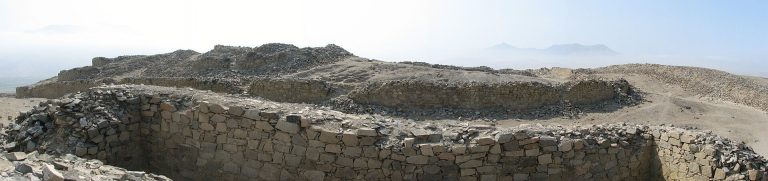
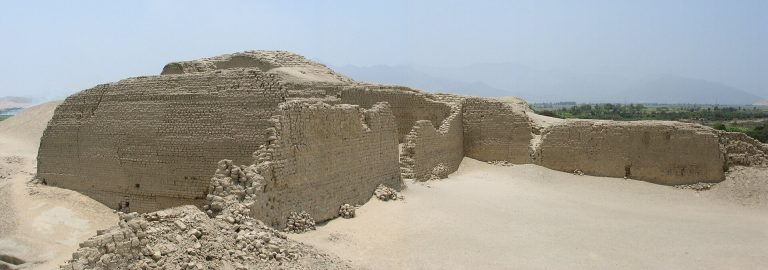
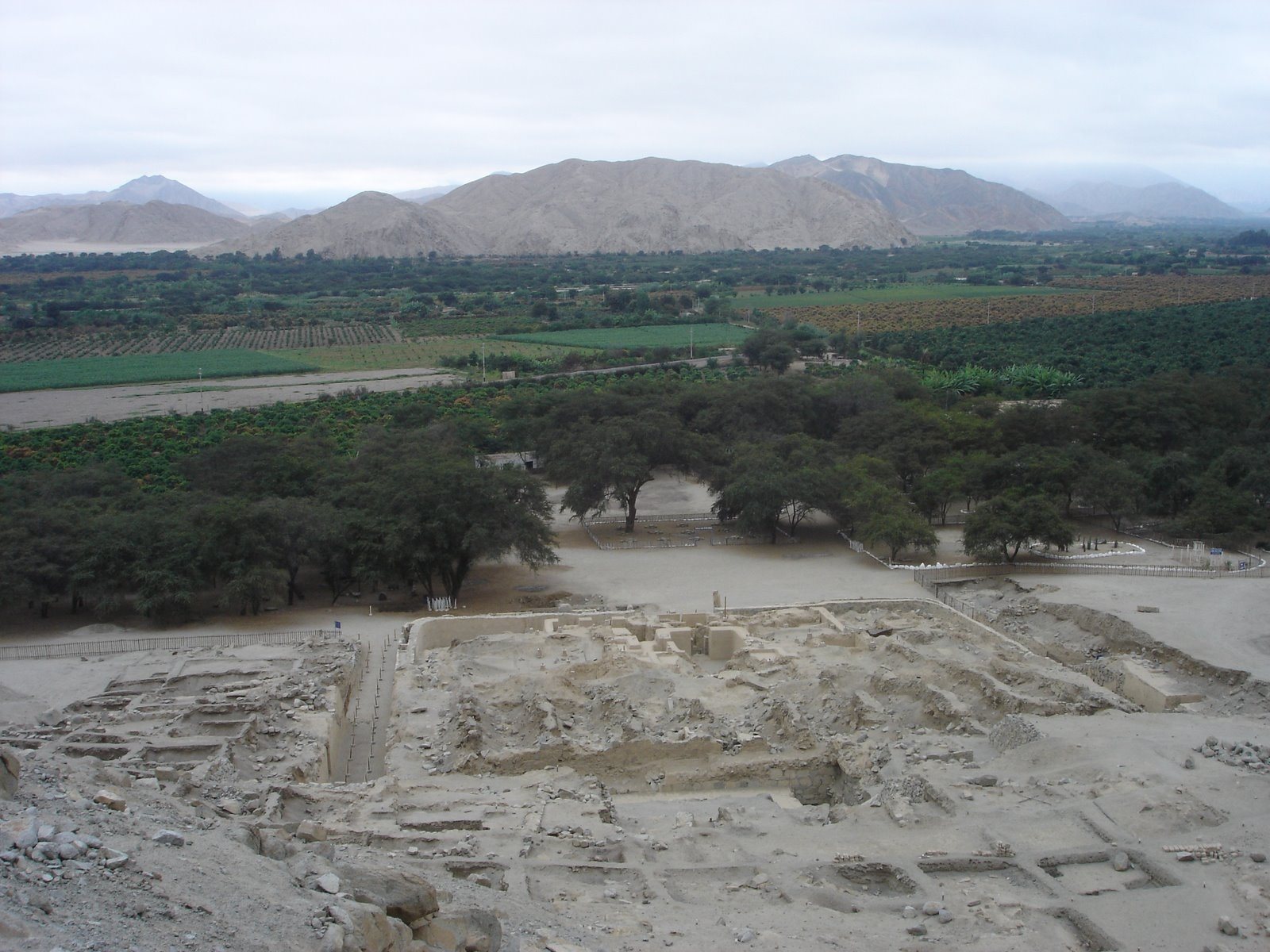
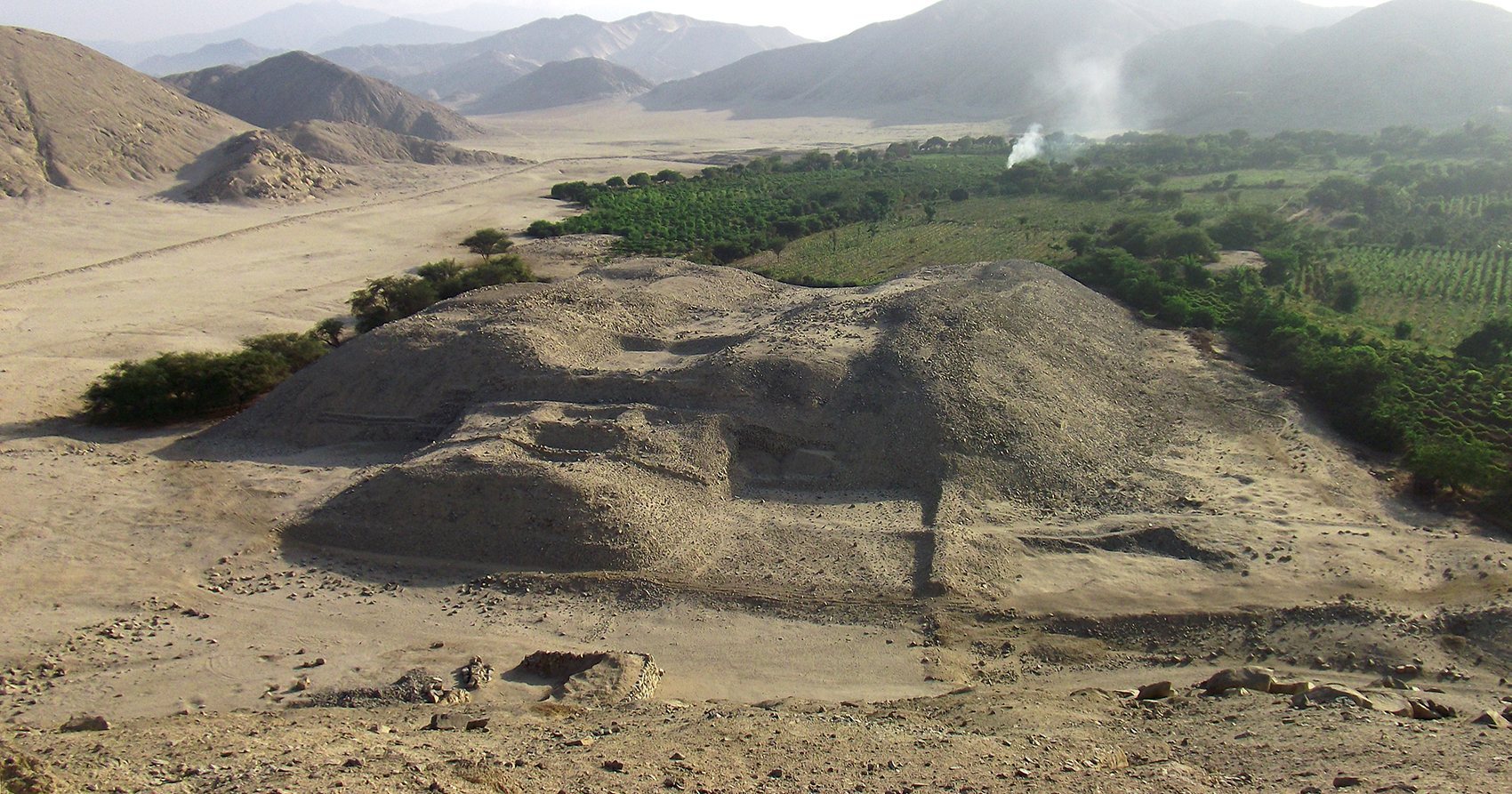
The archaeological complex covers about 37 hectares and lies at approximately 150 m above sea level, in a desert setting beyond the edge of the irrigated Sechin River valley. One description gives the complex a length of about 1,500 m. Its buildings were made chiefly from cut stone brought from nearby hills, together with adobe bricks, a sun-dried earth material formed into blocks. The surviving remains represent three monumental constructions developed over successive periods, with later burial use affecting the former ceremonial center.
Early sunken-plaza complex
First Building
The First Building began as a platform measuring about 16 m square. Built from stone and adobe brick, it rose approximately 2 m above sunken circular plazas. The design was retained through later rebuilding, and the building underwent five reconstructions in which the plazas and stairways were repeatedly constructed, filled, and rebuilt. Calibrated radiocarbon dates for the building range from approximately 3700 to 2900 BCE.
The oldest sunken circular plaza measures about 10 to 12 m across. Its walls were made from rocks and rectangular adobe bricks, and its construction dates to around 3500 BCE. A nearby adobe frieze, a decorative band projecting from a wall, is approximately 2 m high and dates to around 3600 BCE. It portrays a man holding an object in each hand, interpreted as a ritual knife or ceremonial staff in one hand and a human head or shield in the other.
Later monumental buildings
Second Building
The Second Building was raised over the earlier complex during the later development of Sechin Bajo, between approximately 1600 and 1200 BCE. It formed part of the expanded ceremonial center and faced Cerro Sechin across the valley. Its construction used the same broad combination of worked stone and adobe found elsewhere in the complex.
Third Building
The Third Building was the most monumental of the three principal constructions. It included public squares and private spaces, along with numerous walls decorated with relief carvings. A structure associated with this phase measured approximately 180 m by 120 m. During its first phase, it contained two large rectangular courtyards. These were later divided into four courtyards with curved corners and walls containing niches.
A later adobe frieze in the complex shows a man with feline teeth in high relief. He holds a ceremonial knife in his right hand and a serpent in his left. This imagery has been described as the earliest representation of the “decapitator” iconography later disseminated by the Chavín tradition, whose religious imagery included powerful human and animal-associated figures with weapons, serpents, and severed heads.