Bezeklik Thousand Buddha Caves: A Buddhist Cave Complex in Xinjiang
Site at a Glance
- Rating
- 4.1
- Popularity
- Low
- Country
- China
- Primary era
- Medieval
- Eras represented
- Medieval
- Civilizations
- Tang
- Site type
- Religious
- Remains
- Monastery
On this page20 sections
History
The Bezeklik Thousand Buddha Caves are a Buddhist cave complex in the Mutou Valley of the Flaming Mountains near Gaochang in Turpan, Xinjiang, China. The complex was created through successive phases of Buddhist construction from the fifth or sixth century onward and formed part of the Gaochang grottoes. During the Tang administration of Xizhou, it was known as Ningrong Temple or Ningrong Grotto Temple, and under the medieval Kingdom of Qocho it became a major royal Buddhist centre.
The Qu-family Gaochang period
The earliest caves were probably excavated while the Qu family ruled Gaochang, before the Tang administration of Xizhou. The exact beginning is not directly recorded, but a fragment of the Lotus Sutra dated to 559, radiocarbon dates from wooden architectural elements in the fifth or sixth centuries, and other archaeological evidence place the first phase in this period. One proposed date for the beginning of the complex is around 555.
Caves 9, 18, and 34 belong to this early phase. Caves 9 and 34 were later repaired and repainted, while Cave 18 retains the clearest surviving early murals. The first excavations established a religious complex whose caves were used for worship and related monastic purposes, providing the foundation for later expansion.
The Tang-Xizhou period
Construction and mural production reached an important peak after the Tang administration incorporated the region as Xizhou. Large painted scenes based on Buddhist scriptures became prominent, and the complex developed both central-pillar shrines and large rectangular caves with barrel-vaulted roofs.
A stele found among the ruins of Cave 80 records construction and repairs carried out between 786 and 790 by Yang Xigu, the Grand Protector of Beiting and military commissioner of the Yixi-Beiting region. The work included halls, a winter kitchen, corridors, caves, and grape planting below the cliffs. This inscription shows that the site was an active and organized religious institution with buildings and cultivated land beyond the painted cave interiors.
The Kingdom of Qocho
After the Uyghurs replaced the Tang administration, Bezeklik became a royal monastery of the Kingdom of Qocho, a medieval Uyghur state centred in the Turpan region. Royal and aristocratic patrons, together with their attendants, rebuilt existing spaces, altered earlier caves, and opened additional shrines. During the early Qocho period, religious practice still included Manichaeism, represented most clearly by the Tree of Life mural in Cave 38. Buddhism was soon adopted by the Uyghurs, and Buddhist construction and decoration expanded substantially.
Caves from the tenth and eleventh centuries include Caves 15, 20, and 31. Their decoration commonly presented episodes from the Buddha’s previous lives, Buddhist scriptural narratives, and combinations of sculpture and painting, including scenes of the Buddha’s nirvana. Caves 39, 40, and 42 belong to the twelfth and thirteenth centuries and emphasize seated and standing Buddhas, offering bodhisattvas, Thousand-Armed and Thousand-Eyed Avalokitesvara, and other scriptural narratives.
As Qocho declined, these later images increasingly expressed prayers for divine protection rather than the earlier aspiration of rulers to attain Buddhahood after death. In the early thirteenth century, Tibetan Buddhism became influential in Turpan. Bezeklik then acquired donor portraits in Mongolian clothing and stupas made in Tibetan styles.
Decline and abandonment
At the end of the thirteenth century, the ruling Idikut family moved eastward toward the Yongchang area of Gansu. Bezeklik subsequently became a locally used monastery outside royal patronage and gradually declined. The spread of Islam through Turpan contributed to the progressive abandonment and deterioration of the Buddhist monasteries.
Exploration and conservation
Investigations began to intensify from the late nineteenth century. Russian, German, British, Japanese, French, and Chinese investigators documented the caves, assigned numbers, excavated remains, and removed or collected murals and other objects. Many paintings were taken from their original locations and are now dispersed among museums in Germany, Russia, India, Britain, Japan, Korea, and China.
The Russian ethnographer Dmitry Klementz investigated Bezeklik among roughly 130 grottoes in the Turpan region during the late nineteenth century and removed murals to Russia. Albert Grünwedel led the first German Turfan expedition at Bezeklik from November 1902 to March 1903 without removing murals. A second German expedition, led by Albert von Le Coq from November 1904 to December 1905, removed large quantities of murals, manuscripts, sculptures, and stone carvings. More than half of the murals later displayed in Berlin were destroyed during air raids in the Second World War. Fragments that survived are held partly in Berlin’s Museum of Asian Art.
Marc Aurel Stein began investigating Bezeklik in November 1914 during his third Central Asian expedition. By February 1915, he had removed more than 140 crates of murals and other objects from Bezeklik and nearby sites. Much of this material is now in the National Museum in New Delhi and the British Museum. The Japanese Otani expedition excavated 47 caves in 1908 and recovered Buddhist sculpture fragments, silk paintings, a fragmentary Diamond Sutra inscription, and Uyghur manuscript fragments. It also removed eight large murals and many smaller fragments. Koichiro Yoshikawa investigated the site twice in 1912 and removed further murals and Uyghur manuscripts. Material from Japanese collections was later dispersed among the Tokyo National Museum, the National Museum of Korea, the Lushun Museum, and the Ryukoku Museum. In November 1931, Joseph Hackin photographed Caves 1, 3, 6, 7, and 19.
Huang Wenbi investigated Bezeklik in 1928 as a member of the Sino-Swedish Northwest Scientific Expedition. By then, many murals had been removed by foreign expeditions, while much of the remaining decoration had also been damaged. Chinese archaeological and conservation work expanded after the 1950s. A 1961 survey measured and numbered 57 caves, and work from the late 1970s to the early 1980s cleared damaged caves and identified additional ones, bringing the numbering system to 83 caves. Twenty-first-century excavations during emergency cliff-stabilization work exposed more than 50 remains, including nearly 20 caves, building sites, and stupas.
The State Council of the People’s Republic of China designated Bezeklik a Major National Historical and Cultural Site Protected by China in 1982. The complex has also suffered cliff collapses, wind erosion, earthquakes, salt damage, pressure from sand and rubble, biological deterioration, and the destruction and defacement of murals. During the 2010s, two emergency stabilization projects reinforced the cliffs and caves, treated fissures and weathering, removed dangerous rock, and reduced structural risk.
Remains
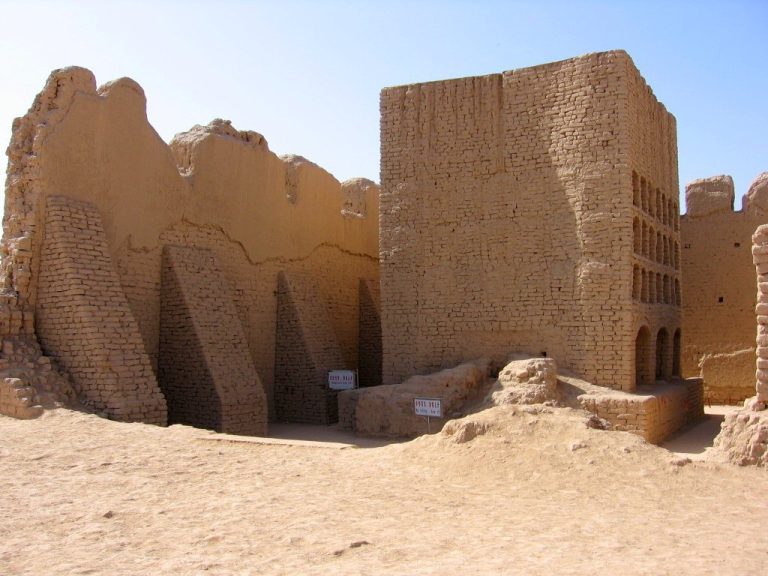
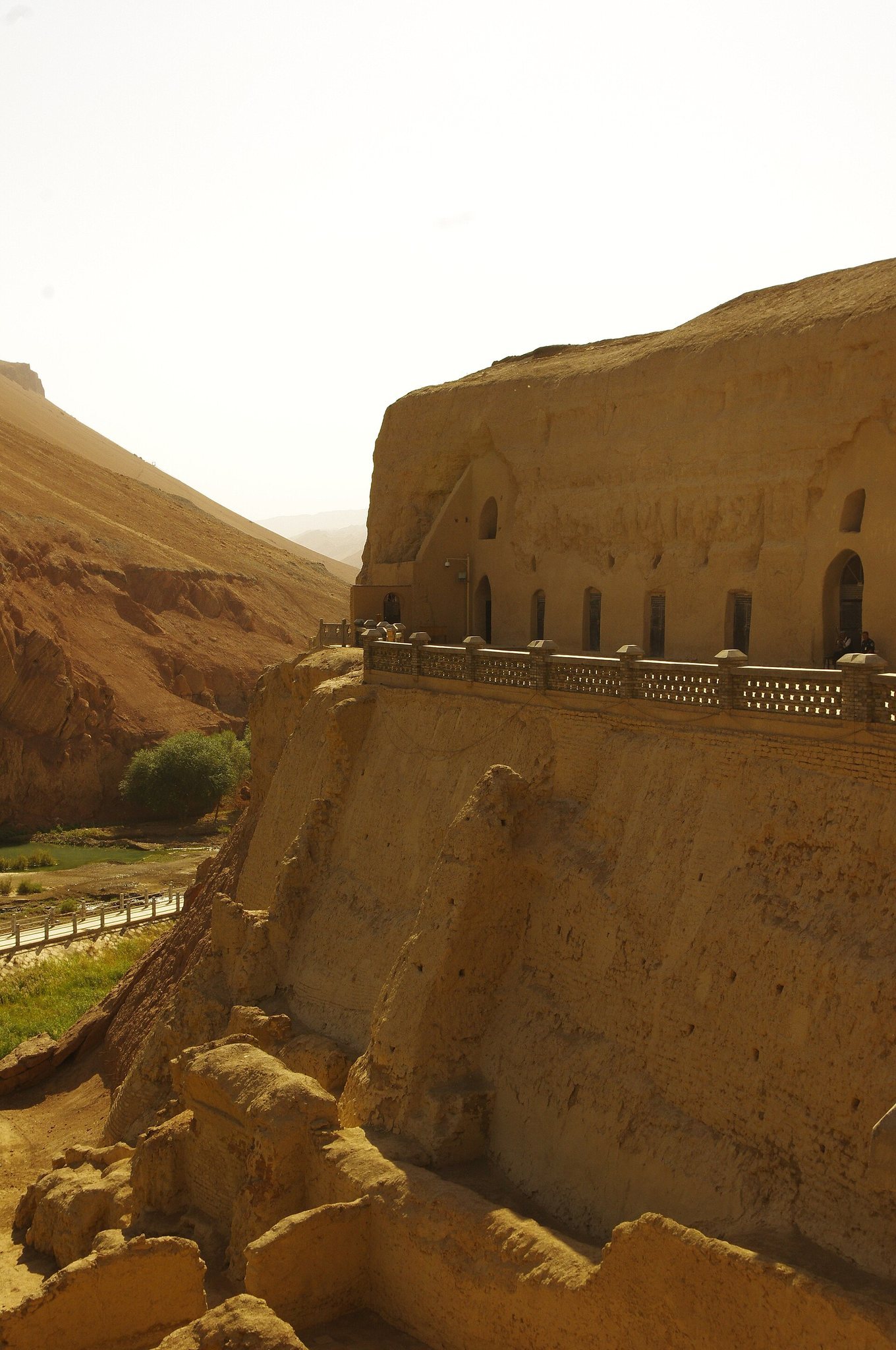
The caves occupy the western cliff of the Mutou Valley and extend mainly from north to south for more than one kilometre, at elevations of approximately 100 to 160 metres. The site is arranged on upper, middle, and lower levels linked by stairs. Stupas dominate the upper level, cave shrines occupy the middle level, and the lower level contains caves, halls, corridors, and living areas. The northern section contains Caves 1 to 7, the central and relatively regular section contains Caves 8 to 39, and the southern section contains Caves 40 to 57, where the cliff is more irregular and the caves are generally smaller. A stairway opposite Cave 27 descends to Caves 75 to 83.
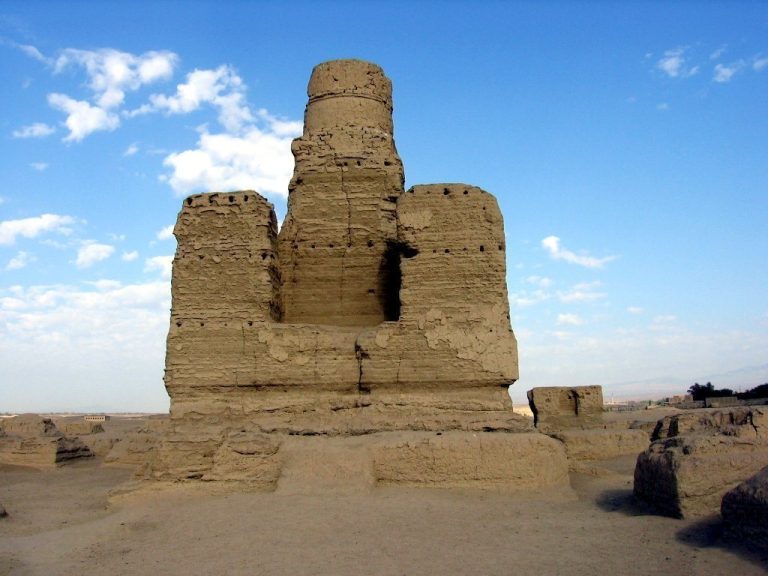
The complex now contains 83 numbered caves, although earlier Western and Chinese surveys used different systems and recorded fewer. The German system numbered 40 caves, Stein’s system 14, Huang Wenbi’s system 18, and the 1961 Chinese survey 57. More than 40 caves retain murals covering over 1,200 square metres. Three stupas remain on the cliff top, including a relatively well-preserved example at the southern end, and three more stand on the lower level.
Cave layout and construction
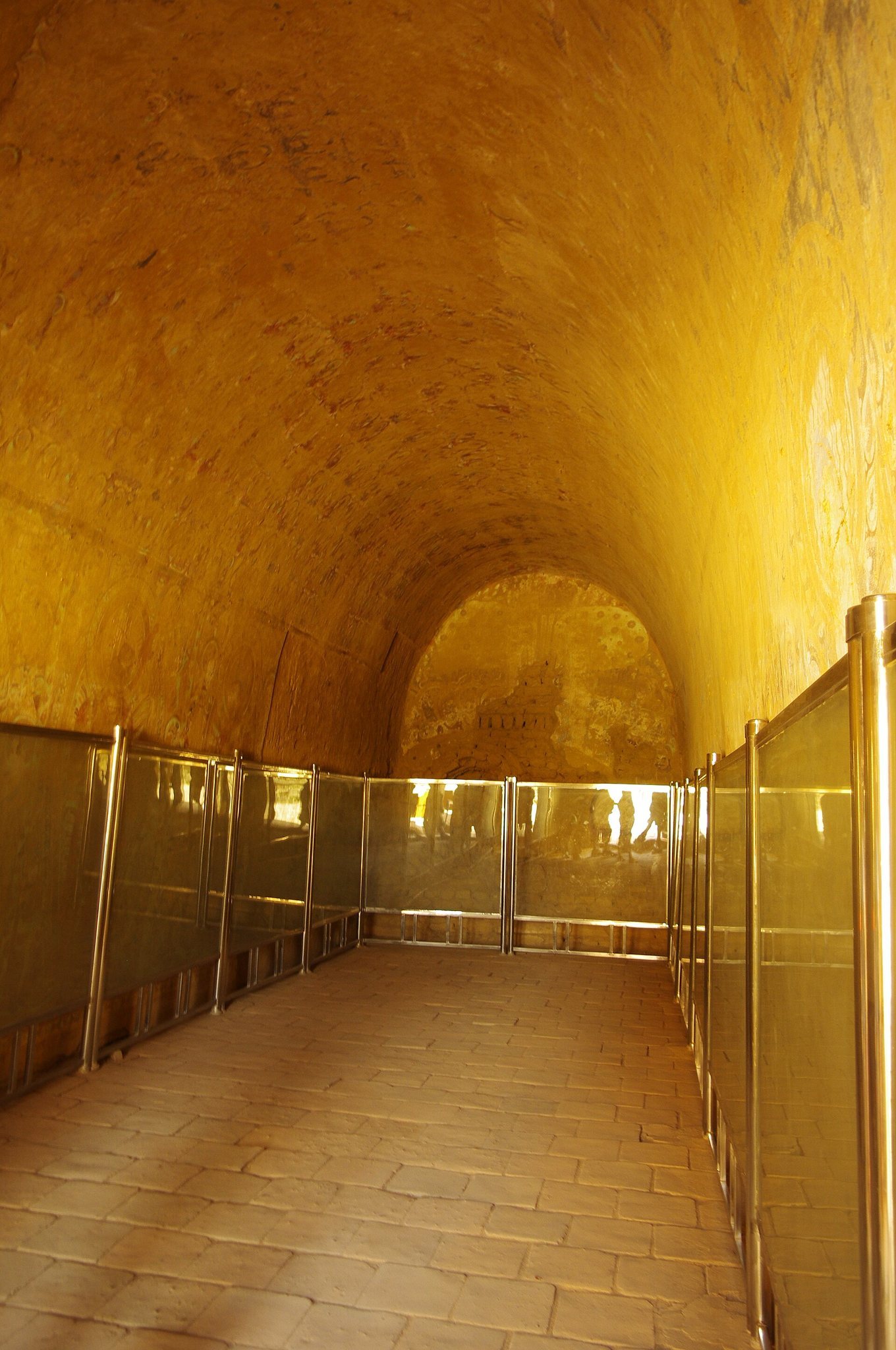
Most caves are single-room structures, while two have two rooms. Central-pillar caves, rectangular barrel-vaulted caves, and square domed caves form the principal types. Some were cut directly into the soft cliff. Others used mud-brick vaulting, buildings set in front of the cliff, or independent structures that functioned as cave shrines. The original front chambers have largely collapsed, while surviving spaces include main chambers, circumambulatory corridors, and rear chambers. These rooms served chiefly as worship halls, but also included meditation caves, living quarters, and memorial chambers associated with eminent monks.
The central caves have different orientations. Caves 8 to 26 face east, Caves 24 to 27 follow an eastward slope in the cliff, and Caves 30 to 39 face northeast. The former temple entrance lay in woodland on the western side of the Mutou Valley. The surviving murals combine Buddhist narrative scenes, scriptural transformations, Thousand Buddhas, donor figures, episodes from the Buddha’s life and previous lives, nirvana scenes, deities, musicians, animals, architecture, landscapes, and representations of daily life.
Early central-pillar caves
Cave 9
Cave 9, also known as German Cave 1, is an early central-pillar shrine first excavated during the Qu-family Gaochang period and later repaired and repainted. The original sculptures on the four sides of its central pillar were destroyed, leaving halos. On the front wall, the Buddha’s first turning of the wheel at Deer Park appears with three monk donors and three lay donors at the sides. Rows of Thousand Buddhas, seated Buddhas in stupas, donor figures, bodhisattvas, and Buddha bases fill the remaining decoration. Uyghur and Chinese captions accompany some images. Flame and scrolling foliage patterns survive, while the ceiling retains fragments of floral medallions and hanging-curtain designs.
Cave 18
Cave 18, or German Cave 8, is a large central-pillar cave from the Qu-family Gaochang period. It preserves the earliest mural content in the complex that can still be clearly seen, although much of its decoration was repaired and repainted during the Qocho period. The upper rear corridor and ceiling retain the only surviving early imitation of a wooden bracket-grid ceiling in the complex. Three nested square layers surround a central lotus, with green water motifs, floral or lotus-bud designs, and geometric borders. A Thousand Buddhas mural from the southern part of the right corridor is now in the National Museum of Korea.
Tenth- and eleventh-century shrines
Cave 15
Cave 15, or German Cave 4, is a tenth- or eleventh-century central-hall cave with a surrounding corridor. Its square hall has a rear platform for a Buddha, entrance steps, small side doors, and a circular domed roof built entirely of mud brick. The ceiling is painted in green, red, and white with floral medallions made from lotus and cloud motifs, flowing clouds, and hanging-curtain patterns. Great Compassion Avalokitesvara occupies the main hall, with images of Vaisravana. The corridors have longitudinal barrel vaults and scenes from the Sutra of the Collection of the Buddha’s Deeds.
The most complete surviving scene from this sutra is now in the Hermitage Museum. It measures approximately 1.25 by 2.15 metres and originally occupied the side wall of the rear corridor. Unlike paintings made directly on the cliff, the Cave 15 murals were painted on mud-brick walls.
Cave 20
Cave 20 is a large central-hall cave built against the cliff with mud-brick construction during the tenth or eleventh century. It has a front chamber, a square central hall, and surrounding corridors beneath a domed roof. Traces of a Buddha platform remain on the floor. The principal wall shows Great Compassion Avalokitesvara, flanked by scenes of Vaisravana travelling through a garden and crossing the sea with his retinue. Three rows of Uyghur donors appear beside the entrance.
Fifteen scenes from the Sutra of the Collection of the Buddha’s Deeds occupy the corridors, with captions in Brahmi and Sanskrit. Their compositions generally place a large standing Buddha at the centre, surrounded by deities, Vajrapani figures, monks, ascetics, Brahmins, foreigners, and merchants. Other walls show monk officials and senior monks with Chinese, Uyghur, or Brahmi captions. Sand buried the cave for a long period and helped preserve its murals, but most were removed by Le Coq and taken to Germany, where some were later destroyed during the Second World War.
Tang-Xizhou and later Qocho decoration
Cave 16
Cave 16, or German Cave 6, is a Tang-Xizhou-period rectangular cave with a longitudinal barrel vault. A platform remains at the centre of the floor, and a nirvana platform stands before the rear wall. The walls contain preaching scenes, flying figures, donor portraits, and a damaged nirvana transformation showing musicians with a pear-shaped lute, large drum, clappers, reed instruments, and flute.
Repeated preaching scenes fill the ceiling. Buddhas sit cross-legged on lotus seats and are accompanied by Sanskrit captions. Uyghur donor figures on the right wall stand on a yellow and red wave-patterned carpet and hold lotus branches. Their murals are now in Berlin’s Museum of Asian Art.
Cave 40
Cave 40, or German Cave 27, is a rectangular cave with a longitudinal barrel vault from the period of Qocho’s decline. Its main wall retains a Buddha’s halo and backlight beneath a canopy, together with traces of upper murals. Earlier investigators could still discern small bell-bearing demons, flying flower-scattering figures, and kneeling worshippers. A base approximately 70 centimetres high once stood in the cave and is now empty. Ten rows of Thousand Buddhas decorate the ceiling. The left wall is dominated by a badly damaged Avalokitesvara, while the right wall retains a recognizable transformation of Cintamani-cakra Avalokitesvara.
Murals and artistic techniques
Large donor and Buddhist narrative compositions known as pranidhi scenes depict vows or aspirations associated with the Buddha’s path to enlightenment. Bezeklik’s murals combine traditions linked with Tang China, later Chinese Buddhist painting, Gandharan linear technique, and the modelling effects of Kucha painting, producing a distinctive Uyghur style. Repeated layouts and themes became increasingly formalized, especially in scenes of the Buddha’s former lives.
The painting process generally began with a light-ink underdrawing, followed by colour and final outlining in vermilion using an iron-wire style. Ochre grounds and warm colours are common, while earlier works also make extensive use of mineral blue and green. Figures were given enlarged heads and feet and reduced waists and hands to compensate for visual distortion in the confined cave spaces.
Excavated manuscripts and objects
Excavations recovered sculptures, silk textiles, wooden architectural elements, and more than a thousand manuscript fragments. The corpus includes nearly 800 Chinese manuscripts, nearly 100 Uyghur manuscripts, more than 130 bilingual Chinese-Uyghur fragments, nearly 30 Brahmi fragments, and additional Sogdian and Tangut materials. These languages and scripts reflect the multilingual religious and cultural connections of the Turpan region.
The manuscripts include Buddhist scriptures from sutra, monastic-discipline, scholastic, and esoteric traditions, including fragments of the Maharatnakuta Sutra, Prajnaparamita Sutra, Avatamsaka Sutra, Nirvana Sutra, and Agama texts. Most represent Mahayana transmission, while some older manuscripts preserve texts associated with early Buddhist traditions. Manichaean and Daoist texts, together with smaller quantities of Confucian and historical writings, broaden the religious and intellectual range of the finds.
Cliff condition and stabilization
Vertical fissures in the cliff reach approximately 20 centimetres in width, and collapse has left some areas near the caves suspended. Gullies near Caves 1 to 8 reach up to two metres deep. In Cave 35, separation between preparatory plaster layers or between plaster and rock affected approximately 60 percent of the mural surface. In Cave 16, flaking of the paint layer affected nearly 24 square metres and was accompanied by extensive loss.
Conservation measures have used rock anchors, mud-brick infill, grouting of fissures, steel supports, surface consolidation against weathering, removal of unstable rock, and a reinforced-concrete walkway. These interventions were intended to stabilize the cliffs and caves and reduce further loss of the surviving structures and paintings.