Changu Narayan Temple: An Ancient Hindu Temple in Nepal
Site at a Glance
- Rating
- 4.7
- Popularity
- Low
- Country
- Nepal
- Primary era
- Classical
- Eras represented
- Classical, Medieval
- Civilizations
- Unclassified
- Site type
- Religious
- Remains
- Temple
On this page21 sections
History
Changu Narayan Temple is an ancient Hindu temple dedicated to Vishnu on the hill of Changu in Changunarayan Municipality, Nepal. Traditionally dated to the fourth century AD and attributed to Haridatta Barma, it is regarded as one of Nepal’s oldest Hindu temples and has a traditional Nepali architectural form. The hill, also called Dolagiri, is in Bhaktapur District and is surrounded by the village of Changu, champak forest, and the Manohara River.
Origins and traditions
Several traditions explain the temple’s name and foundation. One says that a Kashmiri king married his daughter Champak to the prince of Bhaktapur, after which the temple received its name. Another connects it with the warrior Changu, who is said to have defeated the renowned fighter Pranjal about 400 years ago.
A separate foundation legend tells of a cowherd who received an unusually productive cow from the Brahmin Sudarshan. When the cowherd discovered a boy drinking its milk beneath a champak tree, Sudarshan cut down the tree. Vishnu then appeared and revealed that he had been hiding there after receiving a curse for an earlier killing. The fallen tree severed Vishnu’s head and released him from his sin. Sudarshan and the cowherd are traditionally said to have founded a small shrine, whose priestly and custodial duties later continued through their descendants.
Lichhavi evidence
The earliest historical evidence associated with Changu Narayan includes a Sanskrit inscription on a stone pillar erected in AD 464 by the Lichhavi king Manadeva. The Lichhavis were an early ruling dynasty in the Kathmandu Valley, and Manadeva’s reign is conventionally dated to AD 464–505. The inscription records his military campaigns and is considered one of Nepal’s oldest inscribed monuments. It was transcribed and published with inscriptions from nearby monuments in 1885, followed by further transcriptions. Access to the temple compound was restricted for one nineteenth-century researcher by the priests.
Worship and shared religious traditions
The temple is formally Hindu, and Vishnu, understood in Hindu tradition as a preserver of cosmic order, is its principal deity. Buddhists also worship the central image as Hariharihari Vahan Lokeshwara. The image is kept in the sanctum, the innermost and most sacred chamber of the temple, and only the priest may view it.
Regular and periodic worship includes the Changu Narayan pilgrimage fair, the Mahashanan festival, Nag Panchami, and observances connected with Ekadashi, Ashtami, and Navami. Special rites are also performed for family ceremonies and birthdays. These practices have kept the temple an active place of worship rather than solely a historic monument.
Modern protection and damage
Changu Narayan became part of the Kathmandu Valley UNESCO World Heritage property in 1979 under criteria (iii), (iv), and (vi). UNESCO World Heritage status places cultural sites judged to have outstanding universal value within an international heritage-protection framework. The temple is also protected under Nepal’s Ancient Monuments Preservation Act of 1956. A management committee created by the former Changu Narayan village administration oversees protection, conservation, and management with assistance from Nepal’s Department of Archaeology and the Bhaktapur monument-management office. Local youth organizations have helped organize festivals and conservation-awareness activities.
The 2015 Nepal earthquake badly damaged two of the four temples in the complex, while the principal temple and another temple suffered comparatively little damage. Reconstruction supported by a Chinese team was completed over five years. The damage led to consideration of adding the Kathmandu Valley World Heritage property to the list of endangered heritage sites.
Religious images were repeatedly stolen from the complex. A statue of Krishna was taken in 1975, followed by a Kileshwor Mahadev statue in 1977, a Surya statue in 1980, and the principal statue in 1981. In September 2001, three more idols were stolen, including images of King Bhupalendra Malla and his wife, Queen Bhuvan Laxmi. The metal statues had reportedly stood at the main gate for about 297 years, were approximately 19 inches high, and weighed about 50 kilograms. Sand and stone extraction in the Manohara River and overgrazing in the nearby forest have also increased the risks of erosion and landslides around the temple.
Remains
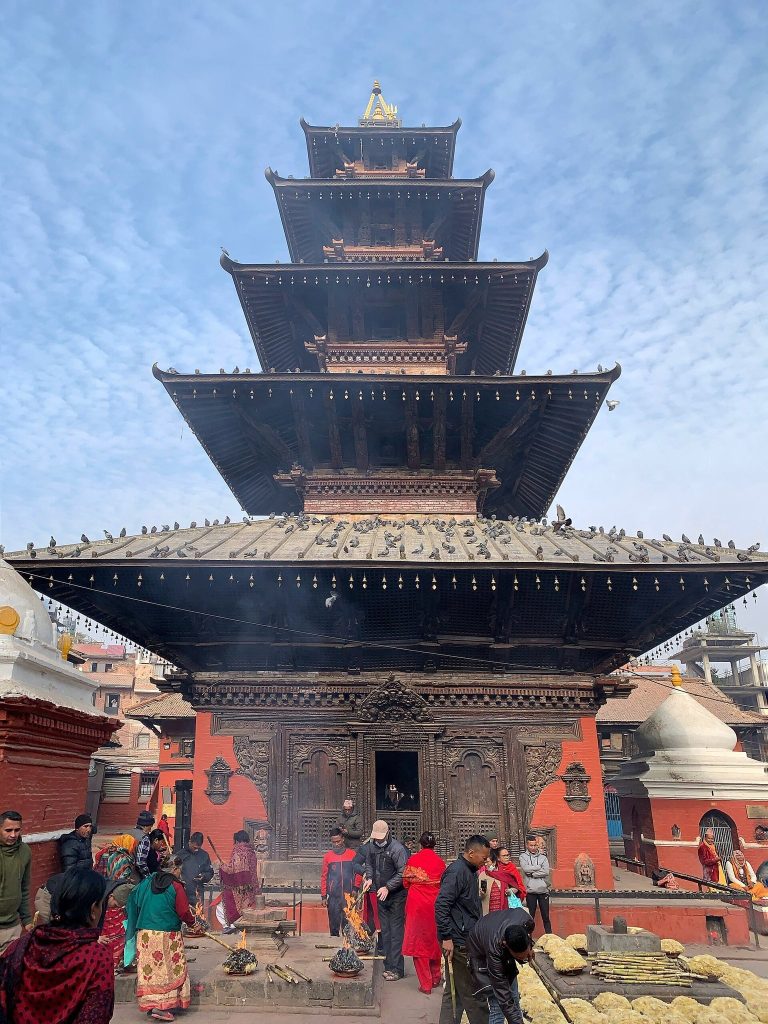
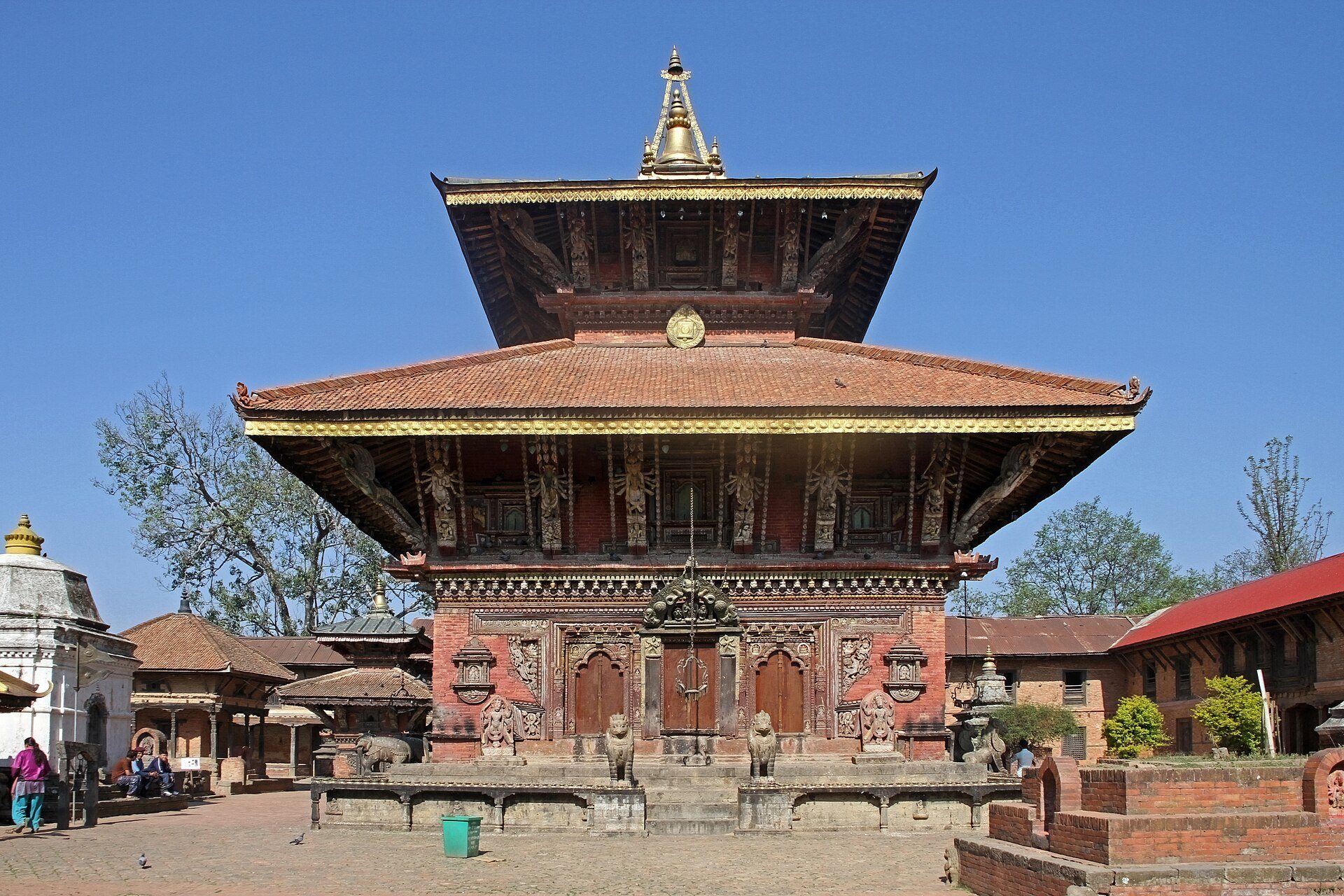
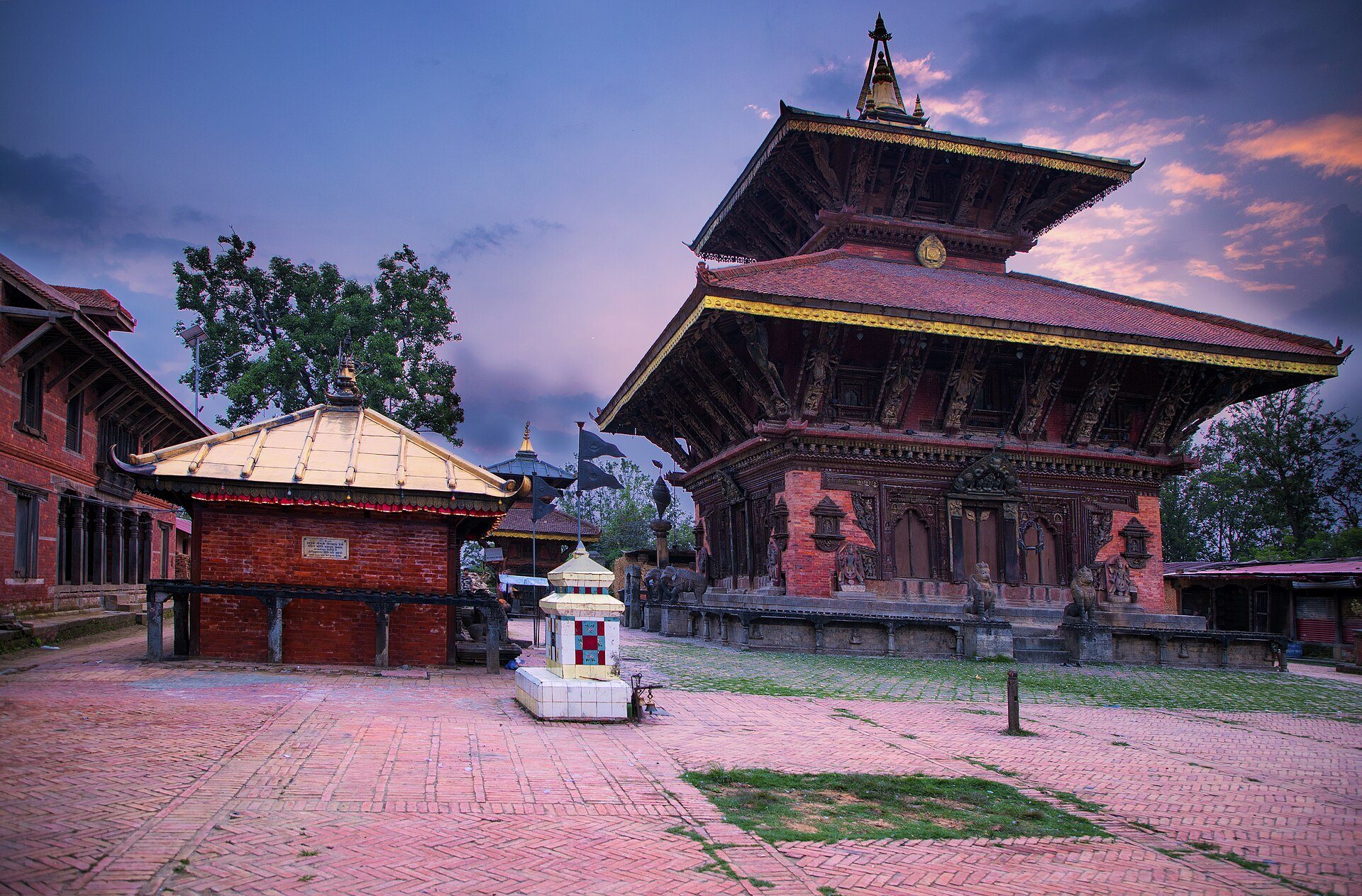
The surviving complex occupies a hilltop beside the Manohara River and is enclosed by champak forest and the village of Changu. Its principal building stands on a broad raised plinth and has two roof levels with symmetrical pitched roofs, presenting a traditional Nepali form often described as pagoda-style. A stone water spout on the route to the temple is traditionally associated with the Lichhavi period.
Principal temple
The main shrine rests on a plinth about four feet high that spreads the building’s weight across the ground. Stepped footings support the walls and contribute to the structure’s resistance to soft ground and earthquakes. The walls use a two-core box arrangement, with sun-dried bricks on the inner faces and smooth fired bricks outside. Yellow clay, mud, or lime-based mortar may bind the brickwork.
Each roof is carried by small rafters radiating from the central masonry core toward purlins and wall plates. Inclined timber struts pass the load toward the walls, while flexible connections allow limited movement in the roof structure. Four entrances are guarded by life-size paired figures, including lions, mythical sarabhas, griffins, and elephants. A sarabha is a mythical protective creature often represented in temple sculpture. Carved Naga figures decorate the doors, and the western principal entrance is associated with a stone pillar bearing representations of Vishnu’s chakra, conch, lotus, and sword. A Naga is a serpent or partly serpentine supernatural being in South Asian religious traditions.
Stone pillar and Vishnu images
Manadeva’s pillar
The main courtyard contains the stone pillar erected by Manadeva in AD 464. Its Sanskrit inscription is among the oldest inscriptions associated with Nepal and records the king’s military campaigns. The top of the pillar at the western entrance carries representations of Vishnu’s attributes.
Chanda Narayan
Chanda Narayan, also called Garuda Narayan, is a seventh-century stone sculpture of Vishnu riding Garuda. Garuda is Vishnu’s eagle-like vehicle and devotee. The sculpture was reproduced on a ten-rupee banknote issued by Nepal Rastra Bank.
Sridhar Vishnu
Sridhar Vishnu is a ninth-century stone sculpture showing Vishnu, Lakshmi, and Garuda standing on pedestals decorated with varied motifs.
Vaikuntha Vishnu
Vaikuntha Vishnu is a sixteenth-century sculpture of Vishnu seated in a relaxed posture on a six-armed Garuda, with Lakshmi seated on his lap.
Vishwarup
Vishwarup is a finely carved seventh-century stone sculpture depicting Krishna revealing his universal form to Arjuna in the Bhagavad Gita.
Vishnu Vikrant
Vishnu Vikrant is a seventh-century sculpture of Trivikrama Vishnu, the form associated with Vishnu’s cosmic strides and the story of Bali Raja. The roof-supporting struts also carry carvings of Vishnu’s ten incarnations and other images.
Narasimha
A seventh-century sculpture of Narasimha shows Vishnu’s man-lion incarnation killing the demon king Hiranyakasyapa to save Prahlada. The image forms part of the complex’s wider group of sculptures and artworks associated with Vishnu.
Subsidiary shrines
Chhinnamasta shrine
The Chhinnamasta shrine is dedicated to the goddess traditionally depicted as having severed her own head and offered her blood to the attendants Dakini and Varnini.
Kileshwor temples
Kileshwor consists of small two-storied temples dedicated to Shiva. Tradition holds that Shiva appeared at the site to protect the hill.
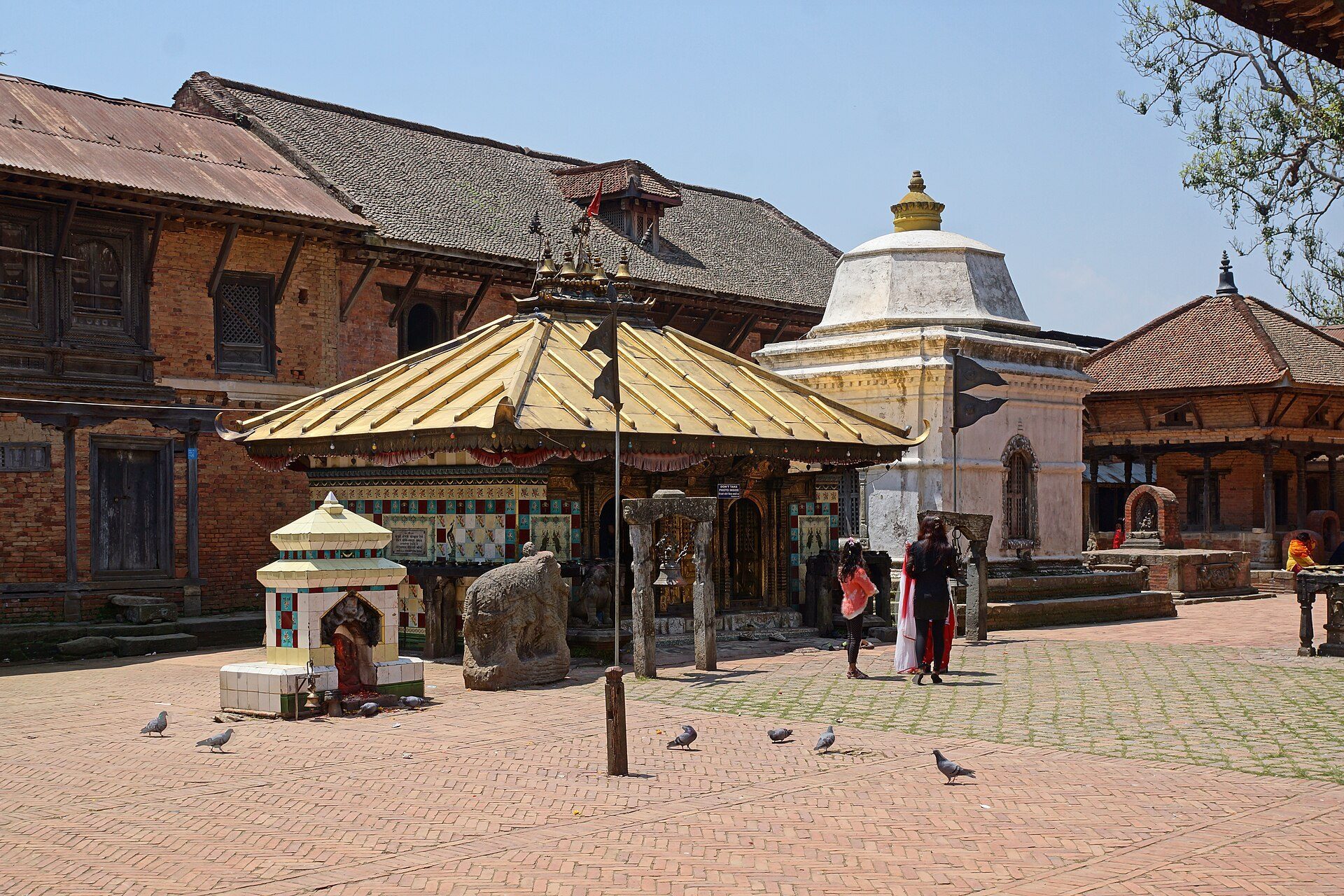
Other subsidiary temples in the precinct are dedicated to Shiva, the Ashta Matrika, Chhinnamasta, Kileshwor, and Krishna. Together with the carved struts, entrance guardians, and stone images, they form a religious and sculptural setting around the principal shrine.
Associated museums and buildings
Changu Museum
The private Changu Museum was established in AD 2000 with permission from the Changu Narayan village administration. Described as Nepal’s first private museum, it contains ancient coins, tools, art, architectural objects, and rare historical, religious, archaeological, and cultural materials. Its collections include tools used by Newar families during the medieval period, a rhinoceros-skin shield, a leaf raincoat, a dish rack about 500 years old, rice more than 225 years old, a cow’s gallstone, and the navel of a musk deer.
Amatya Sattal
An ethnographic and living-traditions museum was established near the temple in 2011 through an agreement involving Nepal’s Department of Archaeology and the Guthi organization. It occupies Amatya Sattal, a rest house associated with an Amatya family from Patan and with ritual, ceremonial, and hospitality functions. The museum displays objects and photographs collected by Judith Conant Chase. The building was damaged in the 2015 earthquake and later underwent repair or reconstruction.