Ake: A Pre-Columbian Maya Archaeological Site in Yucatan, Mexico
Site at a Glance
- Rating
- 4.4
- Popularity
- Very Low
- Country
- Mexico
- Primary era
- Classical
- Eras represented
- Classical, Medieval
- Civilizations
- Maya
- Site type
- City
On this page10 sections
History
Ake is a pre-Columbian Maya archaeological site in Yucatan, Mexico, occupied from the Late Preclassic period, approximately 300 BC to AD 300, until around AD 1450. Its monuments belong mainly to the Classic and Postclassic periods, with some architecture dating to the Early Classic period, approximately AD 250 to 550. The name comes from Yucatec Maya and means “place of climbing plants.”
Late Classic prominence
Ake reached its greatest importance during the Late Classic period, approximately AD 800 to 1000, when it was one of the principal cities of northern Yucatan. Its large settlement, monumental buildings, enclosing walls, and connection to the Maya road network reflect its regional role during this phase of urban and political development.
Rediscovery and later estate
John Lloyd Stephens, an American explorer and writer, and Frederick Catherwood, a British artist and architect, published the first descriptions of Ake in 1841 during their explorations of Maya ruins.
A nineteenth-century henequen estate, San Lorenzo de Ake, later developed around the archaeological site. A henequen hacienda was an agricultural and industrial estate devoted to cultivating and processing henequen, a fiber-producing agave used for rope and related products. San Lorenzo reached peak production in the early twentieth century and continued agroindustrial operations under the ownership of engineer Andres Solis Preciat, although its activities later diversified. During its most productive period, the estate issued exchange tokens whose designs have numismatic interest.
Remains
Ake is enclosed by two concentric walls. The inner rectangular wall surrounds a settlement core of approximately 4 square kilometers, while the outer wall encloses the former city. Within the core, large square spaces and substantial buildings organize the surviving remains. The architecture is chiefly constructed from tightly fitted stone blocks, alongside structures with rounded corners and gently sloping stairways made from roughly worked stone.
Monumental architecture
The Palace
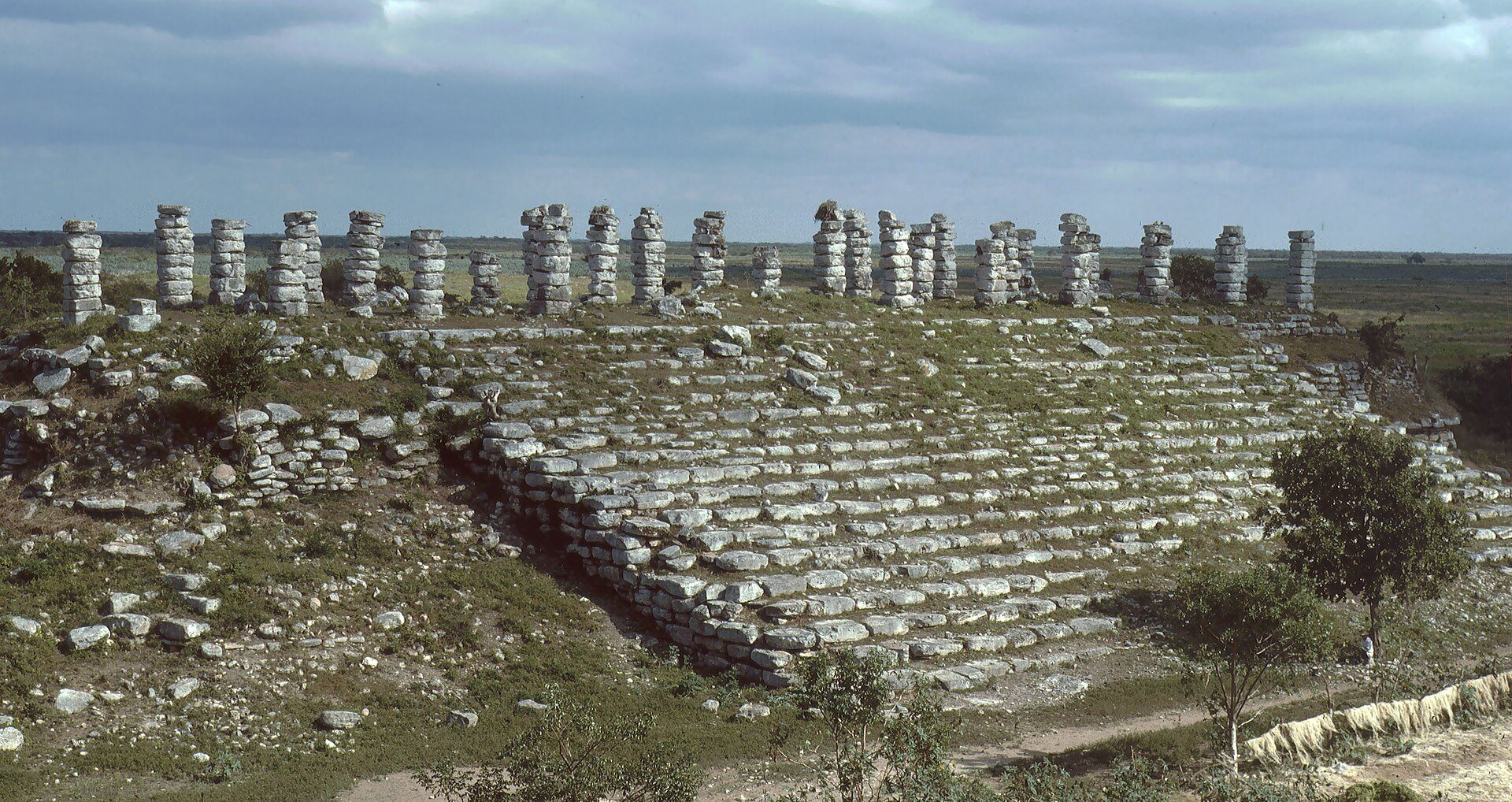
Structure 1, known as the Palace or the Building of the Pilasters, is a rectangular stepped structure set on a platform. Rows of stone columns stand on its summit, with 35 columns arranged in three rows. Each column consists of drum-shaped stone blocks approximately 1.2 meters in diameter. The columns probably supported one of the largest roof structures of their time.
A very broad staircase leads to the Palace platform. Its narrow steps create a gradual ascent, formed from large, flat stone slabs rather than the steep stairways typical of many Maya pyramids.
Structure 2 and related buildings
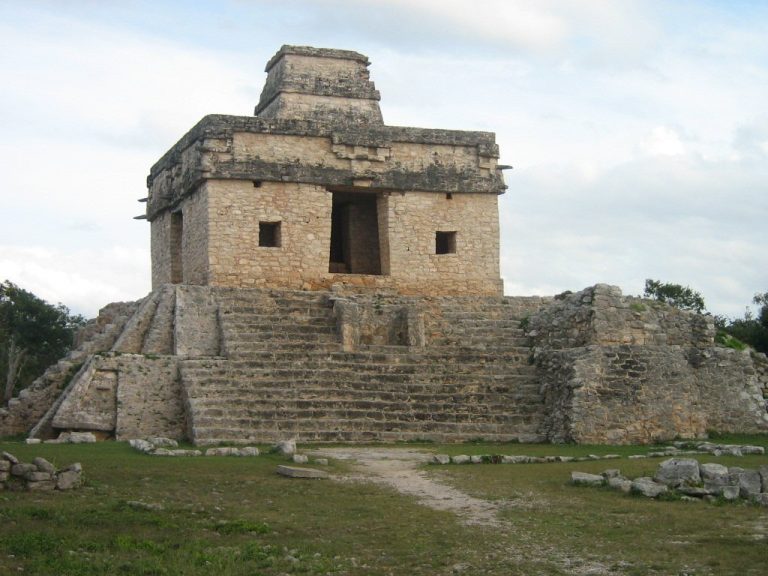
Structure 2 displays features of the Puuc architectural style, a regional Maya tradition associated especially with the hills and northern lowlands of the Yucatan Peninsula and recognized through distinctive masonry and decoration. Other buildings at Ake include large stone structures, rounded-corner constructions, and stairways with gentle slopes.
Roads, water, and the hacienda complex
The raised road to Izamal
A remnant of a Maya sacbe, or raised white road, connects Ake with Izamal, approximately 40 kilometers away. The surviving route formed part of a wider network of Maya causeways linking major settlements, inland sites, ports, and salt-producing centers. Another section of the route is visible at Izamal.
San Lorenzo de Ake
The ruins stand within the grounds of the San Lorenzo de Ake hacienda. The associated complex includes a hacienda church, an arch, henequen-processing machinery, and an abandoned Decauville railway with its track and rail vehicles. A nearby cenote, a natural sinkhole containing groundwater, has an identifiable entrance associated with the site.