Balamku: A Maya Archaeological Site in Campeche, Mexico
Site at a Glance
- Rating
- 4.8
- Popularity
- Low
- Country
- Mexico
- Primary era
- Classical
- External website
- Open
- Eras represented
- Classical
- Civilizations
- Maya
- Site type
- City
On this page15 sections
History
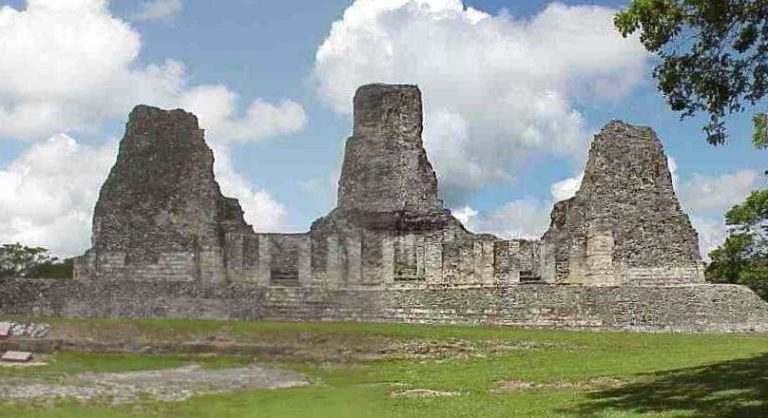
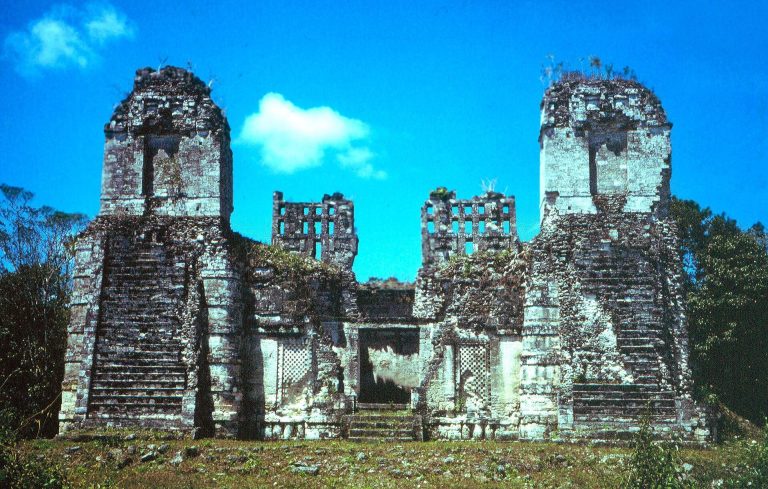
Balamku is a Maya archaeological site in the state of Campeche, Mexico. First occupied around 300 BC, it developed within the regional sphere of Calakmul and later maintained an important relationship with Becan. Its principal buildings belong mainly to the Early Classic period, around AD 300 to 600, and its architecture combines the Chenes tradition with Río Bec and Petén influences.
Early occupation and development
Balamku was occupied from the Late Preclassic through the Terminal Classic, a sequence of successive phases in Maya history. Some ceramics and structures date to approximately 600 to 300 BC, while the site’s earliest known operational phase is represented by Late Preclassic architecture in the Central Group. Construction and use continued through the Early Classic and later periods.
The site was generally abandoned between AD 800 and 1000. Another chronology extends occupation to about AD 1200, indicating that activity may have continued later than the broader abandonment range. Balamku covered approximately 25 hectares, with its architecture concentrated in four principal groups rather than spread densely across the surrounding area.
Rediscovery and archaeological work
Balamku came to the attention of archaeologists in 1990, when Mexican archaeologist Florentino García Cruz and custodians of Mexico’s National Institute of Anthropology and History investigated reports of looting. They found a looters’ trench that had partly exposed a painted stucco frieze. Stucco is a plaster-like material used in Maya buildings for façades, sculpture, and relief decoration.
Rescue operations were followed by excavations from 1994 to 1998 under the direction of Mexican archaeologist Ramón Carrasco. Carrasco’s Mexican team investigated the Central Group, while French archaeologists Claude Baudez and Jean Pierre Courau worked in the South Group. A further phase of excavation took place from 2010 to 2014.
Balamku was designated an Ecological Conservation Zone on 14 August 2003 and lies within the protected Balam Kú Biosphere Reserve.
Remains
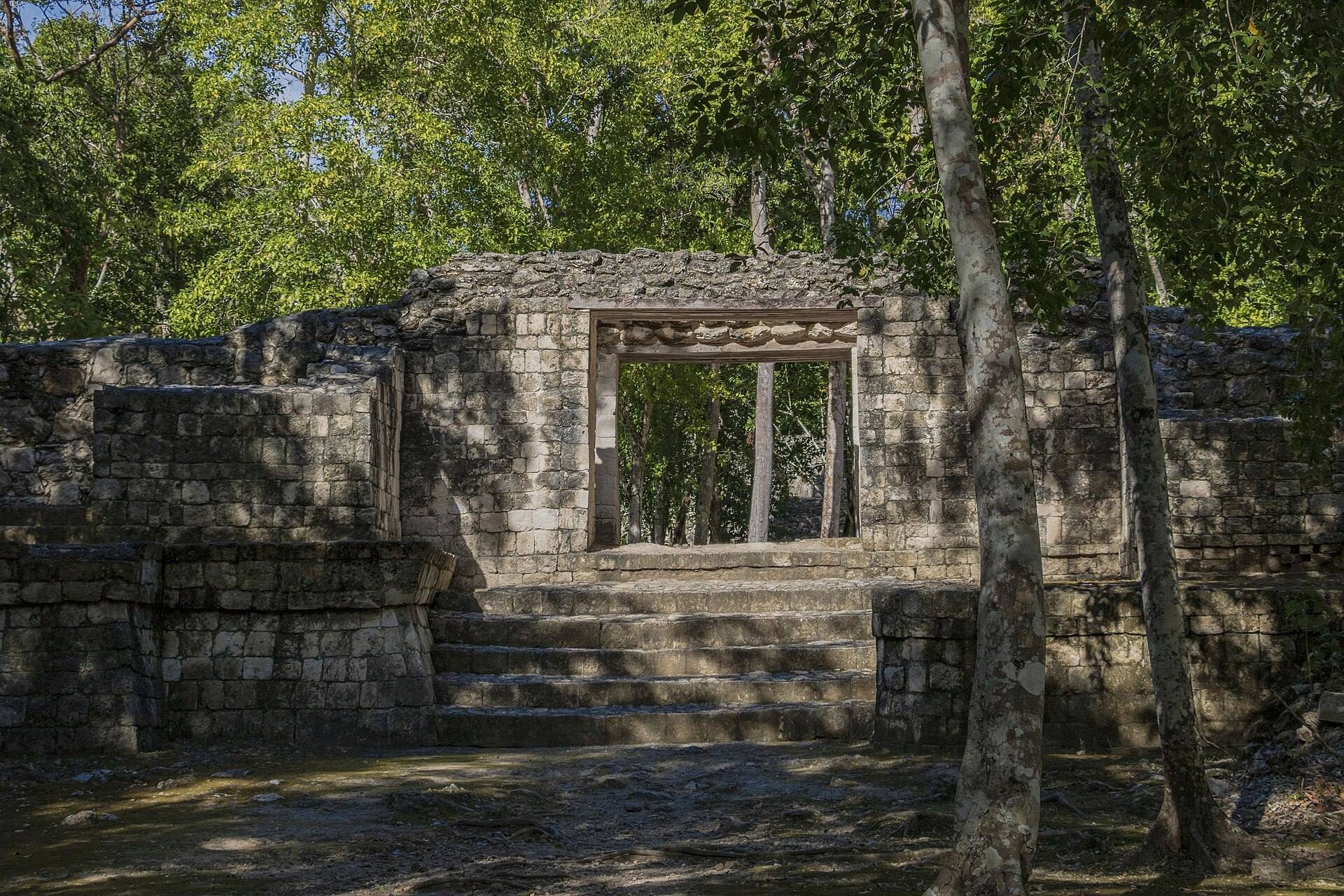
Balamku lies on a poorly drained or partly drained karstic plateau amid dense tropical vegetation. Its ruins are arranged in four major groups: the Central, South, North, and Southwest Groups. The Central and South Groups have been partly excavated, while the North Group has been mapped and contains six plazas. The site’s principal groups stand within a landscape where peripheral architecture is relatively sparse, with very few additional buildings roughly 100 metres from them.
Central Group
Plazas and structures
The Central Group contains three plazas. Plaza A occupies the southern end and includes a Mesoamerican ballcourt together with several mounds awaiting archaeological investigation. Plaza B lies in the northwestern sector. Structure I borders it to the north, Structure IV to the south, and Structures V and VI to the east and west. Test pits in this plaza revealed architectural remains from the Late Preclassic, the earliest known operational phase at Balamku.
Structure V separates Plaza B from Plaza C. Plaza C is bordered by Structure II to the north, Structure III to the west, and several additional structures to the south. These spaces form the principal excavated architectural arrangement in the Central Group.
Structure I and the painted frieze
Structure I contains the earlier substructure known as Sub I-A. Excavation there revealed a large painted stucco frieze that originally formed part of the upper façade of an Early Classic building. When excavated, the frieze measured approximately 16.8 metres long and 1.75 metres high. It is preserved almost intact beneath a protective roof.
The decoration combines ruler imagery with representations of a sacred mountain. Known also as the Universe Frieze or Four Kings Frieze, it includes four apparently sovereign figures, a saurian figure, interwoven or alternating serpents and jaguars, and a mask of Kinich Ahau, a Maya solar deity associated with distinctive facial and solar imagery. Red, blue, and black pigment survive on the surface.
The frieze is generally dated to approximately AD 550 to 600, although stylistic estimates have extended from the fourth century BC to the middle of the sixth century AD. Radiocarbon dating of Structure I’s lintel produced a date of AD 631 plus or minus 30 years.
South Group
Plazas and buildings
The South Group contains four plazas. Plaza A is bounded by Structures D5-5, D5-10, and D5-11. Plaza B is bordered by D5-5, D5-10, and D5-7, while Plaza C is defined by D5-4 and D5-6. Plaza D is enclosed by D5-1, D5-2, and D5-3.
Structure D5-5
Structure D5-5 stands between Plazas B and C. Excavation uncovered two burials within the building, including one individual of elite status.
Structures D5-10 and D5-11
Structure D5-10 was built over two earlier structures dating to the Late Preclassic. Structure D5-11 stands on the southern side of Plaza A and dates at least to the Late Preclassic, making it one of the earliest known buildings at Balamku.
North and Southwest Groups
North Group
The North Group contains six plazas bordered by structures, including buildings more than 15 metres high. The group has been mapped but remains archaeologically unexcavated.
Southwest Group
The Southwest Group consists of two structures forming an E-Group astronomical complex. An E-Group is an architectural arrangement traditionally made up of a large western pyramid or platform and a raised, elongated structure to the east.
Archaeological finds
Excavations at Balamku have produced the monumental painted stucco frieze, stucco figures, ceramics, and the burials associated with Structure D5-5. Together with the surviving plazas and buildings, these remains reflect the site’s long sequence of construction and use from the Late Preclassic into the Classic-period occupation.