Wapauwe Old Mosque: A Historic 15th-Century Mosque in Maluku
Site at a Glance
- Rating
- 4.9
- Popularity
- Very Low
- Country
- Indonesia
- Primary era
- Medieval
- Eras represented
- Medieval, Early Modern, Modern
- Civilizations
- Dutch
- Site type
- Religious
- Remains
- Mosque
On this page8 sections
History
Wapauwe Old Mosque is an active Sunni Muslim mosque in Kaitetu, Central Maluku, Indonesia. Established in 1414, it is regarded as the oldest mosque in the Moluccas and is possibly the oldest mosque in Indonesia to have been maintained in its original form. Its simple wooden construction reflects the early development of Muslim communities in the region.
Foundation at Wawane
The first mosque stood at Kampung Wawane, about 6 kilometres from its present location. Maulana Kiai Pati, an Islamic missionary from the Nukuhaly coast of Seram Island, founded it while spreading Islam among five villages in the Wawane Mountains: Essen, Wawane, Atetu, Nukuhaly, and Tehala.
In 1464, another Muslim group arrived under Kyai Jamilu, a leader from the Sultanate of Jailolo, a historical Muslim sultanate based on Halmahera in North Maluku. Jamilu continued to care for the Wawane Mosque and enlarged it. His descendant, Imam Rijali, later became central to the mosque’s relocation.
Relocation to Kaitetu
After the Dutch took control of Wawane in the early seventeenth century, tensions led Imam Rijali to guide villagers eastward to Tehala in 1614. The mosque was dismantled, carried to a new site, and rebuilt on a plain where wild mango trees grew. Its later name, Wapauwe, comes from local Kaitetu terms: wapa means “wild mango” and uwe means “tree.” Some residents subsequently came to believe that the mosque had moved by itself through supernatural means.
In 1664, the mosque underwent its first major renovation. It was transported and rebuilt twice during this work, while its original appearance was retained. A spire was added in the early eighteenth century. The vertically rising element represents the Arabic letter alif and is understood as a symbol of Allah.
Renovation and continuing use
The second major renovation took place in 1895 under the direction of the local figure Hamid Iha. A porch was added to the front and east side of the older building, the lower parts of the wooden walls were strengthened with lime concrete, and the original coral-gravel floor was replaced with cement.
Later work aimed to preserve the mosque’s appearance. Fencing was installed around the perimeter in 1977, and the building was designated a cultural property in 1982. During the 1990s, the thatched roof was renewed through work involving the Dusun Hila Kristen and Dusun Kalauli communities of Kaitetu under the leadership of the head of the adat community, Ir. H. Abdullah Lumaela. Adat refers to customary social and cultural traditions in Indonesia. The roof thatch was replaced again in March 2008.
The mosque stands within the historic village of Kaitetu, where remnants of a Portuguese church and a Portuguese trading post survive. The trading post was later re-established by the Dutch as a fort. Both Christian and Muslim communities in Kaitetu maintain the mosque, linking its continued use with the village’s wider historical community.
Remains
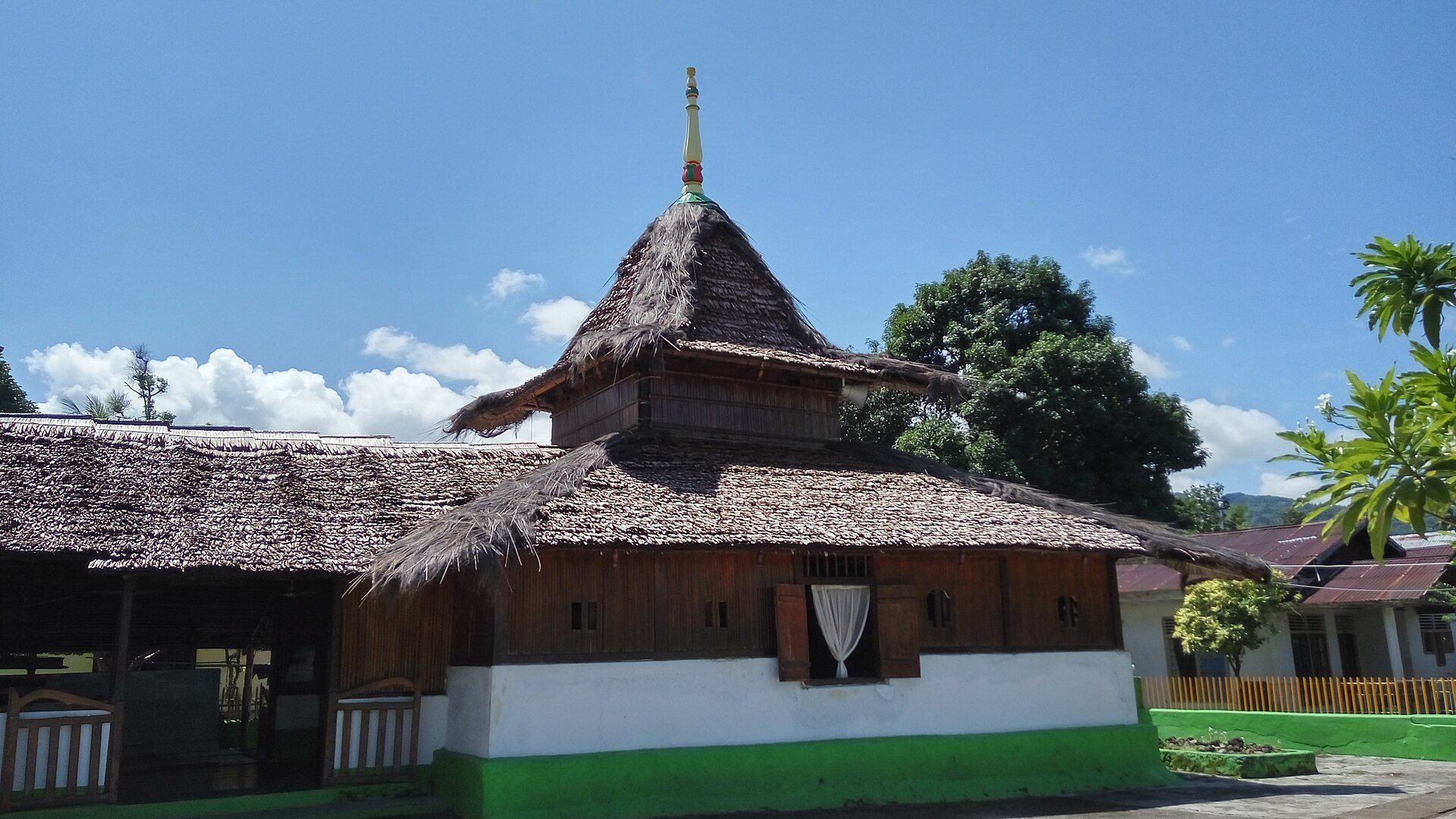
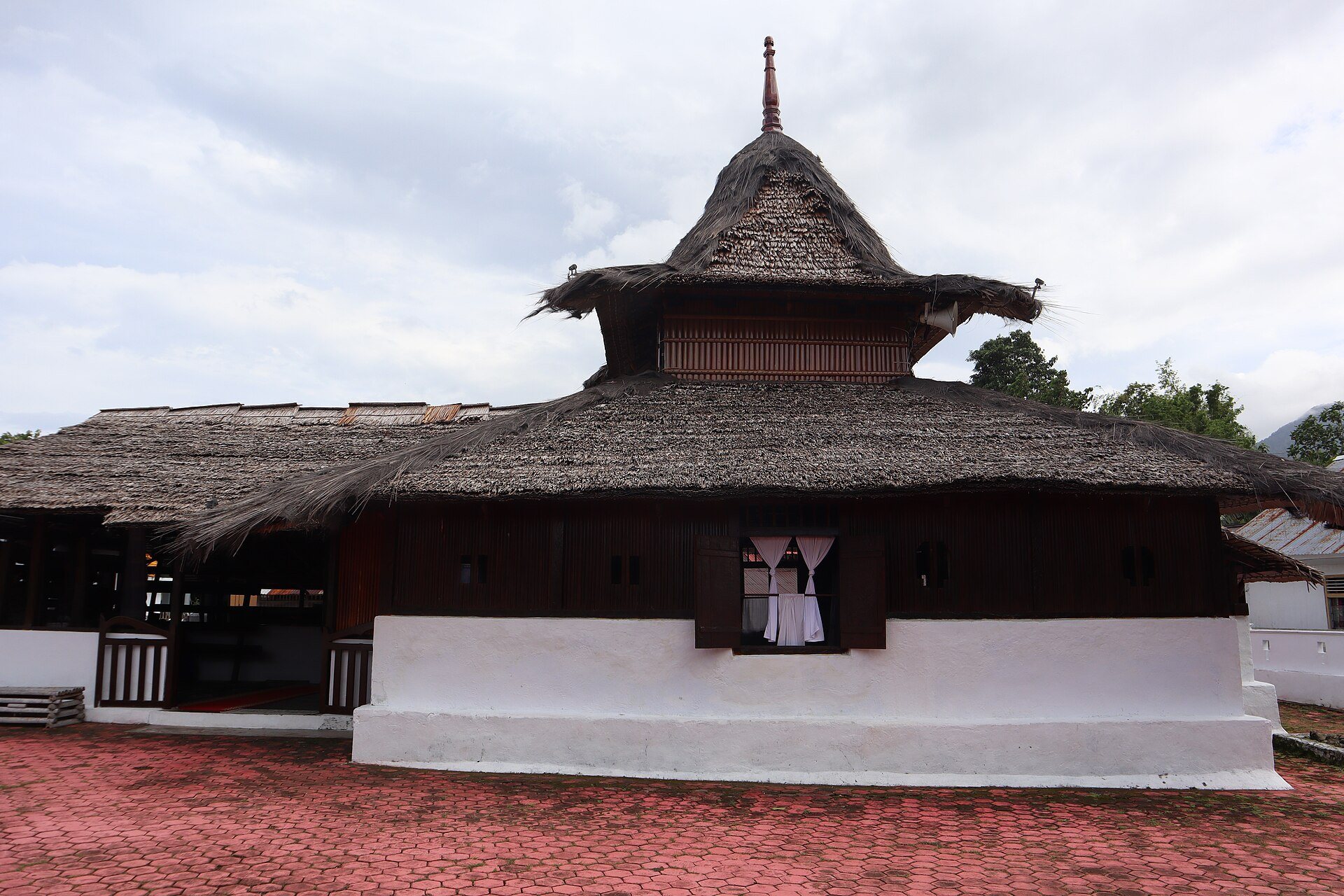
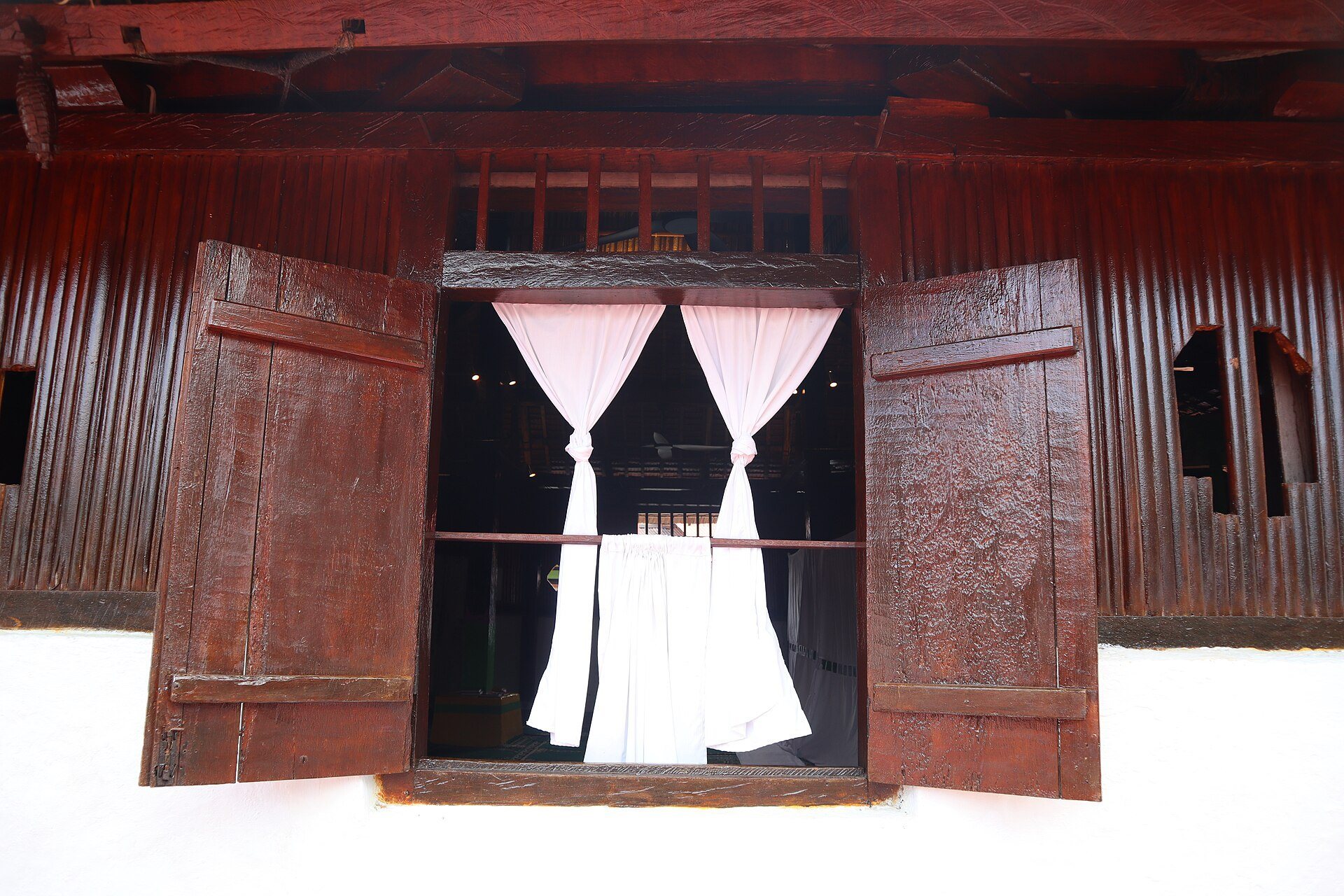
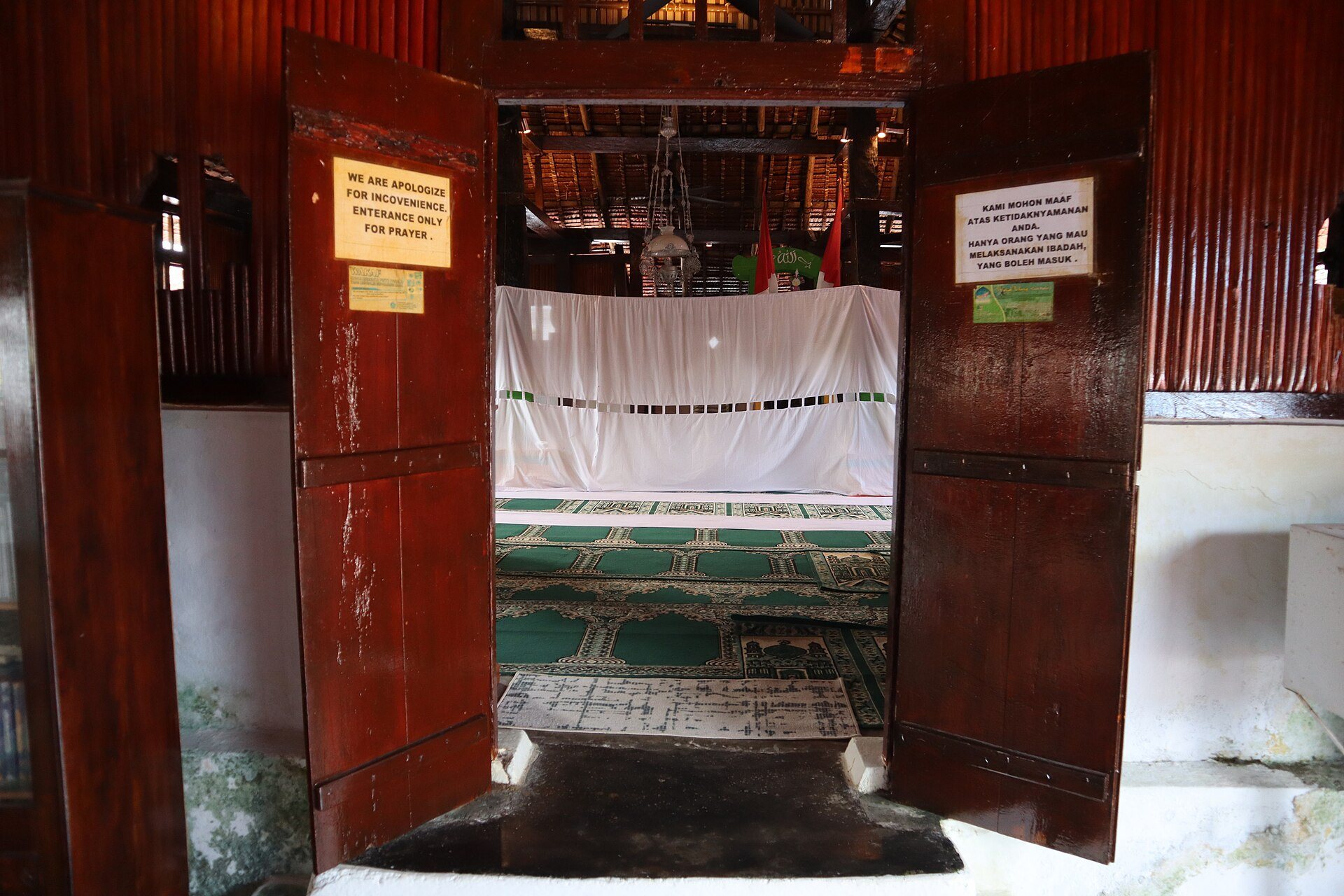
Wapauwe Old Mosque is a small vernacular Indonesian wooden building measuring approximately 10 by 10 metres, with a porch of about 40 square metres. Its construction is retained in a traditional form, with wooden members tied together using ijuk, a strong natural fibre, rather than joined with nails or pegs.
Wooden building and roof
The mosque has a traditional multi-tiered roof supported by four principal columns called saka guru, the main supporting pillars of a traditional Indonesian building. These columns are made from kanjoli or bintanggur wood, identified as Calophyllum soulattri, which grows abundantly along the coast of Tanah Hitu, a historic coastal region of Ambon Island. A vertically mounted wooden finial, a decorative or symbolic element placed at the top of a building, crowns the roof.
Dried sago fronds, known as gaba-gaba, cover the walls, while similar dried fronds form the thatched roof. The porch added in 1895 extends the front and east side of the original structure. Lime concrete reinforces the lower wooden walls, and the floor is cement, following the replacement of the earlier coral-gravel surface during the same renovation.
Door and furnishings
The wooden main door carries spearhead-shaped wooden ornaments. Calligraphic inscriptions referring to Allah and Muhammad fill its four corners, while a turtle-shaped brass plate bears an engraved Salawat invocation, a devotional prayer asking blessings upon Muhammad.
Objects associated with the mosque included two oil lamps made of wood and brass, wooden scales, and a beduk drum carved from lingua wood. A beduk is a large drum traditionally used in Indonesian Muslim communities to announce prayer times.
Manuscripts and devotional tradition
The mosque was associated with early Qur’anic manuscripts and other Islamic writings. Imam Muhammad Arikulapessy, identified as its first imam, completed the oldest of these in 1550. It has no miniature decoration. Another Qur’anic manuscript was completed by Nur Cahya in 1590. She is identified as Arikulapessy’s granddaughter and as a student of Kiai Pati.
Other manuscripts included a Muslim calendar dated 1407 and a Friday-prayer manuscript dated 1661. These treasures are now kept in the heritage house of Abdurrachim Hatauwe, described as the twelfth descendant of Arikulapessy. A book of poems about Muhammad’s life was also associated with the mosque, and villagers regularly sing these poems, especially during the annual Mawlid observance commemorating Muhammad’s birth.