Denbigh Plantation Site: An Early Colonial Archaeological Site in Virginia
Site at a Glance
- Rating
- 4.8
- Popularity
- Very Low
- Country
- United States
- Primary era
- Early Modern
- Eras represented
- Early Modern, Modern
- Civilizations
- English
- Site type
- Domestic
- Remains
- Manor House
On this page10 sections
History
Denbigh Plantation Site is a historic archaeological site in Newport News, Virginia, United States, associated with early English colonial settlement and recorded with a build date of 1630. Also known as Mathews Manor, the property covers approximately 390 acres and preserves evidence of plantation life, industry, and later communities in the Virginia colony.
Early ownership and Mathews Manor
Merchant Abraham Peirsey, who arrived in Virginia aboard the Susan in 1616, was the earliest known owner of land in the area. He died on 16 January 1628. The property later became associated with the name Denbigh, which first appears in a 1635 will. The Anglican parish from which the name came was probably established about a decade earlier.
Captain Samuel Mathews acquired the property through his marriage to Frances Greville, Peirsey’s widow. Greville had arrived in Virginia aboard the Supply in 1620 and had previously been married to Lieutenant Colonel Nathaniel West and Abraham Peirsey. She died around 1633. Mathews spent much of his later life in England and became an important figure in the early political life of the Virginia colony.
Mathews Manor was built about 1626, possibly beginning under Peirsey’s ownership. Its original house burned about 1650. Samuel Mathews Jr. then built a less substantial house nearby. He served as governor of Colonial Virginia from 1656 to 1660 during the Commonwealth period, the English republican government established after the execution of King Charles I.
John Mathews, the son of Samuel Mathews Jr., lived at the property as a child. On 9 March 1678, he received a patent for 2,944 acres on Deep Creek, about two miles south of Denbigh near Blount Point, and remained associated with the home for some time afterward. William Cole was recorded as his guardian on 24 June 1679.
Warwicktowne and the Digges family
In 1680, the Virginia House of Burgesses, the colony’s representative legislative assembly, established Warwicktowne at the meeting of the Warwick River and Deep Creek. The town’s 50 acres were purchased from Denbigh Plantation. By 1691, Warwicktowne had a courthouse, jail, and several houses. By 1730, it had developed into a small commercial center with a tobacco-inspection warehouse, shipbuilding facilities, and a wharf. A free school for poor children was operating there by 1752.
The Digges family acquired Denbigh Plantation between 1698 and 1720, initially through Cole Digges. They built another manor house very near Mathews Manor. Members of the family also owned the Bellfield, or E. D., plantation in York County. Advertisements placed in 1783 and 1784 sought overseers for Denbigh, while an 1785 advertisement offered 600 to 800 acres near Newport News for sale.
The Digges family held important political positions in colonial and revolutionary Virginia. Cole Digges and William Digges represented Warwick County in the House of Burgesses before the American Revolution, and Cole Digges also served on the Virginia Governor’s Council. William Digges Jr. took part in a revolutionary convention and served in the Virginia House of Delegates. His brother Cole Digges served in the Virginia Ratification Convention, which considered Virginia’s approval of the United States Constitution.
From plantation to modern development
The Digges family sold the 2,700-acre plantation to Richard or John Young in 1810. After Warwicktowne’s charter was repealed in 1813, the former town area returned to agricultural use. The new owner later divided the property into four estates. He retained Denbigh and gave Quarterfield, Horse Point, and Reedy Branch to his children.
William Garrow Young eventually inherited Denbigh. The Young family fled to Salisbury, North Carolina, in 1861 and remained there during the American Civil War. Confederate and Union troops occupied the Young farm during the conflict. William Garrow Young served as a first lieutenant in the Warwick Beauregards and was buried near the plantation-house site.
In 1869, the Young family sold the approximately 300-acre farm formerly associated with Warwicktowne to Hudson and Sallie Mench. They operated a sawmill there for about fifty years, and their surname became the source of the modern neighborhood name Menchville. The last Denbigh mansion burned in 1877 and was not replaced.
After William and Anne Young died in 1893, the remaining estate passed to their six children, including physician John A. Young, George Young, and Betty Young. Large portions of the acreage were sold during the late nineteenth century. In 1897, Mennonites, members of a Christian Anabaptist tradition emphasizing disciplined community life, adult baptism, and pacifism, established a nearby colony. The community expanded around the historic Denbigh area, continuing farming, establishing a dairy, and beginning residential development.
By 1931, the former Warwicktowne area had become a municipal prison farm. Warwick County became Warwick City in 1952 and merged with Newport News in 1958. As surrounding farmland was converted to residential and industrial use, archaeological research took place before further development. During the 1960s, archaeologist Ivor Noël Hume excavated the site, revealing evidence of early domestic life in the Virginia colony, the Mathews and Digges residences, several seventeenth-century industrial sites, and early artifacts.
Denbigh Plantation Site was listed in the Virginia Landmarks Register in 1969 and on the National Register of Historic Places in 1970. The National Register is the United States’ official list of places recognized for historical or archaeological significance, while the Virginia Landmarks Register serves the corresponding state-level role. The archaeological remains have been preserved within neighborhood parks as residential development expanded around them.
Remains
The surviving site consists of capped house foundations, standing plantation-related buildings, archaeological industrial areas, and recovered objects preserved within neighborhood parks. The foundation caps outline the plans of the Mathews and Digges houses, while the surrounding residential landscape reflects the later transformation of the former plantation.
Domestic remains
Mathews Manor
The early Mathews Manor was a post-medieval half-timbered house, a structure made with a visible timber frame and infill panels. It had a projecting porch and a central chimney, features associated with Virginia’s earliest substantial dwellings. The house burned about 1650. Its archaeological foundation has been capped, preserving the building’s plan, and one foundation is marked by a historical marker in a small park at 10 Blacksmythe Lane.
Digges manor and associated buildings
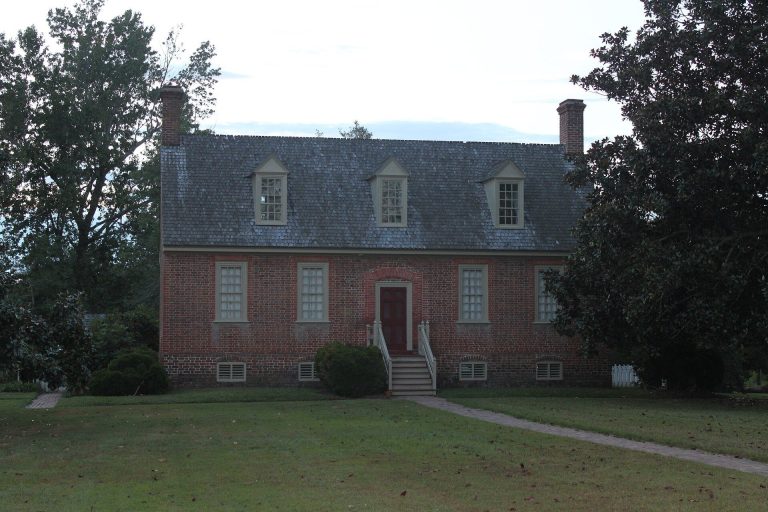
The later Digges manor house stood very near Mathews Manor. Its foundation has also been capped so that the building’s plan remains visible. An eighteenth-century dairy and an early nineteenth-century kitchen associated with the Digges homestead remain standing. In 1935, George and Betty Young were living in the separate kitchen and dairy house of the earlier mansion.
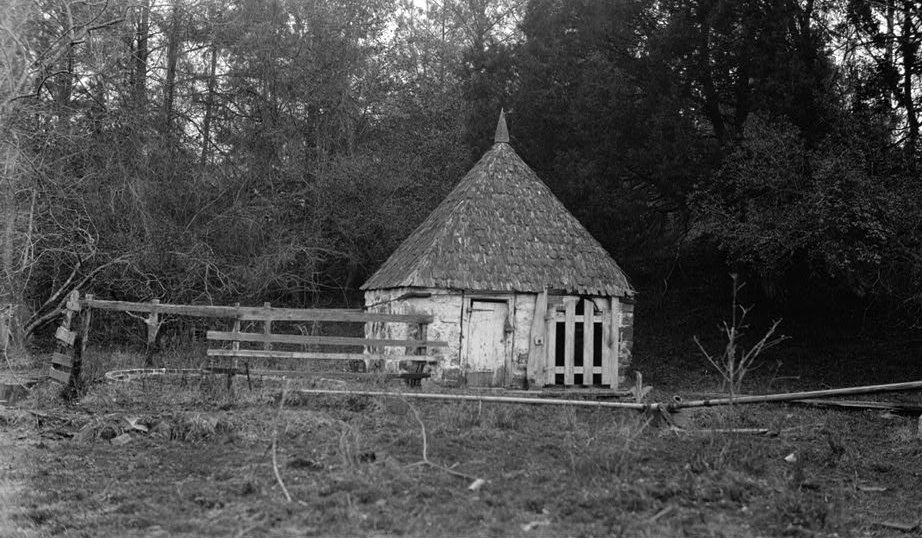
Springhouse
A springhouse at Denbigh Plantation was documented during the 1930s. It forms part of the surviving evidence for the practical buildings that supported the plantation’s domestic life.
Industrial areas and archaeological evidence
Several seventeenth-century industrial sites were identified during excavation. Together with the house foundations, they provide physical evidence of the plantation’s domestic and working activities during the early colonial period.
Excavations also recovered the earliest known porcelain found in Virginia, along with other early artifacts associated with the investigation of colonial domestic life. These finds complement the preserved foundations and standing buildings, extending the site’s evidence beyond its visible structures.