San Ignacio Miní: A Jesuit Guaraní Reduction in Argentina
Site at a Glance
- Rating
- 4.6
- Popularity
- Very High
- Country
- Argentina
- Primary era
- Early Modern
- External website
- Open
- Eras represented
- Early Modern
- Civilizations
- Guaraní, Spanish
- Site type
- Religious
On this page10 sections
History
San Ignacio Miní is a former Jesuit reduction in San Ignacio, Misiones Province, Argentina, founded by Jesuit missionaries for Guaraní communities in 1610. The mission was one of the early Jesuit settlements in the Guayrá region, then part of the colonial Province of Paraguay, a Spanish territory that included areas now belonging to Argentina, Brazil, and Paraguay. Its name, meaning “small” in Guaraní, distinguished it from San Ignacio Guazú, founded in the same year in present-day Paraguay.
Foundation and relocation
José Cataldino and Simón Maceta established San Ignacio Miní to promote Christianity among Guaraní communities. A Jesuit reduction was a planned mission settlement where priests directed religious life and administration while Indigenous residents lived, worked, and took part in local government.
From the 1620s, armed Portuguese expeditions known as bandeirantes attacked the Guayrá reductions and captured Guaraní people for enslavement. San Ignacio Miní and Nuestra Señora de Loreto were abandoned in 1632. Under the direction of Antonio Ruiz de Montoya, thousands of Guaraní moved southward in an exodus that involved several temporary settlements. San Ignacio Miní was established at its present location in 1696.
Life at the mission
After the relocation, San Ignacio Miní became one of the principal reductions in present-day Misiones Province. Its population consisted mainly of Christianized Guaraní. Jesuit missionaries directed religious affairs, while Indigenous authorities participated in governing the community.
During the eighteenth century, approximately 3,000 people lived at the mission. Agriculture, cattle raising, handicrafts, and the production of cultural and craft goods supported the settlement. Some of these goods were traded with Spanish colonists through the nearby Paraná River.
Decline and destruction
The mission’s prosperous period ended in 1767, when King Charles III expelled the Society of Jesus, the Catholic religious order that had established and administered the reductions, from the Spanish monarchy’s dominions. Jesuit administration ceased, other colonial authorities assumed control, and the community then experienced depopulation and gradual deterioration.
Regional conflicts from the late eighteenth to the early nineteenth century accelerated the abandonment of San Ignacio Miní. The complex was destroyed in 1817 during the wars affecting the region and eventually became a ruin.
Rediscovery and preservation
Overgrown ruins were found in 1897. Wider public interest followed the poet Leopoldo Lugones’s expedition in 1903, while formal government exploration and restoration began in 1940. Campaigns of restoration and consolidation from the 1940s onward preserved substantial parts of the original complex.
Argentina declared San Ignacio Miní a National Historic Monument in 1943. In 1983, it became part of the UNESCO World Heritage property Jesuit Missions of the Guaranis, together with Santa Ana, Nuestra Señora de Loreto, and Santa María la Mayor. The property was extended in 1984 to include São Miguel das Missões in Brazil. The designation recognizes the missions as evidence of the urban, religious, and social organization developed by Jesuits and Guaraní communities during the seventeenth and eighteenth centuries.
In 1996, San Ignacio Miní was included in the World Monuments Watch, a heritage-preservation program for sites requiring conservation attention. The eastern lateral portal was restored, the main portal was later repaired, and an interpretation center was constructed. The site also includes the Museo Jesuítico de San Ignacio Miní, built after the ruins received international recognition.
Remains
Planned settlement and central plaza
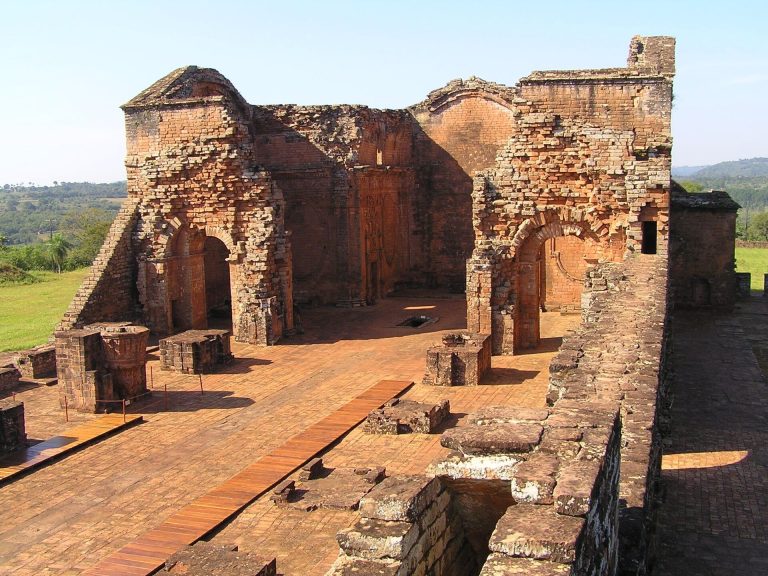
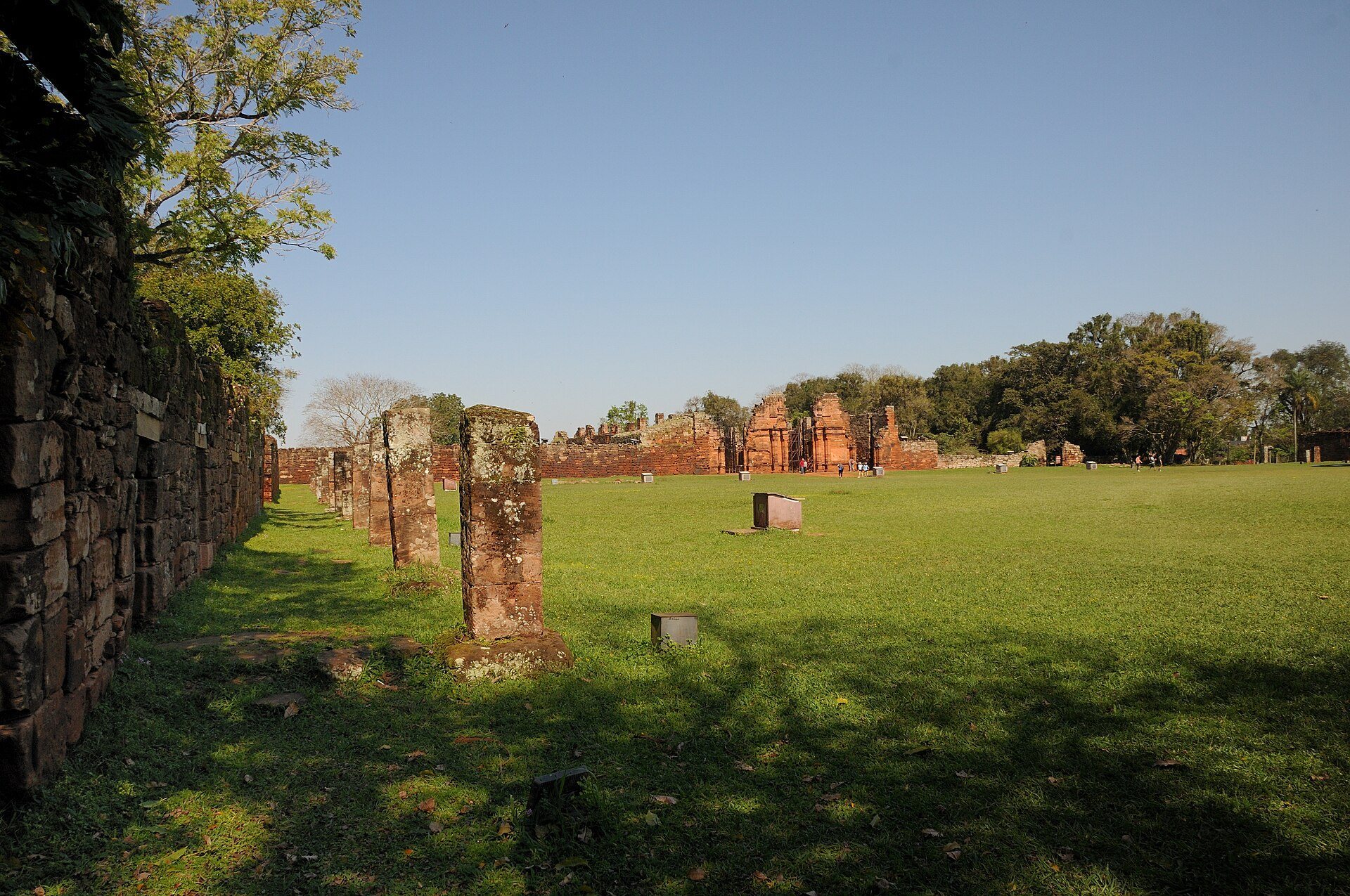
San Ignacio Miní survives as an archaeological ruin arranged according to the planned urban model of the Guaraní Jesuit reductions. A large rectangular plaza formed the center of religious, social, and administrative life. The church, Jesuit residence, college, and other religious and civic buildings stood along one side, while regular residential blocks occupied the surrounding area and were divided by straight streets.
The plaza was bounded by the church, a cabildo, which was a Spanish colonial municipal council, a cemetery, a monastery, and houses. Workshops, storehouses, and other service buildings were distributed around the central space. Consolidation and archaeological work have made the plans of several ancillary buildings identifiable, allowing their relationship to the plaza to be understood.
The church
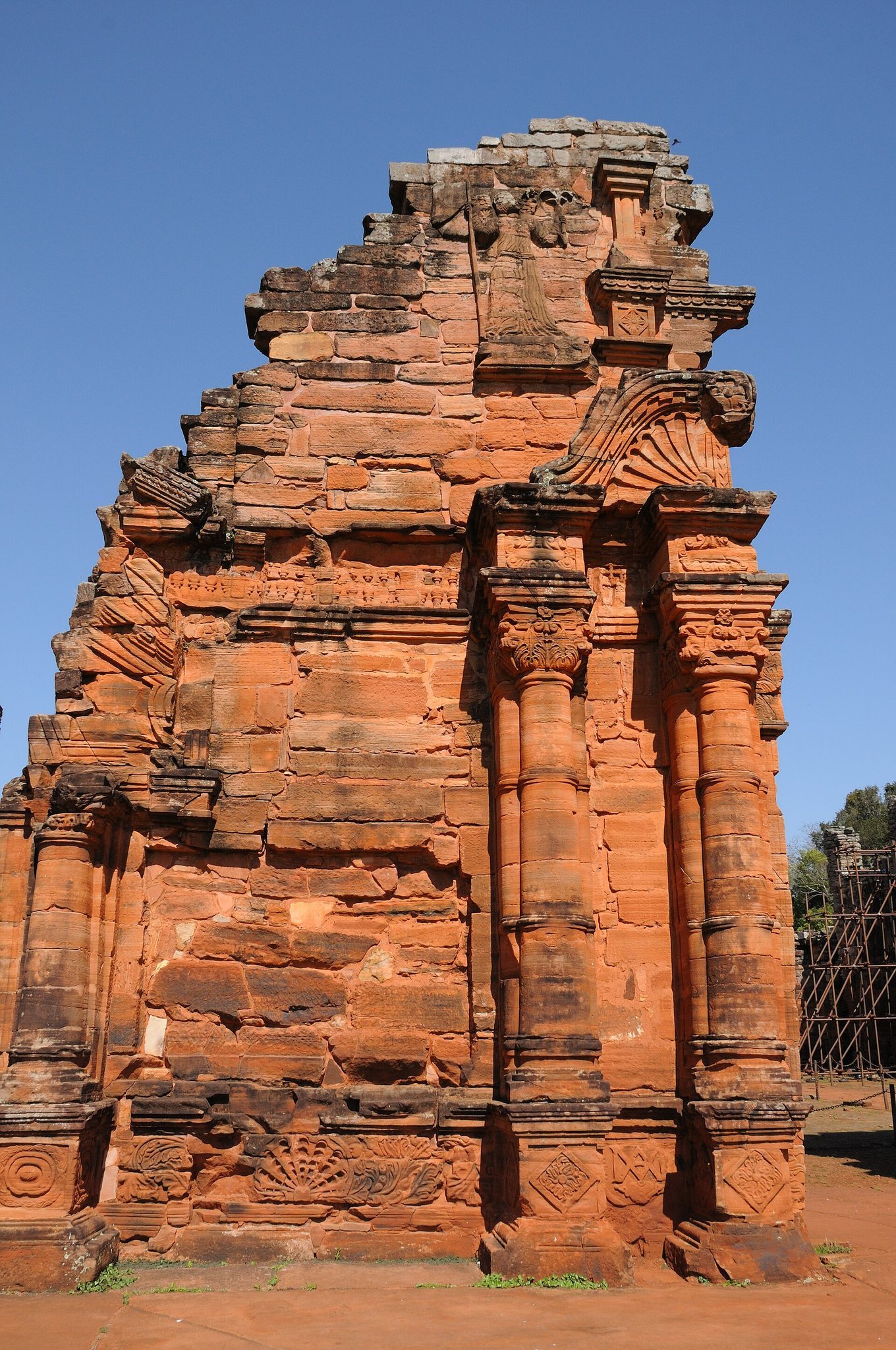
Designed by the Italian Jesuit priest Juan Brasanelli, the church was built from locally available red sandstone. It measured approximately 74 metres in length and 24 metres in width, with walls about 2 metres thick. The building had a large single nave, lateral chapels, and a monumental facade facing the plaza.
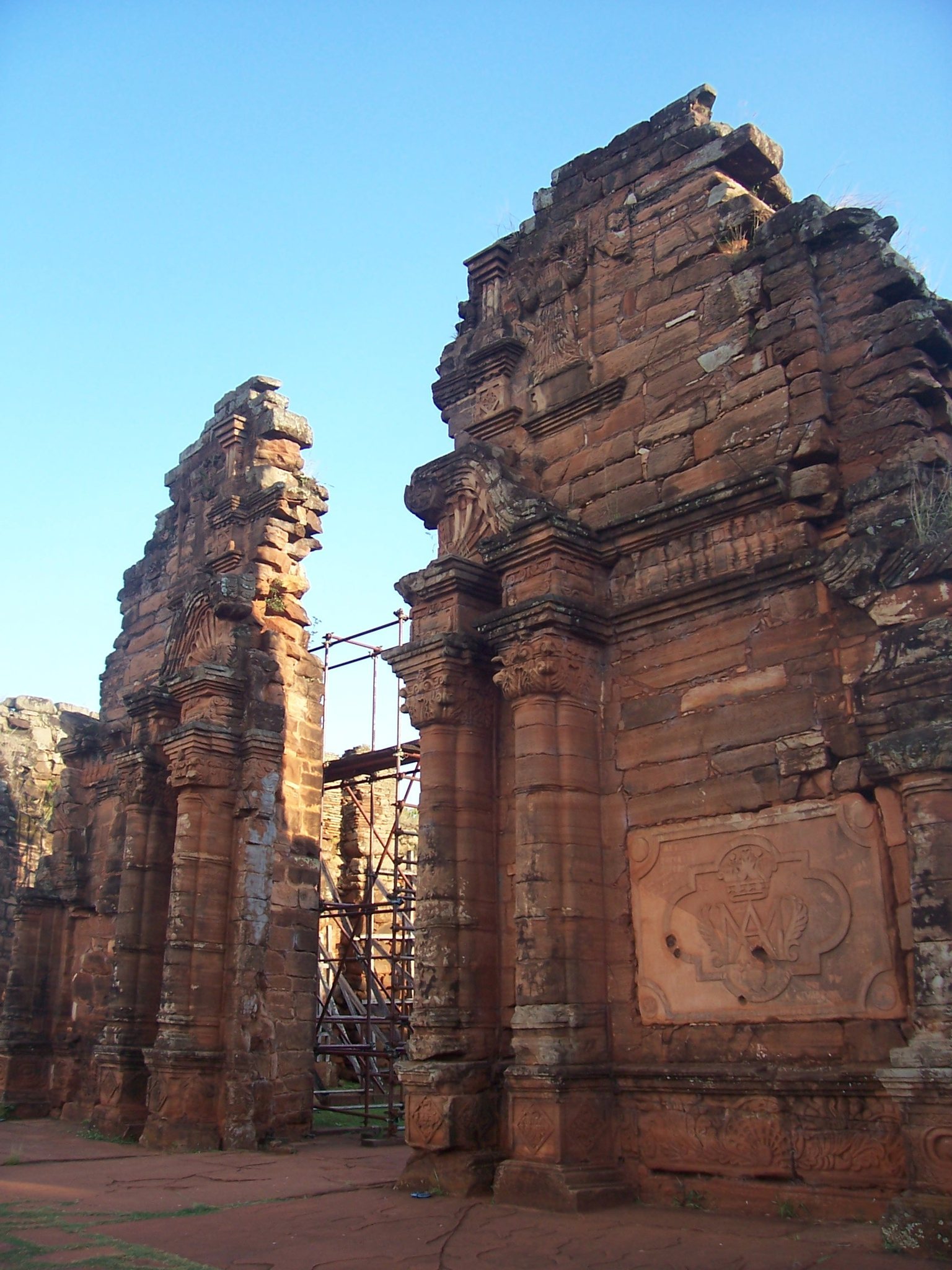
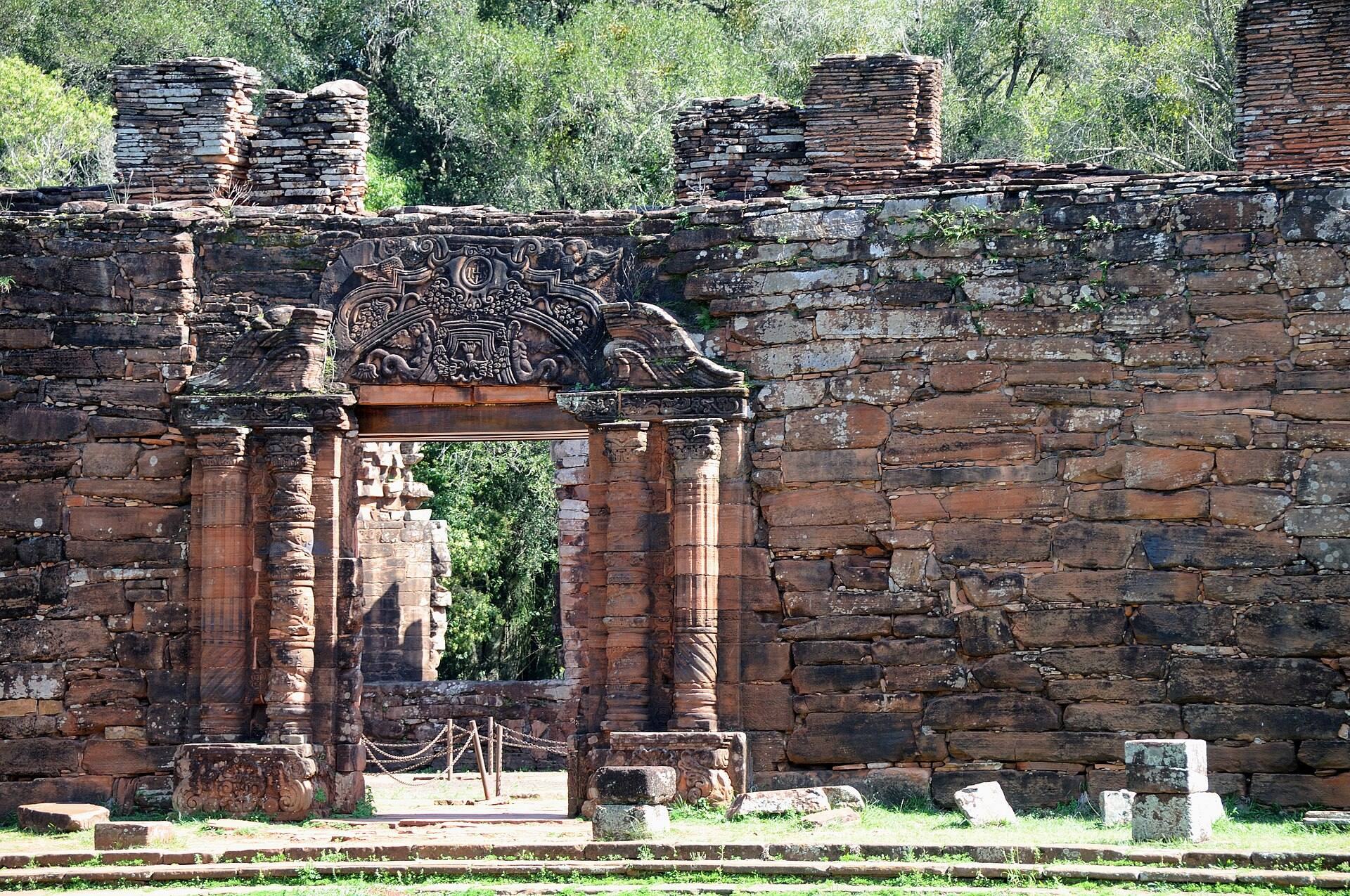
The wooden roof has disappeared, but substantial sections of the perimeter walls remain and convey the original scale of the church. Its facade and entrances combine European Baroque forms with motifs developed by Guaraní artisans working under Jesuit direction. This artistic synthesis is known as Guaraní Baroque, or missionary Baroque.
Ancillary buildings and residential sectors
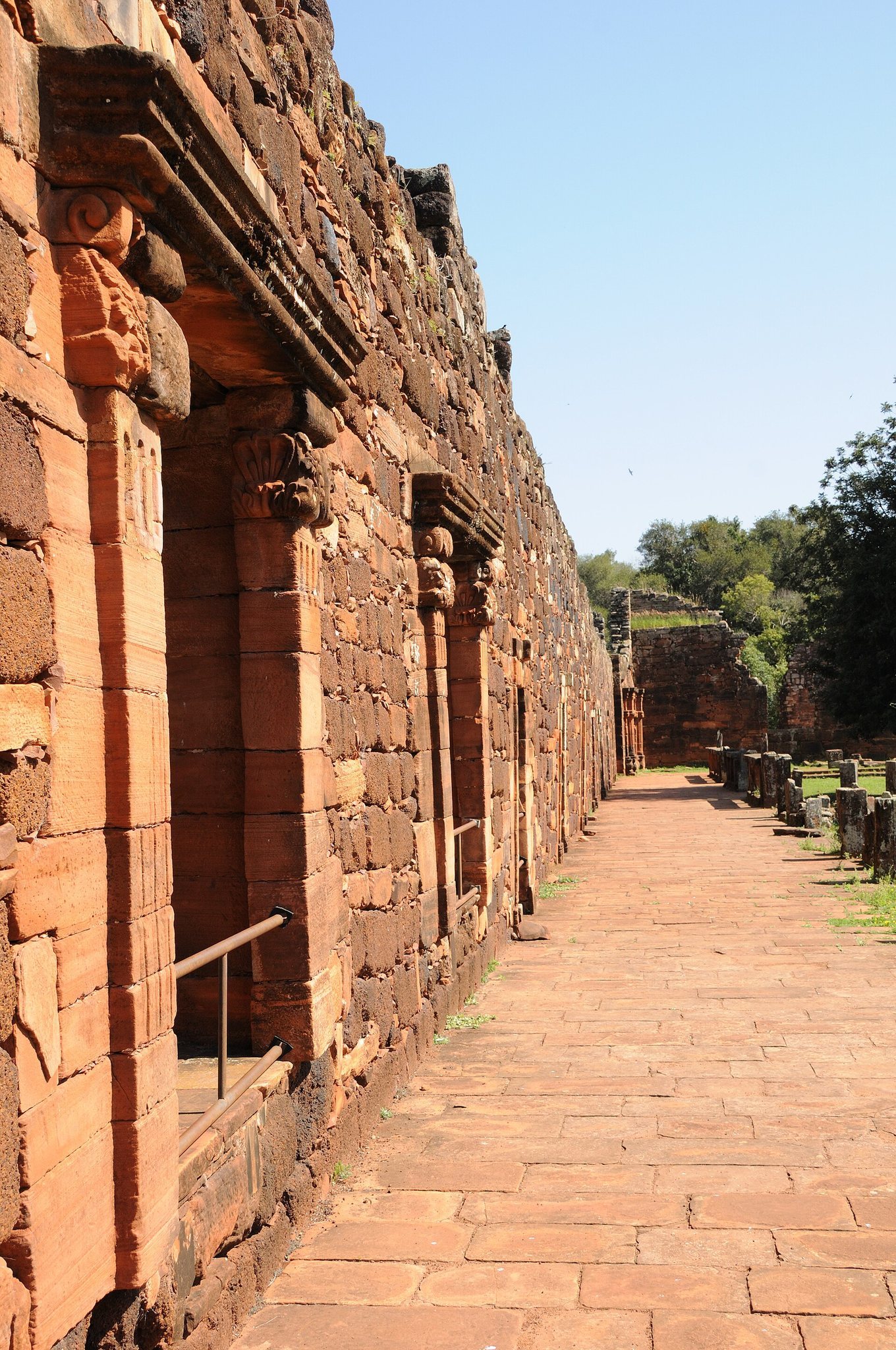
Several sandstone entrances survive among the ancillary buildings, demonstrating the construction techniques and architectural unity of the complex. A historic stone well also remains within the site. Other structures survive chiefly as foundations or partial walls, while restoration has consolidated parts of the ancillary buildings and clarified their original plans.
The foundations and sections of walls belonging to numerous Guaraní residences remain visible. They preserve the arrangement of the housing blocks and streets and show how the residential sectors were organized in relation to the central plaza. The church retains more substantial original architectural and decorative elements than many of the surrounding structures.
Archaeological setting
The ruins stand within the subtropical Paraná forest environment, although the archaeological complex is now incorporated into the urban fabric of San Ignacio. The World Heritage component covers approximately 14.59 hectares within the modern town, about 60 kilometres north of Posadas and near the right bank of the Paraná River. This urban setting distinguishes San Ignacio Miní from the other Argentine missions in the World Heritage property, whose rural surroundings have survived more extensively.