Hoysaleswara Temple: A Hoysala Shiva Temple at Halebidu
Site at a Glance
- Rating
- 4.8
- Popularity
- High
- Country
- India
- Primary era
- Medieval
- Eras represented
- Medieval
- Civilizations
- Unclassified
- Site type
- Religious
- Remains
- Temple
On this page14 sections
History
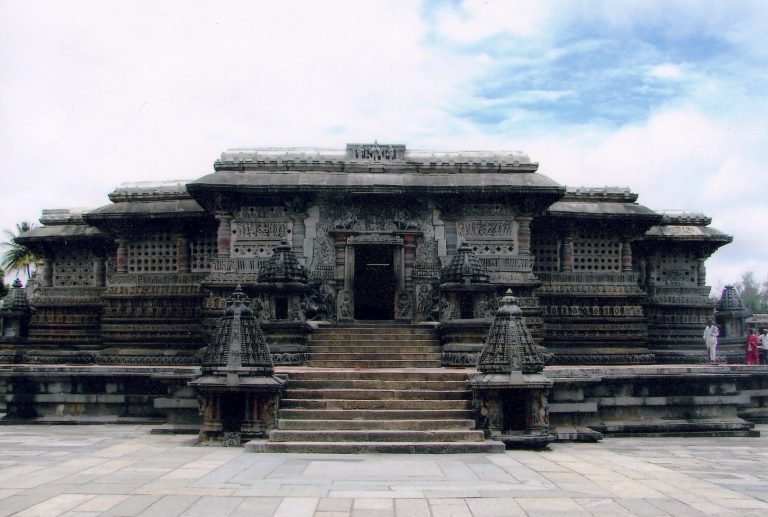
Hoysaleswara Temple is a twelfth-century Hoysala Hindu temple dedicated to Shiva at Halebidu in Karnataka, India. Built in the Hoysala period, construction began around 1121 CE and was completed around 1160 CE. The temple formed part of Dorasamudra, the Hoysala imperial capital that later became known as Halebidu.
Dorasamudra and the Hoysala capital
Dorasamudra became the established Hoysala capital under King Vishnuvardhana and remained the centre of the empire for nearly 300 years. The capital extended around a large lake and contained Hindu and Jain temples, stepwells, ponds, and public halls. Hoysaleswara was among its major religious monuments and is described as the largest Hoysala temple dedicated to Shiva in South India.
The temple was sponsored by Vishnuvardhana, while an inscription near the Kallesvara Temple ruins at Ghattadahalli identifies Ketamalla, an officer in the king’s service, as its builder. The inscription also records a royal land grant intended to support the temple’s construction, operation, and maintenance. The paired sanctums were dedicated to Hoysaleswara and Shantaleswara, associating the monument with masculine and feminine aspects of Shiva and with the king and queen Shantala Devi.
Although Hoysaleswara was fundamentally a Shaiva monument, its sculpture brought together Shaivism, the Hindu tradition centred on Shiva, Vaishnavism, which centres on Vishnu, and Shaktism, which centres on the Goddess or divine feminine power. Jain subjects also formed part of its imagery. This combination reflected the broader religious environment of the Hoysala capital.
Construction and later alteration
The Hoysala period lasted approximately from 1000 to 1346 CE. During this era, Hoysala rulers built about 1,500 temples in 958 centres. Hoysaleswara was altered during the life of the temple. An inscription records that the originally open central hall was enclosed with doors and perforated stone screens during the reign of King Narasimha I. By the fourteenth century, outer walls, doors, and stone screens had been added, while the temple’s crowning towers were later lost.
Dorasamudra suffered repeated attacks in the early fourteenth century. An army of Alauddin Khilji, a ruler of the Delhi Sultanate, destroyed the capital, and another Delhi Sultanate army under Sultan Muhammad bin Tughlaq attacked Belur and Halebidu for plunder and destruction in 1326 CE. The territory subsequently came under the Vijayanagara Empire. In the historical reconstruction associated with the site, the Hoysala kingdom ended in the mid-fourteenth century after King Ballala III was killed in a war with the Madurai Sultanate. After the capital was abandoned, Dorasamudra became known as Halebidu, meaning “old camp” or “old capital.”
Rediscovery and conservation
After Tipu Sultan’s defeat in 1799, the ruins came under British colonial administration and scholarship. Hoysaleswara was among the earliest Hoysala remains to be surveyed and was photographed in the 1850s. Richard Banner Oakley photographed much of its sculpture, while James Fergusson published studies in 1866 and 1876 without visiting the temple. Later inscriptions and translations corrected parts of Fergusson’s chronology and led to a more precise reconstruction of Hoysala history.
Indian scholars including Narasimachar and Srikantaiya later emphasized the temple’s importance for Hoysala art. Krishna’s 1930 report was described as the most thorough study of the site up to that time. Interpretation also changed as later scholars criticized the nineteenth-century imperial contrast between supposedly rational Western monuments and supposedly excessive Eastern monuments, while retaining Fergusson’s role in bringing Hoysaleswara to wider attention.
Several repair and restoration campaigns took place during the nineteenth and twentieth centuries. Some were not thoroughly recorded, and panels from other temple ruins were reused to cover the Nandi pavilion and repair the plinth and pillars. The temple’s present form therefore combines the original Hoysala monument with later additions, the loss of its towers, reused material, and successive repairs. In 2023, Hoysaleswara, the Chennakeshava Temple at Belur, and the Keshava Temple at Somanathapura were inscribed together as the Sacred Ensembles of the Hoysalas World Heritage Site.
Remains
Plan and principal shrines
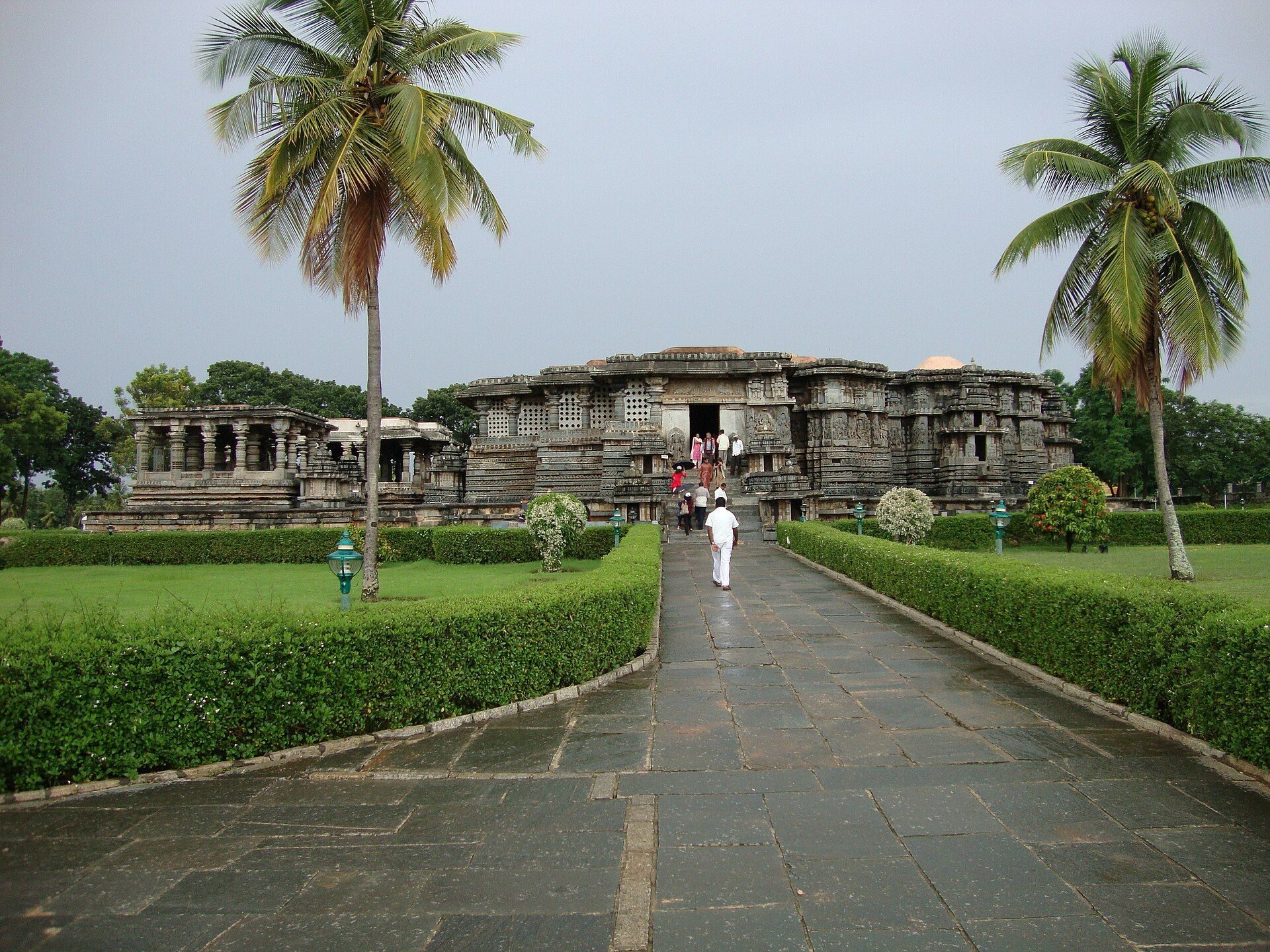
Hoysaleswara is a twin temple, or dvikuta vimana, with two equal-sized shrines arranged on a north-south axis and opening east toward the sunrise. The northern sanctum is dedicated to Hoysaleswara Shiva and the southern one to Shantaleswara Shiva. Both contain Shiva lingas, aniconic representations of the deity. Each square sanctum has an eastern viewing doorway and three external niches on its north, west, and south sides.
The two shrines stand on a jagati, or raised platform, whose outer edge carries a circumambulatory path about 15 feet wide. Smaller shrines share the platform and connect with the main temple by stone stairs. Each sanctum originally possessed a crowning shikhara tower, while the connecting vestibules had sukanasi superstructures. These elements have disappeared, leaving the temple visually flat. The missing towers may have followed the star-shaped form associated with better-preserved Hoysala shrines. Decorated miniature roofs, eastern perimeter walls, and additional shrines also disappeared.
Nandi and Surya shrines
Two Nandi shrines stand east of the principal sanctums. Each contains a seated Nandi, Shiva’s bull vehicle, facing the corresponding linga. A smaller Surya shrine is attached to the east of the southern Nandi shrine. Its seven-foot, or 2.1-metre, statue of Surya, the Hindu Sun deity, faces the Nandi and the southern sanctum. The Nandi and Surya structures each have their own sanctum.
Halls, entrances, and interior sculpture
A mandapa, or pillared hall, stands before each sanctum. The two halls join to form a large open navaranga, a central hall suitable for family and public gatherings. The temple originally had an open navaranga, which was later enclosed with doors and perforated stone screens. Four entrances serve the complex, with one on the north, one on the south, and two on the east. The eastern entrances face two detached open pavilions whose roofs rest on lathe-turned pillars.
Doorways and guardian figures
The northern entrance is generally used today. Its original dvarapalas, or doorway guardian figures, have been lost and replaced by two mismatched figures recovered from regional ruins. The northern lintel carving is damaged and is less carefully executed than other entrance sculpture.
The southern entrance retains two guardian figures about six feet high. They wear jewellery and originally had four arms, a third eye, fangs, a piled hairstyle, and a three-bended standing posture known as tribhanga. Their surviving attributes include a small drum, cobra, and trident. The figures were defaced, and twentieth-century trimming, restoration, and repolishing left their faces artificially disproportionate. Above the lintel, Nataraja performs the Tandava with Nandi, dancers, and musicians.
The southeastern entrance preserves better guardian faces, although two hands are broken. Its lintel shows a ten-armed Nataraja accompanied by Narasimha, Saraswati, Brahma, Ganesha, Parvati, Shiva, Bhairava, Indrani, Keshava, and Surya. The northeastern entrance is damaged. Its guardians are missing, but the pedestal and panels remain, while the lintel carvings have been defaced.
Pillars and ceiling figures
The interior walls are relatively plain compared with the exterior. Rows of lathe-turned pillars extend between the northern and southern entrances. The four pillars before each shrine are the most elaborate and are the only pillars with madanika or salabhanjika figures, decorative female forms, in their brackets.
The central part of each mandapa contains four pillars and a highly carved raised ceiling. Each pillar originally carried four standing madanakas, giving 16 figures in each temple and 32 in total. Eleven survive in damaged condition, six in the northern temple and five in the southern one. Figures that once occupied the eastern row do not survive, while two damaged madanakas remain near the second eastern doorway.
Exterior sculpture and religious narratives
Hoysaleswara is built from chloritic schist, commonly called greenschist or soapstone. The stone was soft and easy to carve when quarried but hardened after exposure to air. Its exterior walls carry about 340 large reliefs and a series of horizontal bands. From the base upward, these show elephants, lions, foliage scrolls with miniature dancers, horses, further scrolls, scenes from Hindu religious texts, mythical makaras, and swans.
The outer walls form a wide-ranging visual account of Hindu mythology. Large panels and smaller friezes draw on the Ramayana, Mahabharata, Bhagavata Purana, and major Shaiva and Vaishnava Puranas. The sequences interweave different texts rather than always completing a single story from beginning to end. Deities and figures represented across the walls include Shiva, Vishnu, Krishna, Rama, Durga, Ganesha, Saraswati, Brahma, Hanuman, Bhairava, Mohini, and many other divine or heroic forms.
Northern temple panels
The northeastern wall of the northern temple includes a court scene, Bhairava, Bharavi, the Churning of the Ocean, musicians with twelfth-century instruments, Sukracharya, the Kacha and Devayani legend, Lakshmi, Umamahesvara, the Vamana, Bali, and Trivikrama legend, an Indra legend, Virabhadra, and Shiva in meditation. Its southeastern wall shows dancers, Bhairava, Bhairavi, and Umamahesvara.
The southwestern wall presents Brahma, Shiva, Vishnu, Durga, Saraswati, Kama, Rati, and Parvati, together with the Indrakila legend and Parvati practising yoga. Ramayana scenes show the golden deer, Hanuman’s first meeting with Sugriva, Rama shooting through seven palm trees, and Hanuman giving Rama’s ring to Sita. Other panels show Mohini, reclining Vishnu on Sesha, Vishnu’s avatars, the twelve Adityas, Arjuna and Bhishma, and Shiva dancing with Mohini.
The northwestern wall includes Nataraja in the Tandava, Durga with the Saptamatrika, Abhimanyu, Drona, Krishna and Arjuna, the eight forms of Rudra, Bharavi, Saraswati, Ganesha, Narasimha, Vishnu in several forms, Kartikeya, Parvati, dancers, and musicians. The western wall contains eight representations of Umamahesvara, 25 of Shiva as Nataraja or a destroyer of demons, six Bhairavas, 18 Shakti images, 15 Vishnus, 12 Krishnas as Venugopala, and further representations of Varaha, Narasimha, Vamana, Trivikrama, Harihara, Ganesha, Kartikeya, Brahma, Saraswati, Indra, Surya, Mohini, and Arjuna.
Southern temple panels
The northeastern wall of the southern temple depicts Krishna’s life and exploits. Scenes include Vasudeva carrying the newborn Krishna across the Yamuna, Krishna killing Putana and other demons, stealing butter, playing the flute among people and animals, the Krishna and Pradyumna legend, and Krishna lifting Govardhana. The same wall also shows Yudhishthira and Shakuni playing dice and Bhima confronting Kichaka after Kichaka’s assault on Draupadi.
The southeastern wall presents episodes from the Bhishma and Drona books of the Mahabharata, with Vishnu, dancers, and musicians celebrating Arjuna’s victory over Drona. The southwestern wall includes Arjuna and Krishna, celebrations of the Pandavas’ victory, Mohini legends, Dakshinamurti, Umamahesvara, Tandavesvara, Vishnu, Arjuna meeting Shiva, and further Mahabharata scenes. Other panels show Bhima and Bhagadatta, Ganesha, Vamana, the marriage of Parvati and Shiva, Shanmukha and Tarakasura, Brahma on a swan, Shiva with Ganesha and Kartikeya, Narasimha, and Durga as Mahishasuramardini.
The northwestern wall shows reclining Vishnu with gods and goddesses, the Prahlada, Hiranyakashipu, and Narasimha legend, Mohini as Bhairavi with Bhairava, Rama fighting Ravana, Indra, Brahma with Saraswati, the Karna and Arjuna and Bhima and Dushasana legends, Umamahesvara, Ganesha, musicians, dancers, courtship scenes, Kali Shakti legends, and further episodes involving Arjuna.
Doorways, inscriptions, and associated remains
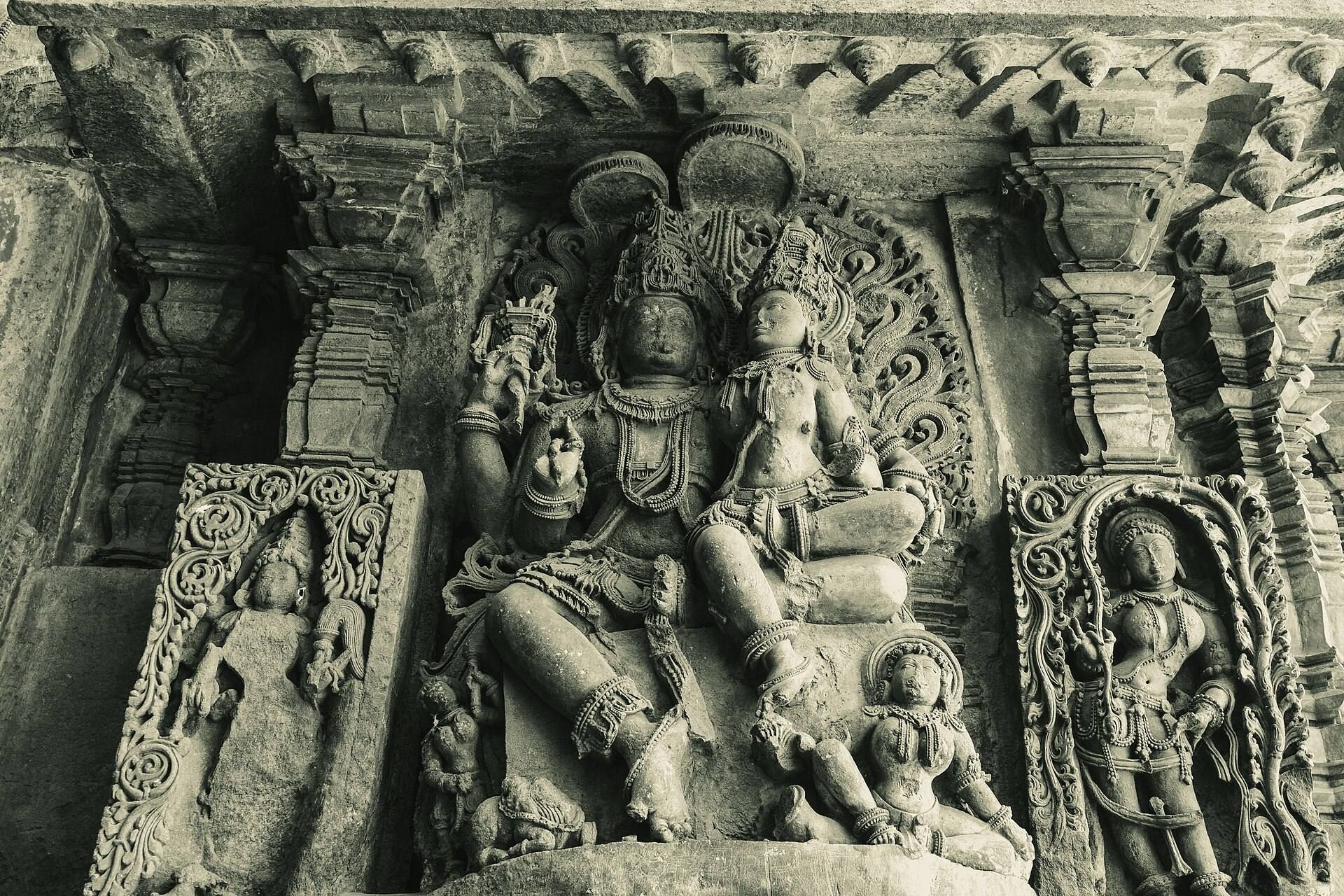
The sanctum doorways are flanked by dvarapalas and lead toward the vestibular chambers. Their lintels carry complex carvings of Shiva with Parvati and other deities, as well as two large makaras ridden by Varuna and Varuni. The doorjambs are decorated with purnaghatas, vessels of abundance. The plain sanctum walls direct attention toward the sacred image.
Two small facing niches stand where the two temples meet in the navaranga. They retain carvings and other artwork, while their internal statues have disappeared. A stone panel near the western niche carries a large Sanskrit inscription in North Indian and South Indian scripts. Outside the southern doorway, a large Ganesha statue stands in the park. It originally stood farther out at the outer gate, was damaged, recovered from the ruins, and placed near the temple.
South of the temple is a damaged Garuda pillar whose upper portion is missing. Its inscription breaks off midway but records that the general Lakshmana, his wife, and followers sacrificed themselves after the death of Ballala II. Eight male figures occupy the middle of the pillar. Four use swords in self-sacrifice, one sits in a prayer posture preparing for the act, and the others are shown during the sacrifice.
The premises preserve evidence of other shrines. A Chandra, or Moon, monument was attached to the Nandi shrine opposite the Nandi associated with the Surya monument, and excavation southwest of the temple revealed remains of a destroyed temple. Numerous sculptural panels bear artists’ signatures or guild marks, usually at their base or beneath the artwork. Repeated names include Manibalaki, Mabala, Ballana, Bochana, Ketana, Bama, Balaki, and Revoja. Guild marks and names include Agni-Indra, Indra, Paduca, and Paduvala-badaga.
The temple artwork is damaged but largely intact. Fragments and other recovered pieces are held in the Archaeological Survey of India museum within the premises, where they can be examined three-dimensionally. Some figures hold objects resembling maize ears. One interpretation identifies them as evidence of pre-Columbian contact between India and the Americas, while another identifies them as muktaphala, or “pearl-fruit.” Their identification remains disputed.