Forges du Saint-Maurice: Canada’s First Industrial Ironworks
Site at a Glance
- Rating
- 4.5
- Popularity
- Low
- Country
- Canada
- Primary era
- Early Modern
- External website
- Open
- Eras represented
- Early Modern
- Civilizations
- French
- Site type
- Economic
- Remains
- Production Complex
On this page13 sections
History
Forges du Saint-Maurice was an ironworking establishment north of Trois-Rivières in Quebec, Canada, created under French colonial rule in 1730. It became the first successful ironworking industry in New France, the French colony in North America that included the St. Lawrence valley and present-day Quebec before the British conquest of 1760, and the first industrial establishment in Canada.
Foundation under French rule
The iron-ore resources around Trois-Rivières, Cap-de-la-Madeleine, and Batiscan had been recognized since the seventeenth century. In 1729, François Poulin de Francheville, seigneur of Saint-Maurice and a Montreal merchant, requested a twenty-year monopoly for mining ore and producing iron in his seigneury, a large territorial concession whose holder exercised landholding and certain administrative rights, and on neighboring lands. The French Crown granted the privilege in 1730.
Francheville recruited two French metallurgical workers, who arrived late in 1731 and began examining and testing the ore in 1732. His foreman, Jean-Baptiste Labrèche, also inspected small ironworks in the British colonies to the south, which Francheville hoped to use as models. In 1733, Francheville founded the Compagnie des Forges du Saint-Maurice with several partners. His sudden death on 28 November that year left his widow, Thérèse de Couagne, responsible for his company obligations, while the remaining partners and colonial officials took practical control.
Production began during the winter of 1734. Four inexperienced workers made only about 2,000 pounds of uneven-quality iron by direct reduction, a process that produces iron without first melting it in a blast furnace. The forge stood on unstable ground, and work stopped in the spring. Colonial officials sent iron bars and a model of the forge to France for expert assessment. The failure was attributed to inadequate technical skill rather than unsuitable ore.
Reconstruction and industrial expansion
In 1735, Pierre-François Olivier de Vézin, a French master ironworker who directed the technical design and operation of an ironworks, inspected the site. He advised restarting the enterprise on a new basis and recommended a blast furnace, which produces molten cast iron by reducing ore with fuel at high temperature. A second company was formed in the mid-1730s with Vézin, François-Étienne Cugnet, Ignace Gamelin, Thomas-Jacques Taschereau, and other investors.
Between the summer of 1736 and the autumn of 1739, the complete ironworks were built on the model of large European establishments. Vézin underestimated the Canadian climate, groundwater, soil conditions, spring floods, and freeze-thaw cycles. Rushed construction and a shortage of skilled labor created technical and financial difficulties. French specialists, especially workers from Champagne and Burgundy, were recruited, and they and their families formed an industrial community of more than 400 people.
Between 1735 and 1741, establishment and operating costs reached 505,356 livres, while sales and production receipts totaled 114,473 livres. The company accumulated debts of about 350,000 livres and went bankrupt in 1741 after production stopped. The Crown seized the establishment in compensation for unpaid advances in 1742 and formally took ownership in 1743. Officials continued operating the works because they believed the colony’s iron resources could become profitable, although no adequately financed private successor was available.
Crown administration and military production
Under French state administration, the lower forge was destroyed by fire in 1747 and rebuilt. A water-powered forge hammer known as a martinet was added, while French molders introduced methods for casting artillery. The works produced domestic goods such as pots, pans, and stoves, and they were also directed toward military production. Their attempts to make heavy artillery of good quality were unsuccessful.
The forges were profitable until about 1749, partly because more than half their products were exported to France under favorable tariffs. Later, costly repairs, competition from French imports, falling iron prices, epidemics, and labor shortages produced recurring deficits. Production was repeatedly interrupted by labor disturbances after 1752. Soldiers were employed to work at the site, contributing to a production peak in 1752, described as the enterprise’s most productive year.
British operation and closure
The ironworks remained in operation when Britain took control of the colony in 1760. Under British rule, the establishment operated as a leased concession. Matthew Bell controlled the concern from 1800 to 1845. In 1806, the lease to Monro and Bell was renewed for 790 pounds less than the previous lease after the Executive Council, under Thomas Dunn, failed to establish a reserve price.
In 1810, the plant supplied all the ironwork for John Molson’s steam ferryboat Accommodation, the first steamship to operate on the Saint Lawrence River. The ironworks eventually became obsolete and closed permanently in 1883. The site then remained abandoned for nearly a century.
Archaeology and preservation
The Quebec Ministry of Cultural Affairs acquired the property in 1963 and transferred it to the Canadian federal government in 1973. Extensive archaeological work took place from 1973 to 1979, and research has continued. The site was recognized as a national historic site in 1919 and received its federal National Historic Site designation in 1973. Its historical interpretation commemorates the establishment and development of Canada’s first industrial community and ironmaking industry.
Remains
The former ironworks occupies the southwest bank of the Saint-Maurice River, north of Trois-Rivières, beside a creek flowing into the river. Built between 1736 and 1739 as a large European-style industrial complex, it included a blast furnace and other facilities for making cast and wrought iron. Unstable ground, a high water table, spring flooding, and severe freeze-thaw cycles placed continual strain on foundations and interfered with blast-furnace operations.
Industrial remains
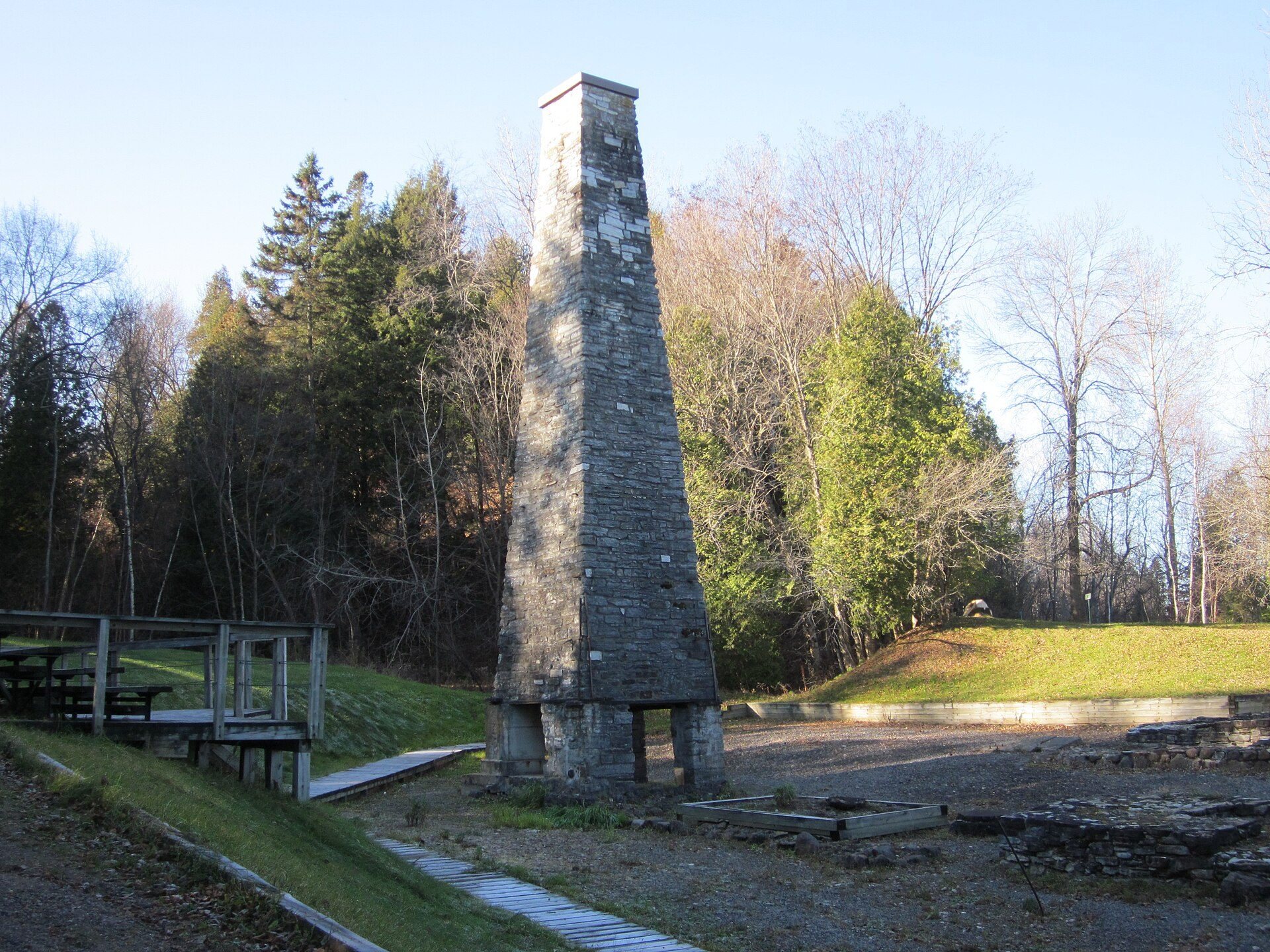
Lower forge
The ruins of the lower forge preserve part of the production complex that was rebuilt after a fire in 1747. The reconstruction included a martinet, a water-powered hammer used to work and shape heated iron. The lower forge formed part of an industry that made domestic goods and attempted the casting of artillery, and its surviving remains contribute to the archaeological picture of the works’ changing production.
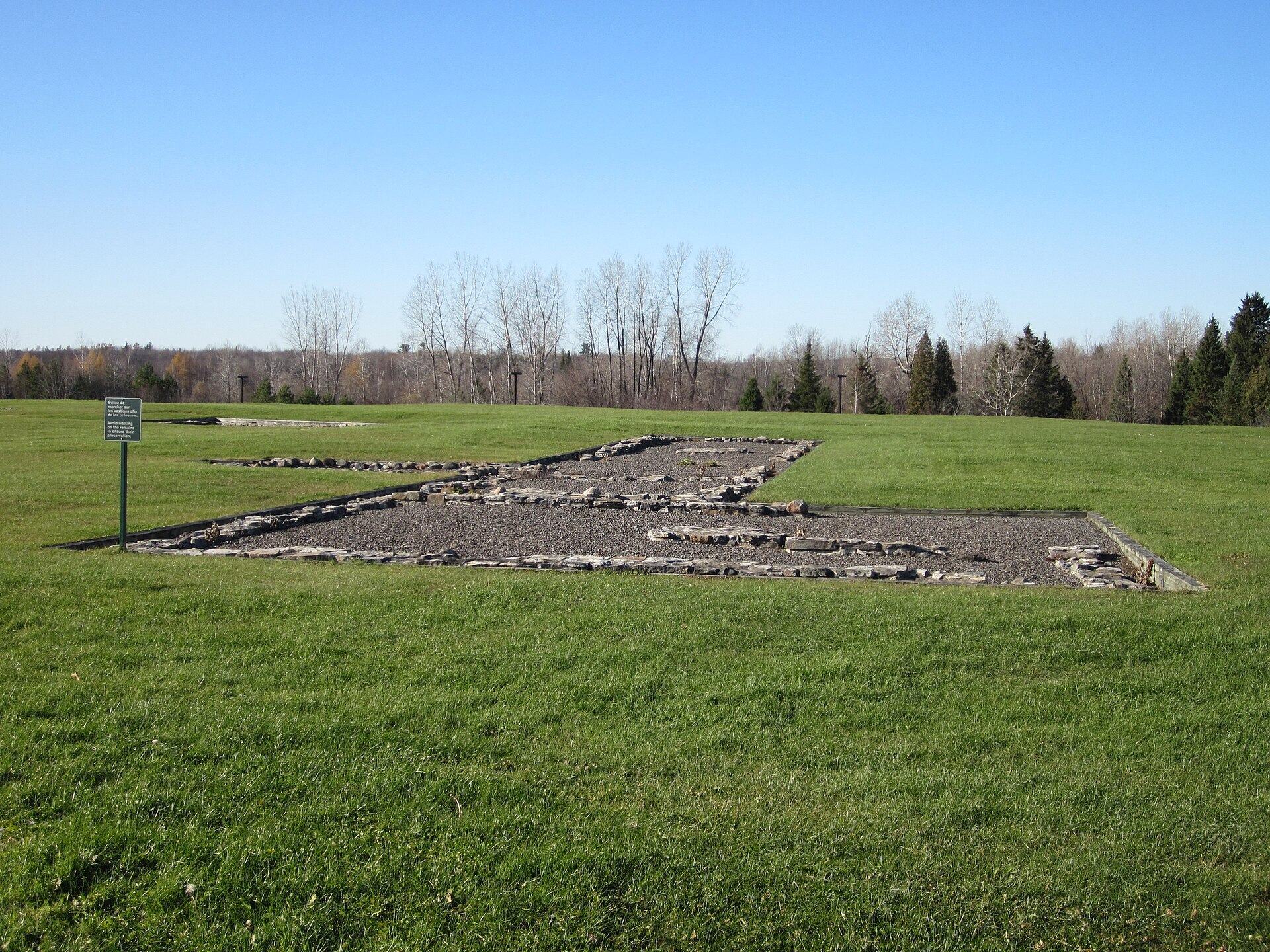
Upper forge
The ruins of the upper forge are among the surviving remains of the large ironworks established in the 1730s. Together with the other industrial foundations, they document the layout and operation of facilities designed for the production of cast iron and wrought iron.
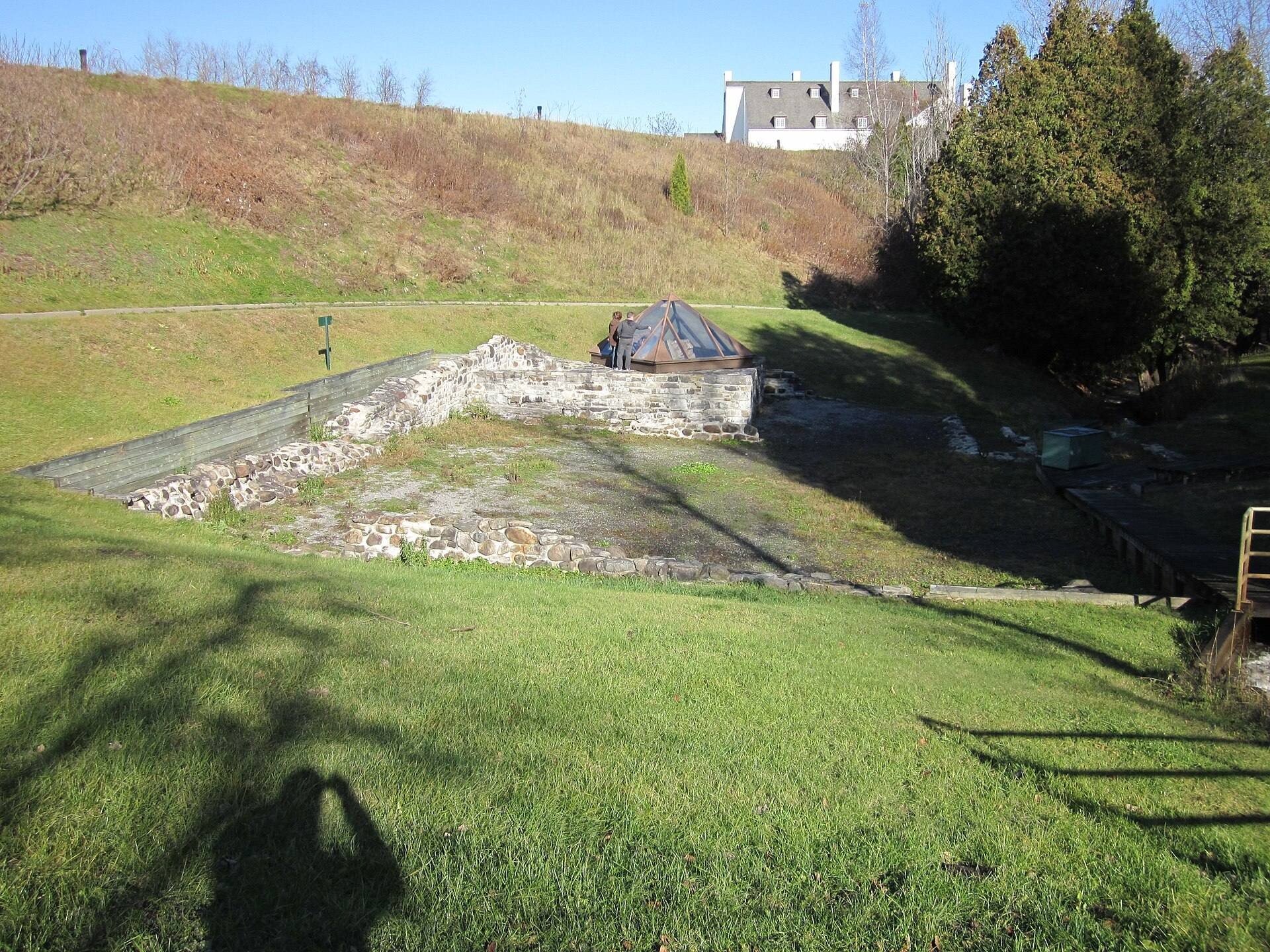
Mill ruins
The ruins of a mill form another part of the industrial landscape. Their survival, alongside the forge remains and foundations, helps define the extent and development of the former establishment.
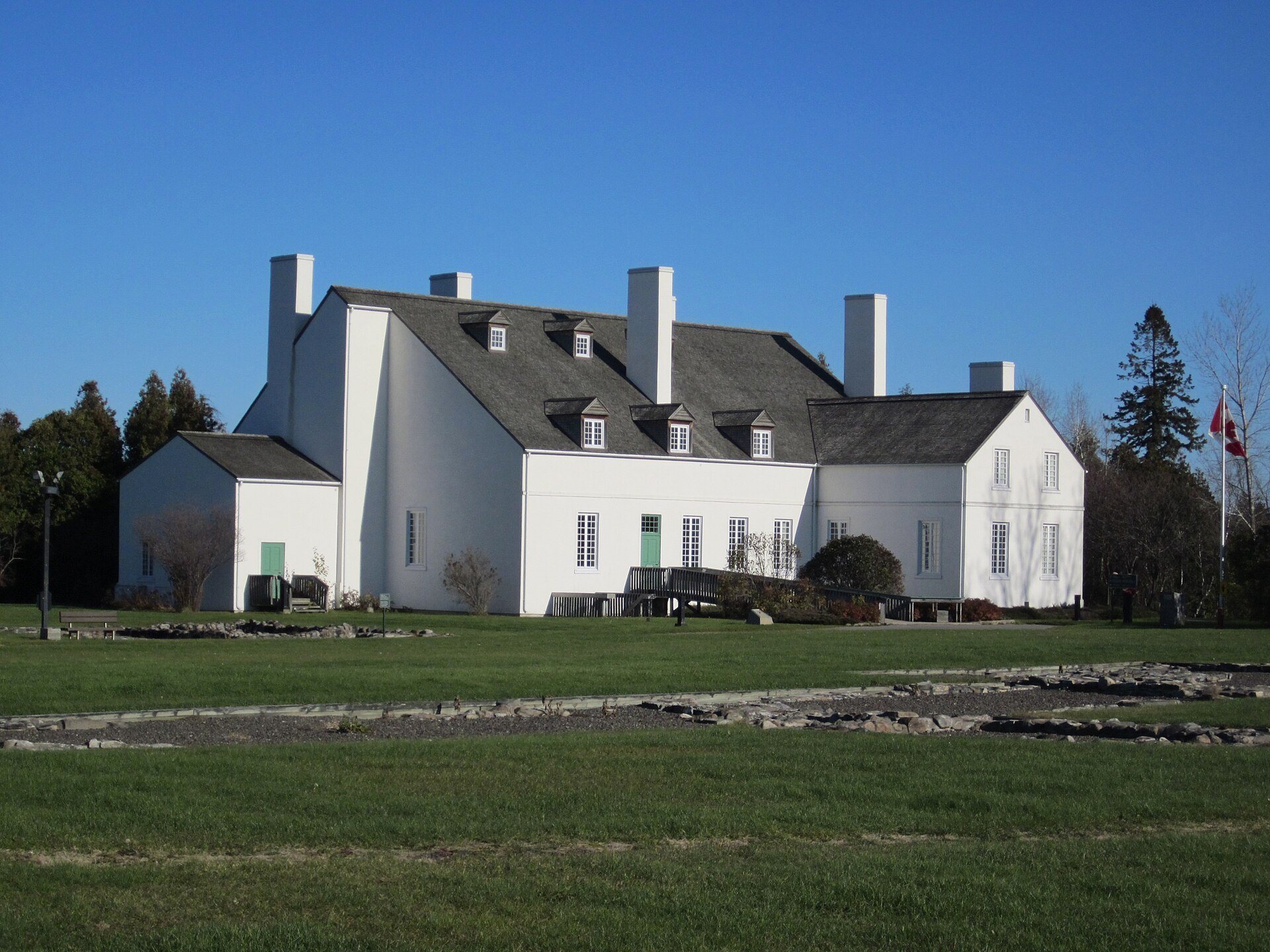
Grande Maison
The Grande Maison is one of the substantial remains associated with the industrial settlement. It stands within an archaeological landscape that also contains numerous other vestiges connected with the community formed by the workers and their families.
Settlement landscape and surviving features
The extensive archaeological landscape preserves evidence for the arrangement, operation, and growth of the ironworks and its associated industrial community. Other surviving features include a boundary marker, a fountain known as the Devil’s Fountain, and an eastern white cedar identified in the site inventory. Parks Canada preserves the former industrial property as a historical and archaeological landscape.