Ezana Stone: Aksumite Stele of Royal Conversion and Conquest
Site at a Glance
- Rating
- 4.1
- Popularity
- Very Low
- Country
- Ethiopia
- Primary era
- Classical
- External website
- Open
- Eras represented
- Classical
- Civilizations
- Aksumite
- Site type
- Civic
- Remains
- Monument
On this page6 sections
History
The Ezana Stone is a commemorative stele in Axum, Ethiopia, probably dating from the fourth century and associated with the ancient Kingdom of Aksum. It honors King Ezana, who ruled approximately from AD 330 to 356, and preserves evidence for the kingdom’s adoption of Christianity and expansion into neighboring territories.
Ezana and the adoption of Christianity
The inscriptions present Ezana’s conversion to Christianity as a major event in his reign. The change is associated with Saint Frumentius, a freed slave who became tutor to the young king and was later connected with the beginnings of Christianity in Aksum. The Ethiopian Orthodox Tewahedo Church traces its origins to this period.
The texts praise God, identify Ezana as king, and describe his authority over Aksum and other territories. His victories are represented as achievements accomplished through divine power, while the closing prayer asks God to strengthen his reign and allow him to rule with justice and equity.
Campaigns against Kush and Nubia
Toward the end of Ezana’s reign, around AD 350, his forces campaigned against Nubians and the Kushites. Kush was an ancient kingdom centered in Nubia, south of Egypt, and Meroë was its principal later capital. The conquest brought about the fall of Kush.
The inscriptions describe Nubian rebellions, attacks on Ezana’s messengers and envoys, and fighting at the Takaze River and the Kemalke ford. They then recount a twenty-three-day pursuit. The campaigns reached the confluence of the Seda and Takaze Rivers and included movements toward settlements named Alwa and Daro, along with other towns associated with the Noba, Kasu, and Red Noba.
The account describes villages with stone and straw walls being burned, cereals and materials being seized, idols being destroyed, and boats being sunk or otherwise destroyed. The listed goods include bronze, iron, copper, cotton, cattle, and sheep. Prisoners and booty were taken, and captives were thrown into the Seda River, which the translation identifies with the Blue Nile.
Ezana gives detailed figures for the campaign. He lists 214 male and 415 female prisoners, making 629 prisoners, and records 602 men and 156 women and children killed, making 758 deaths. Together, prisoners and dead amounted to 1,387 people. The booty is listed as 10,560 cattle and 51,050 sheep.
The king also states that he erected a throne at the confluence of the Seda and Takaze Rivers, opposite a stone-walled town on a peninsula, and another throne at Shado. These statements connect the monument with royal claims made during the campaigns and with the territories described in the inscriptions.
Languages and historical preservation
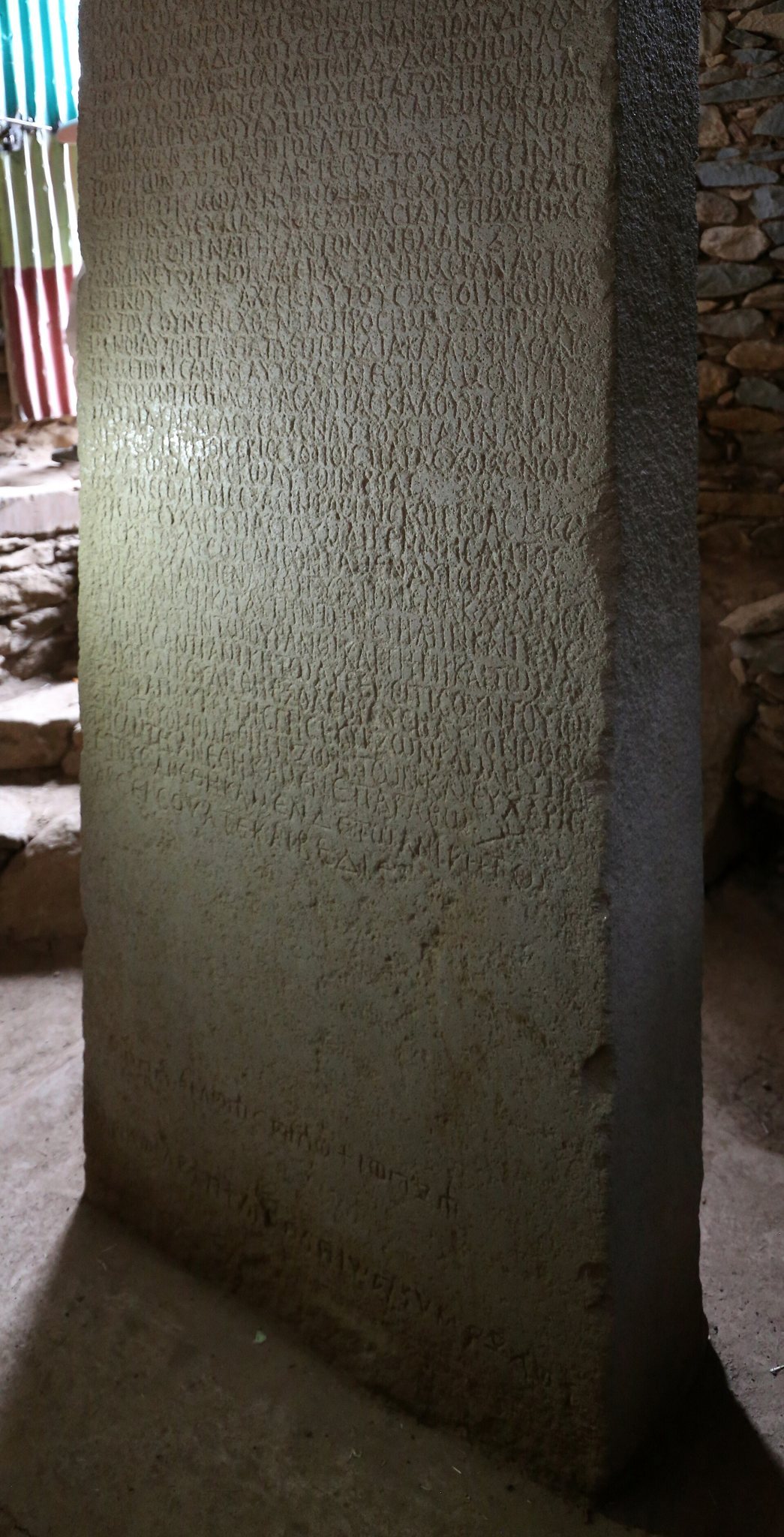
The stone’s related texts are written in Ge’ez, Sabaic, and Greek. Ge’ez was the classical Semitic language of the Ethiopian highlands; Sabaic was an ancient South Arabian language, and Greek served as a language of administration and monumental communication in parts of the eastern Mediterranean and Red Sea world. The three-language format has therefore been compared with the Rosetta Stone, whose inscriptions also present related content in multiple languages.
Stone inscriptions written in Ge’ez have also been found at Meroë, linking the written evidence from Aksum with the central city of the Kushite kingdom. Aksum, including the Ezana Stone, forms part of the UNESCO World Heritage property designated in 1980.
Remains
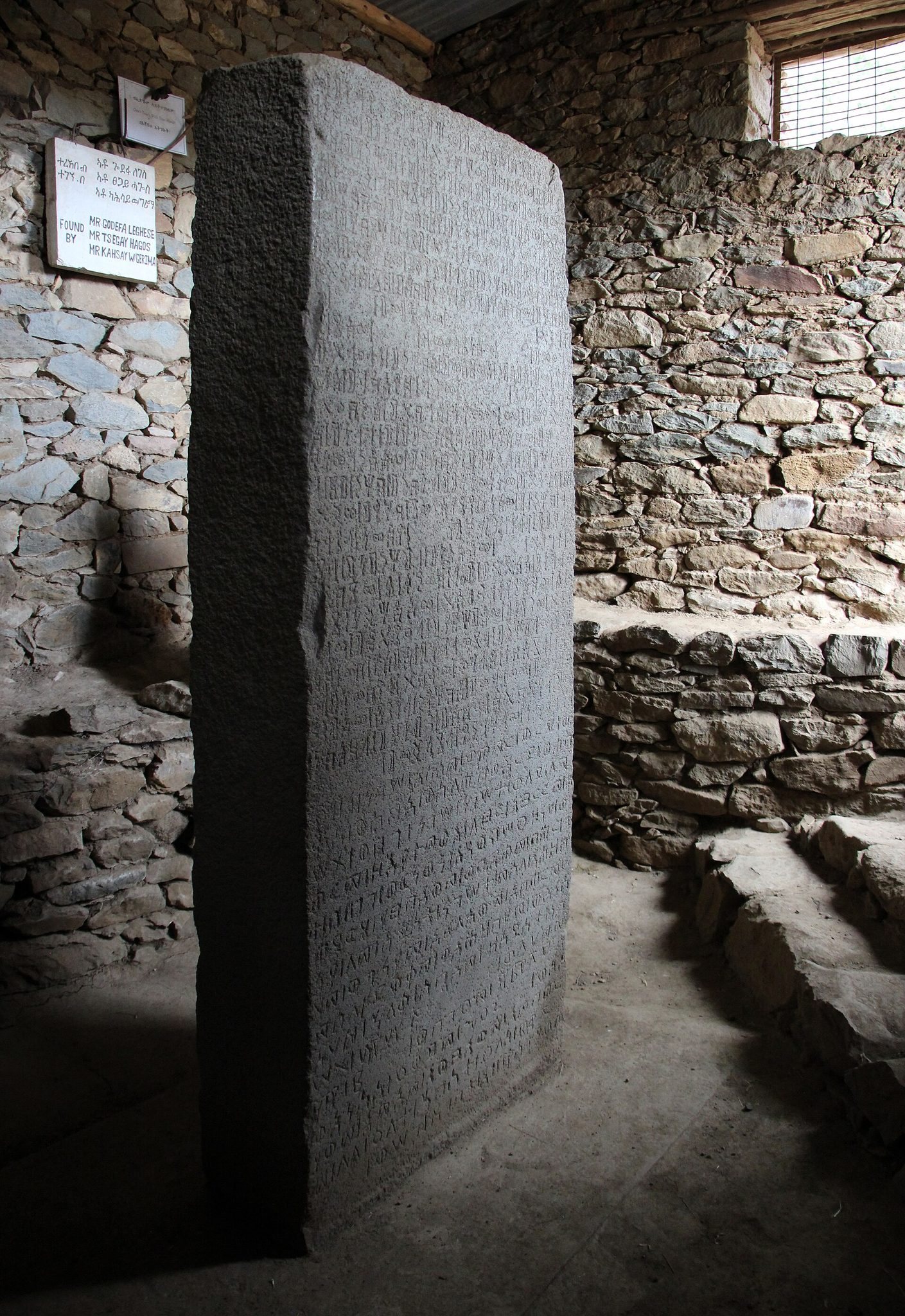
The Ezana Stone survives as a standing stone monument in modern Axum. Its surface carries inscriptions in three languages and scripts: Ge’ez written in the Ge’ez script, South Arabian Sabaic, and Greek. Together, the texts combine royal identification, religious statements, territorial claims, and an account of military action.
The inscribed monument
The surviving Ge’ez text names rivers, settlements, military columns, prisoners, casualties, and booty. It refers to stone-walled and straw-walled settlements, the Takaze River, the Seda River, the Kemalke ford, and places including Alwa and Daro. It also describes the destruction of idols and the seizure of metal goods, agricultural produce, livestock, and textiles.
The text preserves the king’s account of two royal thrones, one placed at the Seda and Takaze confluence and another at Shado. These references form part of the monument’s inscribed record of royal action, while the descriptions of people, settlements, rivers, and captured goods provide detailed physical and geographic context for the campaigns.