Vaikom Temple: A Shiva Temple and Centre of Kerala’s Social Reform History
Site at a Glance
- Rating
- 4.8
- Popularity
- High
- Country
- India
- Primary era
- Early Modern
- External website
- Open
- Eras represented
- Early Modern
- Civilizations
- Unclassified
- Site type
- Religious
- Remains
- Temple
On this page22 sections
History
Origins and religious traditions
Vaikom Temple, also known as Vaikom Sree Mahadeva Temple, is a Hindu temple dedicated to Shiva in Vaikom, Kerala, India. Its present reconstructed form is dated to AD 1539, while its foundation traditions connect the shrine with Parashurama, a warrior ascetic regarded in Hindu tradition as an avatar of Vishnu. The temple is regarded as one of Kerala’s major Shiva temples and is administered by the Travancore Devaswom Board.
Religious tradition identifies the temple as one of 108 Shiva temples established by Parashurama. Another tradition places the principal linga, the aniconic form in which Shiva is worshipped, in the Treta Yuga, the second of the four traditional Hindu cosmic ages, and holds that worship has continued there since its manifestation. These accounts belong to religious tradition rather than archaeologically established chronology.
The principal foundation story concerns the asura Khara, who is said to have received three Shiva lingas from Shiva after performing austerities at Chidambaram. Khara installed one at Vaikom, another at Ettumanoor, and a third at Kaduthuruthy before attaining liberation. The three temples consequently form a pilgrimage associated with visiting each shrine before midday worship.
Khara is said to have entrusted the Vaikom linga to the sage Vyaghrapada, whose name means “tiger-footed.” On the eighth day of the waning half of the Malayalam month Vrischika, Shiva and Parvati appeared before the sage. This event is commemorated each year by the Vaikathashtami festival.
Parashurama is traditionally credited with recognizing the linga, establishing its worship, and commissioning a great temple from Vishvakarma, the divine architect of Hindu tradition. A related account says that Parashurama built the temple, entrusted it to a Brahmin from Taruna village, and appointed the first chief priest after teaching him the required rites and mantras.
The name Vaikom is also explained through a legend concerning Shiva’s arrival at the site with Parvati. According to the tradition, Shiva had carried Brahma’s skull while seeking relief from the sin of killing Brahma and wandered for twelve years. The expression meaning “I shall place it” is regarded in this story as the origin of the place-name.
Construction and changing ritual authority
The temple is traditionally associated with Perumthachan, a legendary master carpenter and architect connected with Kerala’s building arts, who is said to have lived around AD 300. A stone inscription concerning construction was recorded as having been found and dated to approximately 800 years ago. The present reconstructed temple is dated to AD 1539, and the sanctum was later rebuilt under the Vadakkumkoor dynasty by Vishvakarma craftsmen from Thanjavur.
Vaikom’s Shiva is worshipped by both Shaivas, whose Hindu tradition centres on Shiva, and Vaishnavas, whose tradition centres on Vishnu. The principal deity is known as Vaikkathappan, meaning “Lord of Vaikom,” and as Annadanaprabhu, the lord associated with feeding devotees. The deity is understood through three daily manifestations: Dakshinamurti in the morning, Kiratamurti at midday, and Rajarajeshwara in the evening.
Ritual authority was originally associated with the Monatt Illam, a traditional Kerala Brahmin lineage. It later passed to the Mekkatt family, and a traditional episode is said to have led to its division between Mekkatt and Bhadrakali Mattappilly. The two tantric families, whose ritual authorities oversee prescribed temple ceremonies, alternate responsibility. The festival flag is raised toward the south or north in successive years according to the location of the family responsible for the rites.
The chief-priestly office belongs to the Tarani Illam, a Brahmin family that migrated from Kadathanad for temple service. Earlier rights were held by the Chozhamangal and Arangottu families before those lines became extinct. Ten other Brahmin families from Kadathanad serve as assistant priests.
The Vaikom Satyagraha
The Vaikom Satyagraha began on 30 March 1924 and continued for more than a year. A satyagraha was a form of nonviolent resistance associated with the pursuit of truth and justice. At Vaikom, the campaign sought the right of communities classified as avarna to use the roads around the temple. The movement became a major episode in Kerala’s social reform history and later served as a model for other satyagrahas.
The first phase involved Kunjappi, Bahuleyan, and Govinda Panikkar, who attempted to walk together along a road closed to them. Govinda Panikkar was allowed to proceed separately but refused to continue without his companions. All three were arrested. T. K. Madhavan and K. P. Kesava Menon were also arrested during the campaign and later released.
Mahatma Gandhi, Mannath Padmanabhan, and Sree Narayana Guru supported the movement. E. V. Ramasamy Naicker, later known as Periyar, and Akali volunteers from Punjab also joined it. Mannath Padmanabhan led a savarna procession to Vaikom in November 1924, while Sree Narayana Guru repeatedly visited the protest site and established a movement fund at his ashram.
The protest was temporarily suspended during negotiations, but resumed after those discussions failed. A legislative proposal concerning access to the roads was defeated in the Travancore legislature by one vote on 7 February 1925.
Festivals and continuing observances
Vaikathashtami is the principal annual festival. It lasts thirteen days, with its twelfth day falling on Krishna Ashtami of Vrischika. The central tradition recalls Shiva’s appearance before Vyaghrapada. During the festival, Shiva from Vaikom ceremonially meets Subrahmanya from the nearby Udayanapuram Temple. The north gateway is opened for Subrahmanya’s arrival, followed by a major offering, fireworks, a silent ritual separation, and the return of the two deities to their own temples. The following day includes bathing rites at Udayanapuram and the offering known as Mukkudi.
Other established observances include Maha Shivaratri, Tiruvathira during the Malayalam month Dhanur, Kumbhashtami, Navaratri, Vishu, the 41-day Mandala season, and Vinayaka Chaturthi. The twelve-year Vadakkupurathu Pattu invokes Bhadrakali, a fierce protective form of the goddess, through twelve days of ritual drawing and song followed by a thirteenth-day Gurusi ceremony. It was last held in 2025.
The temple maintains five daily pujas, or worship services, and three daily processions. During evening lamp worship and the third circuit of the night procession, the special ceremony called Ghattiyam Chollal consists of reciting praises while holding a silver staff topped by a bull. Tradition dates this practice to the reign of Ayilyam Thirunal. In 2013, the Daksinamurti Music Festival was established in memory of the Malayalam musician V. Daksinamurti Swami and became part of Vaikathashtami.
Recent conservation
The temple tank underwent a major Devaswom intervention after remaining heavily neglected until 2015. The murals in the sanctum were repainted in 2016. These interventions form part of the temple’s continuing physical and ritual history under the administration of the Travancore Devaswom Board.
Remains
Compound and eastern approach
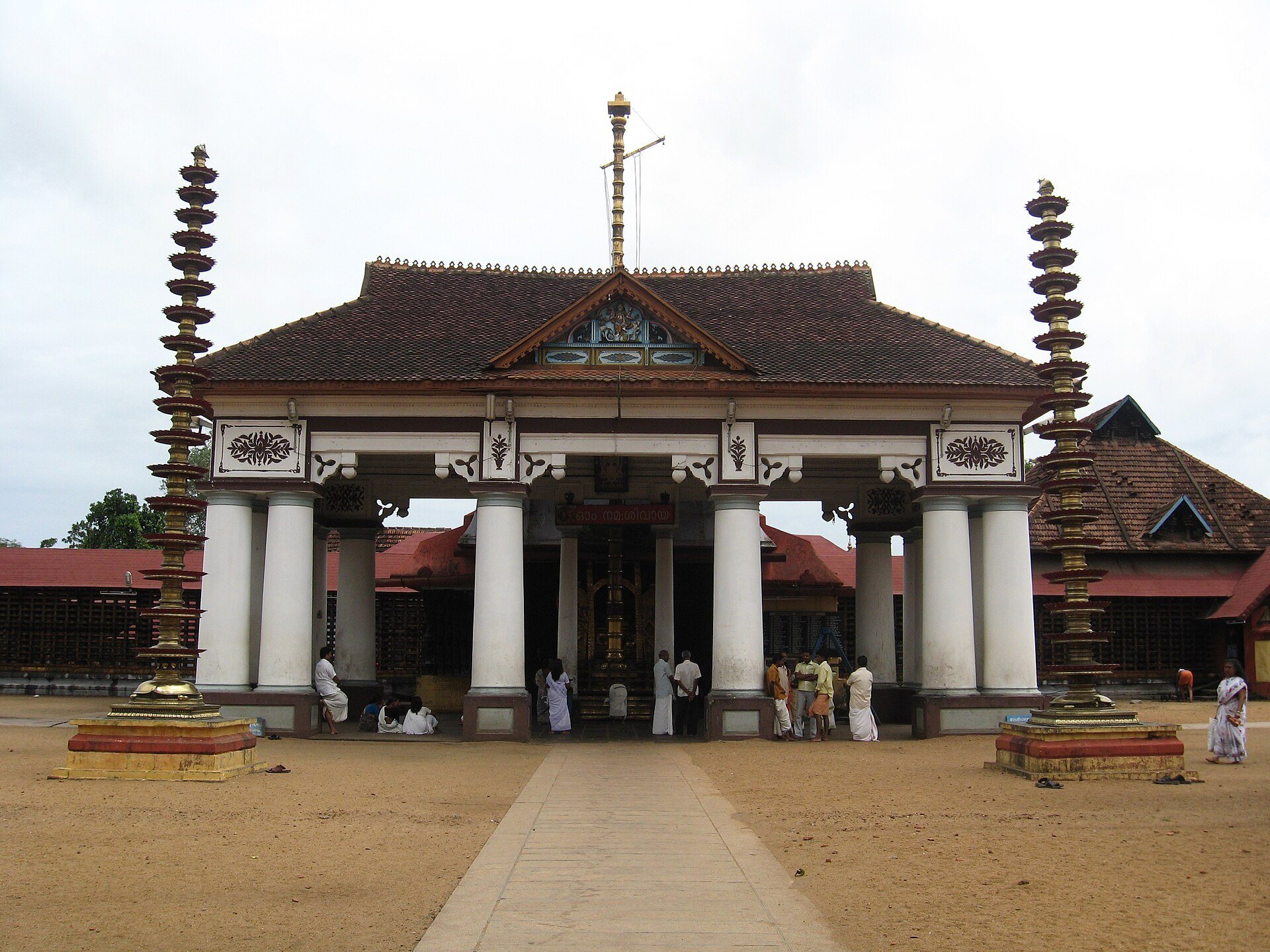
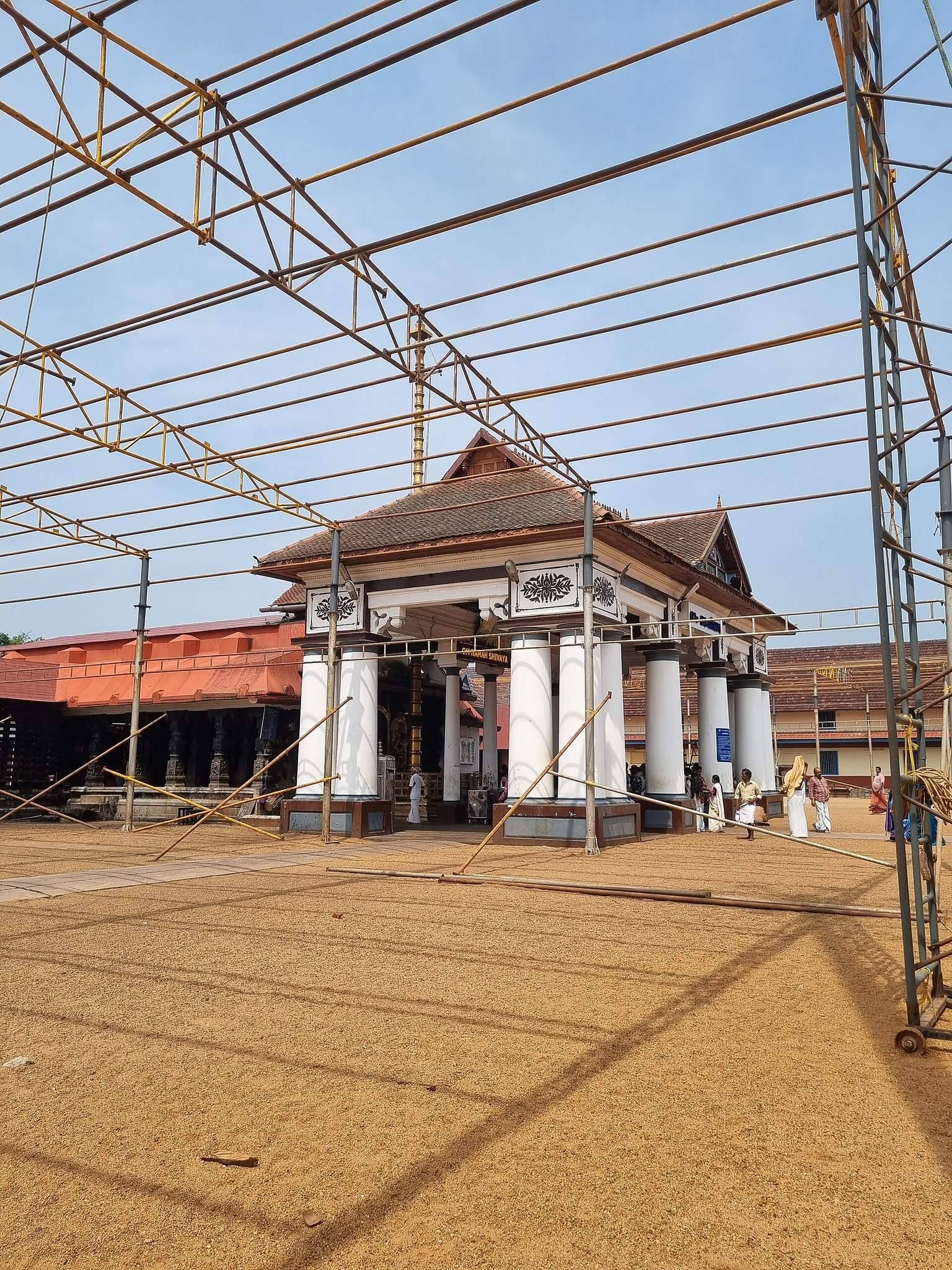
The temple occupies more than eight acres within walls levelled and reinforced with river sand. An elephant-proof fortification wall surrounds the compound, which has four gateways, or gopurams, monumental entrance towers. The temple faces east, although its alignment is described as deviating by five degrees from a strict north-south axis. The four entrance towers are relatively small and plain. Vembanad Lake lies approximately half a kilometre to the west, with a boat jetty beside the lake and the Cherthala area across the water.
The eastern gateway opens toward a large elephant shelter. A sacred peepal tree stands to its north and is associated with Vyaghrapada’s austerities and Shiva’s appearance before him. Devotees traditionally circumambulate the tree before continuing toward the main shrine. A later elephant shelter nearby is used for weddings, rice-feeding ceremonies, devotional singing, ritual vows, weighing offerings, and festival performances. Its massive granite pillars carry numerous divine figures.
Flagstaff and offering hall
Beyond the elephant shelter stands a tall golden flagstaff bearing the image of Nandi, Shiva’s bull vehicle. It is described as one of Kerala’s largest temple flagstaffs and as approximately 600 feet high. The offering hall beyond it contains guardian figures, a permanent lamp, and a colossal balikkallu, a ritual offering stone, more than ten feet high. Its ceiling represents Brahma and the eight directional guardians. At the hall’s northeast side stands a west-facing stone image of Ganesha called Sthambha Ganesha. Parvati and Subrahmanya are carved on the same pillar but are not visible.
Subsidiary shrines and enclosure features
The southeast portion of the enclosure contains several peepal trees and the open-air shrine of Panachikkal Bhagavati. The goddess is worshipped as Vanadurga, Bhadrakali, and Yakshi. A nearby serpent shrine contains Vasuki, Nagayakshi, Nagakanya, Nagachamundi, and Chitrakuta. Monthly offerings are made there, with a special serpent sacrifice during the Ayilyam observance of the Malayalam month Kanni.
Southern and western features
The southern side contains a temple auditorium and a closed western door. Tradition associates the door with a temple manager who was bitten and killed by a snake after defiling a food offering. It is said to have been closed thereafter and is not opened.
Kalaykkal Temple
In the northwest part of the enclosure stands the small Kalaykkal Temple. It houses Nandi as Kalaykkal Valiyachan and is served by Ezhava priests. Its annual festival takes place on the tenth day of Medam. The deity is traditionally regarded as the guardian of the temple after the main shrine closes.
Northern gateway and dining hall
The northern gateway has an additional entrance for elephants and receives Subrahmanya from Udayanapuram during Vaikathashtami. Beside it stands a two-storey dining hall. Brahmins formerly ate on both floors; the upper floor now houses the Temple Arts Centre, while communal meals continue below. The adjacent temple tank covers more than two acres.
The northeastern part of the enclosure contains the Devaswom office and offering counters. Vaikom Devaswom is an A-grade Devaswom under the Travancore Devaswom Board and serves as the headquarters of the Board’s Vaikom group. Several subsidiary temples stand around the main complex, including Vadakkumkoor Mookambika Temple, Vaikom Sreekrishna-Navagraha Temple, Madathilkkavu Bhadrakali Temple, and Vaikom Ayyappa Temple. These are later foundations, generally no more than one or two centuries old, and maintain daily worship.
Sanctum and central shrine
Elliptical sanctum
The main sanctum is a large single-storey structure with two chambers. Its exterior appears circular, but it is described as Kerala’s only oval or elliptical sanctum, an unusual form traditionally associated with Perumthachan. Built of stone, it has an approximately 200-foot circumference and a copper-sheet roof crowned by a golden finial. The inner chamber contains an east-facing Shiva linga more than six feet high on a pedestal approximately two feet high. The linga is regarded as one of Kerala’s largest Shiva lingas.
Six steps lead to each chamber of the sanctum. Tradition interprets the six steps as the abandonment of desire, anger, greed, delusion, pride, and envy. The sanctum walls carry murals of Nataraja, the ten avatars, Vishnu with Sri Devi and Bhu Devi, and Shiva granting the Pasupata weapon to Arjuna. These murals were repainted in 2016.
Sanctum doors and drainage outlet
A western door in the sanctum remains closed and is associated with the presence of Parvati. Lamps are placed there instead. On the northern side, a drainage outlet with a yali face carries away liquid used during ablutions. A yali is a mythical animal motif commonly used in South Indian temple architecture. Circumambulation beyond this outlet is prohibited.
Nalambalam and inner circuit
The extensive nalambalam, the enclosed quadrangular passage surrounding a Kerala temple’s central sanctum, has a copper roof and outer walls decorated with a lamp gallery. Door halls inside provide spaces for chanting and rest. A kitchen occupies the northeastern corner, while a smaller Ganesha shrine stands south of the main sanctum. The inner sacrificial circuit contains stones representing the eight directional guardians, the seven mothers, Virabhadra, Ganesha, Shasta, Subrahmanya, Durga, Brahma, Ananta, and Chandikeshvara in the form of Nirmalyadhari. Offerings are made to these stones during processions.
A bilva tree with two branches grows in the northwest corner of the nalambalam, and its leaves are used in offerings to Shiva. The complex also contains a large kitchen where food for communal feeding is prepared. Its ash is distributed as sacred ash.
Ganesha shrines
The Ganesha shrine beside the main sanctum contains two east-facing Panchaloha images, a four-foot Mahaganapati and a two-foot Balaganapati. Panchaloha refers to a traditional five-metal image. Another four-foot stone image, the west-facing Sthambha Ganesha, stands in the offering hall and is traditionally believed to be self-manifested. A third Ganesha is installed near the shrine of Krishna and faces east.
Mandapas and sacred images
Namaskara Mandapa
The Namaskara Mandapa stands directly before the sanctum. This copper-roofed pillared hall has sixteen pillars decorated with wooden carvings showing scenes from the Ramayana, Mahabharata, and Bhagavata. Its ceiling represents the nine planets. A large Nandi image stands at the western end, while additional Nandi images occupy roofed and gilded platforms outside the nalambalam.
Principal Shiva image
The principal Shiva image is an east-facing linga in the form of Sadashiva. It is regularly adorned with bilva garlands, flowers, rudraksha garlands, sacred ash, lunar emblems, and representations of the third eye. Daily and festival worship includes processions of the portable deity, ablutions, food offerings, communal feeding, and special rites such as Udayastamana Puja, Pradosha Puja, Uma-Maheshwara Puja, Svayamvara Pushpanjali, Mrityunjaya rites, Rudra Sukta Pushpanjali, and bilva-garland offerings.
Panachikkal Bhagavati and serpent platform
Panachikkal Bhagavati is installed on an uncovered platform south of the main shrine rather than inside a sanctum. The nearby serpent deities occupy a separate platform where milk, offerings, serpent songs, and turmeric ablutions are performed. Their open-air arrangement forms a distinct ritual area within the larger temple compound.