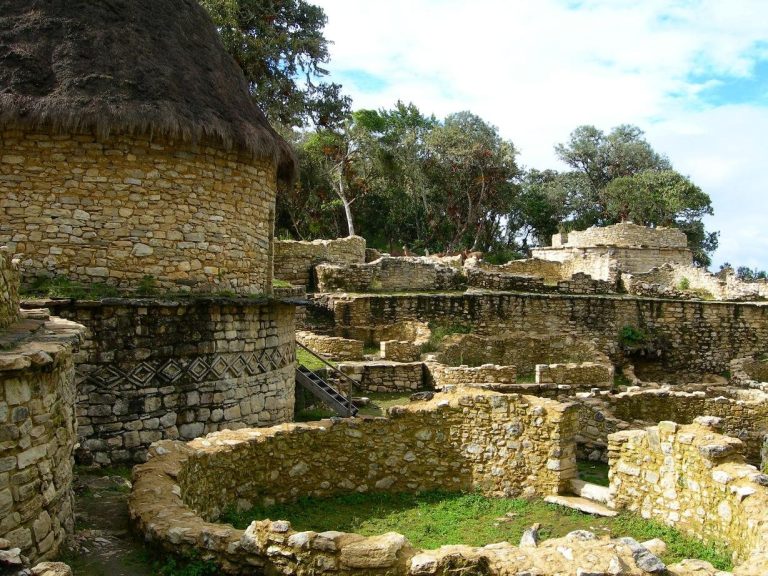
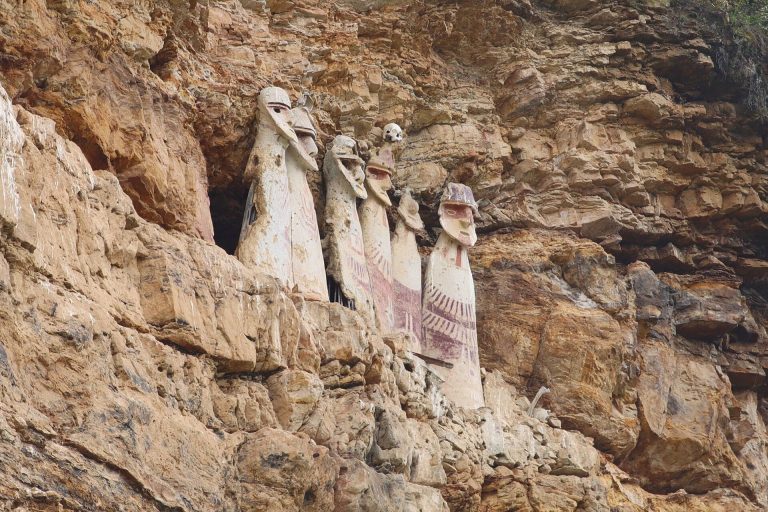
Revash: A Chachapoya Funerary Complex in Peru
Site at a Glance
- Rating
- 4.7
- Popularity
- Low
- Country
- Peru
- Primary era
- Medieval
- Eras represented
- Medieval
- Civilizations
- Chachapoya
- Site type
- Burial
- Remains
- Necropolis
On this page6 sections
History
Revash is a Chachapoya funerary complex in Santo Tomás District, Luya Province, Amazonas, Peru. Built during the Late Intermediate period, the pre-Inca era before the expansion of the Inca Empire, it is generally dated to the fourteenth century. The complex consists of mausoleums associated with prestigious or powerful people, although osteological evidence indicates that they served as collective burial residences rather than individual tombs.
Chachapoya Funerary Traditions
The Revash mausoleums belong to the funerary architecture of the Chachapoya, a pre-Inca culture of the northern Peruvian Andes and adjacent eastern valleys. In 1950, Paule and Henry Reichlen proposed a fourteenth-century date and compared the structures with chullpa traditions, a form of Andean funerary construction used to bury or preserve human remains. The complex appeared relatively late in Peru’s archaeological history and has not been linked to identified Inca cultural influence.
Federico Kauffman Doig interpreted the mausoleums as representations of the houses inhabited by local people. Their resemblance to the cliff dwellings of Colorado is regarded as coincidental rather than evidence of a historical connection. The meaning of their painted and incised symbols remains uncertain. Their cruciform motifs resemble decoration on the side walls of the church at La Jalca, whose construction local tradition attributes to Juan Oso, or “Little Bear,” a figure from regional mythology.
Discovery and Archaeological Study
During the nineteenth century, the explorer Charles Wiener identified mausoleums in the Utcubamba region. Henry and Paule Reichlen later examined the Revash structures, particularly after the collapse of one roof covered and protected cultural remains. Between 1983 and 1986, expeditions organized by the Institute of Amazonian Archaeology surveyed and recorded previously unknown mausoleum groups at Ochín and other locations around Revash. Further sarcophagus groups are known at La Petaca near Leimebamba.
Revash comprises two burial groups, while additional groups in the surrounding region have been found or remain unidentified. The mummies once placed inside the mausoleums were destroyed by rodents and looted long ago, but the burial structures themselves remain almost intact.
Remains
Cliff-Built Mausoleums
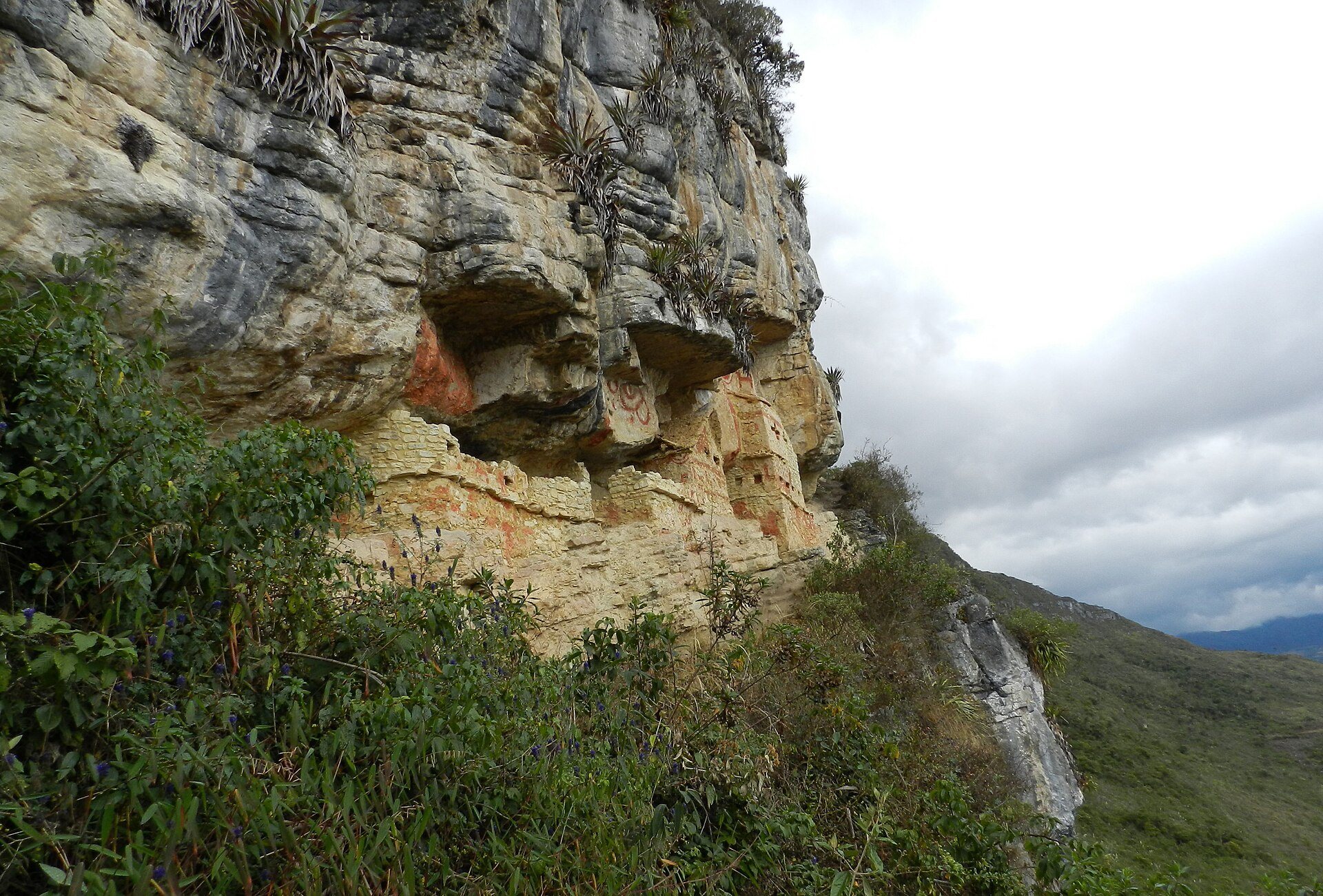
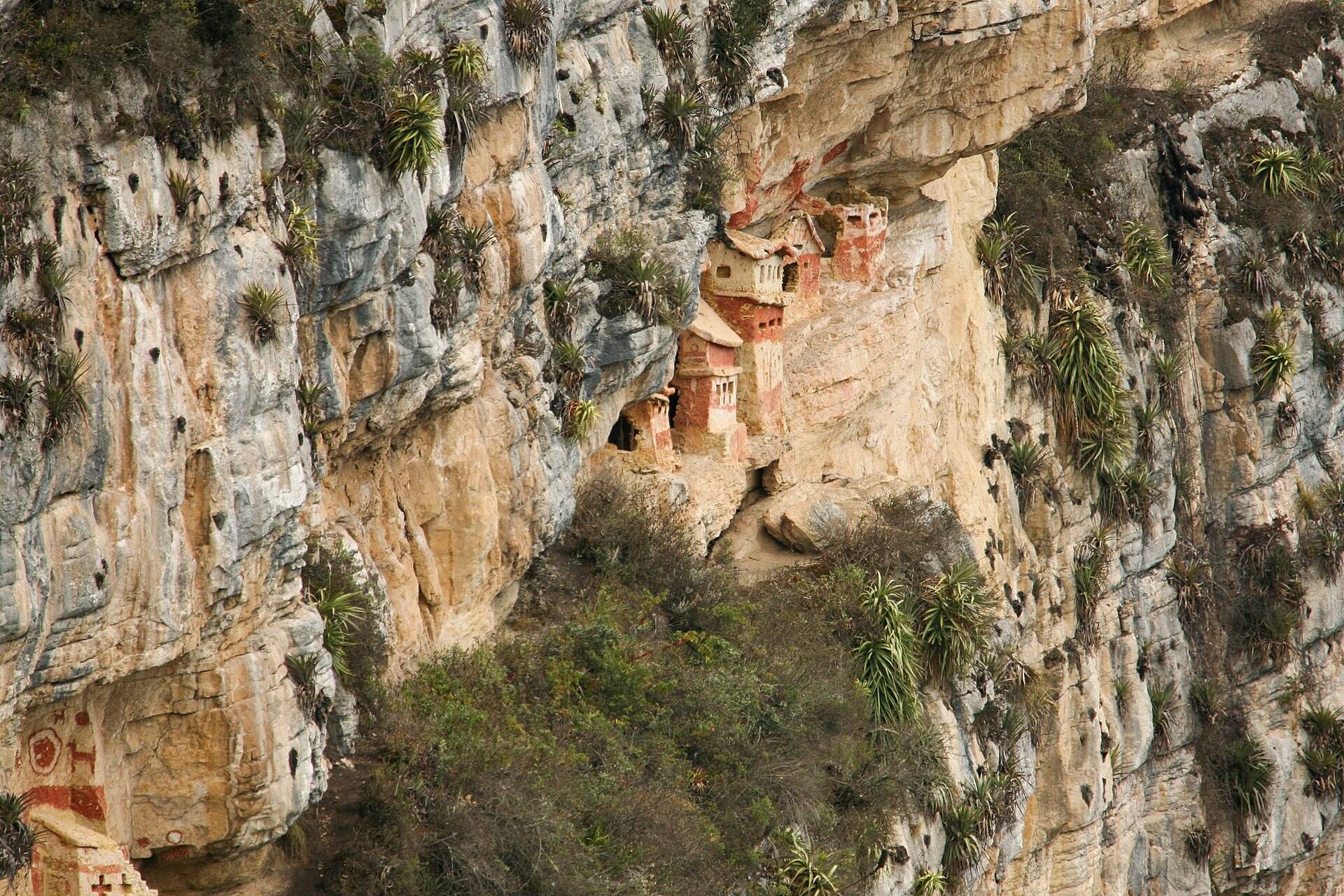
The mausoleums occupy a narrow corridor within a cavity in the limestone rock formation of Cerro Carbón, on the edge of the Alto Utcubamba Valley at about 2,800 metres above sea level. The San José de Laumar River marks the southeastern boundary of the area. Arranged in a straight line beneath the rocky overhang, the structures resemble small houses attached to the cliff and form miniature groups of dwellings.
Each mausoleum has a rectangular lower level and one or two upper levels. Doors open from the sides rather than the front, and adjoining structures often connect laterally through dividing walls or shared party walls. The rear sides were built directly against the rock. Walls consist of stones laid with mud mortar, while the roofs have two slopes and were largely symbolic because the overhang shielded them from rain and sunlight. Their construction imitated adobe roofs, using sticks and reeds covered with mud in the quincha technique.
Painted and Incised Decoration
Moldings run across the upper sections of the walls. Painted designs include felines, South American camelids, human figures, and circles divided into two colors. Other decoration was cut directly into the walls, including T-shapes, crosses, and rectangles. The crosses recall motifs used in the wall decoration of Peru’s ancient Virú culture, an early society of the northern coast.
The paintings include five apparently dancing couples. Their detailed bodies and faces, especially the eyes, show controlled artistic treatment, with the figures’ gazes directed toward the viewer.