Kuélap: A Chachapoyas Walled Settlement in Peru
Site at a Glance
- Rating
- 4.7
- Popularity
- Medium
- Country
- Peru
- Primary era
- Medieval
- External website
- Open
- Eras represented
- Medieval, Early Modern
- Civilizations
- Chachapoya, Inca
- Site type
- Military
- Remains
- Fortified Town
On this page23 sections
History
Kuélap is a monumental walled settlement built by the Chachapoyas culture in Peru’s northern Andes. Human occupation began by the fifth century AD, while most of the surviving structures were constructed between about AD 900 and 1100, during the later development of the Chachapoyas cultural tradition. The precise stage at which the main monument was erected remains uncertain, but its scale made it an important centre within the Chachapoyas cultural area.
A Chachapoyas centre before and during Inca expansion
The settlement predates the Inca Empire, the imperial state that controlled much of the central Andes before the Spanish conquest. Later Inca activity at Kuélap is shown by buildings placed over older circular structures and by an adolescent burial accompanied by valuable objects. This activity belongs to the Late Horizon, the final major pre-conquest period of the central Andes, conventionally associated with Inca expansion and dated here to approximately AD 1470–1532.
Kuélap may have housed as many as 3,000 people, although its exact function remains unresolved. Its enormous walls and restricted entrance have encouraged interpretations of the site as a fortress or emergency refuge. Other interpretations view it as a protected pre-Columbian sanctuary, as well as an administrative and residential centre for an aristocratic or theocratic elite connected with food production and the ritual control of atmospheric forces. Questions also remain about how the builders transported the great limestone blocks, organized the water supply, and sustained the settlement over time.
Violence and the end of occupation
Occupation probably ended around 1570, after the Spanish conquest, although the duration and causes of abandonment are uncertain. A large massacre probably occurred at about this time during a local political and religious conflict. More than 100 skeletons, mostly those of children and apparently not women, were found near the cliff beside the sacred temple. The bodies had not been placed according to funerary practice.
The massacre was confined to the Circular Platform and was probably carried out by a well-organized local group against the ruling lineage. A major fire followed and marked the end of the settlement’s occupation. The event has been interpreted as a reaction to upheavals associated with the Spanish conquest, including epidemic disease and famine, but the precise cause remains uncertain.
Rediscovery, research, and conservation
Kuélap was effectively unknown to outsiders until 1843, when Juan Crisóstomo Nieto, a judge from Chachapoyas, reached the site while conducting official business with local guides. Antonio Raimondi surveyed it in 1870, and Charles Wiener visited in 1881. Ernst Middendorf studied the settlement in 1887, followed by Adolf Bandelier before or around 1940 and Henry and Paule Reichlen in 1948. Louis Langlois produced a detailed study in the 1930s, while Arturo Ruíz investigated the site in 1972. Federico Kauffmann Doig became one of the principal long-term investigators of Kuélap and the Chachapoyas culture. Peruvian and foreign archaeologists have continued excavation and research since the 1980s.
Kuélap is recognized as Cultural Heritage of the Nation and appears on Peru’s tentative list for World Heritage. Its protected area covers about 218 hectares, with a buffer zone of about 610 hectares. Together, these areas protect approximately 12 archaeological sites in addition to the principal monument.
Structural instability was documented from 2013 onward and culminated in the collapse of part of the perimeter wall in April 2022. The Ministry of Culture, assisted by Peruvian and foreign experts, began emergency conservation and scientific investigations to identify the causes and prevent further collapses. Partly obstructed drainage channels have allowed water pressure to expand the artificial platform and loosen facing stones, making the management of the surviving structures an important part of current archaeological work.
Excavations in 2026 uncovered a stone funerary structure containing five individuals, four adults and one infant. The context dates to the Late Horizon, about AD 1470–1532, and provides evidence for funerary and ritual practices in the Chachapoyas region during the final pre-conquest centuries. The discovery adds to the wider evidence for later activity at a settlement whose main monumental phase was centuries earlier.
Remains
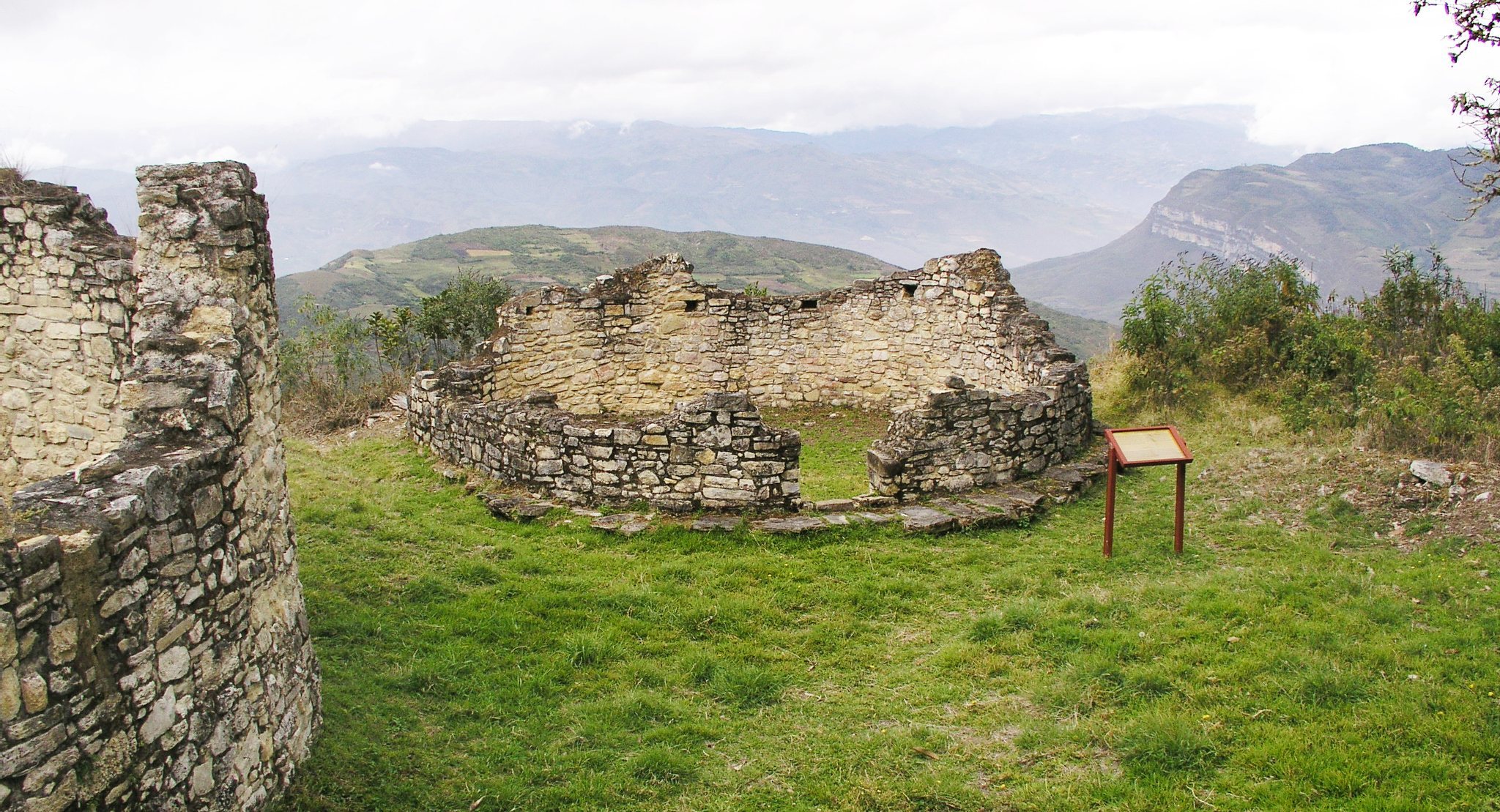
Kuélap stands at about 3,000 metres above sea level on a limestone ridge above the left bank of the Utcubamba River. The settlement occupies roughly six hectares and uses the mountain’s natural escarpment. Its principal artificial platform is oriented approximately from south to north, extends about 584 metres, and reaches up to 110 metres in width. Enormous stacked terraces form three principal levels, while a large group of circular buildings, later Inca structures, sacred centres, burials, and water channels occupy the enclosed area.
Platforms, walls, and entrances
Main platform and terraces
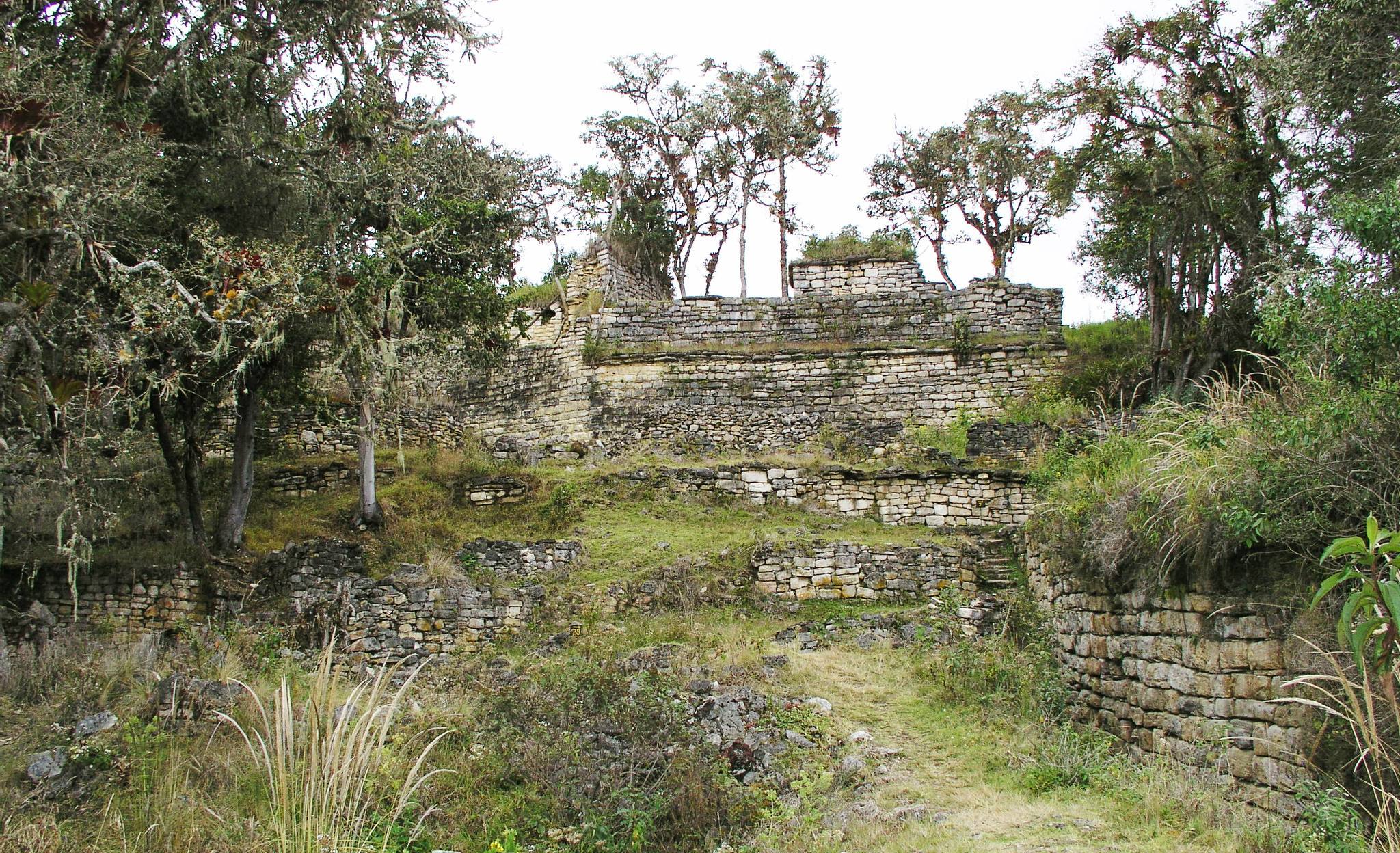
The main platform is an irregular, very elongated rectangle whose northern end narrows to a point. Two additional platforms or terraces continue its form. Pueblo Alto, the upper platform, overlaps the western wall of the main platform and is divided into southern, central, and northern sectors. The terraces created a massive artificial base for the settlement, but the drainage system that protected them from rain is now partly obstructed. Water pressure has caused movement within the platform and contributed to the detachment of wall stones.
Perimeter walls
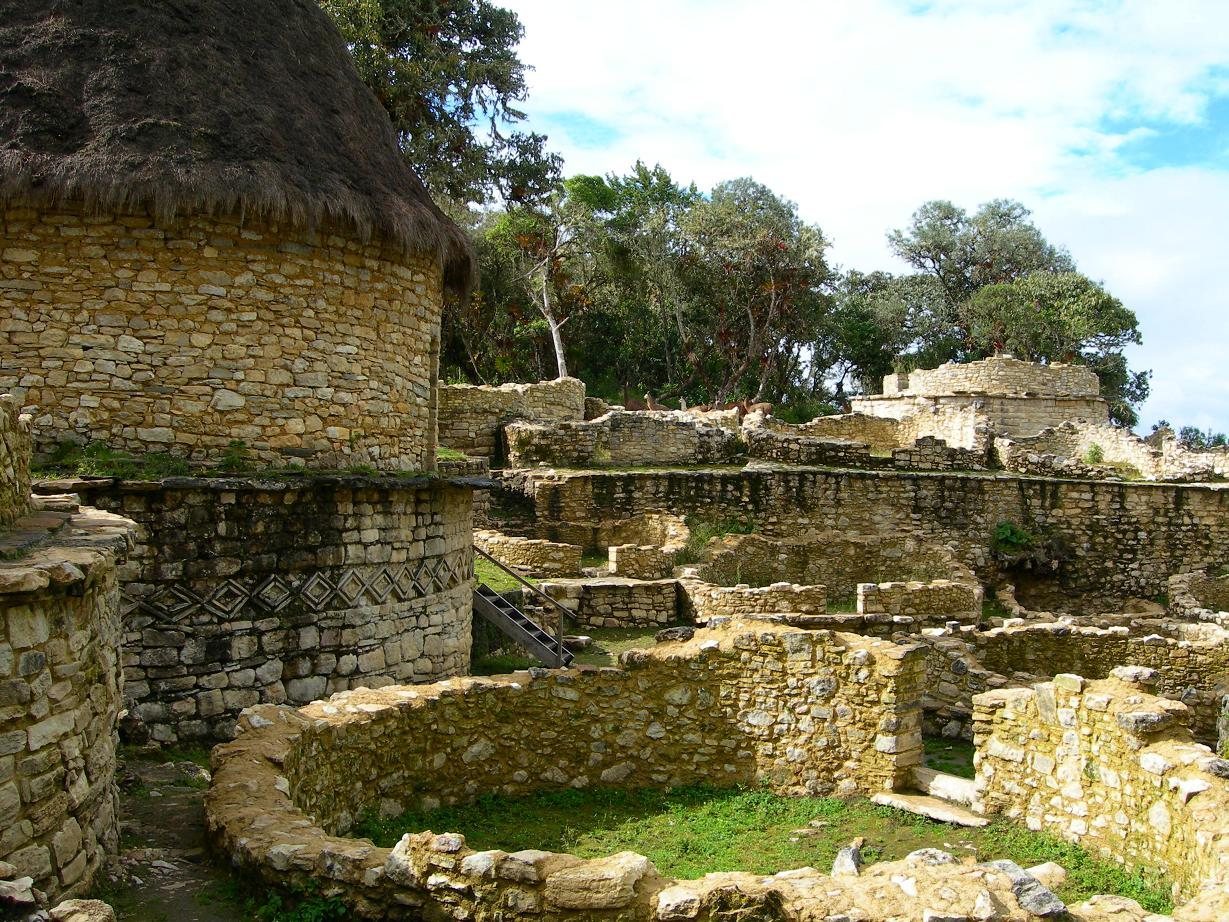
The perimeter walls generally rise between 10 and 20 metres and reach about 19 metres in places. They are built from finely worked limestone blocks, some weighing as much as three tonnes. The walls also contain buildings and burials, while surviving internal walls can reach two metres in height and about half a metre in thickness. A few structures have been restored.
Entrances
Three entrances pierce the enclosure, two through the eastern wall and one through the western wall. The eastern openings divide the main enclosure into southern, central, and northern sectors. The principal entrance is trapezoidal and narrows progressively towards the interior until only one person could pass. It may originally have had a corbelled arch, an arch-like opening made by placing successive stones so that each projects inward until the space is closed. Layers of fill show that the entrance was enlarged upward and inward more than once. Decorated limestone blocks bear religious symbols, including faces, animals, mythical creatures, and serpents.
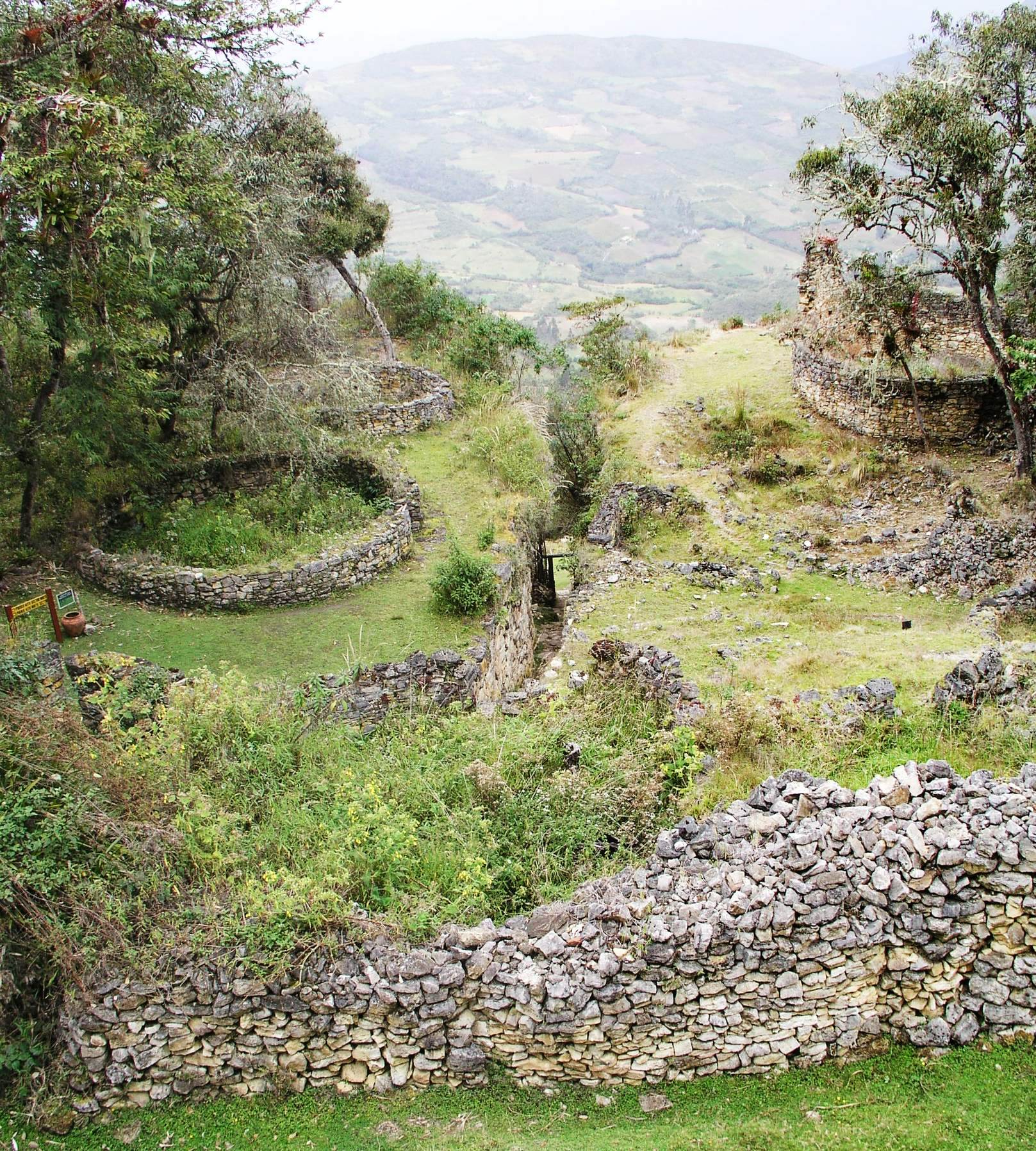
The western entrance lies almost opposite the principal eastern entrance and may have been used to bring food and drinking water into the settlement. Stone aqueducts or channels are believed to have carried water from a spring at the top of the mountain, although the precise system by which residents obtained and stored water remains uncertain. Inaccessible enclosures may have served as reservoirs, while many other enclosures may have been used for food storage.
Circular buildings and sacred areas
General circular buildings
Kuélap contains almost 400 structures, although the total may exceed 550 when ruined buildings represented only by foundations or fragments of walls are included. Most are circular, reflecting a characteristic form of Chachapoyas construction. Five structures are rectangular or square, while several other quadrilateral buildings belong to the later Inca period. Some circular walls have rhomboid or zigzag forms and carry projecting cornices that protected them from rain. Friezes of eyes or joined birds encircle some buildings, and other stones bear anthropomorphic, animal, and geometric reliefs.
El Tintero
El Tintero, also called Templo Mayor, is an inverted truncated cone in the southwest of the settlement. It is about 5.5 metres high and measures approximately 13.5 metres across at its upper part. One of Kuélap’s principal sacred centres, it contained ceremonial offerings and human bones placed inside the structure. Burials and offerings from the northern coast, the Ayacucho highlands, and Cajamarca were also found there, turning its interior into a large ossuary.
Circular Platform
The Circular Platform lies immediately above the southern perimeter wall and was closely connected with Templo Mayor. It probably housed the person responsible for operating the temple and contained an ossuary similar to the one inside Templo Mayor. The violent episode at the end of Kuélap’s occupation took place within its limits, where the disordered human remains were found beside the cliff.
Pueblo Alto and Inca-period structures
Pueblo Alto
Pueblo Alto occupies the northern and western parts of the settlement and is bounded by a wall about 11.5 metres high. Two narrow entrances lead into its three sectors. One gives access to the northern and central sectors, while the other leads only to the mainly residential southern sector. A third level occupies about one-third of the southern part of Pueblo Alto. Several hundred circular buildings are distributed across its sectors and levels, alongside the five rectangular or square structures.
Central sector buildings
The central sector probably had a public function during the final occupation. Three square or rectangular Inca-period structures were built over older circular buildings. At the southern end, a badly ruined quadrangular building contained numerous primary and secondary human burials. It probably carried a roof with two or four slopes, and traces of earlier buildings survive beneath it.
Inca Tomb
The Inca Tomb of Pueblo Alto held the burial of an adolescent accompanied by fine ceramics, badly deteriorated wooden objects, and a metal nose ornament. The assemblage may represent a Capacocha offering, an Inca state ritual that could involve human sacrifice at important religious centres, although that interpretation remains tentative.
Callanca
Callanca is the largest Inca-period building at Kuélap. It is rectangular and has been interpreted as a structure for roofed ceremonies and as lodging for travellers or guests. Its form distinguishes it from the predominantly circular Chachapoyas buildings around it.
El Torreón
El Torreón is a solid, ceremonial-looking tower at the northern end of Pueblo Alto, beside an inaccessible western precipice. It rises about seven metres. Hundreds of rounded limestone stones were found at its top. Although they could have served as sling projectiles, their apparent ineffectiveness for defence and the limited visibility created by neighbouring roofs have led to the interpretation that they were probably ceremonial.
La Atalaya and El Castillo
La Atalaya lies at the extreme north of Kuélap. El Castillo occupies the upper platform, the sector containing the greatest number of remains. Together these northern areas form part of the settlement’s highest concentration of surviving structures.
Burials and later funerary evidence
Stone funerary structure
The stone funerary structure excavated in 2026 contained five individuals, four adults and one infant. It also held ceremonial objects, carved bone artefacts, metal objects, stone mortars, and fragments of Spondylus shell. Its Late Horizon date, about AD 1470–1532, places the burial within the period of Inca activity at Kuélap and helps illuminate funerary and ritual practices in the Chachapoyas region during the final pre-conquest centuries.
Burials in the settlement
Numerous other burials occur within the perimeter walls and circular buildings. These funerary remains, together with the ossuaries in Templo Mayor and the Circular Platform, show that burial and ritual activity formed an important part of the settlement’s physical organization.