Yusif ibn Kuseyir Mausoleum: A Medieval Funerary Monument in Nakhchivan
Site at a Glance
- Rating
- 4.5
- Popularity
- Very Low
- Country
- Azerbaijan
- Primary era
- Medieval
- Eras represented
- Medieval
- Civilizations
- Seljuk
- Site type
- Burial
- Remains
- Tomb
On this page6 sections
History
Construction and attribution
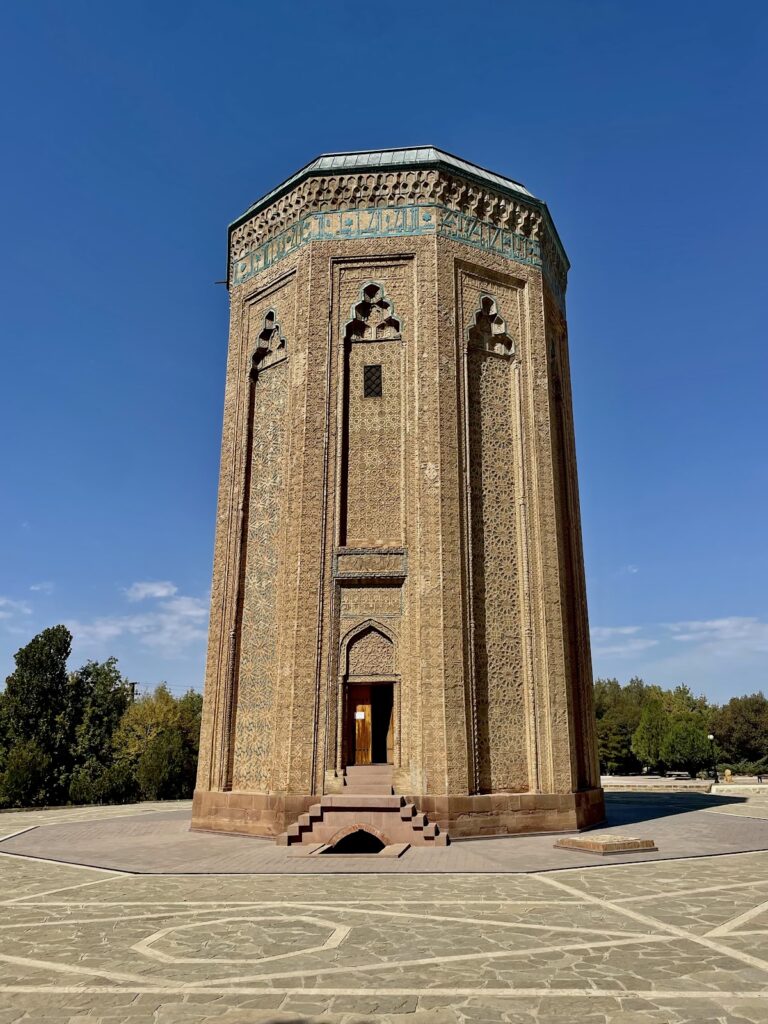
The Yusif ibn Kuseyir Mausoleum is a medieval funerary monument in Nakhchivan, Azerbaijan, built in 1161–1162 as an early example of the Nakhchivan–Maragha architectural school. This medieval tradition was associated with monumental brick construction and geometric decoration in the historic regions of Nakhchivan and Maragha. An inscription dates the building to 1162, corresponding to AH 557, and identifies Ajami ibn Abubakr Nakhchivani as its architect.
The mausoleum is dedicated to Yusif ibn Kuseyir, whom the inscription describes as a distinguished official, religious scholar, and leader of the shaykhs. It is also known as the Atababa Mausoleum. The building is regarded as the earliest example of the Nakhchivan–Maragha architectural school and as one of the finest examples of Azerbaijani architecture.
Heritage recognition
The mausoleum is registered nationally in Azerbaijan as a monument of world significance. The mausoleums of Nakhchivan were nominated for the UNESCO World Heritage List in 1998, and the mausoleum of Nakhichevan was added to the UNESCO Tentative List in 2001.
Remains
Form and structure
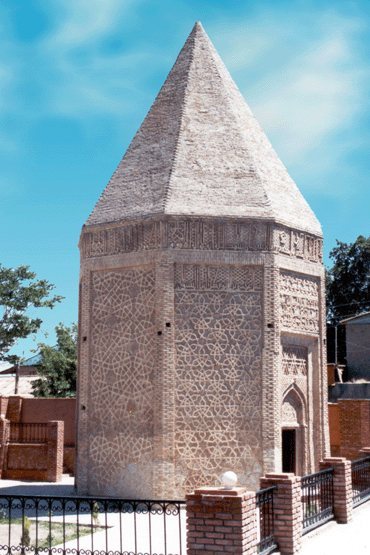
The building is a small, two-level octagonal structure. Its lower level is a subterranean crypt, a below-ground burial chamber, so the monument appears externally as a single-storey tower. The crypt has a dome with a flat top. Above it, the upper chamber is covered by a vaulted spherical dome with pointed-arch geometry, and an octagonal opening in the floor connects this chamber with the crypt.
Outside, the mausoleum has a prismatic body and an eight-sided pyramidal roof. The upper pyramidal covering has survived for more than 800 years. Thickened supports reinforce the corners, while rectangular niches occupy the spaces between them. The intermediate walls are approximately 80 centimetres thick, helping to stabilize the structure.
Brickwork and inscriptions
High-quality baked brick forms both the structure and its facing. No glazed bricks were used, giving the monument a unified reddish colour and a restrained geometric appearance. Each exterior face carries patterns assembled from small bricks. These bricks were joined into panels with plaster mortar and fixed to the wall surfaces.
The frieze between the main body and pyramidal roof contains a Kufic inscription. Kufic is an early angular form of Arabic calligraphy often used for Quranic and architectural texts. The letters are made from bricks measuring approximately 20 by 20 by 4 centimetres and project about 2 centimetres from the frieze.
The entrance facade differs from the other sides. Its doorway is set within a recessed pointed arch and topped by a large inscription panel. The text identifies Yusif ibn Kuseyir as the person buried in the mausoleum and gives the construction date of 1162. A separate inscription names Ajami ibn Abubakr Nakhchivani as the builder or architect.
The interior surfaces are undecorated, while the exterior is covered with dense geometric brick patterns. Ornamental compositions fill the niches and reinforce the vertical rhythm of the corner supports. The monument’s visual effect comes from the combination of its prismatic body, pyramidal roof, recessed and projecting surfaces, and the contrasts between light and shadow. Brick borders and inscriptions use pieces of different sizes, while geometric patterns fill the spaces between the vertical Kufic letters.