Temple of the Qian Kings: A Memorial Temple in Hangzhou
Site at a Glance
- Rating
- 4.3
- Popularity
- Very Low
- Country
- China
- Primary era
- Medieval
- Eras represented
- Medieval, Early Modern
- Civilizations
- Chinese, Qing
- Site type
- Religious
- Remains
- Temple
On this page11 sections
History
Foundation and Wuyue commemoration
The Temple of the Qian Kings is a Chinese temple in Hangzhou, China, dedicated to the Qian family, which ruled Wuyue during the Five Dynasties and Ten Kingdoms period. Founded in 1077 during the Northern Song dynasty on the eastern shore of West Lake, it was established as the Biaozhong Temple, meaning “Temple of Displayed Loyalty.” Although the name often suggests Qian Liu, the first king of Wuyue, the temple commemorates the ruling house as a whole, described as three generations and five kings.
Wuyue was a regional kingdom in southeastern China during the politically divided period between the Tang and Northern Song dynasties. Its rulers eventually submitted their territory to the Northern Song, an act central to the temple’s commemorative purpose. Su Dongpo, also known as Su Shi, was then prefect of Hangzhou. He composed and wrote the Stele Record of the Biaozhong Temple, praising the Qian kings for protecting their people, remaining loyal to the central dynasty, and ultimately yielding Wuyue to the Song.
Later name and imperial associations
After the Qing dynasty, the site became commonly known as the Temple of the Qian Kings. It is also called the Qianwang Temple and the Qian Ancestral Temple. The Kangxi and Qianlong emperors left imperial inscriptions and plaques there, including the phrases “Ensuring the Land” and “Shelter Left by the Loyal and Obedient.”
Destruction, rebuilding, and continued tradition
The temple became a Hangzhou cultural-protection site in 1957, but it was destroyed during the Cultural Revolution. The complex was rebuilt in 2003 and again received recognition as a Hangzhou cultural-protection site. In 2007, Hangzhou held a ceremony for the 1,100th anniversary of Qian Liu’s investiture as king of Wuyue. Around 400 descendants of the dynasty attended. Ritual music accompanied offerings of incense, silk, grain, an ox, a sheep, and a pig, while a bell was struck fourteen times, once for each prefecture of Wuyue.
The Qian King Sacrifice associated with the temple was recognized as an item of Zhejiang provincial intangible cultural heritage in 2009. The designation reflects the continuing ritual tradition connected with the temple’s commemoration of the Qian rulers.
Remains
Temple grounds and halls
Courtyards and principal buildings
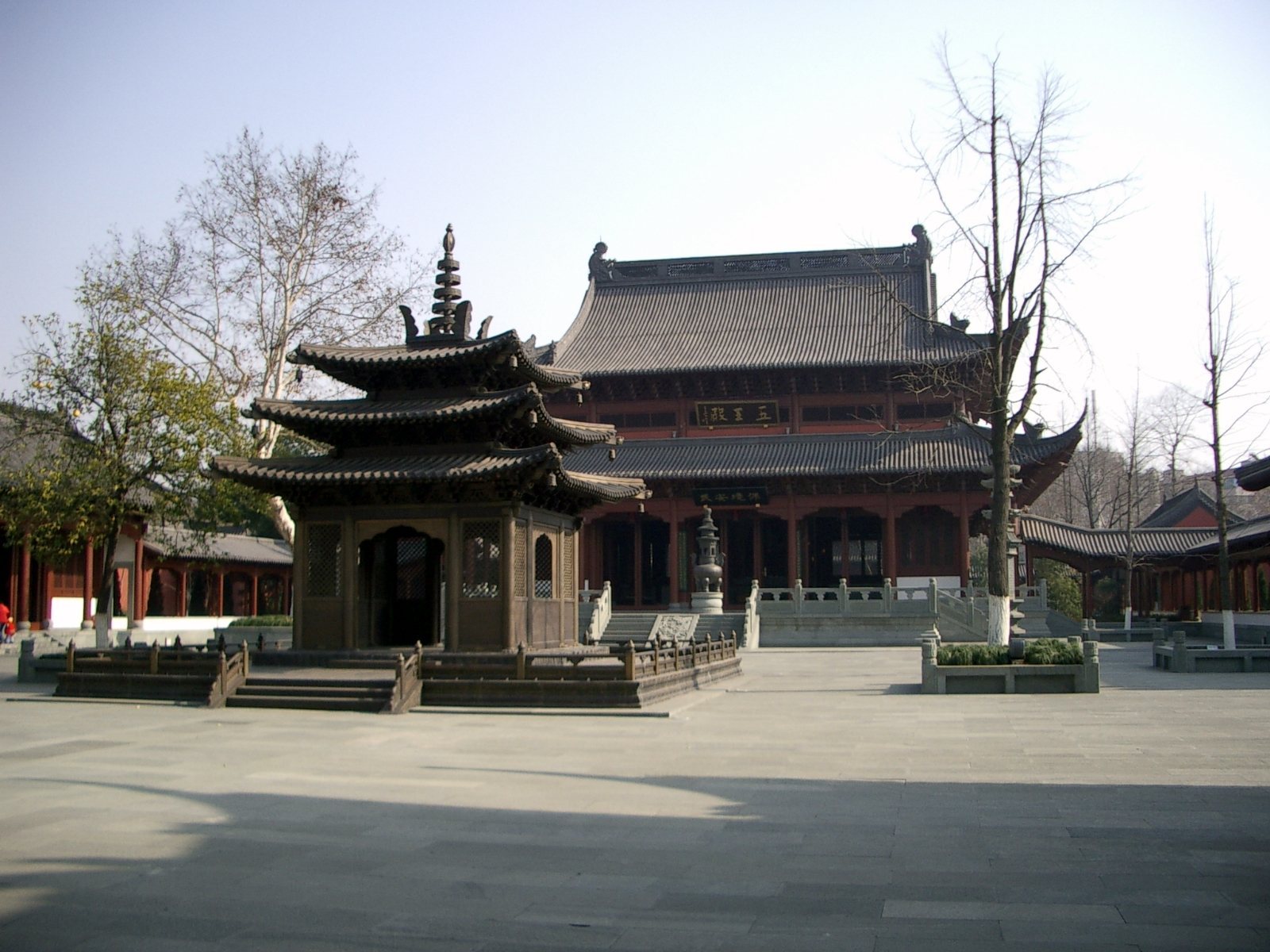
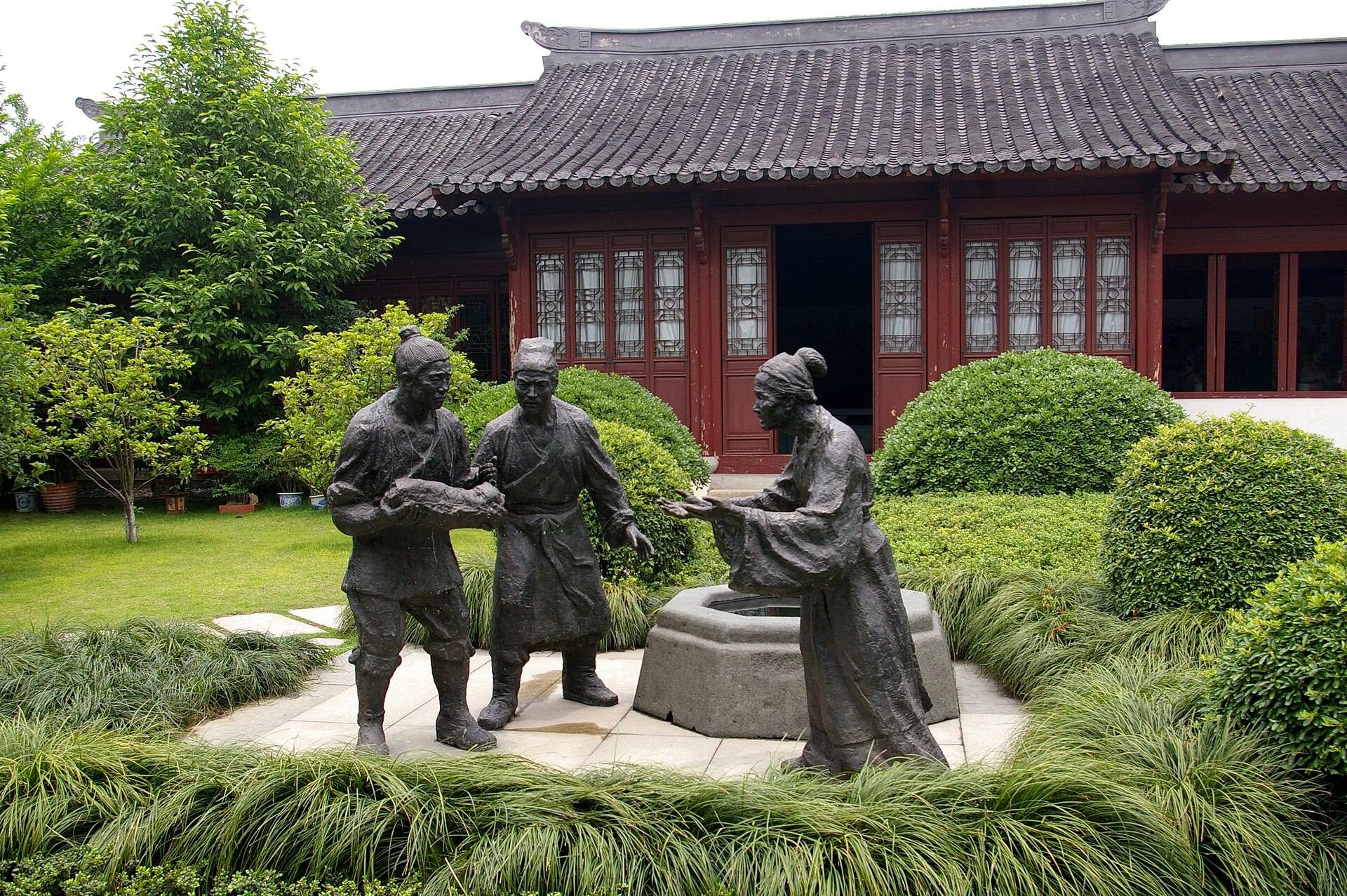
The temple stands within the Park of Orioles Singing in the Willows on the eastern shore of West Lake, south of the present location of Yongjin Pond. The reconstructed grounds cover approximately 11,300 square metres, with about 4,600 square metres of building area. Two courtyards are enclosed by traditional halls containing paintings and statuary associated with the Qian kings.
The principal buildings include the Copper Offering Hall, the Merit Hall, and the Five Kings Hall, which serves as the main hall. The inner courtyard before the central hall dedicated to Qian Liu contains a large incense burner.
Ancient theatrical stage
An ancient theatrical stage forms another principal element of the reconstructed complex. It stands among the traditional halls and courtyards that organize the temple grounds.
Royal tombs and commemorative monuments
Tombs of the Qian family
The grounds include the tomb of Qian Liu and the tombs of four of his children. These burials connect the physical complex with the temple’s wider commemoration of the Qian ruling family.
Stele and imperial plaques
The Stele Record of the Biaozhong Temple, written and calligraphed by Su Dongpo, is regarded as a notable monument in the history of Song-dynasty calligraphy. The temple also preserves Qing imperial plaques and inscriptions bearing the phrases “Ensuring the Land” and “Shelter Left by the Loyal and Obedient.”