QV55: The Tomb of Prince Amun-her-khepeshef in the Valley of the Queens
Site at a Glance
- Rating
- 4.8
- Popularity
- Very Low
- Country
- Egypt
- Primary era
- Bronze Age
- Eras represented
- Bronze Age
- Civilizations
- Egyptian
- Site type
- Burial
- Remains
- Tomb
On this page12 sections
History
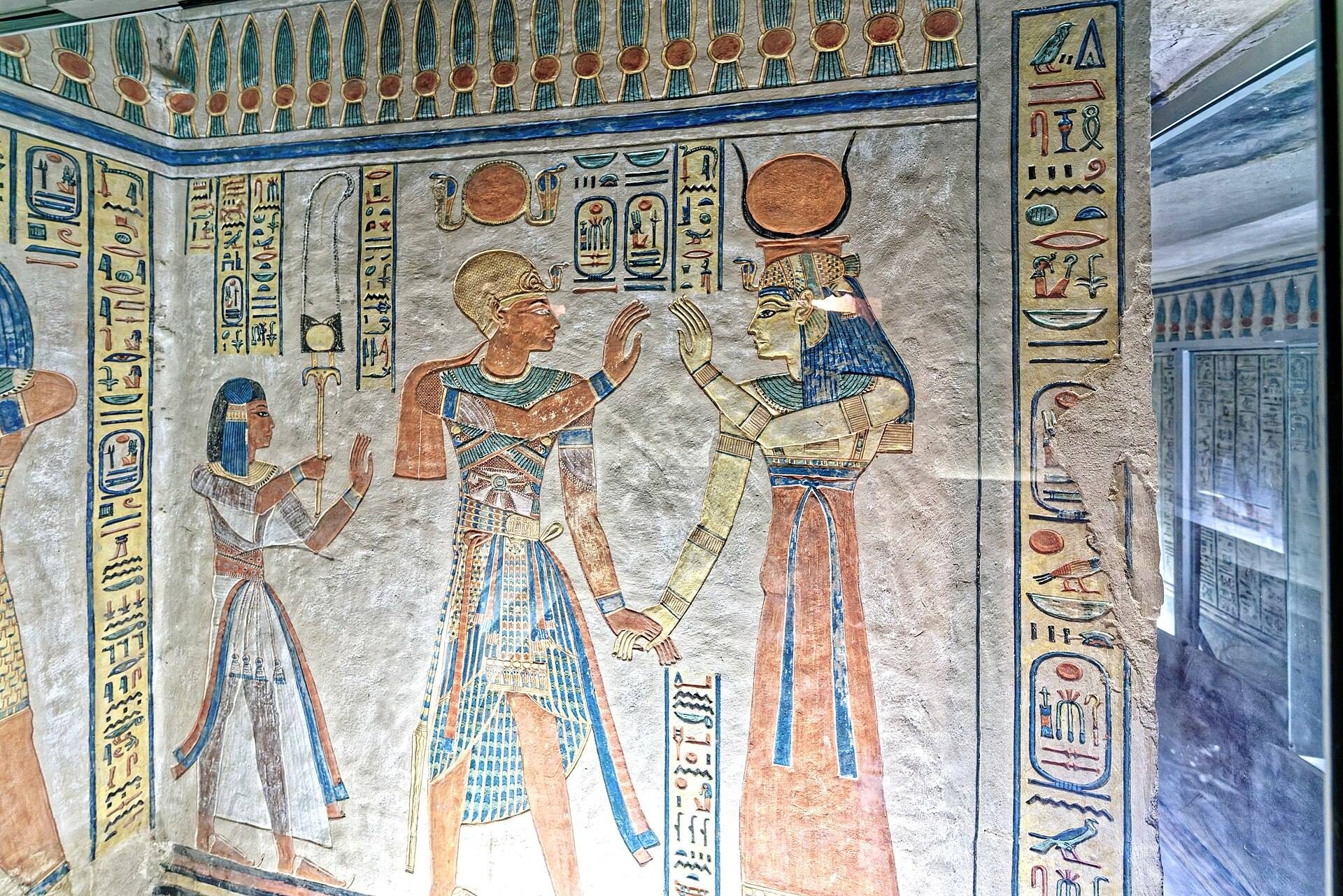
QV55 is an ancient Egyptian tomb in the Valley of the Queens at Al Qarna, Egypt, on the west bank of the Nile opposite Luxor. It was built for Prince Amun-her-khepeshef during Egypt’s Twentieth Dynasty, a late period of the New Kingdom. The tomb’s decoration presents the prince as a youthful figure behind his father, Pharaoh Ramesses III, who performs the offerings and dominates the scenes.
Royal Tomb of the Twentieth Dynasty
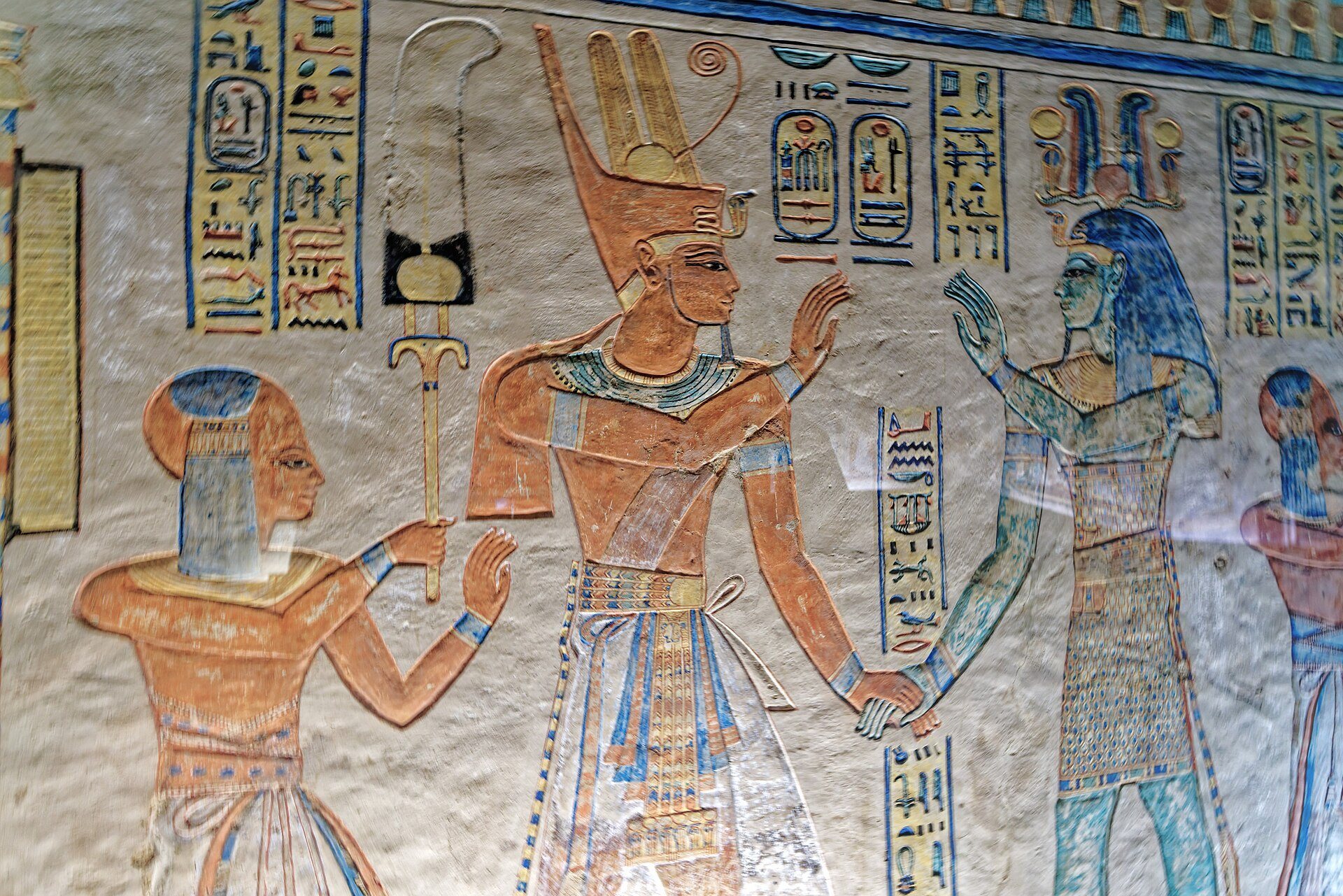
Amun-her-khepeshef is associated with QV55 as its intended occupant. His sidelock of youth identifies him as a child in the painted scenes, while Ramesses III appears in direct interaction with several deities. The arrangement reflects the royal and funerary character of the tomb, with the king acting prominently in rituals intended to support the prince’s passage into the afterlife.
Discovery and Later Conservation
Ernesto Schiaparelli found QV55 in 1904 after tracing an ancient dam to the upper part of the entrance ramp. Stones blocked the entrance, and part of the plastered wall that had sealed it remained in place. The Italian Archaeological Mission recorded the discovery with photographs and constructed enclosure walls, a vault over the entrance, and a heavy metal door. A marble plaque along the southwestern wadi, a valley or watercourse often dry except after rainfall, commemorates Schiaparelli’s discovery.
A Franco-Egyptian mission involving the CNRS and the Supreme Council of Antiquities studied the tomb in 1988 and 1994. Further planning, conservation assessment, stabilization, mural-painting assessment, and site-management work in the Valley of the Queens was carried out by the Getty Conservation Institute and the Supreme Council of Antiquities between 2006 and 2011, including work specifically associated with QV55 from 2006 to 2008. Photographs made after the discovery preserve views of the entrance, chambers, sarcophagus, and painted scenes in the photographic archive of the Museo Egizio in Turin.
Remains
Layout and Construction
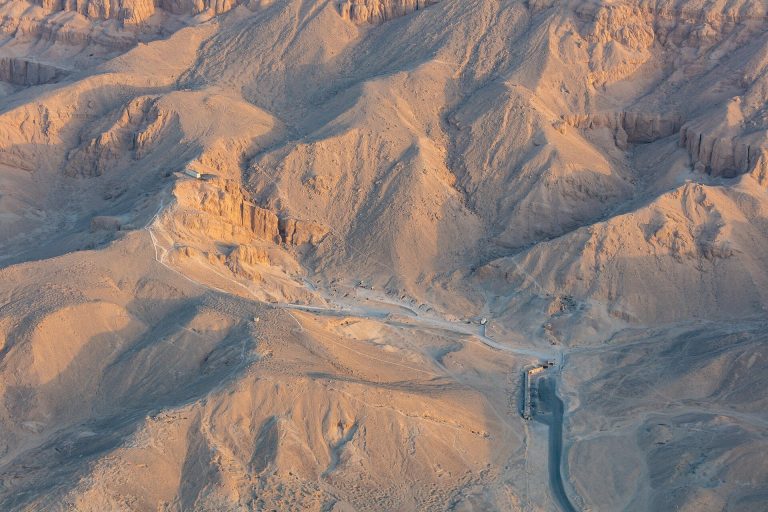
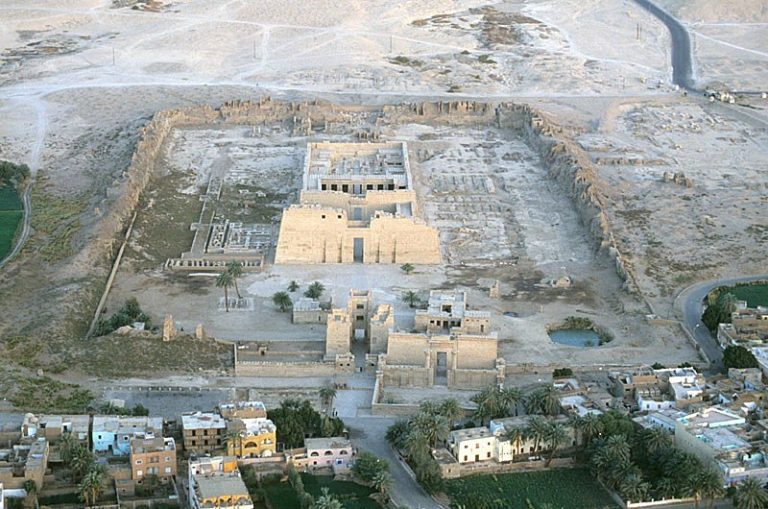
QV55 lies at the western end of the main wadi of the Valley of the Queens and follows a northeast–southwest axis. Its main axis is recorded as 239° 27′ 44″. The tomb was cut into greyish marl, a soft clay-rich limestone-like sediment containing chert, a hard silica-rich stone. The rock was generally sound, so little filling was needed, although concrete partly reconstructs the jambs, or vertical sides, of some doorways.
A long entrance ramp, designated A, leads to chamber C. Chamber E opens north from C, while corridor G follows the chamber and has side chamber I to the north. The route ends in rear chamber K. The entrance-related works added by the Italian Archaeological Mission include a modern brick covering and the enclosure structures around the entrance.
Burial Chambers and Objects
Sarcophagus
Chamber K contains the unfinished granite sarcophagus intended for the prince. Excavation photographs identify the stone as pink granite, while its position and dimensions remain approximate on the Theban Mapping Project plan. At the time of discovery, the tomb was empty apart from a few funerary objects and the unfinished sarcophagus. The stone had originally been found in chamber G and was moved to K so that it could pass through a narrow space.
Mummified Fetus
A mummified fetus from the Valley of Prince Ahmose, tomb QV88, was placed in chamber K around 1974. It was transferred to chamber E in February 2010.
Painted Decoration
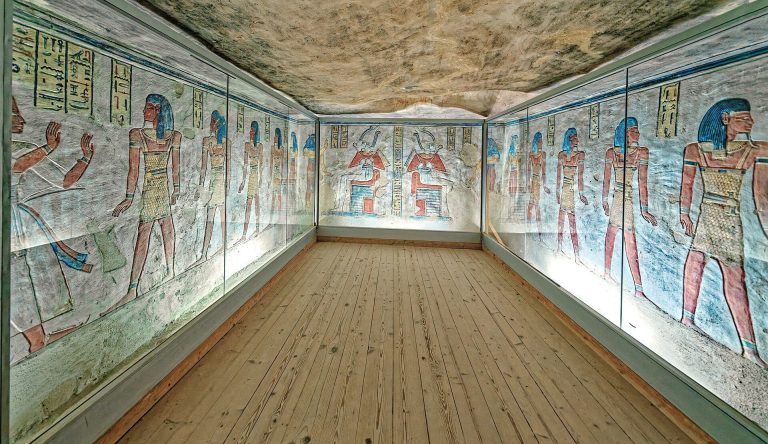
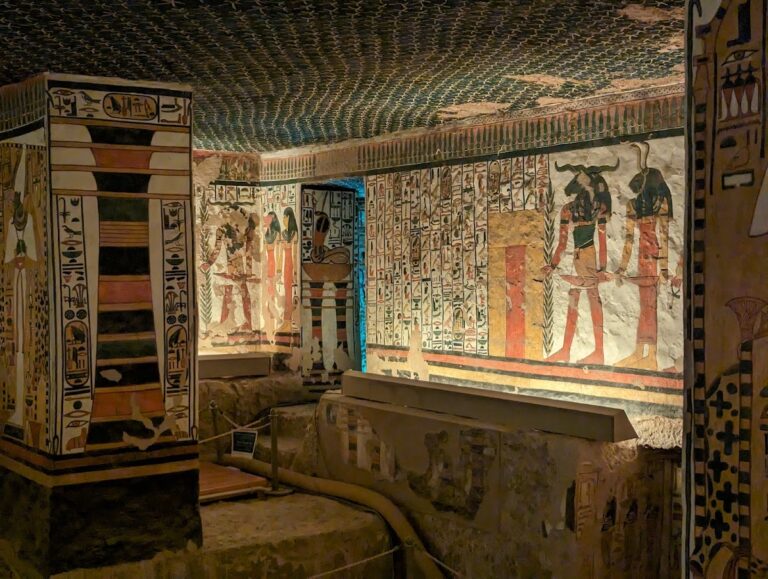
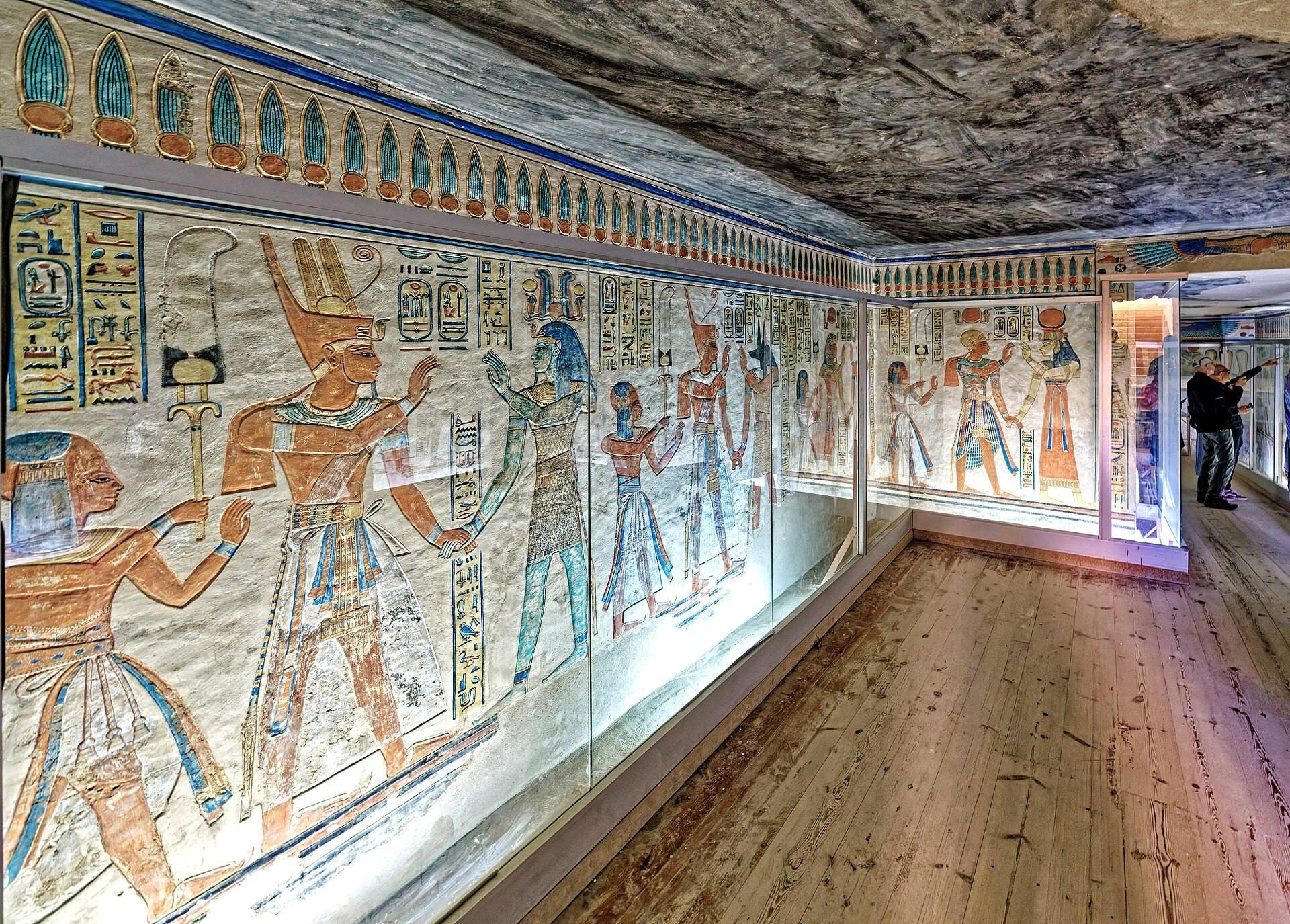
The tomb retains extensive painted sunk relief, a technique in which designs are carved into the surface rather than raised from it. The decoration is worn and its colors have faded, although the original scheme was strongly colored. Several areas were left incomplete. Chamber E was plastered but received no painted decoration apart from linear figure drawings, while chamber K retains only a base layer of plaster. Its ceiling may also have remained unfinished, since it received only black paint.
Chamber C and the Antechamber
The south wall of chamber C shows two scenes of Ramesses III with the prince. One presents the king with Isis, a goddess associated with protection, kingship, mourning, and the afterlife; the other shows him with Hathor, another major goddess connected with protection and the afterlife. The west wall of the antechamber includes Shu, a god associated with air and separation, together with a scene of Ramesses III holding the hand of Qebehsenuef, a son of Horus associated with protecting the organs of the dead.
Entrance F and Corridor G
At entrance F to the burial chamber, Isis and Nephthys hold the water symbol and perform a welcoming ritual for the deceased as he enters the underworld. Corridor G contains four gate guardians corresponding to gates five through eight of chapter 145 of the Book of the Dead, a corpus of funerary spells intended to assist the dead in the afterlife. Ramesses III again interacts with the deities, while Amun-her-khepeshef stands behind him.
Entrance J
Above entrance J to rear chamber K is a winged sun disk with two uraei, rearing cobra emblems associated with royal protection and power. The uraei surround the cartouches of Ramesses III, oval frames enclosing his royal names. Images of Isis and Nephthys also appear at this entrance. Side chamber I and rear chamber K otherwise retain no decoration beyond the features described above.