Battle Pass: A Revolutionary War Site in Brooklyn’s Prospect Park
Site at a Glance
- Rating
- 4.6
- Popularity
- Very Low
- Country
- United States
- Primary era
- Modern
- External website
- Open
- Eras represented
- Modern
- Civilizations
- Unclassified
- Site type
- Civic
- Remains
- Monument
On this page9 sections
History
Colonial route and boundary
Battle Pass is a historic hill pass in Brooklyn, United States, now incorporated into Prospect Park. It followed the Native American trail called Mechawanienck through the Heights of Guan, a route that preceded Kings Highway and later became part of Flatbush Road. Governor Lovelace mentioned the pass in documents from 1670. Under the Dongan Charter of November 12, 1685, a colonial charter defining municipal boundaries and local privileges, it marked the boundary between the towns of Brooklyn and Flatbush in Kings County.
The Battle of Long Island
On August 27, 1776, Battle Pass became the scene of a skirmish during the Battle of Long Island, also called the Battle of Brooklyn. This major engagement of the American Revolutionary War ended with British and allied forces defeating the American army and forcing its withdrawal from Long Island. At the pass, 1,300 American troops commanded by John Sullivan faced 5,000 Hessian troops under Leopold Philip de Heister. Hessians were German soldiers hired by the British government for service in the war. The American force had two cannon on the eastern Redoubt Hill.
The fighting ended by late morning after Sullivan was captured. A Hessian bayonet charge killed many American soldiers, and many of the American dead were buried at the Flatbush Reformed Dutch Church Complex. Human remains continued to be found in the surrounding area occasionally for years afterward. Some Hessian participants appear to have etched their names at the Wyckoff-Bennett Homestead.
The battle also became associated with the Dongan Oak. Simon Voorhis may have felled the tree after American defenders used it as a barricade against the northward invasion. Its stump was still recorded in the 1840s. The tree may later have been destroyed when Prospect Park was landscaped and portions of the hills were leveled.
Preservation and commemoration
Preserving the battlefield was among the reasons given for creating Prospect Park. The pass later included a vineyard planted with Isabella grapes in the early nineteenth century. The park’s original emphasis on naturalistic landscape architecture discouraged the construction of a large memorial, leaving Battle Pass relatively inconspicuous within the wider landscape.
The United States Centennial of 1876 led to the erection of the Line of Defense monument, sponsored by the Sons of the Revolution, and to the planting of a Centennial Oak. On Arbor Day in 1890, John W. Hunter planted a symbolic replacement Dongan Oak in the presence of members of the Dongan family. During the 1910s, Raymond Ingersoll installed temporary markers for Battle Pass and other Revolutionary sites in the park. These markers were later lost. Charles M. Higgins wrote some of the inscriptions and proposed a larger group of Battle of Long Island monuments, including Revolutionary-era cannon or captured Imperial German cannon on Redoubt Hill.
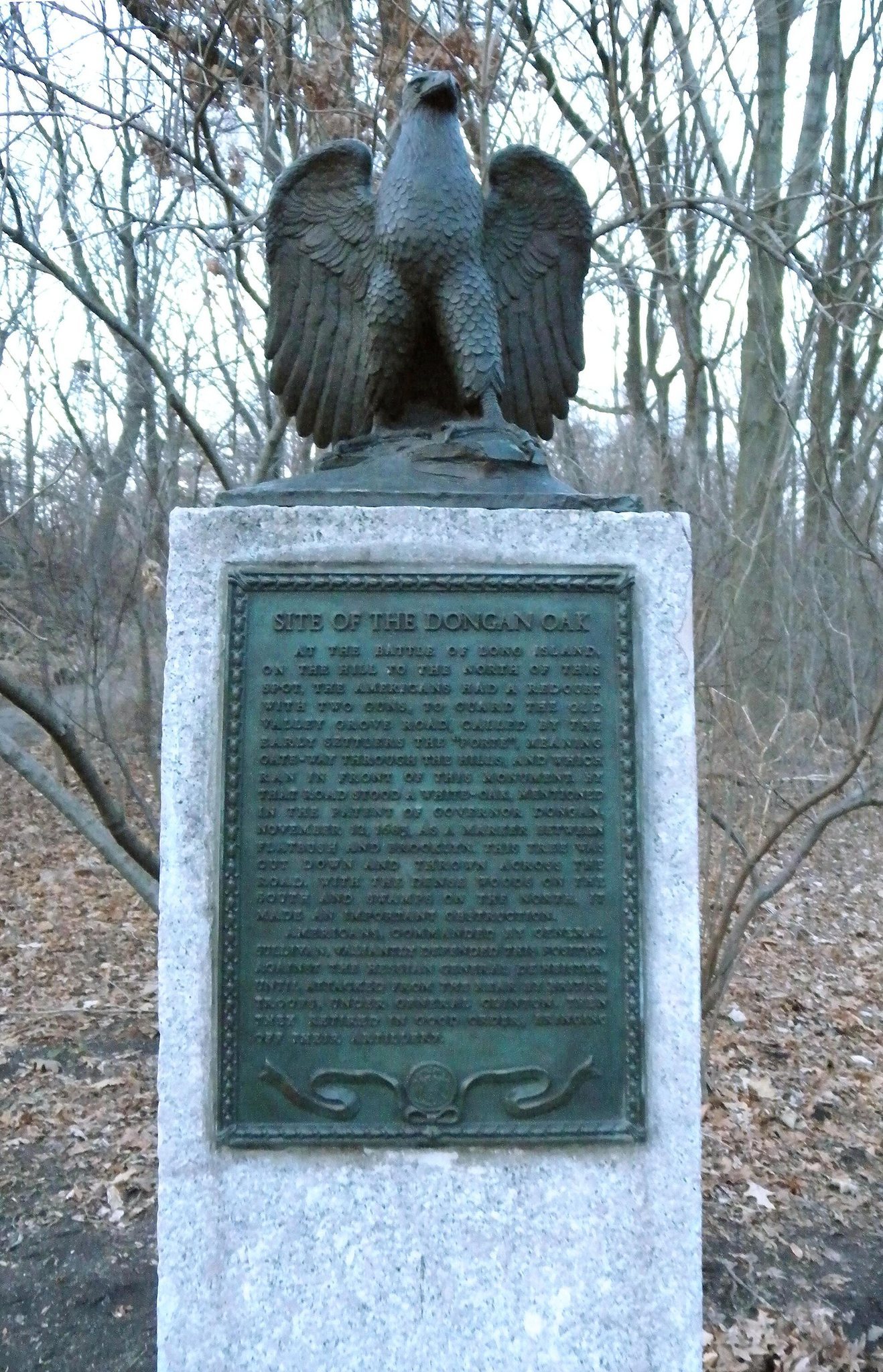
The Dongan Oak Monument was dedicated on Evacuation Day in 1922. Frederick Ruckstull designed it, and the Saint Nicholas Society of the City of New York sponsored it. The local Battle Pass Chapter of the Daughters of the American Revolution dedicated another boulder marker in 1929. The monument’s eagle was stolen in the 1970s and again in the 1990s, and the Prospect Park Alliance replaced it after each theft. Flooding around the monument led to repairs during the 2010s.
Remains
The pass and commemorative markers
Battle Pass extends for approximately 150 feet, or 45 meters, along East Drive in Prospect Park. Its surviving markers occupy the historic pass within the park landscape. The principal monument is the small Dongan Oak Monument, a stele, or upright commemorative stone, topped by a bronze eagle. It recalls the boundary tree associated with the American defensive barricade during the 1776 battle.
Dongan Oak Monument
The Dongan Oak Monument preserves the memory of the tree through a later memorial and the symbolic oak planted in 1890. The monument has undergone replacement of its bronze eagle after two thefts and repairs connected with flooding during the 2010s. Its present form therefore reflects both the original 1922 dedication and later conservation work.
Battle Pass markers
Two historic tablets set in boulders also mark Battle Pass, alongside the separate boulder marker dedicated in 1929. The Line of Defense monument and the Centennial Oak belong to the commemorative additions associated with the 1876 centennial. Together with the later replacement Dongan Oak, these features identify the pass as a memorial landscape formed over several periods.
Redoubt Hill and battlefield evidence
The eastern Redoubt Hill forms part of the battlefield setting associated with the two cannon used by the Americans during the 1776 skirmish. The hill’s connection with the defensive position helps locate the military action within the pass. The nearby Wyckoff-Bennett Homestead also preserves the names etched by some Hessian participants, linking a surviving historic building to the events of the battle.