Qarat Qasr Salim: Late Period Tombs in Egypt’s Bahariya Oasis
Site at a Glance
- Rating
- 4.6
- Popularity
- Very Low
- Country
- Egypt
- Primary era
- Iron Age
- Eras represented
- Iron Age, Classical
- Civilizations
- Egyptian, Roman
- Site type
- Burial
- Remains
- Necropolis
On this page7 sections
History
Qarat Qasr Salim is a mound and cemetery site east of el-Bawiti in Egypt’s Bahariya Oasis. Ancient Egyptians used it during the Late Period, particularly during the reign of Ahmose II of the Twenty-sixth Dynasty, also known as the Saite Dynasty. The site contains the tombs of Bannentiu and Djed-Amun-ef-Ankh, whose painted decoration provides evidence of the wealth and religious practices of people connected with trade.
The cemetery mound
The origin of the name Qarat Qasr Salim is unknown. Small chapels or other buildings may have stood on the mound before it became a cemetery, although this possibility remains uncertain. The mound was used repeatedly for burial, and both principal tombs were later adapted for additional interments during the Roman period, when Egypt was under Roman rule.
Local residents discovered the two principal tombs in 1918. The Egyptian Egyptologist Ahmed Fakhry excavated them in 1938 during his archaeological work in Egypt’s western oases. Both tombs had been robbed in antiquity. In more recent decades, modern tomb robbers cut away two scenes in Bannentiu’s tomb, further changing the painted decoration.
Bannentiu and Djed-Amun-ef-Ankh
Bannentiu and Djed-Amun-ef-Ankh lived during Ahmose II’s reign and were closely related. Bannentiu may have been Djed-Amun-ef-Ankh’s son or brother, but the exact relationship is uncertain. Little is known about Bannentiu’s life. His father was a merchant, and Bannentiu may also have worked in trade.
Djed-Amun-ef-Ankh was the son of Ben-Ah and the husband of De-Isis-Beken. Her name may point to a foreign origin, although that interpretation is uncertain. Their daughter was Khonsuirdis. Djed-Amun-ef-Ankh’s tomb gives him no titles, suggesting that he was neither an official nor a priest. His wealth may nevertheless have derived from commercial activity.
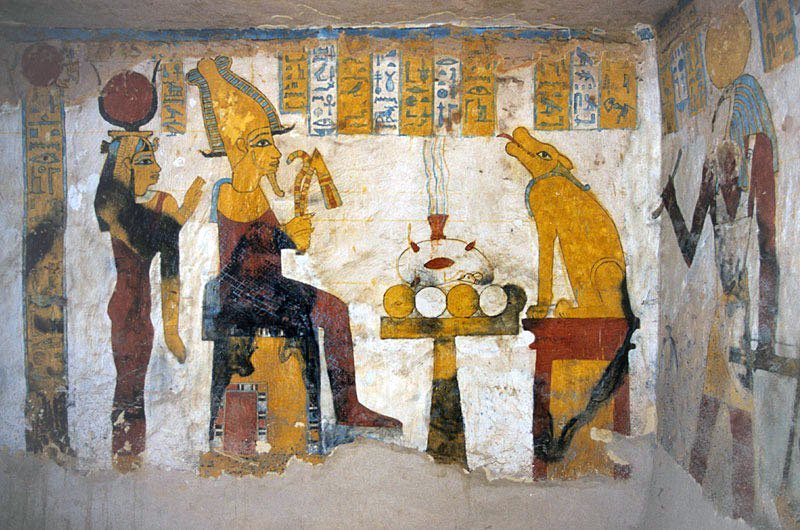
The decoration of Bannentiu’s tomb includes evidence for devotion to both a solar deity and a lunar deity, rather than to the solar cult alone. The tombs also preserve evidence of their later use, including fragments of mummies, broken pottery from vessels and coffins, and other wooden remains. Bannentiu’s tomb received secondary burials during the Roman period, and Djed-Amun-ef-Ankh’s tomb was also altered to accommodate later interments.
Remains
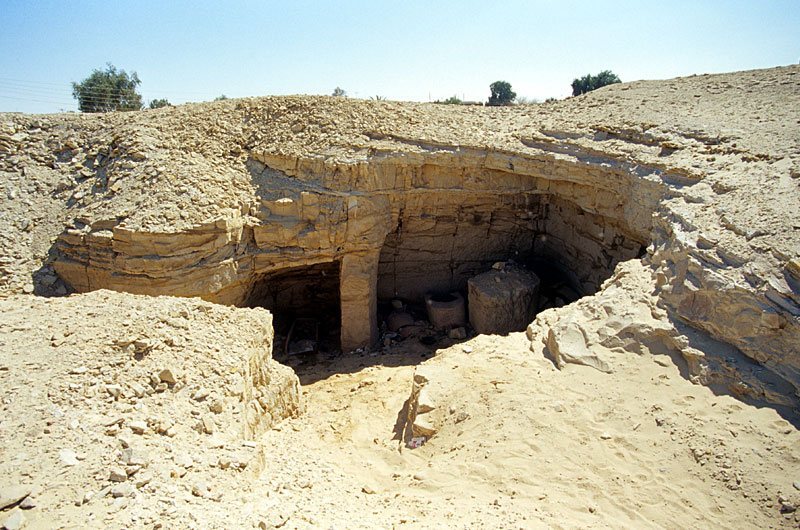
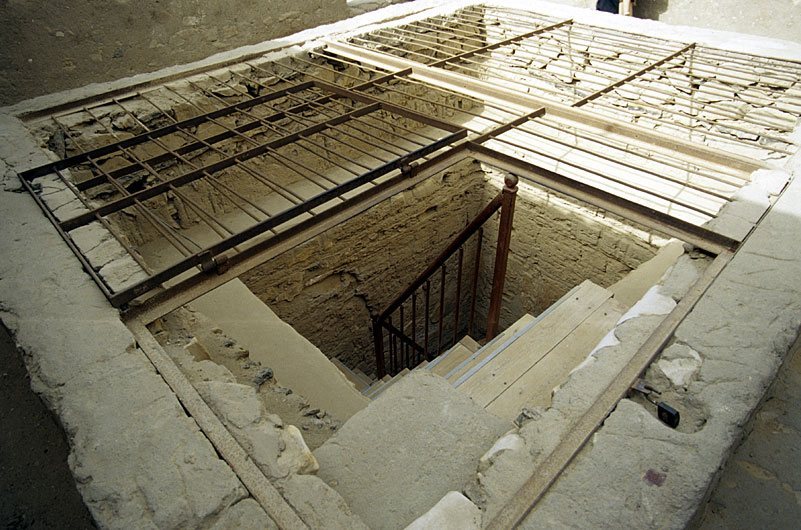
Qarat Qasr Salim is a northeast-aligned mound approximately 200 metres long and up to 90 metres wide. Rock-cut tombs and burial shafts remain visible on its surface. The two principal tombs are positioned about 15 metres south of the mound, with Djed-Amun-ef-Ankh’s tomb approximately 15 metres northwest of Bannentiu’s. A guardian’s house now surrounds Bannentiu’s shaft, while a metal shelter protects the other tomb.
The mound and burial shafts
Bannentiu’s square burial shaft is about 6 metres deep. At its foot, entrances lead to two underground tombs. The northern entrance opens into Bannentiu’s tomb. The entrance opposite leads to an unfinished, undecorated tomb with columns, which may have been intended for Bannentiu’s wife and is now used as a storage room. Wooden stairs have been installed in the burial shafts.
Bannentiu’s tomb
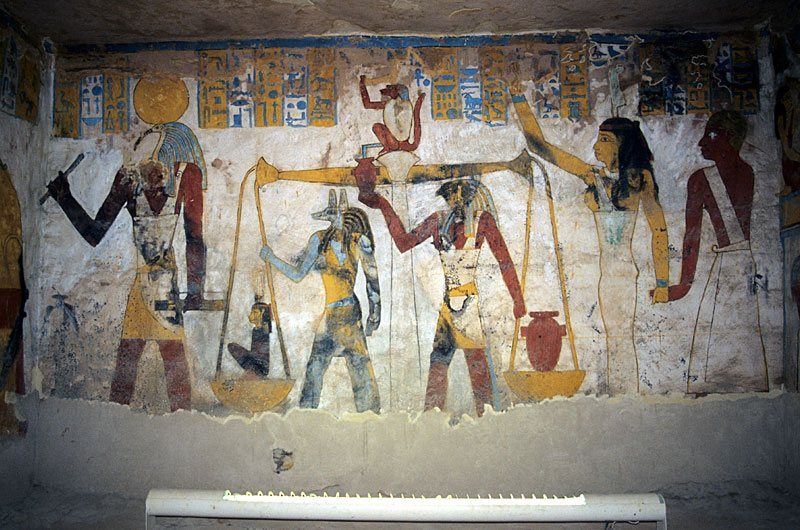
Bannentiu’s tomb was carefully cut into the rock, coated with plaster, and painted. It consists of a pillared front hall with four columns, side chambers, and a smaller burial chamber behind them. The front hall is approximately 8 metres wide and 7 metres long. The nearly square burial chamber measures about 3 metres in length. The side chambers carry no wall decoration, while the principal spaces preserve painted surfaces and inscriptions.
The entrance beneath the shaft is undecorated and looks through the columns toward the stone sarcophagus. The ceiling was whitewashed, with surviving traces of decoration and inscriptions. The shaft and chambers also contained fragments of mummies, pottery from vessels and coffins, and other wooden remains. A guardian’s house now stands over the shaft, and wooden stairs provide access within the burial passages.
Djed-Amun-ef-Ankh’s tomb
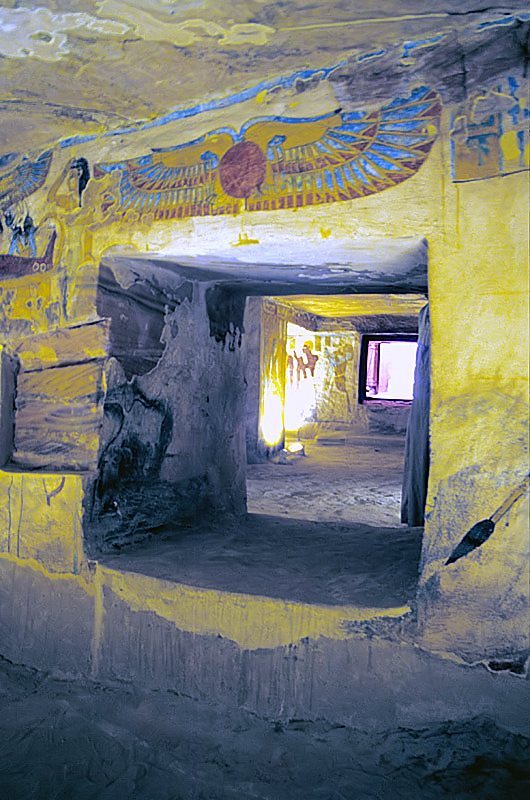
The decorated entrance to Djed-Amun-ef-Ankh’s tomb lies at the end of a shaft approximately 5 metres deep. It faces west and was originally closed by a sandstone slab. Above the entrance are a small bay and two winged solar disks, symbols associated with Egyptian solar deities.
The right and left doorjambs show Thoth and Horus presenting water. Thoth was associated with writing, knowledge, and the moon, while Horus was connected with the sky and kingship. Two priests carrying vessels appear on the right side as they enter the tomb. The inner jambs bear offering texts, inscriptions linked with the presentation of food, drink, and other funerary offerings, arranged in three columns.
The burial chamber is approximately circular, with four round lotus columns standing at its centre. Its walls were plastered and painted. During the Roman period, six niches were cut in place of six of the tomb’s original seven false-door representations. A false door was a symbolic doorway intended to provide the deceased with a spiritual passage. The later niches accommodated secondary burials, and their entrances carry additional offering texts.