Hazrat Nizamuddin Dargah: A Chishti Sufi Shrine and Mosque Complex in Delhi
Site at a Glance
- Rating
- 4.6
- Popularity
- Very High
- Country
- India
- Primary era
- Medieval
- External website
- Open
- Eras represented
- Medieval, Early Modern
- Civilizations
- Delhi Sultanate, Mughal
- Site type
- Religious
- Remains
- Tomb
On this page14 sections
History
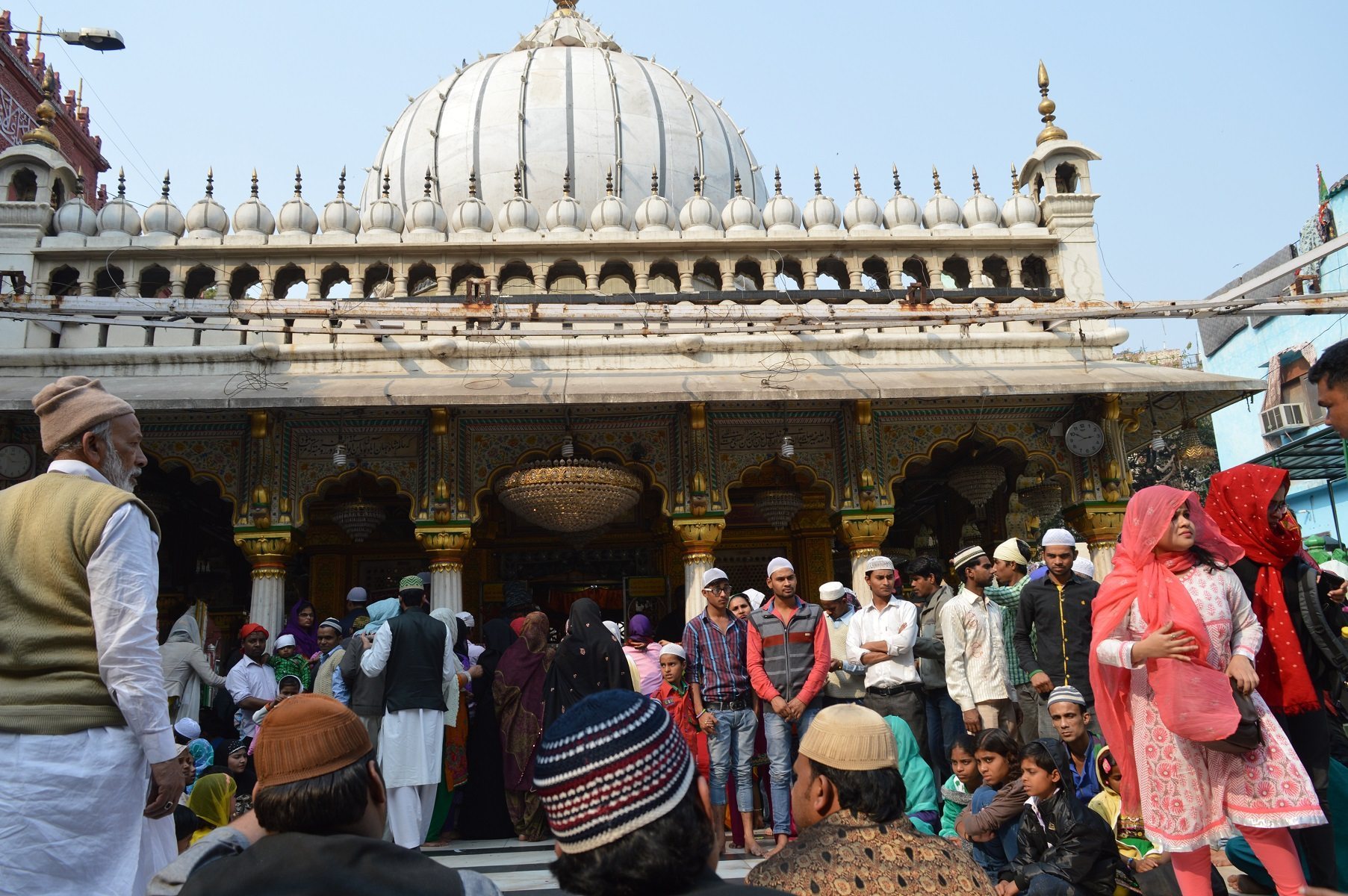
Hazrat Nizamuddin Dargah is an active Sunni Sufi shrine and mosque complex in Nizamuddin West, New Delhi, India, centered on the tomb of the Chishti saint Nizamuddin Auliya. The shrine developed during the Tughlaq period after the saint’s death in 1325 and remains an important place of pilgrimage, prayer, commemoration, and qawwali, a form of Sufi devotional music.
Nizamuddin Auliya and the Tughlaq period
Nizamuddin Auliya lived from 1238 to 1325 and became the fourth successor of the Chishti Sufi order in India. The Chishti tradition emphasized spiritual discipline, devotion, charity, and close relationships between saints and disciples. After Nizamuddin Auliya died in Delhi, Muhammad bin Tughluq built the principal tomb structure in 1325, establishing the shrine around which the complex grew.
Firuz Shah Tughlaq later repaired the tomb. The present dome was built by Faridun Khan in 1562, although the wider construction history remains uncertain. The surviving shrine building is also said to have been rebuilt during the reign of the Mughal emperor Akbar in 1562 to 1563. Numerous additions and alterations were made over the following centuries.
The settlement of Ghiyaspur, where Nizamuddin Auliya had lived, developed into the surrounding Nizamuddin Basti and was later named after him. Before the Partition of India, the area was mainly occupied by pirzadas, shrine custodians associated by descent or established tradition with families connected to the saint. Its population expanded substantially after refugees settled there during Partition.
Amir Khusrau and the growth of the complex
Amir Khusrau, Nizamuddin Auliya’s close disciple, died in the same year as his master and was buried within the complex. A major medieval Indo-Persian poet, musician, and cultural figure, he is remembered alongside the saint, and his birth and death anniversaries draw many visitors.
The Jamat Khana Masjid, also known as the Khilji Mosque, was begun during the reign of Alauddin Khalji by his son Khizr Khan. Its central dome and hall were completed between 1312 and 1313. Around 1325, Muhammad bin Tughluq added two adjoining halls. A baoli, or stepped water reservoir, was commissioned by Nizamuddin Auliya and completed in 1321. Local tradition connects its construction with the simultaneous building of Tughlaqabad Fort by Ghiyasuddin Tughlaq.
Ritual life and administration
The dargah remains an active religious institution. Nizamuddin Auliya’s birth anniversary and urs, his death anniversary understood in Sufi traditions as a symbolic union with God, are observed on the seventeenth and eighteenth days of Rabi al-awwal. The ceremonies include illumination of the complex and tombs, recitation of the fateha, offerings of rose petals and sweets, and the placement of fragrant chaddars, or ceremonial cloths, over the tombs.
Amir Khusrau is also commemorated, while Basant Panchami is celebrated with yellow clothing and springtime observances. Tradition attributes the introduction of this celebration at the dargah to Khusrau, who is said to have used it to comfort Nizamuddin Auliya after the death of his nephew Khwaja Taqiuddin Nuh. A separate annual Prophet festival in the third month of the Islamic calendar includes a religious assembly and the public display of the shrine’s relics.
Qawwali is performed regularly after the Maghrib, or sunset, prayer, especially on Thursday nights. These gatherings attract approximately 1,500 visitors. The complex also provides a daily langar, a communal meal offered without charge. Dua-e-Roshni, an evening prayer during which lamps are lit, brings pilgrims around the khadim, or shrine caretaker, who prays for the fulfillment of their wishes. Women have traditionally been restricted from entering the inner sanctum.
Offerings are collected through the baridari system, an arrangement in which pirzadas collect offerings and manage customary shrine services. The Anjuman Peerzadan Nizamiyan Khusravi committee manages the dargah. The shrine’s continuing rituals attract visitors from different religious communities and from outside India.
The complex was renovated and restored around 2010 by the Aga Khan Trust for Culture. The Archaeological Survey of India administers many of its structures. The tombs of Nizamuddin Auliya and Amir Khusrau, the graves of Jahanara Begum and Muhammad Shah, and the baoli are listed as Monuments of National Importance, while the dargah is owned by the Delhi Waqf Board.
Remains
The precinct extends mainly from north to south and contains closely grouped tombs, a red-sandstone mosque, devotional and commercial spaces, offices, and buildings donated by wealthy Muslims. Marble and carved-stone elements, perforated jalis, domes, Quranic inscriptions, lotus-bud ornament, and ornamental medallions give the complex its Indo-Islamic and Mughal architectural character.
The principal tombs
Tomb of Nizamuddin Auliya
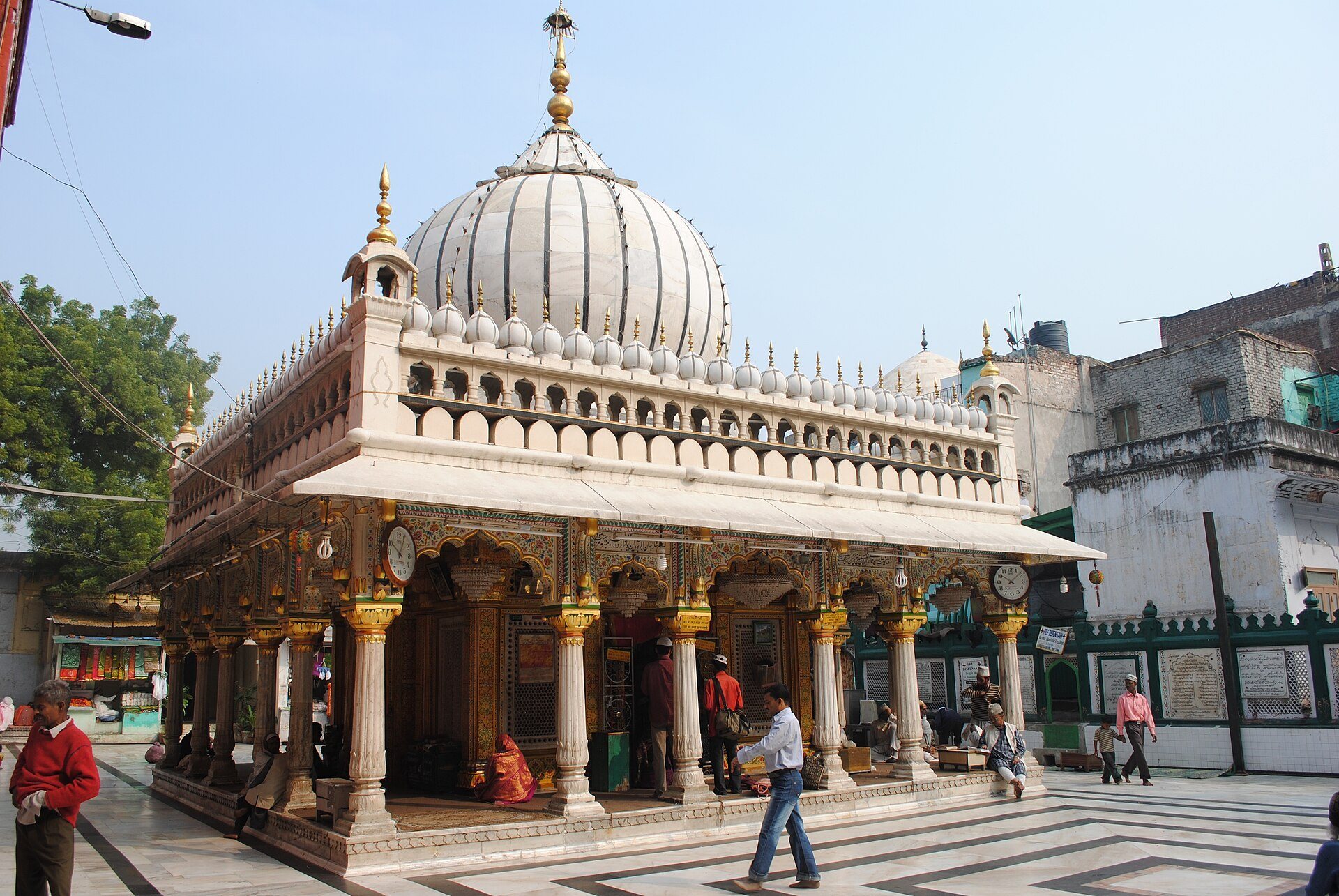
Nizamuddin Auliya’s tomb is covered by a white dome approximately 6 metres in diameter. A marble balustrade donated by Nawab Khurshid Jah of Hyderabad’s Paigah family surrounds the tomb, together with a marble patio and intricately carved jalis, or perforated stone screens. Firuz Shah Tughlaq is said to have hung four golden cups in recesses inside the dome. Later additions and alterations have shaped the structure’s present form.
Tombs and graves within the complex
Amir Khusrau’s tomb and the grave of Jahanara Begum, Shah Jahan’s daughter, stand near the entrance. Ziauddin Barani and Muhammad Shah are also buried within the complex, which contains more than 70 graves in total. The tombs of Nizamuddin Auliya and Amir Khusrau are distinguished from the surrounding secular graves as places of religious devotion. Their tombstones are covered with sacred cloths and enclosed by railings, while the associated buildings have white domes, perforated wall designs, and elaborately decorated supports.
Jamat Khana Masjid and the baoli
Jamat Khana Masjid
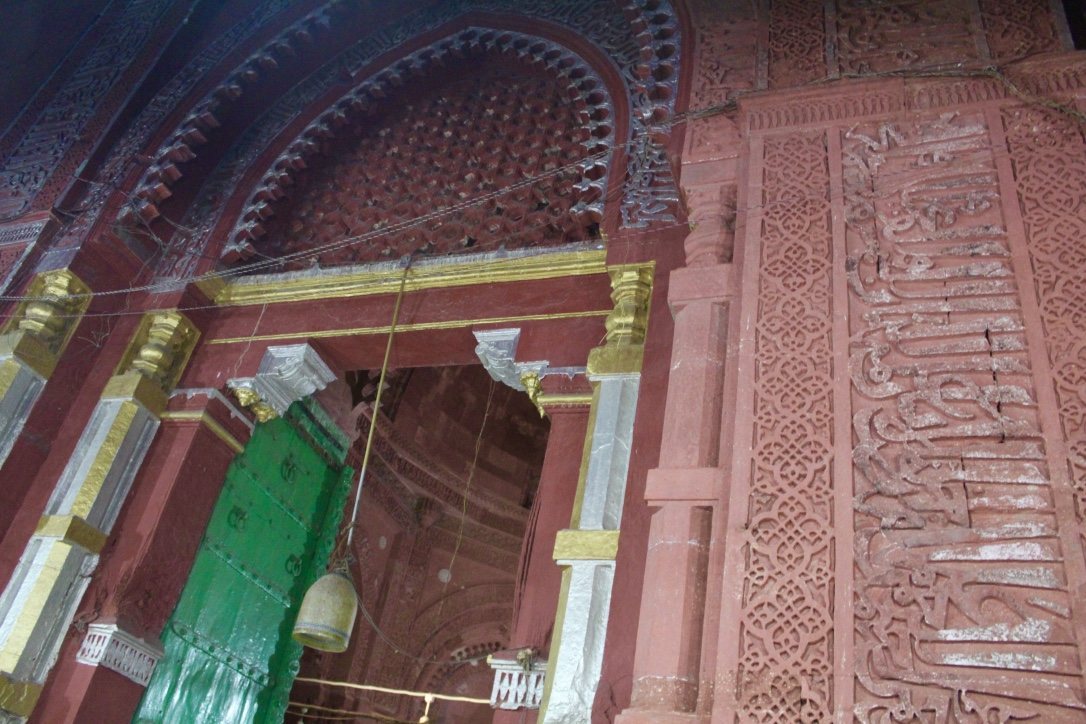
The Jamat Khana Masjid stands beside the dargah and is built of red sandstone. Its central section contains three bays, Quranic inscriptions carved into the stone walls, arches decorated with lotus-bud motifs, and ornamental medallions on the exterior of the dome. Khizr Khan was responsible for the central dome and hall. The two adjoining halls added under Muhammad bin Tughluq each have two domes.
The southern hall, known as the Chhoti Masjid, or Small Mosque, is reserved for women and has a wooden door. A golden bowl hangs from the center of the mosque’s large dome. The mosque’s west-facing façade and carved details form part of the complex’s red-sandstone architectural group.
Nizamuddin Baoli
The Nizamuddin Baoli is a stepwell near the rear entrance, close to the Yamuna River. It was completed in 1321 and remains filled with water. Local belief holds that its water has magical powers, and people bathe in it. The baoli forms a distinct water structure within the dense funerary and devotional precinct.
Relics and surrounding structures
Relics associated with the Prophet and his relatives
The complex contains four relics linked to the Prophet Muhammad or his relatives. They are a purported strand of the Prophet’s beard, a fragment of the leather cover of a Quran manuscript attributed to Ali, earth from Karbala traditionally believed to have absorbed the blood of Husayn, and a purported footprint of the Prophet Muhammad.
The first three relics are kept in display cases on raised platforms about chest height and are normally concealed beneath velvet cloths. The purported footprint lies beneath a case-bearing platform, with rosewater and a water vessel provided for ritual purification. These relics are publicly displayed during the annual Prophet festival.
Structures around the dargah
The complex is immediately surrounded by the Sabz Burj, the Urs Mahal, and the Chausath Khamba. The Urs Mahal serves as a stage for qawwali performances. The broader precinct contains numerous medieval Islamic tombs and other funerary structures, linking the principal shrine to a larger landscape of religious and commemorative buildings. A wazookhana, or ablution area, is also present within the complex.