Yaxchilan: Maya City and Dynastic Capital
Site at a Glance
- Rating
- 4.8
- Popularity
- Medium
- Country
- Mexico
- Primary era
- Medieval
- Eras represented
- Classical, Medieval
- Civilizations
- Maya
- Site type
- City
On this page23 sections
History
Yaxchilan is an ancient Maya city and former dynastic capital on the south bank of the Usumacinta River in Ocosingo Municipality, Chiapas, Mexico. Originating in the Preclassic Period, it developed mainly between about 300 BC and AD 850, reached its greatest political and artistic influence during the Late Classic Period, and was largely abandoned around AD 900.
Origins and the Early Dynasty
The ancient name of the city and its kingdom may have been Pa’ Chan, commonly interpreted as “Cleft Sky.” The name Yaxchilan was later assigned by Teoberto Maler and is said to mean “Green Stones” in a Maya language. Earlier explorers used other names, including “Lorillard City,” given by Désiré Charnay, and “Menché,” used by Alfred Maudslay. The city’s emblem glyph was once read as Siyaj Chan, or “Sky Born.” Paired emblem glyphs may have expressed the union of two states or a system of joint rule.
The known dynastic sequence begins with the accession of Yopaat B’alam I, most likely on 23 July 359. He was described as the first enthroned lord and established the dynasty that governed Yaxchilan for centuries, when the settlement was still a minor center. Much of the surviving account of earlier history was written retrospectively during the Late Classic Period under the authority of later rulers. Hieroglyphic Stairway 1 was especially important in this presentation of the past, although some inscriptions appear to have reshaped earlier dynastic events to strengthen the legitimacy of subsequent kings.
Yaxchilan’s early rulers expanded their influence through warfare and the capture of prominent opponents. In the early fifth century, K’inich Tatb’u Skull I captured the ruler of Bonampak and lords from Lakamtuun. Another capture, associated with Dzibanche, took place in AD 537. Jatz’o’ Jo’l was credited with defeating Piedras Negras in AD 460 and capturing an enemy identified either as a subordinate lord or as King K’an Ahk II. By about AD 478, Bird Jaguar II had taken a vassal of Piedras Negras.
Joy B’alam I captured nobles from Bonampak, Piedras Negras, and Tikal, but was himself taken prisoner by Ruler C of Piedras Negras in AD 514. The event appears on Piedras Negras Lintel 12. K’inich Tatb’u Skull II came to the throne on 11 February 526. He commissioned carved lintels with a dynastic list and restored Yaxchilan’s fortunes through campaigns against Bonampak, Lakamtuun, Calakmul, and Tikal.
Rival Kingdoms and Regional Power
Between AD 537 and 629, four rulers are known to have reigned, although the surviving evidence provides only scattered details. Knot-eye Jaguar II captured the lord of Lacanja in AD 564. The limited record may reflect a period in which a stronger neighboring power, such as Piedras Negras, Palenque, or Tonina, exerted pressure over Yaxchilan, but the precise political situation remains uncertain.
Bird Jaguar III took power in AD 629 and captured a lord of Hix Witz in AD 646 or 647. Hix Witz, meaning “Jaguar Hill,” was a political entity associated with sites including Zapote Bobal, Pajaral, and La Joyanca. In the Late Classic Period, Yaxchilan became one of the most powerful states along the Usumacinta. It controlled smaller centers including Bonampak, competed with Piedras Negras for the river trade route, maintained formal contacts with Tikal, and fought Palenque in AD 654. Differences in the architecture of subordinate sites indicate a political boundary between the realms of Yaxchilan and Piedras Negras.
The Reign of Itzamnaaj B’alam II
Yaxchilan reached a high point under Itzamnaaj B’alam II and his son Bird Jaguar IV. Itzamnaaj B’alam II was enthroned in October 681 and ruled for more than sixty years, dying in AD 742 at about ninety years of age. He was also known as “Master of Aj Nik,” a title connected with the capture of his first captive before he became king.
During the latter third of his reign, a major building program transformed the capital. Monumental buildings, carved lintels, hieroglyphic stairways, and stelae proclaimed the authority of the ruling house. Yaxchilan’s territory extended to La Pasadita and El Chicozapote, while Lacanja and Bonampak appear to have fallen under its control at different times. Tonina controlled the region in AD 715, showing that Yaxchilan’s authority remained contested.
Itzamnaaj B’alam II captured Aj Sak Ichiy Pat in AD 689, Aj K’an Usja of B’uktunn in AD 713, and Aj Popol Chay, ruler of Lacanja, in AD 729. Piedras Negras defeated Yaxchilan in AD 726 and captured one of its subordinate lords, an event recorded on Piedras Negras Stela 8. Yaxchilan’s later construction program may indicate that the city subsequently secured greater independence and stronger control of profitable river commerce.
Bird Jaguar IV and the Late Dynasty
Yopaat B’alam II may have ruled between AD 742 and 752. In AD 749 he attended a ceremony honoring the ruler of Piedras Negras. If he was then king of Yaxchilan, the ceremony suggests a period of subordination. No contemporary record of his reign survives at Yaxchilan, possibly because later rulers destroyed records that did not support their political claims.
Bird Jaguar IV acceded in AD 752 and ruled for approximately sixteen years. He promoted his legitimacy through an extensive program of public art and architecture, presented himself as a warrior, and emphasized dynastic continuity with his father, Itzamnaaj B’alam II. His monuments show royal ceremonies, warfare, ritual bloodletting, and the history of the ruling family.
Shield Jaguar III was in power by February AD 769. Around AD 790 he supervised the installation of Chan Muwaan II as ruler of Bonampak. Yaxchilan artists then commemorated Chan Muwaan II and his predecessor in the murals of Bonampak Structure I. The last known ruler, K’inich Tatb’u Skull III, came to power shortly after AD 800. His monuments include a final group of lintels and a victory over Piedras Negras. Lintel 10, dated to AD 808, may record his capture of the last known ruler of Piedras Negras, identified as Ruler 7.
Yaxchilan was massively abandoned soon after the completion of Structure 3. Simple houses appeared in the former Great Plaza, while broken monuments were incorporated into later constructions. These changes mark the end of dynastic government and the city’s role as a capital. Lacandon Maya continue to make pilgrimages to Yaxchilan for rituals addressed to Maya gods.
Rediscovery and Archaeological Work
Juan Galindo published the first known modern notice of Yaxchilan in 1833. Edwin Rockstoh visited in 1881, followed by Alfred Maudslay and Désiré Charnay in 1882. Their drawings, photographs, and reports brought the ruins to wider attention. Teoberto Maler made repeated visits between 1897 and 1900. Gerónimo López de Llergo mapped the Great Plaza and Great Acropolis in 1891, and a Carnegie Institution expedition led by Sylvanus Morley mapped the site and recorded additional monuments in 1931.
From the 1970s, Ian Graham documented the inscriptions, which were published from 1977 onward in the Corpus of Maya Hieroglyphic Inscriptions. Tatiana Proskouriakoff used Yaxchilan’s texts in pioneering research on Maya writing, identifying signs associated with death, capture, and captors. Peter Mathews and other scholars later extended this work.
Mexico’s National Institute of Anthropology and History, or INAH, carried out archaeological investigations from 1973 to 1985 under Roberto García Moll. Daniel Juárez Cossío and Mario Pérez Campa continued work in 1989 and 1990. More than ten research seasons included consolidation and conservation in the central area and developed methods for conserving and presenting the buildings. Since 1990, a National Autonomous University of Mexico project on pre-Hispanic mural painting has recorded and studied Yaxchilan’s wall paintings.
Archaeological materials were removed from Yaxchilan during the nineteenth and twentieth centuries. Maudslay took six lintels between 1882 and 1887. Five are in the British Museum, while a sixth, sent to the Ethnological Museum in Berlin, disappeared during the Second World War. Mexico’s National Museum removed nine lintels and three stelae for its 1964 inauguration; one stela was returned to Yaxchilan in 1981. The site is administered by INAH and lies within the Yaxchilan Natural Monument, whose protected area contains more than 1,435 plant and animal species, including 158 species in a Mexican risk category and 15 exotic species.
Remains
River Setting and Central Groups
Yaxchilan occupies the apex of a horseshoe-shaped meander on the south bank of the Usumacinta. The river protects the site on all sides except for a narrow approach from the south. It lies about 40 kilometers downriver from Piedras Negras, 21 kilometers from Bonampak, and 80 kilometers downriver from Altar de Sacrificios, on the Mexican side of the border with Guatemala.
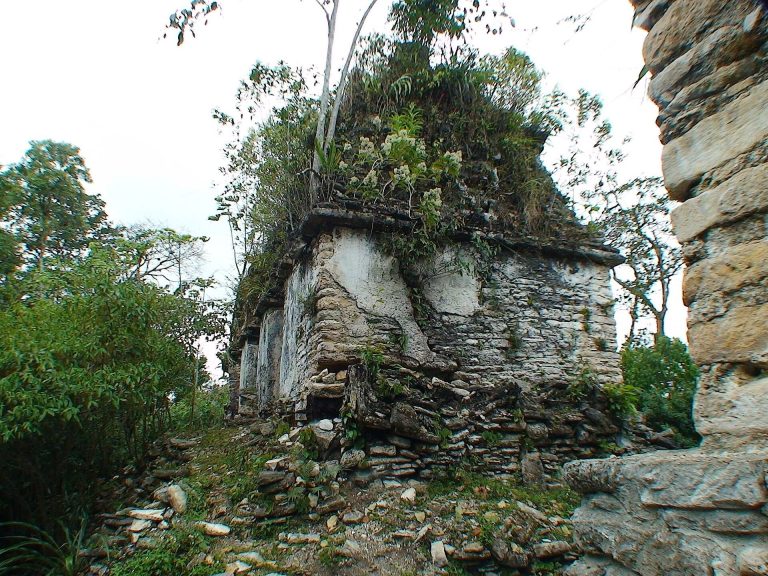
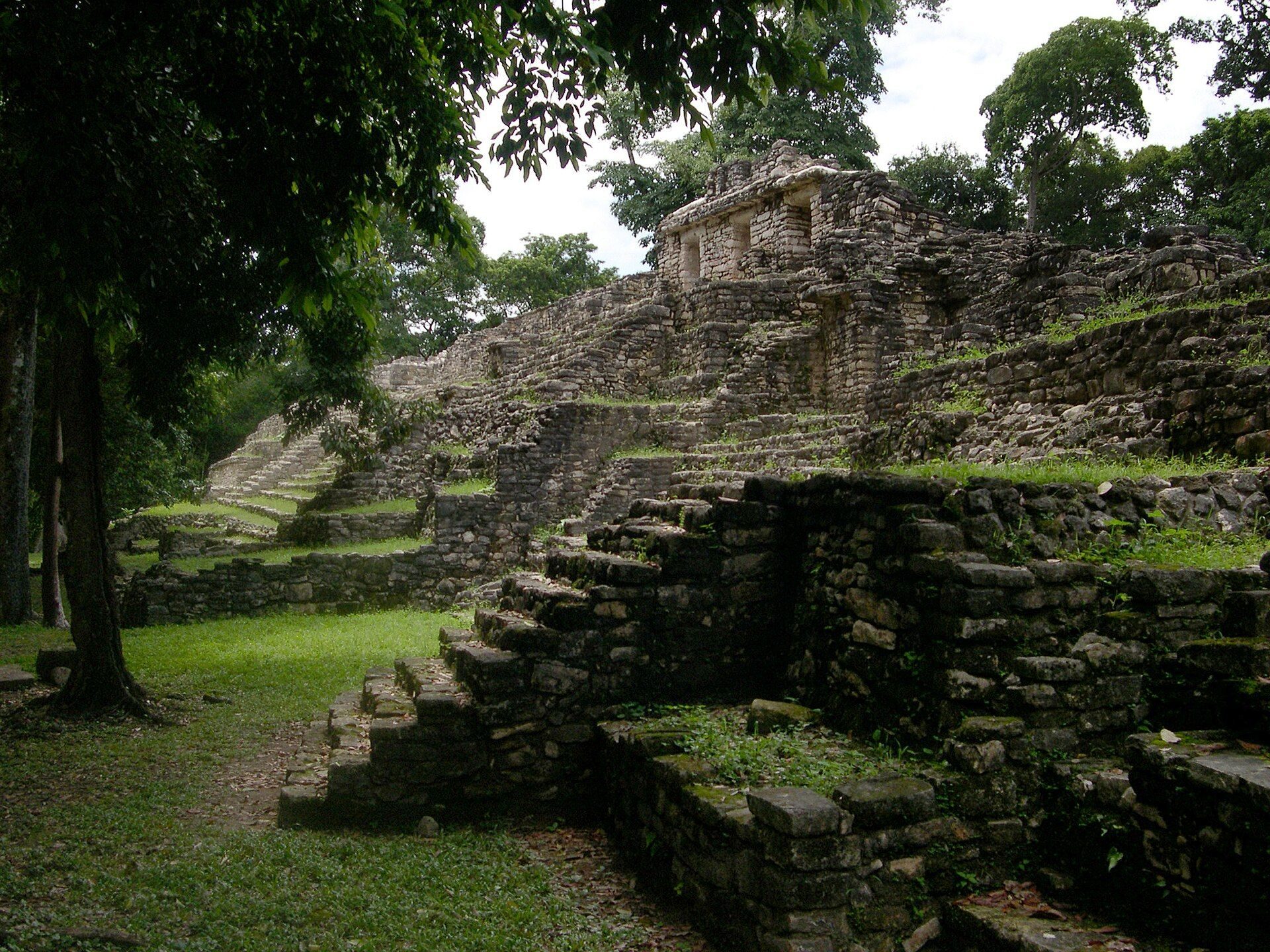
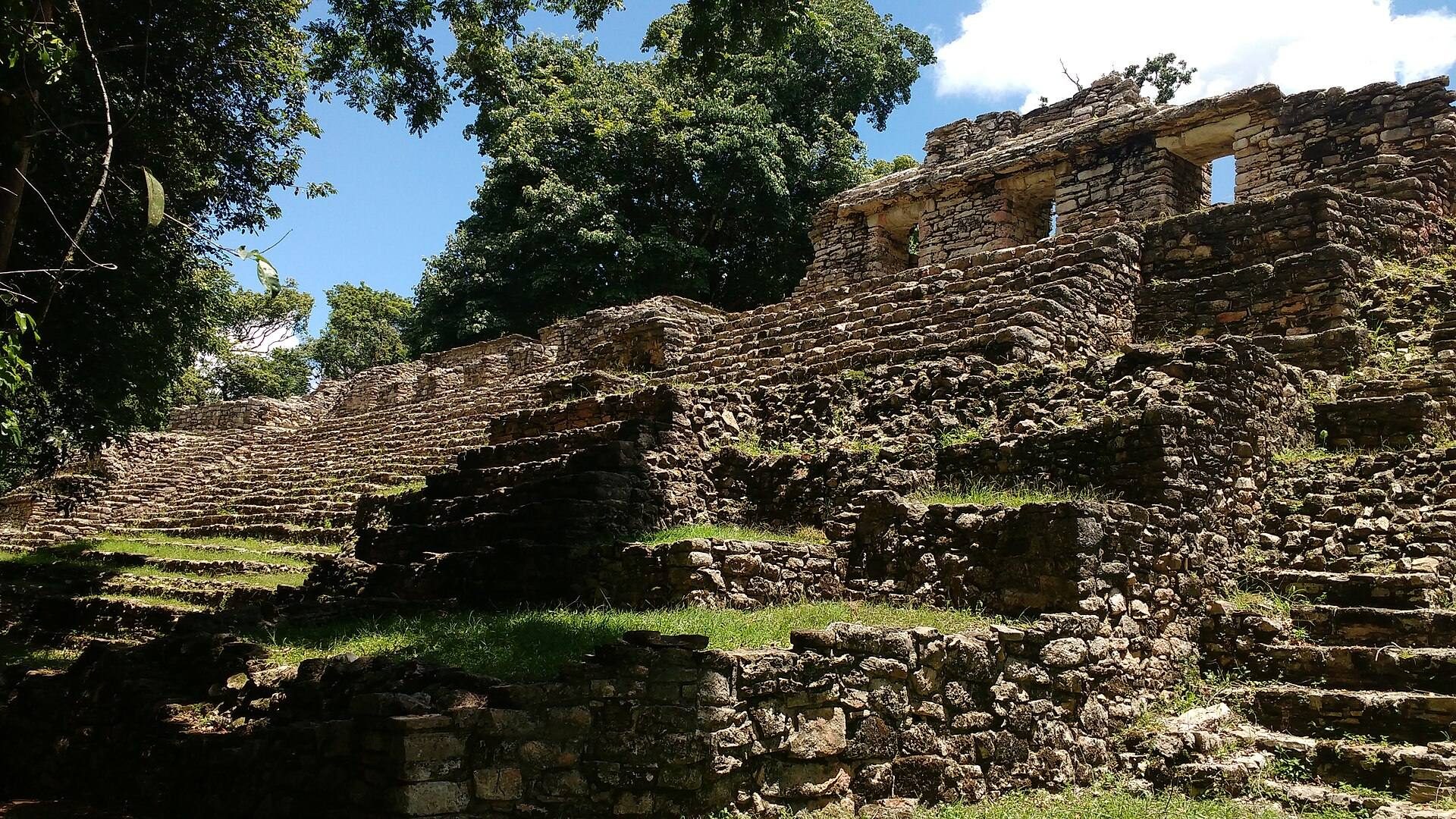
The nuclear area contains about 120 identified buildings, of which approximately 50 are currently accessible. The Great Plaza, Great Acropolis, and Small Acropolis form the principal groups. Stairways, ramps, and terraces connect them, while the Small Acropolis occupies the highest part of the site. The buildings are aligned with the Usumacinta, producing unusual orientations in some major structures, including the two ballcourts, architectural complexes used for the Mesoamerican ballgame.
Structures 6 to 8, 9 and 10, 12 to 14, 16 to 26, 30, 33, 39 to 44, 67, 74, 77, and 78 contain plazas, temples, ballcourts, vaulted rooms, roof combs, stucco masks, murals, carved lintels, and hieroglyphic stairways. A roof comb is a raised architectural crest above a Maya building’s roof. Structure 17 was probably a sweat bath, or temazcal. Around AD 740, Structures 18, 77, and 78 and their small plaza were covered by a platform approximately 8 meters high.
Structures of the Great Plaza
Structure 23
Structure 23 was built during the reign of Itzamnaaj B’alam II and dedicated to Lady K’ab’al Xook. It was the first major construction after a lapse of about 150 years. Its three carved lintels appear to have asserted the refoundation of Yaxchilan and the ruler’s dynastic right to govern. Lintels 24 and 25 are now in the British Museum, while Lintel 26 is in Mexico City.
Structure 33
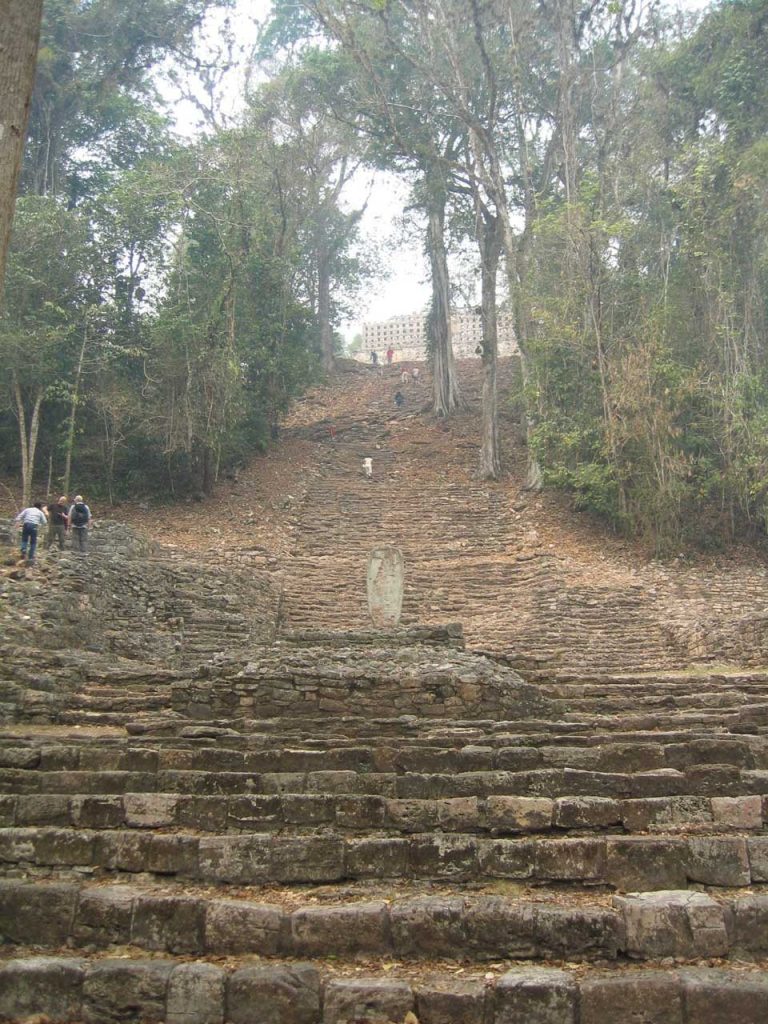
Structure 33, probably dedicated by Bird Jaguar IV in AD 756, stands about 40 meters above the Great Plaza. Three doorways contain Lintels 1 to 3. A rear niche held a headless human sculpture probably representing Bird Jaguar IV. Much of the vaulted roof, frieze, and roof comb survives. Hieroglyphic Stairway 2 rises from the plaza toward the building.
Structure 44
Structure 44 was built by Itzamnaaj B’alam II and dedicated around AD 732. Its carved lintels and sculpted steps carry texts describing the city’s resurgence during the eighth century.
Carved Lintels and Stairways
Hieroglyphic Stairway 2
Hieroglyphic Stairway 2 preserves scenes of Bird Jaguar IV, his father, and his grandfather as ball players using symbolic balls made from bound captives. It also contains Yaxchilan’s only surviving account of the Ux Ahal myth, which recounts three victories and the decapitation of three figures possibly representing underworld deities.
Lintels 1 to 3 and Lintel 9
Lintels 1 to 3 show Bird Jaguar IV with Lady Great Skull, his son and heir Shield Jaguar III performing a bird-scepter dance in AD 757, and an ally. Lintel 9 records a ritual held on 16 June 768. It gives Bird Jaguar IV the title of captor of Ah Kuk, lord of twenty captives, and sacred ruler of Yaxchilan.
Lintels 15 to 17
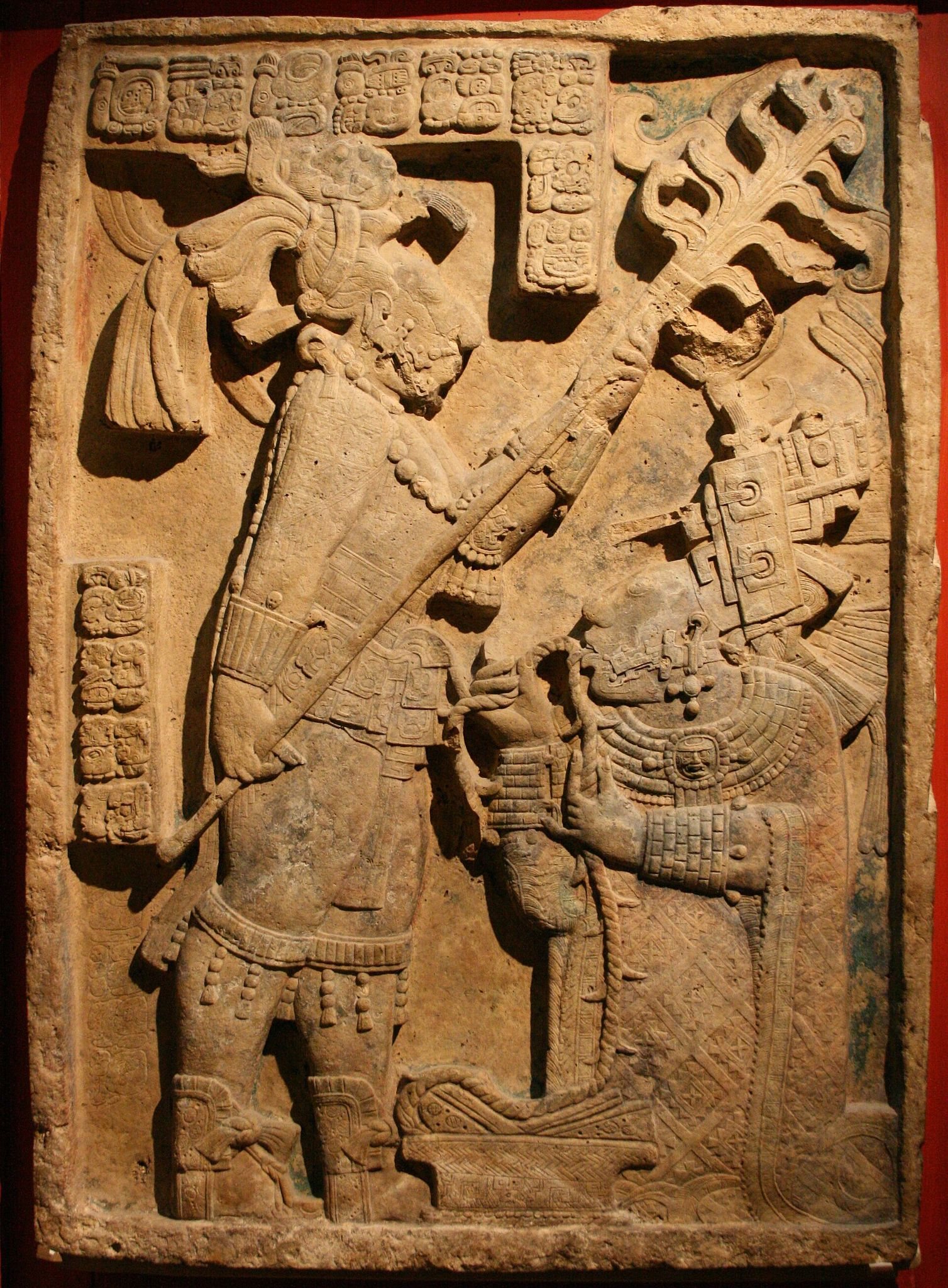
Lintels 15 to 17 depict bloodletting rituals involving Lady Wak Tuun, Bird Jaguar IV, and Lady Mut B’alam. Maya bloodletting was a royal and elite ceremony in which participants drew blood to communicate with supernatural beings. Lintel 16 shows Bird Jaguar IV standing over a kneeling captive in an event dated to AD 752, while Lintel 17 represents a bloodletting ritual eight days later. The three lintels are now in the British Museum.
Lintels 24 to 26
Lintel 24 depicts Itzamnaaj B’alam II holding a burning torch over Lady K’ab’al Xook as she draws a spiked rope through her tongue. The ceremony took place on 28 October 709. On Lintel 25, Lady K’ab’al Xook invokes a two-headed Vision Serpent. One mouth produces a warrior and the other the head of Tlaloc, a central Mexican water deity associated with Teotihuacan. Lintel 26, dated to AD 726, bears a portrait of Itzamnaaj B’alam II.
Other Dynastic Lintels
Lintel 10, dated to AD 808, is the last known monument at Yaxchilan and may show K’inich Tatb’u Skull III capturing Ruler 7 of Piedras Negras. Lintels 29 to 31 form a continuous text about Bird Jaguar IV’s birth and accession, while Lintel 35 records victories including one over Calakmul. Lintel 41 shows Bird Jaguar IV preparing for battle in AD 755 as Lady Wak Jalam Chan Ajaw of Motul de San José offers him a spear. Lintel 43 depicts Bird Jaguar IV and Lady Mut B’alam performing autosacrifice on 12 October 752. Lintels 47 and 48 preserve dynastic history and a chronological count connected with rituals held on 11 February 526.
Small Acropolis and Stelae
Structure 42
Structure 42 in the Small Acropolis contained Lintels 41 to 43. Lintel 42 remains in place, while the other carved scenes are known through the wider corpus of Yaxchilan’s monuments.
Stelae of the Central Area
Stela 2 stands before Structure 33 and is badly weathered. Its date is uncertain, with proposed dates of AD 537 and AD 613. Stela 3 was intentionally destroyed in antiquity, later restored, and re-erected. Stelae 5 and 6 depict Itzamnaaj B’alam II and Bird Jaguar III. Stela 7 shows a kneeling figure and probably dates to about AD 771.
Stela 9 depicts Bird Jaguar IV performing a dance. Stela 10 shows the ruler with his wife and warriors, his parents, the solar deity, and a celestial two-headed serpent. Stela 11 records the transfer of power from Itzamnaaj B’alam II to Bird Jaguar IV and now lies near the river after its return from Mexico City in 1965. Stela 18 shows Itzamnaaj B’alam II standing over Aj Popol Chay, ruler of Lacanja, although the date of the event is uncertain.
Early and Later Stelae
Stela 27, dated to AD 514, depicts Knot-eye Jaguar I and is the earliest known Yaxchilan stela. A stela is a freestanding carved stone monument. Stela 31 is carved from a stalactite. Stela 35 was found during the 1983 excavation of Structure 21 and depicts Ix Uhu’t Chan Lem, the mother of Bird Jaguar IV.
Inscriptions and Monumental Sculpture
Yaxchilan is especially known for monolithic stelae and narrative stone reliefs carved on lintels, the horizontal stones spanning temple doorways. More than 120 inscriptions have been identified on its monuments. Together, the lintels, stairways, stelae, murals, and sculpted architectural elements present royal genealogy, military victories, captive-taking, ceremonies, bloodletting, and ritual encounters with supernatural beings. Their concentration across the Great Plaza, Great Acropolis, and Small Acropolis preserves the political and religious program of a Maya capital whose rulers used architecture and writing to shape the memory of their dynasty.