Cleopatra’s Needle: An Ancient Egyptian Obelisk in Central Park
Site at a Glance
- Rating
- 4.7
- Popularity
- Low
- Country
- United States
- Primary era
- Bronze Age
- External website
- Open
- Eras represented
- Bronze Age
- Civilizations
- Egyptian
- Site type
- Civic
- Remains
- Obelisk
On this page9 sections
History
Cleopatra’s Needle is an ancient Egyptian red-granite obelisk at E 81st St in Central Park, New York, United States. It was erected at Heliopolis around 1475 BC during Egypt’s Eighteenth Dynasty, using the tall, four-sided monument form that tapers toward a pyramidal summit. The monument was commissioned by Thutmose III, an Egyptian pharaoh associated with major military expansion, and later received inscriptions added by Ramesses II.
Egyptian and Roman phases
Cleopatra’s Needle forms one of a pair known collectively by that name. Approximately two centuries after its erection, Ramesses II, a pharaoh of the Nineteenth Dynasty also known as Ramesses the Great, added texts commemorating his military victories. These inscriptions created two chronological layers on the monument, preserving the memory of both rulers.
During the reign of Augustus, the first Roman emperor, the Romans moved the pair from Heliopolis to Alexandria around 12 or 13 BC. They installed the obelisks at the Caesareum, a temple dedicated to the imperial or ruler cult and associated with Cleopatra. The Alexandrian temple was dedicated either to Mark Antony or to Julius Caesar. The obelisks were later toppled and became partly buried, a change that helped protect much of their hieroglyphic carving from weathering.
Acquisition by New York
New York City’s campaign to obtain an Egyptian obelisk began in March 1877, after newspapers reported on the transportation of the obelisk sent to London. Those reports incorrectly attributed an earlier proposal to John Dixon, who denied making it. Henry G. Stebbins, commissioner of the city’s Department of Public Parks, sought funding for the project that same month, and railroad magnate William H. Vanderbilt offered more than $100,000 to finance the transportation.
Elbert E. Farman, the United States consul general in Cairo, formally requested an obelisk from the Khedive in March 1877 and secured the gift in writing by May. The transfer took place while France and Britain were maneuvering for political control of the Egyptian government, with the United States expected to remain a friendly neutral. Farman and Stebbins conducted the exchange through the United States Department of State.
Removal and Atlantic transport
Henry Honychurch Gorringe, a lieutenant commander on leave from the United States Navy, was entrusted with the transportation. The obelisk was shifted from its upright position to horizontal, nearly falling during the operation. Local protests and legal challenges suspended the work for two months in August 1879. Once the legal difficulties were resolved, the monument was moved about seven miles to Alexandria.
The obelisk was loaded onto the modified steamship SS Dessoug, which sailed on June 12, 1880. A large opening had been cut into the starboard side of the ship’s bow, and the monument was rolled through the hull on cannonballs. Although the vessel suffered a broken propeller, it reached the United States. The obelisk and its 50-ton pedestal arrived at New York’s Quarantine Station in early July 1880.
Installation in Central Park
Gorringe, William Henry Hurlbert, and Frederic Edwin Church selected the monument’s site in 1879. During the planning, the location was kept secret because its elevated position, isolation, and bedrock foundation were considered advantageous for securing the obelisk. The monument was then moved from the East River to Greywacke Knoll over 112 days. Thirty-two horses transported it across part of the route, while a steam engine pushed it over a specially constructed trestle bridge.
Jesse B. Anthony, Grand Master of Masons in New York State, presided over the cornerstone ceremony on October 2, 1880. More than 9,000 Masons joined the parade, which drew an estimated 50,000 spectators, while Gorringe supervised the structure used to raise the obelisk. The monument was formally erected in Central Park on January 22, 1881, and its installation is dated February 22, 1881. A further commemorative ceremony took place inside the Metropolitan Museum of Art one month later.
A time capsule buried beneath the monument contains an 1870 United States census, a Bible, a Webster’s Dictionary, the complete works of William Shakespeare, a guide to Egypt, and a copy of the United States Declaration of Independence. The person who arranged the purchase and transportation also placed a small box inside the capsule, although its contents remain unknown.
Conservation concerns
After its installation, the obelisk underwent substantial deterioration from New York’s pollution, acid rain, and repeated freeze-thaw cycles. Photographs from around the time of its installation show inscriptions that were relatively legible, while the hieroglyphs have since faded and chipped as the red-granite surface deteriorated. In 2010, Zahi Hawass, then Egypt’s minister of antiquities, urged improved conservation and threatened to seek the artifact’s return to Egypt if it was not adequately protected.
Remains
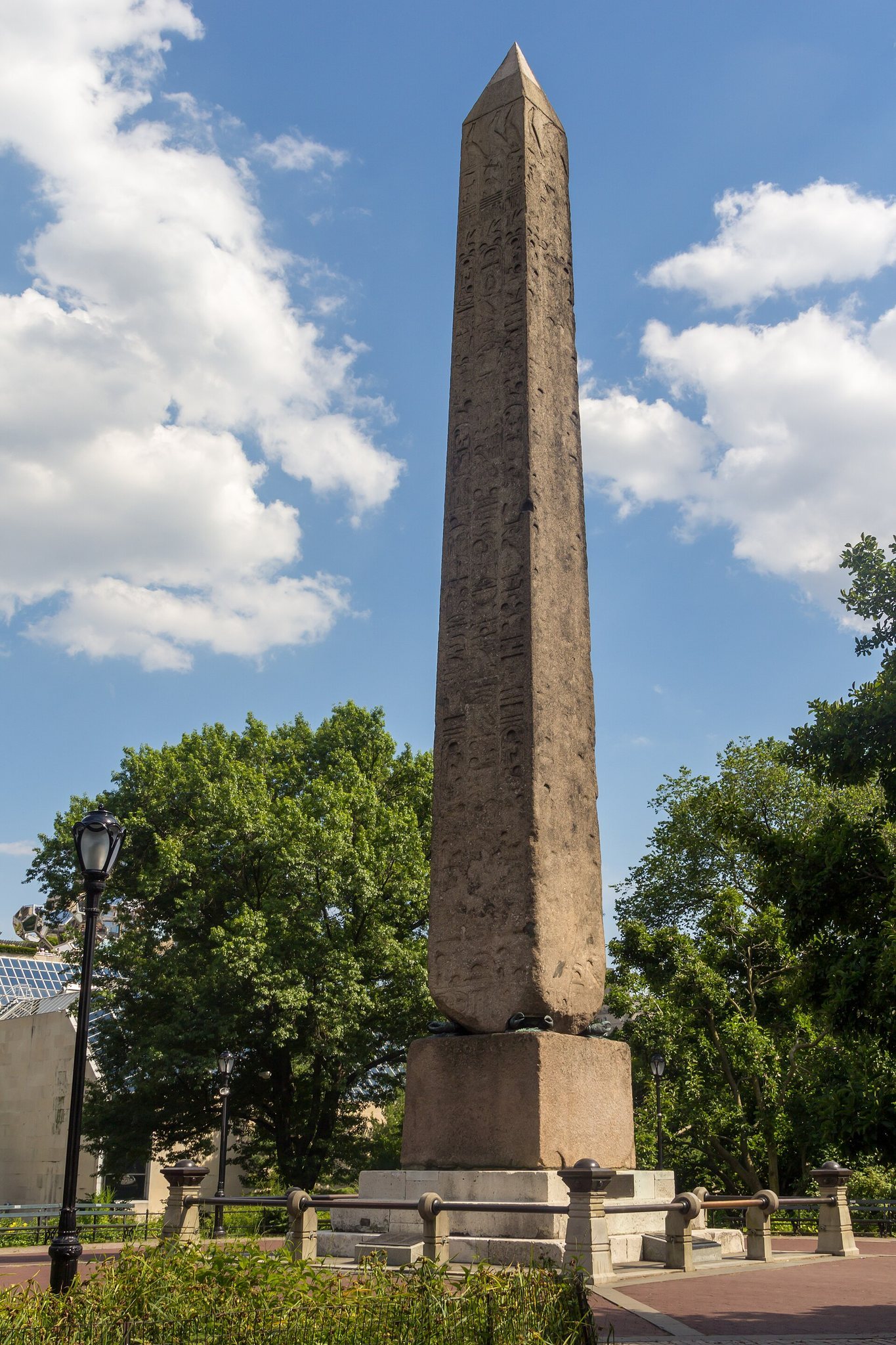
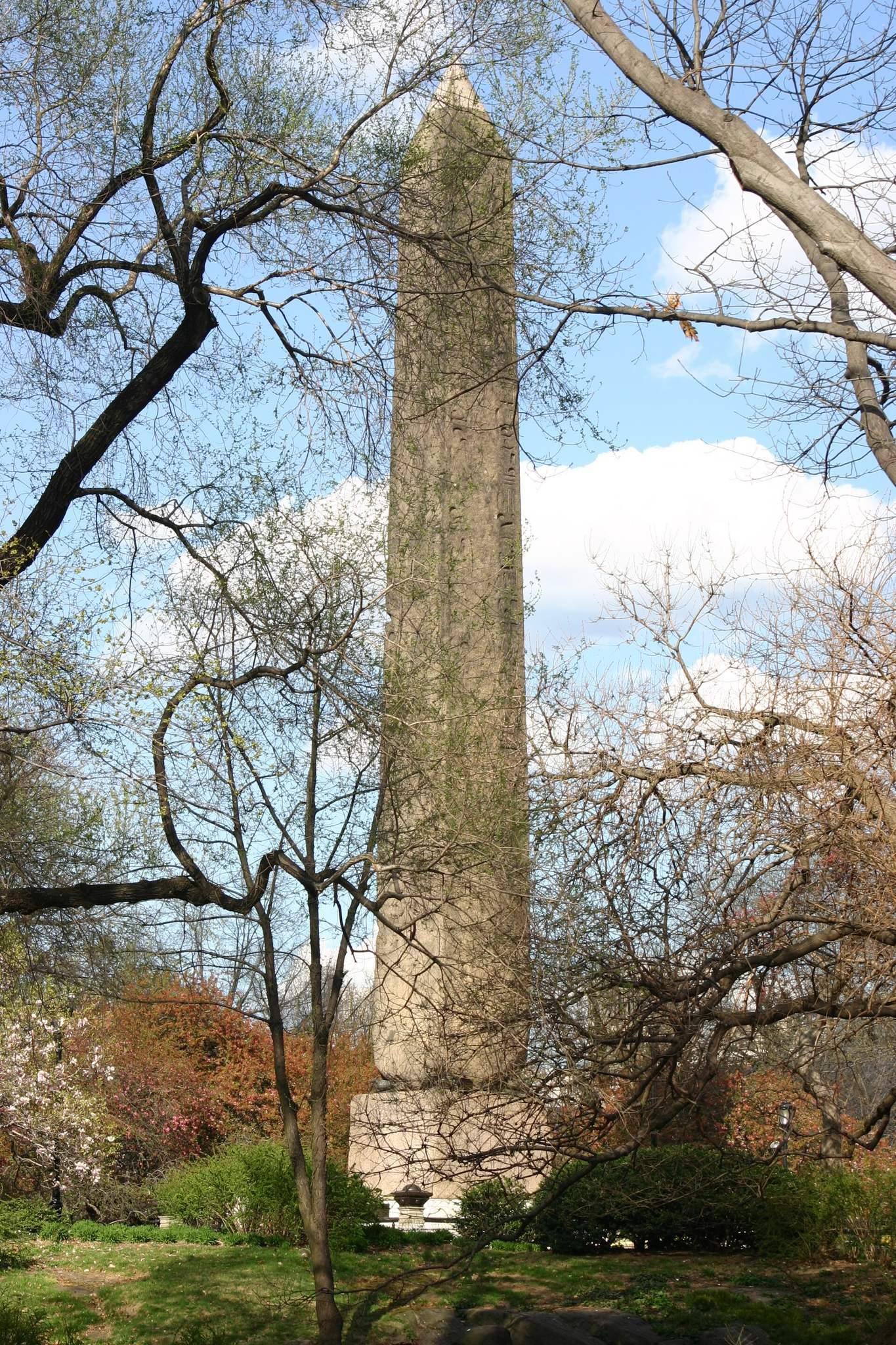
Cleopatra’s Needle stands west of the Metropolitan Museum of Art on Greywacke Knoll in Central Park. It is a red-granite obelisk approximately 21 metres, or 69 feet, high and weighs about 200 tons. Its granite was quarried at Aswan, near the First Cataract of the Nile. The monument rises from a foundation intended to anchor it firmly in the bedrock of the elevated knoll.
Obelisk and inscriptions
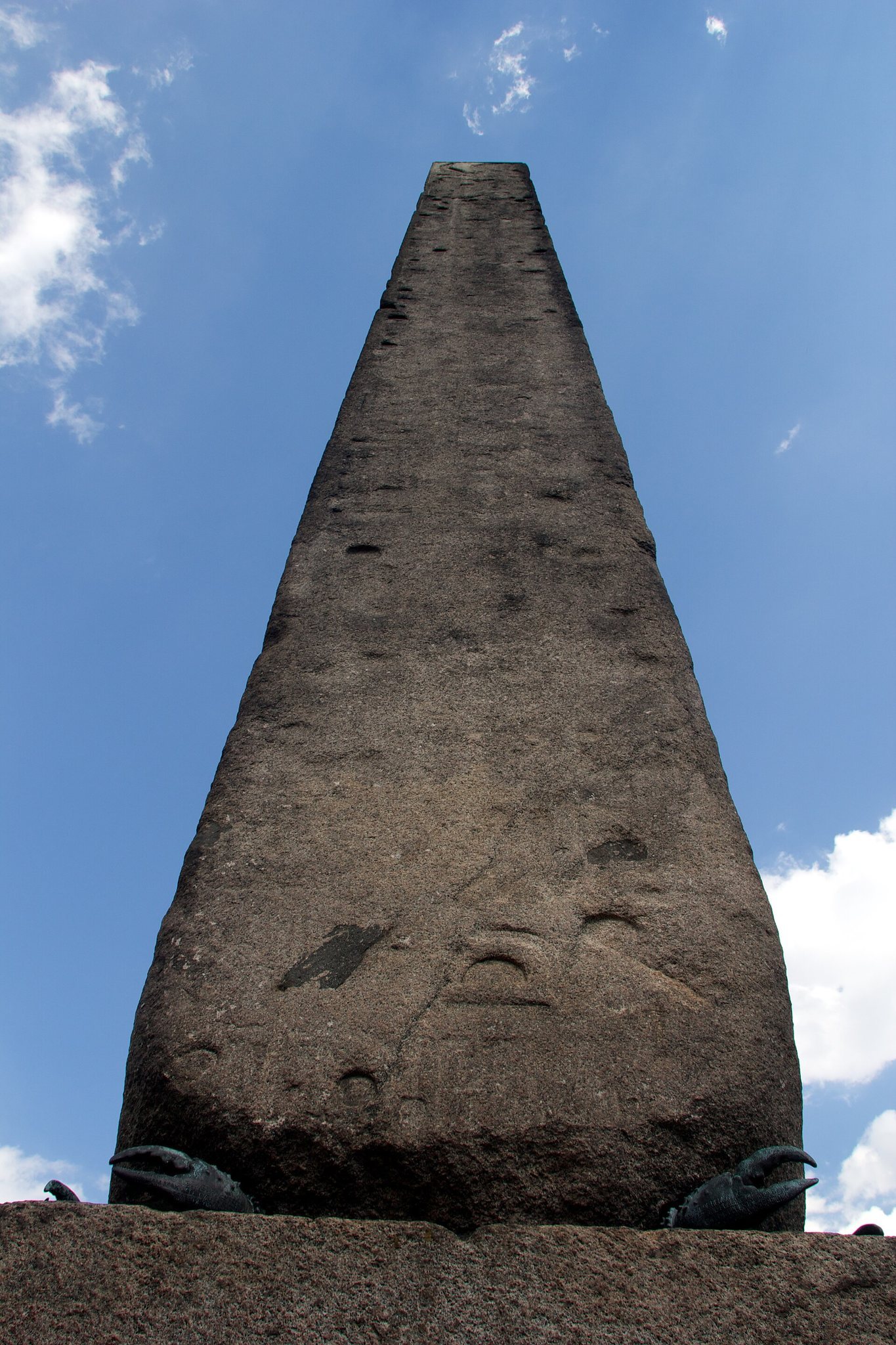
The monument has carved hieroglyphic inscriptions on all four sides. The earlier texts belong to Thutmose III and date to the fifteenth century BC; additions made by Ramesses II approximately two centuries later commemorate his military achievements. The inscriptions survived in relatively good condition through the obelisks’ period of toppling and partial burial at Alexandria, but the New York monument’s exposed granite has since weathered, leaving the carvings faded and chipped.
Pedestal and transport features
The approximately 50-ton pedestal arrived with the obelisk at New York’s Quarantine Station before both were taken to Central Park. The monument’s foundation was designed for a firm bedrock anchorage on Greywacke Knoll. Its present setting therefore preserves the relationship between the tall stone shaft, its pedestal, and the elevated ground selected during the planning of the New York installation.
The modified SS Dessoug also formed part of the monument’s transport history. Workers opened the ship’s starboard bow so the obelisk could be rolled through its hull on cannonballs. The ship’s side was opened again in New York to unload the stone, allowing the ancient monument and its pedestal to continue their journey to Central Park.