Yiftahel: A Neolithic Archaeological Site in Israel
Site at a Glance
- Rating
- 4.4
- Popularity
- Very Low
- Country
- Israel
- Primary era
- Stone Age
- Eras represented
- Stone Age, Bronze Age
- Civilizations
- Unclassified
- Site type
- City
On this page9 sections
History
Yiftahel is an archaeological site in Israel’s Lower Galilee, on the eastern bank of Nahal Yiftahel. Its principal historical importance comes from a substantial Pre-Pottery Neolithic B settlement, a period associated with settled communities, rectangular buildings, cultivated plants, managed animals, and increasingly complex ritual practices.
Earlier identification and discovery
A small nearby tell called Khirbet Khalidiya in Arabic has been identified with Yiftah-el, a city mentioned in Joshua 19:27 as part of the territory of the Tribe of Asher. The archaeological site itself came to light in 1982 during construction of Highway 77. An initial salvage excavation, carried out before construction threatened the remains, exposed about 80 square metres of a Pre-Pottery Neolithic B settlement.
Further excavations in 1983 and 1984 revealed Early Bronze Age I remains above earlier Neolithic deposits. These investigations also identified five Pre-Pottery Neolithic B occupation levels, with buildings, stone-working pits, burials, and animal bones. The results led to a decision to divert the planned road and preserve the site.
Neolithic settlement and economy
Additional excavation followed damage caused by the Mekorot water company in 1997, when a rectangular Neolithic building was exposed. Work resumed in 2007 and 2008 before construction of the Hamovil Interchange. The excavations examined about 1,500 square metres and revealed a sequence extending from the Roman period through modern times, as well as several earlier phases, including Early Bronze Age IV, the period after Early Bronze Age I, Early Bronze Age I, the Pottery Neolithic Wadi Rabah culture, Pottery Neolithic Jericho IX, and Pre-Pottery Neolithic B.
The Pre-Pottery Neolithic B settlement covered approximately 40 dunams. Its residential and communal buildings point to organized community life, while plant remains, animal bones, craft evidence, and ritual objects indicate a complex economy. The inhabitants produced goods for household use and for exchange with nearby and more distant communities. Large quantities of seeds and a rounded silo show the importance of plant cultivation. More than 1,000,000 lentils were recovered, providing evidence for controlled cultivation, and the site also yielded its earliest known domesticated fava-bean seeds. Animal remains contributed to understanding the management and use of animals during the Neolithic.
Later occupation and archaeological preservation
Yiftahel continued to accumulate archaeological layers after the Neolithic, including the Pottery Neolithic, Early Bronze Age, Roman, and later phases. The 2007 to 2008 excavations showed that these layers were distributed unevenly across Areas F, G, H, and I. Together with the earlier road diversion and subsequent salvage work, the excavations transformed a threatened construction site into a preserved record of long-term occupation.
Remains
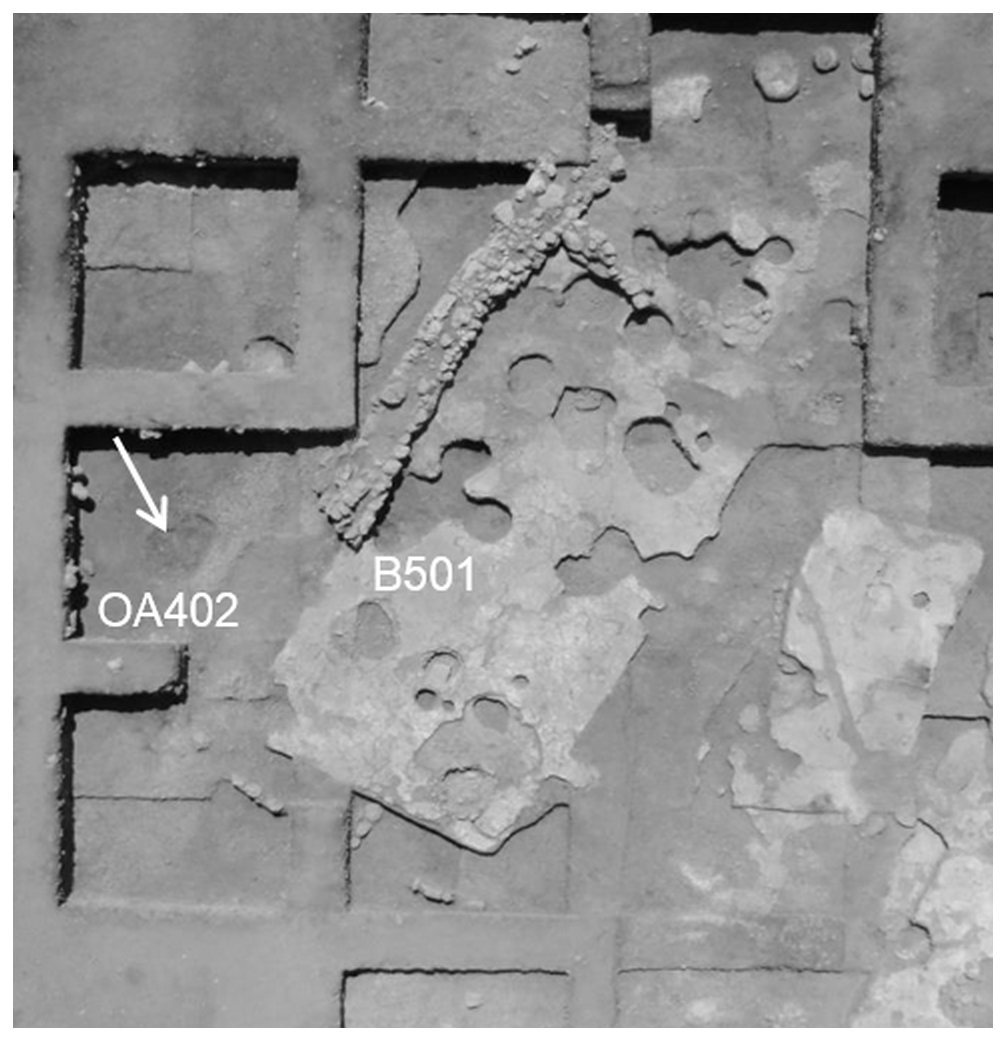
The surviving remains are distributed across four excavation areas named F, G, H, and I. The deposits contain seven chronological layers, although their distribution differs between the areas. The physical evidence includes rectangular Neolithic buildings with plastered floors, Early Bronze Age structures, storage facilities, stone-working areas, burials, botanical remains, animal bones, and ritual deposits.
Neolithic settlement
Buildings and storage
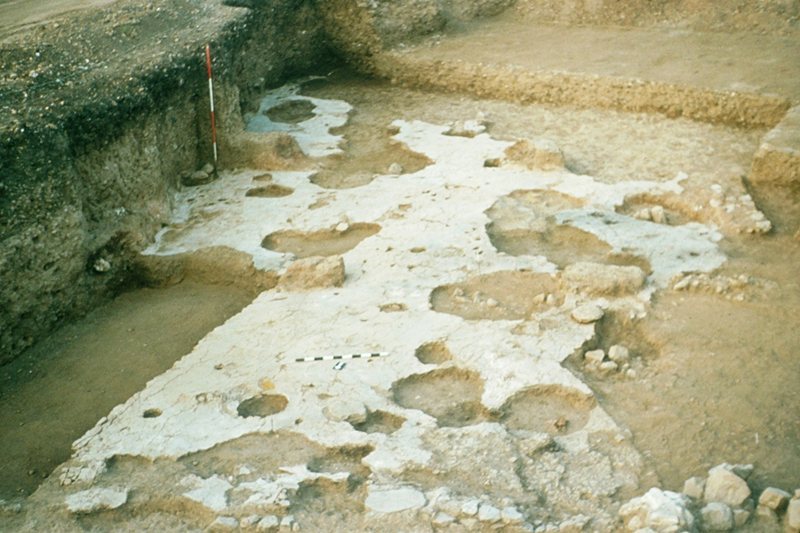
The Pre-Pottery Neolithic B settlement contained numerous rectangular buildings. Their floors were plastered with burnt limestone, and the occupation levels also included stone-working pits, burials, and animal bones. A rounded silo formed part of the Neolithic storage system, while the associated plant remains, especially the large quantity of lentils and early domesticated fava beans, provide physical evidence for cultivation and food management.
Mortuary and ritual remains
Three human skulls were placed together in a pit beside a building. They were coated with plaster, with shells set into the eye sockets and the nose and mouth reconstructed. One skull retained a complete plaster mask that preserved the facial features of the deceased. An intact wild-bull horn and other associated objects were found with the skulls. These remains provide evidence for Neolithic mortuary ceremonies and ritual activity.
Early Bronze Age structures
The Early Bronze Age I remains include about 20 oval and rounded structures. Their forms represent a characteristic village layout of that period in the southern Levant. These buildings lay above earlier Neolithic remains and form part of the later occupational sequence preserved at Yiftahel.