Castillo de Teayo: A Huastec-Mesoamerican Archaeological Site in Veracruz
Site at a Glance
- Rating
- 4.5
- Popularity
- Low
- Country
- Mexico
- Primary era
- Medieval
- External website
- Open
- Eras represented
- Medieval
- Civilizations
- Aztec, Toltec
- Site type
- Religious
- Remains
- Temple
On this page7 sections
History
Castillo de Teayo is a pre-Hispanic Mesoamerican archaeological site in Huauchinango, Veracruz, Mexico, associated with the Huastec cultural tradition and occupied mainly between the tenth and twelfth centuries, approximately AD 1000 to 1200. Its surviving pyramid belongs to the Late Postclassic period, the final major pre-Hispanic era in Mesoamerica before the Spanish conquest. The monument stands at the center of the modern settlement, which developed around it and took its name from the ancient structure.
Cultural Traditions and Historical Setting
The site reflects several cultural connections. It formed part of the Huasteca, a region of northeastern Mexico that included northern Veracruz, while strong Mexica influence reached it during the Late Postclassic. The Mexica, commonly called the Aztecs, were the dominant imperial power in central Mexico during this period. Castillo de Teayo has also been associated with Toltec groups from the Mexican Plateau. Specialists describe its architecture as Mexica-affiliated, while other interpretations regard the surviving building as Toltec in origin or connect its sculptural style with a Toltec occupation.
Other interpretations identify a mixture of Olmec and Huastec traditions at the site. The sculptures incorporate Maya and Toltec influences, although their precise cultural attribution remains debated. These overlapping interpretations reflect the site’s position within a region where different Mesoamerican traditions interacted over time.
Name and Later Recognition
The place was formerly called Tzapotlán. It appears as the Teayotlán glyph in the Tuxpan Canvases, Indigenous map documents found at Tihuatlán that record places and territorial information through pictorial signs. One explanation derives teayo or teayoc from a Huastec expression meaning “on the stone turtle.” An official interpretation instead derives the name from the Nahuatl term Teayok, meaning “turtle on stone.”
The pyramid is described as the only surviving vestige of a large ancient Indigenous city. Sculptures recovered from the monument and its surrounding area are preserved in the site museum, whose displays focus mainly on pre-Hispanic objects from northern Veracruz and Castillo de Teayo. Stone figures of deities, animals, and humans provide information about the site’s inhabitants, origins, history, and excavated material. Their forms have also been interpreted as evidence of phallic worship, meaning ritual or symbolic practices centered on representations of the male sexual organ.
Remains
Central Monument and Sculptures
Pyramid
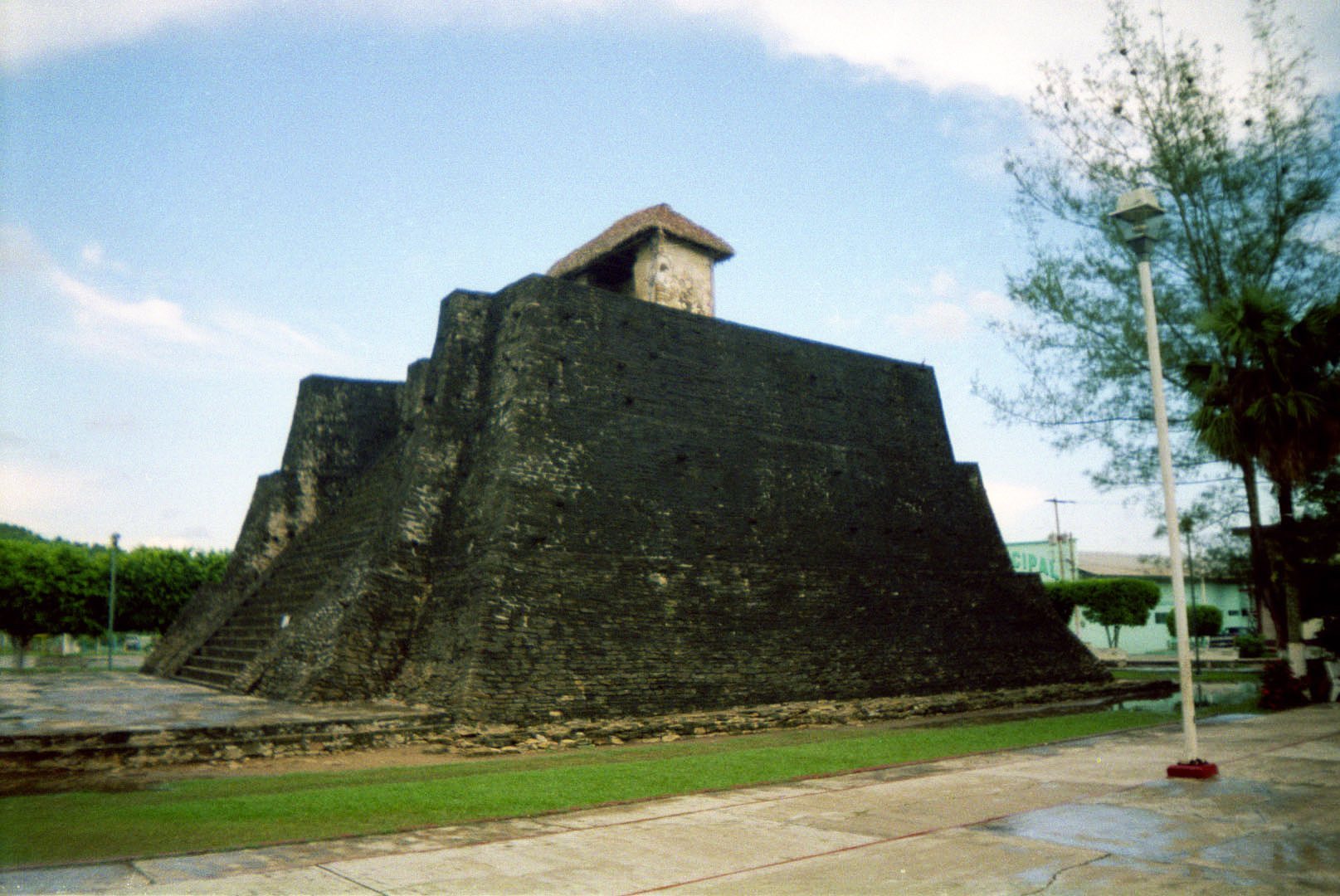
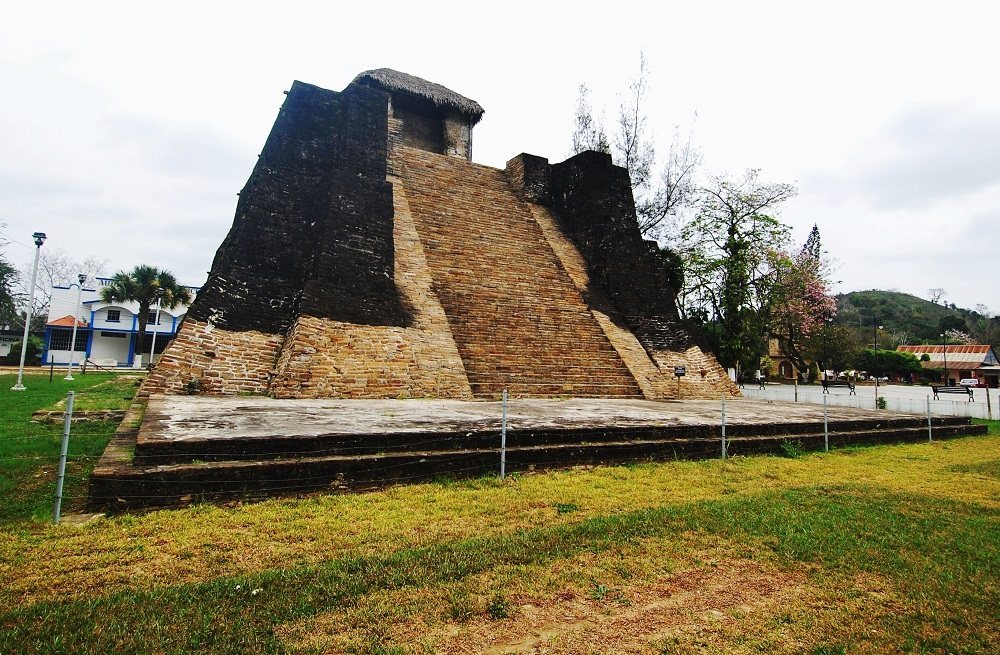
The principal surviving monument is a pyramidal building in the center of the modern settlement. It has a square plan measuring approximately 24 metres on each side and rises about 11.3 metres. The structure preserves most of its mass and is among the few surviving buildings of this type in Mesoamerica.
The pyramid consists of three slightly inclined bodies separated by a landing, a level platform between sloping sections. A stairway ascends the structure, and a building at the summit probably represents the remains of a temple. A small, flat molding runs around the perimeter at a height of approximately 1.40 metres. Humidity has damaged the stucco and walls, while neglect and inadequate protection from rain and moisture have contributed to serious deterioration.
Stone Sculptures
Sculptures of different sizes and styles once stood around the pyramid. Excavated pieces from the monument and nearby area are now held in the site museum, whose collection consists predominantly of stone representations of deities, animals, and human figures. Their varied forms preserve the material evidence for the cultural traditions associated with Castillo de Teayo.