Nikwasi: A Cherokee Mother Town and Sacred Mound in Franklin, North Carolina
Site at a Glance
- Rating
- 4.3
- Popularity
- Very Low
- Country
- United States
- Primary era
- Medieval
- External website
- Open
- Eras represented
- Medieval
- Civilizations
- Unclassified
- Site type
- Religious
- Remains
- Sanctuary
On this page7 sections
History
Nikwasi is a former Cherokee town and ceremonial center in Franklin, North Carolina, United States. Its surviving platform mound was constructed around 1000 CE by Indigenous ancestors of the Cherokee during the South Appalachian Mississippian culture period, a regional tradition associated with platform mounds and organized ceremonial communities. The later Cherokee town existed before the mid-sixteenth century and appears on a 1566 map. Nikwasi was regarded as one of the Cherokee homeland’s Mother Towns, although Kituwa was considered the first.
A Cherokee town and sacred center
Nikwasi occupied approximately 100 acres, or 40 hectares, on the floodplain of the Little Tennessee River. The later European-American town of Franklin developed around the site. In 1718, English colonial records first mentioned Nikwasi, and English missionaries recorded a population of 162 in 1721, comprising 53 men, 50 women, and 59 children.
The townhouse, a Cherokee communal meeting hall and public building, stood on the mound. Its fire pit held an ever-burning sacred fire that Cherokee tradition regarded as having continued since the beginning of Cherokee culture. Townhouses traditionally contained fire pits for this purpose, making Nikwasi both a community center and a spiritual place.
Diplomacy and colonial pressure
Nikwasi was involved in colonial diplomacy during the early eighteenth century. A delegation from Charleston, South Carolina, probably met with the Nikwasi community in its townhouse during treaty negotiations in 1727. Colonel John Herbert took part in a treaty council there on December 3, 1727.
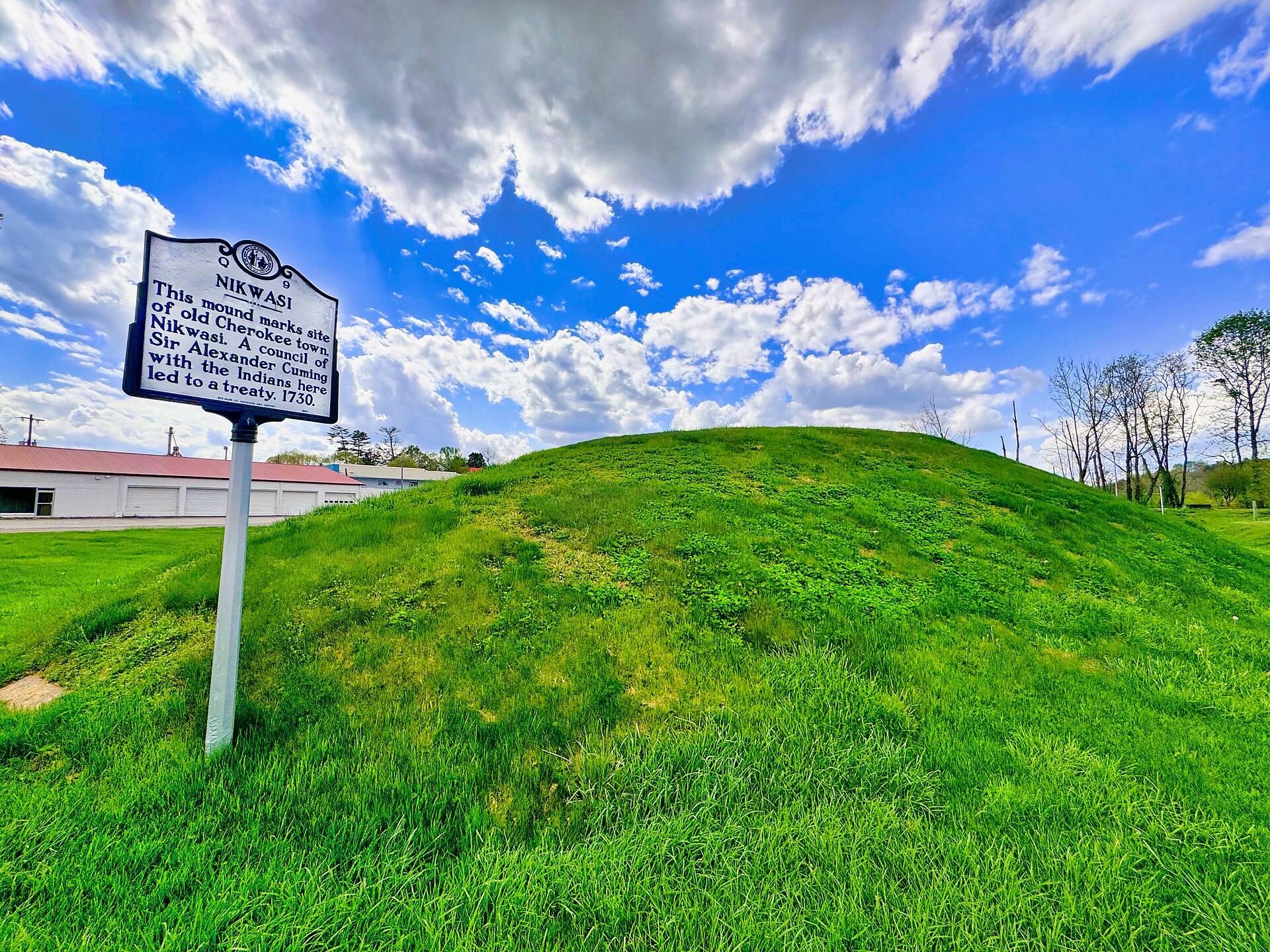
Alexander Cuming, a self-appointed royal ambassador, stayed at Nikwasi from April 3 to 4, 1730, while negotiating with the Cherokee. He met Moytoy, also known as Ama-edohi, a Cherokee leader traditionally titled the First Beloved Man. Cuming appointed him “Emperor” of the Cherokee and obtained a disputed pledge of allegiance to King George II. The treaty was generally honored until 1741.
War, destruction, and rebuilding
During the French and Indian War, the North American theater of the wider Seven Years’ War, an English punitive expedition led by James Grant used the Nikwasi townhouse as a field hospital in the summer of 1761. Grant’s forces then razed most of the town. The Cherokee rebuilt Nikwasi afterward.
During the American Revolutionary War, the Cherokee allied with the British in the hope that Britain would support the removal of settlers from Cherokee territory. On September 10, 1776, the Rutherford Light Horse expedition leveled and burned Nikwasi and its farmlands. Following a severe winter, the town sought peace with the colonists the next spring. The Cherokee rebuilt it and continued living there.
Removal, preservation, and renewed Cherokee stewardship
In 1819, the federal government forced the Cherokee of the region to cede their lands and move to the Qualla Boundary, the land base of the Eastern Band of Cherokee Indians in western North Carolina. Nikwasi mound and an associated 690 acres were acquired by European Americans. The removal policy intensified in the 1830s after Congress authorized it in 1830.
The mound remained in private European-American ownership for more than a century. In 1946, the town of Franklin raised money to purchase and preserve it, with schoolchildren among the contributors. A single 5-by-5-foot test shaft excavated by University of North Carolina archaeologists in 1963 is the only known formal excavation at the site. The mound’s preservation was also aided because Smithsonian staff did not excavate it during their mound investigations in the 1880s.
Nikwasi was listed on the National Register of Historic Places, the United States’ official register of historically and culturally important sites, in 1980 under the transliterated name “Nequasee.” The listed area covers 18 acres, or 7.3 hectares.
In 2012, Franklin applied herbicide to the mound to control grass. The Eastern Band regarded the treatment as desecration, and Principal Chief Michell Hicks requested that the site be transferred to the Eastern Band. The town declined. The federally recognized Eastern Band established the nonprofit Nikwasi Initiative to regain control of traditional lands and sacred mounds and to support interpretation of historic Cherokee and ancient Indigenous sites along the Little Tennessee River.
The Eastern Band bought a building beside the mound in 2017 and later considered adapting it as a museum. In May 2019, Franklin transferred the mound to the Nikwasi Initiative, and in July 2019 the Eastern Band’s Tribal Council voted to provide the initiative with $300,000. In 2020, Mainspring Conservation Trust acquired Watauga Mound and part of its historic town site for conservation, with the property intended to form part of the proposed Nikwasi-Cowee Corridor.
On February 26, 2026, the Eastern Band of Cherokee Indians officially regained ownership of Nikwasi Mound after more than 200 years, following a vote by the Franklin town council to return the land.
Remains
The platform mound
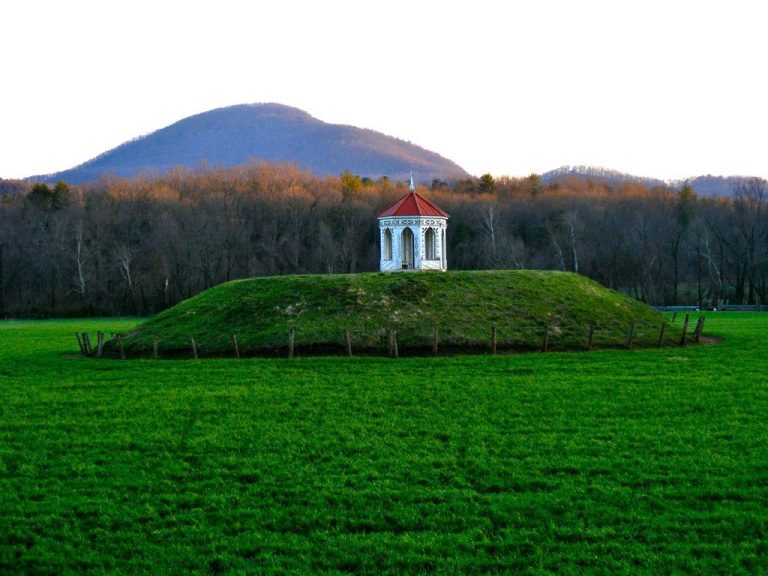
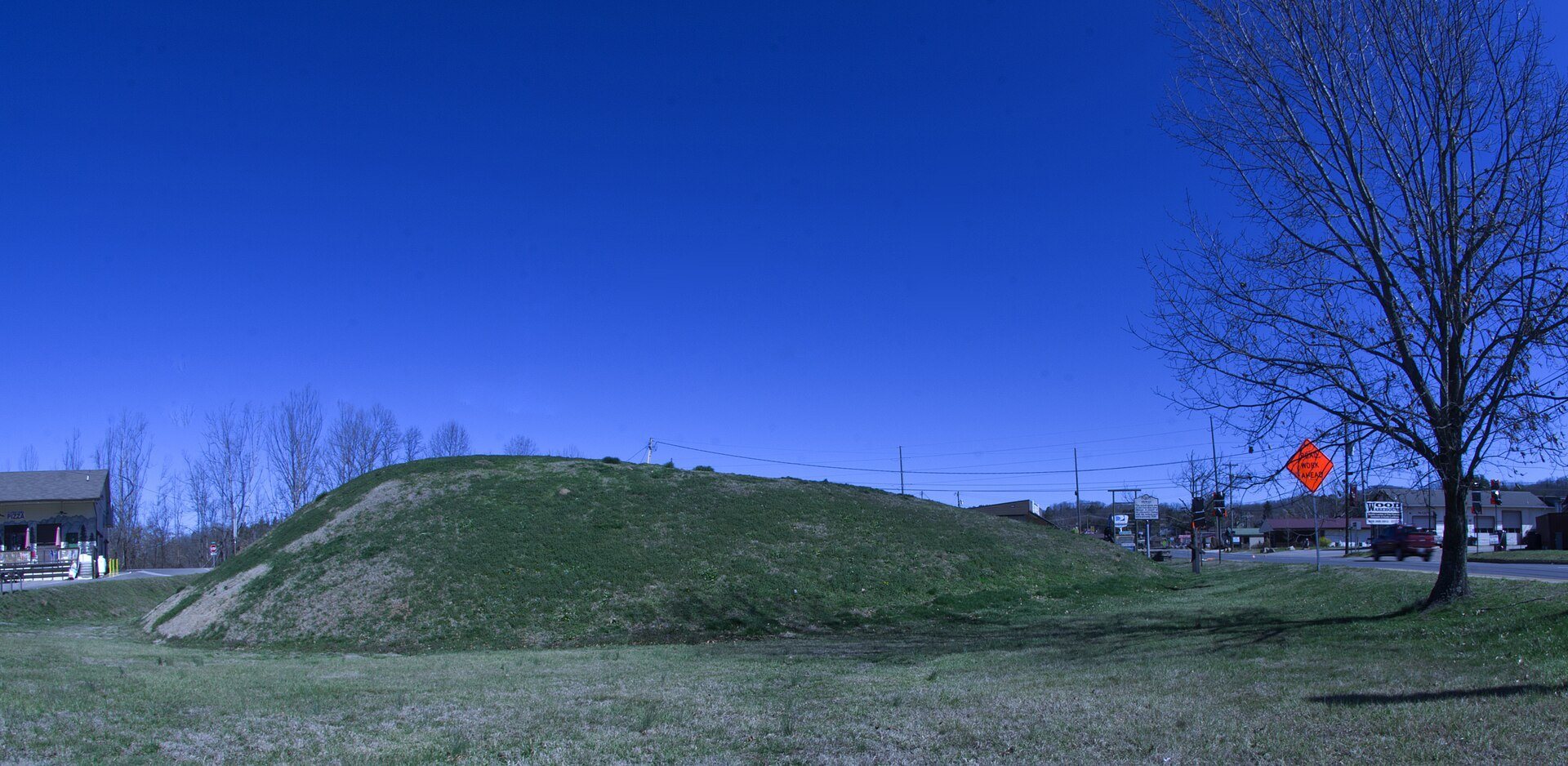
The only surviving feature of the Cherokee town is a platform mound, a deliberately raised, usually flat-topped earthen structure that could support buildings or ceremonial spaces. Estimated to have been built around 1000 CE, it belongs to the South Appalachian Mississippian culture period. The mound has a flat summit and a southeast-oriented access ramp, both of which remain clearly distinguishable.
The summit is thought to have supported the Cherokee communal townhouse. This interpretation rests on the ramp’s orientation and on the results of a 2009 ground-penetrating-radar survey, a non-invasive method that uses radar pulses to detect buried layers and structures. The investigation also provided evidence for the mound’s former topographic setting and supported the interpretation of the summit as the townhouse location.
Approximately 1 to 2 meters of combined alluvial deposits and artificial fill cover the mound’s base. Before later flooding and filling, the mound had greater topographic prominence and formed a more visually imposing part of the cultural landscape. It remains well preserved and conspicuous along US 441 Business in downtown Franklin, with a small surrounding area preserved since the town acquired the property in 1946.
The proposed Nikwasi-Cowee Corridor would connect Nikwasi mound with Cowee Mound and the Cowee village site, another ancient platform mound across the Little Tennessee River and north of Franklin.