Rabban Hormizd Monastery: A Rock-Cut Christian Monastic Complex in Iraq
Site at a Glance
- Rating
- 4.6
- Popularity
- Low
- Country
- Iraq
- Primary era
- Medieval
- Eras represented
- Medieval, Modern
- Civilizations
- Ottoman, Sassanid
- Site type
- Religious
- Remains
- Monastery
On this page9 sections
History
Rabban Hormizd Monastery is a rock-cut Christian monastic complex near Alqosh in Nineveh Governorate, Iraq. Founded around AD 640 by Rabban Hormizd, a seventh-century monk of the Church of the East, it became an important centre of that ancient Mesopotamian church and flourished until the tenth century.
Church of the East and the patriarchal see
Before the end of the fifteenth century, Rabban Hormizd Monastery had become a burial place for patriarchs. Nine patriarchal graves, dating from 1497 to 1804, remain along the corridor leading to Rabban Hormizd’s cell. Yohannan Sulaqa was once a monk here before travelling to Rome, where he became the first patriarch of the Chaldean Catholic Church, which emerged from part of the Church of the East through union with Rome.
From 1551 until the eighteenth century, the monastery served as the official residence of the patriarchs of the Eliya line. This hereditary patriarchal line was based at Alqosh and represented the oldest and largest patriarchal see, the institutional seat and jurisdiction of a patriarch, within the Church of the East before Sulaqa’s division in 1553. Repeated attacks in the sixteenth century led to the transfer of the patriarchal residence to Tel Keppe.
Attacks and religious change
Timur, the fourteenth-century Central Asian conqueror also known as Tamerlane, attacked the monastery in 1393. Some monks were killed and others fled. In 1508, the Mamluk commander Murad Beg attacked the monastery after inhabitants of Alqosh sought refuge there. During the sixteenth century, both the town and monastery endured further attacks by Kurdish and Turkish princes.
The monastery was temporarily transferred to the Chaldean Catholic Church in 1714, then returned to the Church of the East. It remained under the Church of the East until the nineteenth century, when its monks ultimately became Catholic after the church’s union with Rome.
Around 1743, plague, Kurdish attacks, and the opening of the Ottoman-Persian War of 1743-1746 brought a period of decline. During the war, the army of Nader Shah, the eighteenth-century ruler of Iran, besieged and attacked the monastery while Christian villagers had taken refuge there. Many people were killed, and the complex was subsequently left largely unoccupied.
Revival, persecution, and relocation
In 1808, the Assyrian Gabriel Dambo revived and rebuilt the abandoned monastery. He gathered pupils who took vows of poverty and celibacy, commitments to communal religious life, material renunciation, and abstinence from marriage, and established a seminary, an institution for the education and formation of clergy. Yohannan VIII Hormizd, then Archbishop of Mosul, initially opposed the initiative, while the patriarchal administrator Augustine Hindi supported it. Joseph Audo, who later became patriarch of the Chaldean Catholic Church, had previously been a monk at the monastery.
Gabriel Dambo was murdered in 1832 by soldiers of Mohammed Pasha, the Kurdish emir of Rawanduz. In 1838, Kurdish forces from Soran attacked the monastery and Alqosh, killing hundreds of Assyrian and Chaldean Christians. Further Kurdish persecution in 1843 killed more than ten thousand Christians, and the monastery’s icons were defaced.
The old monastery was too exposed to attack to remain fully functional. In 1859, Patriarch Joseph Audo therefore established Our Lady of the Seeds on a safer plain site about one mile from Rabban Hormizd near Alqosh, with financial assistance from the Vatican. The new foundation soon became the principal monastery of the Chaldean Church, and most of the monks moved there.
Library and later religious memory
The monastery’s Syriac library suffered repeated attacks. Moussa Pasha looted and destroyed many manuscripts in 1828, while his successor, Ismael Pasha, seized 147 volumes, manuscripts, and printed works in 1868. The monks continued to purchase and copy manuscripts, rebuilding an important library.
Eliya XII died in 1884 and was buried at Rabban Hormizd. His death marked the end of the Eliya patriarchal line of Alqosh after the towns under its authority had been devastated. The monastery remains historically associated with both the Church of the East and the Chaldean Catholic Church. It is now linked with the Chaldean Catholic Eparchy of Alqosh and is regarded as an origin point of the Chaldean Antonian Order of St. Hormizd.
Christians of the Nineveh Plain commemorate Rabban Hormizd on the second Sunday after Easter. The celebration is known by a Syriac expression meaning “night watch” and usually includes pilgrimage to the monastery and prayer, along with traditional dances and songs performed by young people.
Remains
Mountain setting and rock-cut cells
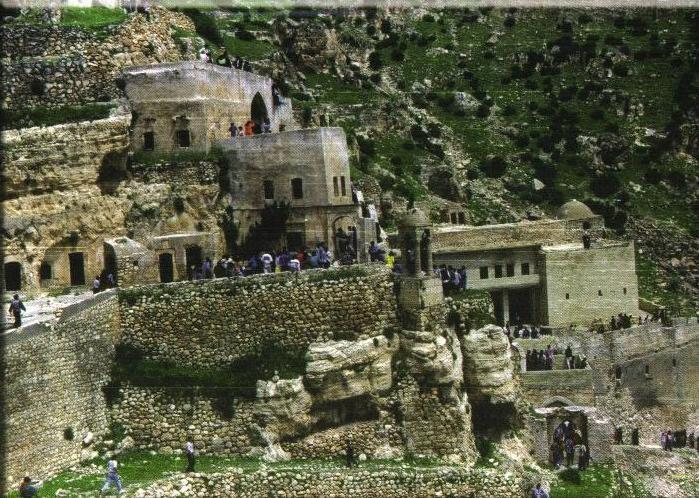
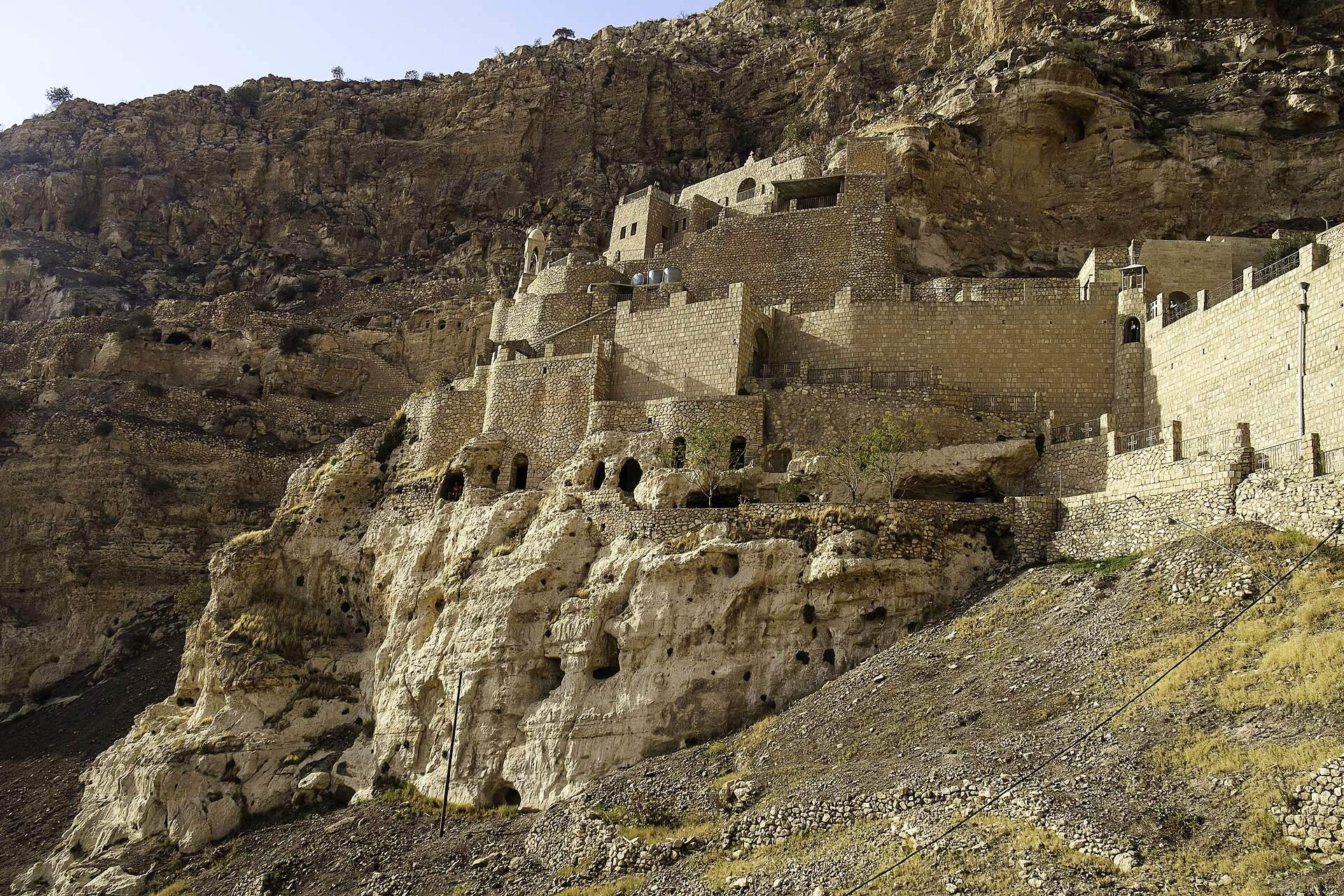
Rabban Hormizd Monastery occupies an amphitheatre-like setting about halfway up the mountain range enclosing the Nineveh Plain to the north. The complex lies approximately two miles from Alqosh and twenty-eight miles north of Mosul, at an elevation of about 856 metres. A rocky path passes through a narrow defile to reach the monastery, and generations of monks paved the route.
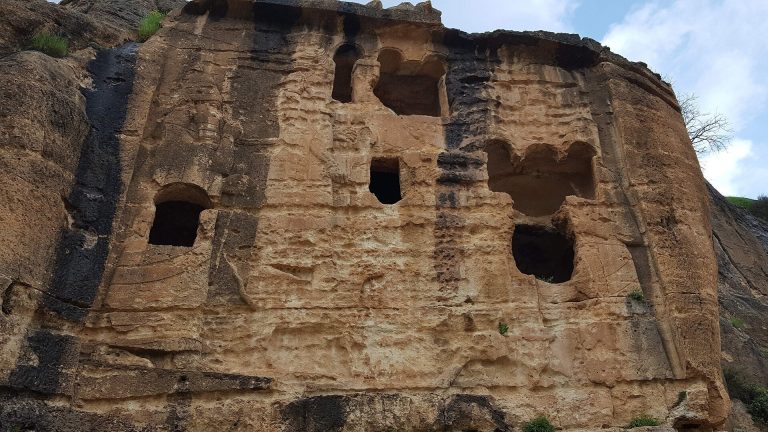
Rows of caves cut into the solid rock surround the church and monastic buildings. These rock-cut cells, monastic dwellings excavated directly into natural rock, served earlier ascetics who practised severe self-discipline and renunciation. The cells are arranged separately and approached by narrow terraces. Some occupy difficult positions that may originally have been reached by descending from the mountain crest and swinging into the openings. Several contain a smaller chamber behind the main room, entered through a passage large enough for an average-sized person to crawl through. Niches cut into the sides or rear walls of some cells probably served as sleeping places, while rainwater was collected in rock cisterns.
Church and monastic complex
The church is built of stone, has a dark reddish colour, and stands on an enormous rock. It forms the central built element among the surrounding caves and monastic structures. The community was summoned to prayer by a bell at sunset, midnight, daybreak, and other times of the day. The recorded monastic population fell from about fifty monks in 1820 to thirty-nine in 1843, sixteen in 1879-1880, and about ten in 1890.
Patriarchal graves and library remains
The corridor leading toward Rabban Hormizd’s cell contains nine patriarchal graves dating from 1497 to 1804. These burials preserve the monastery’s role as a resting place for leaders of the Church of the East and connect the rock-cut complex with the patriarchal history of Alqosh.
The monastery also held a substantial Syriac manuscript library. Looting and destruction in 1828 and 1868 removed many manuscripts and printed works, but the monks continued acquiring and copying texts. The name Rabban Hormizd refers to the founder, while rabban is a Syriac term meaning “monk.”