Timna Valley: An Ancient Copper-Mining Landscape in Israel
Site at a Glance
- Rating
- 4.7
- Popularity
- Medium
- Country
- Israel
- Primary era
- Iron Age
- External website
- Open
- Eras represented
- Stone Age, Bronze Age, Iron Age, Medieval
- Civilizations
- Egyptian
- Site type
- Economic
- Remains
- Mine
On this page21 sections
History
Timna Valley is an archaeological and geological landscape in Timna Park, Israel, where human communities exploited copper and other natural resources over thousands of years. Human activity began during the Neolithic period, and copper working probably started in the late Neolithic or early Chalcolithic period, around the sixth millennium BCE. The valley lies in the southern Arava, about 25 to 30 kilometres north of Eilat, and its resources supported changing mining and metallurgical traditions from prehistory into the Middle Ages.
Prehistoric copper production
Flint tools from the Pre-Pottery Neolithic B period indicate activity roughly 12,000 years ago. These early visitors may have collected attractive stones rather than smelted copper. Copper extraction and metallurgy developed later, probably during the sixth millennium BCE, and continued through successive periods with long interruptions or changes in intensity.
Early production lasted for more than 2,000 years, from the sixth to the fourth millennium BCE. It developed from small household operations using pits and bellows into more efficient furnaces built for smelting. Even so, production during this early phase remained modest, generally at a kilogram scale. Mining and metalworking left behind shallow pits, shafts, tools, slag, furnaces, and other remains.
Iron Age industry and the question of Solomon’s Mines
During the later second and early first millennia BCE, copper production became a major regional industry. Earlier interpretations connected the most productive phase with Egyptian miners of the New Kingdom, the period of Egyptian imperial power from roughly the sixteenth to the eleventh centuries BCE. These interpretations also emphasized cooperation with Midianite and local Amalekite groups.
Excavations by Nelson Glueck in the 1930s associated the mines with King Solomon and helped popularize the name “King Solomon’s Mines.” Later research challenged the attribution of the principal mining area to the tenth century BCE. Excavations and radiocarbon studies have instead placed major smelting activity broadly between the eleventh and ninth centuries BCE, including the tenth century BCE. No archaeological evidence from the Arava has established that the kings of Judah controlled the industry.
Current interpretations associate the early Iron Age mines and smelting camps with a local society, possibly an early nucleus of the Kingdom of Edom. The Edomites were an ancient society and polity associated with the southern Levant and the lands east and south of the Dead Sea. Research has also emphasized the technological and organizational role of local desert communities rather than treating copper production primarily as an Egyptian enterprise.
Excavations at several smelting sites, including Site 34, known as Slaves’ Hill, placed an important phase of production in the early Iron Age. This dating shifted the main industrial period from the Late Bronze Age chronology formerly linked with the Egyptian sanctuary to a later phase. Mining continued under later local and regional powers, including Israelites, Nabataeans, Romans, and the Umayyad Caliphate, with activity extending into the Middle Ages. Roman and early Islamic exploitation focused mainly on nearby areas after much of Timna’s principal copper ore had been used.
Egyptian and local religious activity
The valley’s mining history included Egyptian religious activity during the New Kingdom. A sanctuary dedicated to Hathor, an Egyptian goddess associated with mining and the protection of miners, was built during the reign of Seti I at the end of the fourteenth century BCE. After Egyptian rule receded in the mid-twelfth century BCE, the sanctuary was abandoned with the mines. Midianite groups later reused the area, changing its imagery and ritual arrangements.
The later interpretation of the sanctuary as a local Semitic or Midianite cult site reflects this reuse. The area contained standing stones, offering benches, textiles, beads, ritual vessels, and a copper snake with a gold-plated head. A mould for making the snake was also found. Textiles and ritual objects concealed in a cave have been interpreted as components or coverings of a tent shrine, although this interpretation is not a proven identification with a biblical sanctuary.
Archaeological investigation
Beno Rothenberg conducted systematic excavations in the valley from 1959 and continued investigating the region through 1990. His work identified mines, smelting camps, shrines, temples, rock drawings, and other remains, establishing a long sequence of copper production from the Late Neolithic period to the Middle Ages.
Renewed research began in 2009 under Erez Ben-Yosef of Tel Aviv University. Excavations and surveys were combined with radiocarbon dating, archaeomagnetic dating, and other methods. This work revised earlier chronological and technological interpretations, placing major production at several sites in the early Iron Age and demonstrating a longer history of local development.
Modern mining and the creation of Timna Park
Commercial copper mining resumed after the establishment of the State of Israel. New mines were established in 1951, a subsidiary of the government mineral-development authority was founded in 1954, and commercial extraction began in 1959. The modern operation used heavy machinery in ten open and underground workings. It produced about 1.1 million tonnes of ore annually and employed approximately 1,000 people during the 1960s and 1970s, becoming an important source of employment for Eilat and an influence on the city’s industrial development.
The mines first closed in 1976 after falling world copper prices caused operating losses. An attempt to restart copper production and add manganese extraction began in 1980 but failed, and mining ended permanently in the early 1980s. After pumping stopped, most underground workings filled with groundwater. A small processing plant established in 1997 produced copper sulfate for agricultural fertilizers and animal-feed ingredients, processed aluminum, and later used recycled electrical wire and sulfuric acid.
After the modern mines closed, Timna Park was developed to present the valley’s geological and archaeological remains. Its landscape plan was prepared by Zvi Dekel in 1979, and implementation began in 1980. In 2000, Timna was placed on Israel’s tentative list for UNESCO World Heritage. In 2002, about 42,000 dunams of the valley became a nature reserve, ending mining within the reserve area. Conservation work on rock drawings began in 2010, and since 2019 the park has included measures intended to reduce light pollution and limit environmental pressure.
Remains
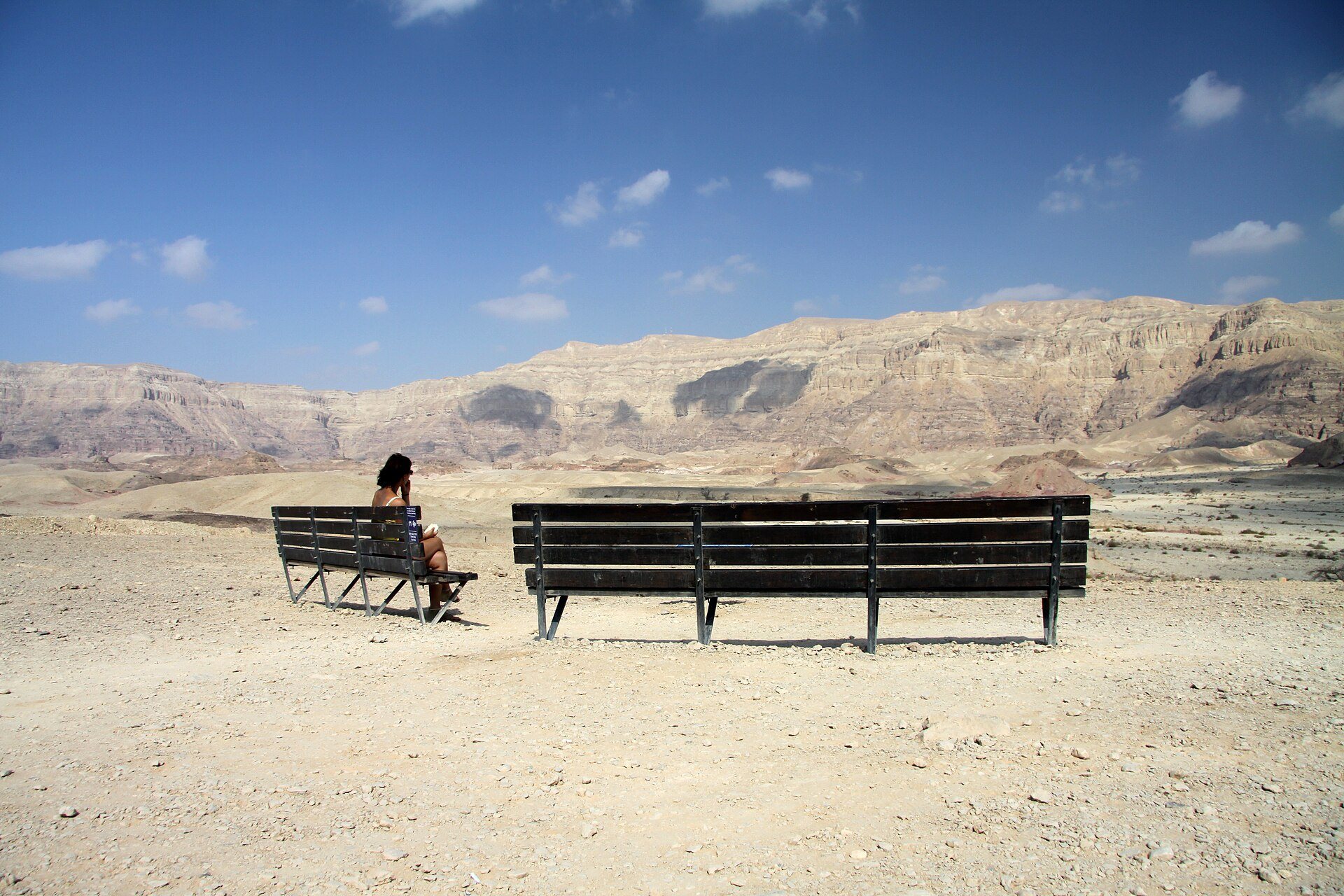
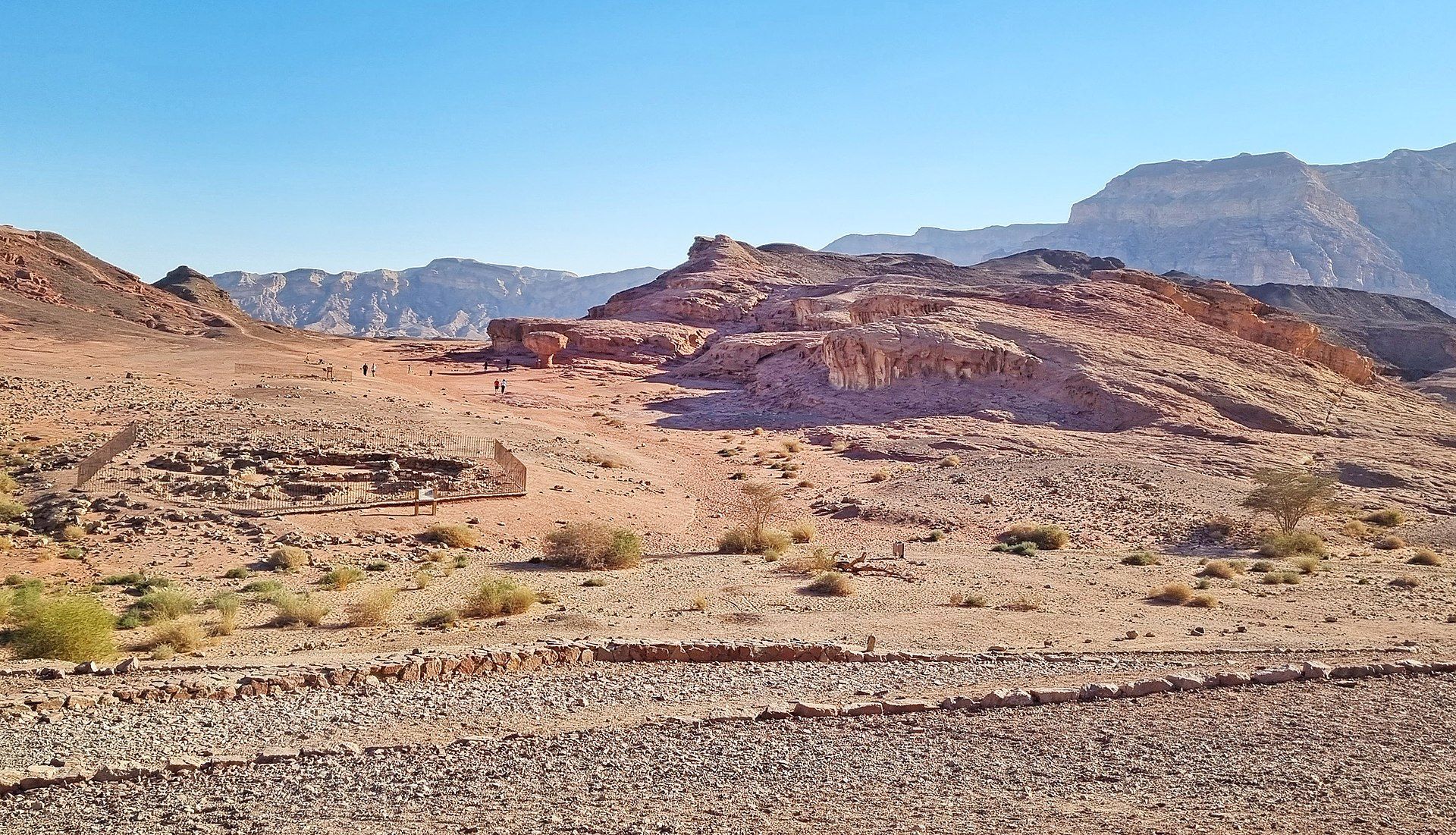
Timna Valley is a horseshoe-shaped depression covering about 60 square kilometres. Steep cliffs bound it on three sides, while the Timna and Nehushtan streams form its northern and southern drainage boundaries before flowing east toward the Arava. Mount Timna rises to 453 metres at the centre. The exposed landscape includes volcanic, plutonic, terrestrial, and marine sedimentary rocks, as well as conglomerates and sandstones in several colours. Copper, iron, manganese, granite, syenite, gabbro, dolomite, shale, limestone, clay, phosphorite, and flint occur in the geological formations.
Mines and smelting installations
Ancient shafts and galleries
Ancient mining areas contain thousands of circular shafts, popularly called “plates.” Many are about 80 centimetres across, and some reach approximately 35 metres deep. They were initially interpreted as wells but were later identified as prospecting and mining shafts that were filled with sand after use.
Later underground mines were entered through vertical shafts about 80 centimetres wide, with footholds cut into their sides. Horizontal galleries followed branching mineral veins from the bottoms of the shafts. Some systems had several levels, internal connecting shafts, ventilation shafts, and ore-lifting shafts. Early miners used stone tools, while later workers used chisels and hammers. In the more developed workings, shafts and galleries had regular tubular forms, and copper ore was reached at depths of about 30 metres.
Smelting camps
Eleven later smelting camps have been identified. Some also served as living quarters and storage areas. Furnaces were usually pits about 45 centimetres wide and deep, lined with stone and clay and supplied by two or three pairs of leather-and-clay bellows. A typical operation used about 50 kilograms of copper ore, 100 kilograms of iron oxide, and 150 kilograms of charcoal, producing roughly 1.5 kilograms of copper and 25 kilograms of slag, the glassy or stony waste left by smelting.
An earlier prehistoric smelting site beside a pit-mining area contains slag with partly melted ore and fragments of white sandstone. The furnaces there did not reach a fully liquid state, so copper droplets remained trapped in viscous slag. Workers had to break and crush the slag to release them.
Modern workings
Modern mining created about 50 kilometres of underground tunnels on several levels, branching from open pits. The southern workings connected with a vertical service-lift system for raising ore, and the tunnels were wide enough for vehicles. Most of these workings are now flooded by groundwater.
Geological formations and natural landmarks
The valley lies at the northern edge of the Arabian-Nubian Shield, an ancient geological province of crystalline basement rocks exposed across parts of northeastern Africa and the Arabian Peninsula. Uplift about 550 million years ago and later erosion exposed granite, syenite, gabbro, and other ancient rocks. Cambrian marine flooding deposited the Timna Formation, including sandy dolomite, shale, sandstone, and copper-bearing mineral layers.
Later erosion and renewed sandstone deposition around 320 million years ago produced white and coloured sandstones. Iron- and copper-rich fluids contributed to their surface colours. Marine sedimentary layers up to about 800 metres thick contain fossils, including ammonites, and preserve evidence of the Tethys Sea, an ancient ocean that covered parts of the region. Faulting and subsidence linked with the Syrian-African Rift exposed these layers along the Timna and Nehushtan streams and continue to shape the valley’s slopes and channels.
Solomon’s Pillars and the Arches
Solomon’s Pillars are natural pillar-like forms in a red sandstone cliff. Water erosion along fractures separated the pillars. Their association with Solomon comes from a later name and interpretation rather than evidence that he constructed them. The Arches are natural sandstone openings formed by erosion along the western cliffs, with ancient copper-mining shafts near them.
The Mushroom and Spiral Hill
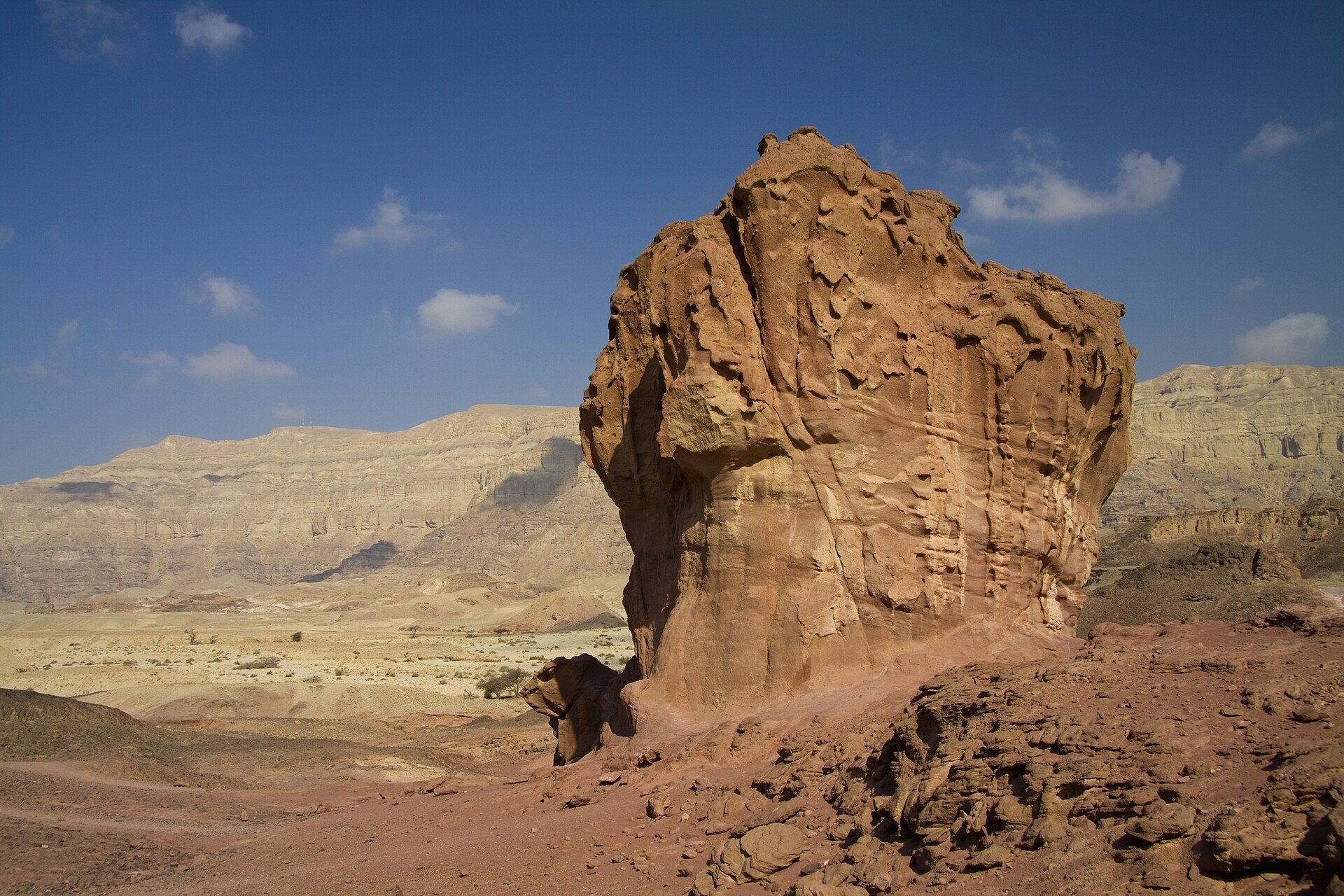
The Mushroom is a single red sandstone formation shaped like a mushroom because its lower layer eroded more rapidly than the upper layer. Copper-smelting installations dating from approximately the fourteenth to twelfth centuries BCE occur nearby. Spiral Hill takes its form from a staircase that runs diagonally around the hill. Different rates of erosion in differently oriented rock layers produced its irregular shape.
The Observer, Hanging Stone, and Reclining Lion
An eroded rock composition known as the Observer, the Hanging Stone, and the Reclining Lion forms silhouettes resembling a person, a suspended or balanced stone, and a lion. Seen from the eastern side, the Observer resembles a sphinx.
Rock drawings and the Hathor sanctuary
Egyptian rock drawings
Rock drawings and petroglyphs occur throughout the valley, including images made during the period of Egyptian presence. One group depicts Egyptian warriors carrying axes and shields as they travel in ox-drawn chariots. Another carving shows Ramses III presenting offerings to Hathor. The figures are about 80 centimetres high, and two cartouches, oval frames enclosing Egyptian royal names, appear at the centre. A rock-cut stairway beside the sanctuary leads to this carving.
Temple of Hathor
The Shrine of Hathor stands near Solomon’s Pillars. Its earliest remains date to the Late Chalcolithic period, although the area may not initially have been a formal sacred site. A small shrine was built during the reign of Seti I. The original complex included an open courtyard and a rock-cut cella, the enclosed inner chamber of a temple, and measured about 15 by 15 metres. White sandstone from the mining area faced the structure.
An earthquake badly damaged the shrine, which was rebuilt during the reign of Ramses II. The later complex had a larger courtyard, white stone paving, more elaborate sandstone and granite walls, and a white sandstone facade. Two square columns bearing Hathor heads formed part of the rebuilt temple. A workshop in the courtyard was used to cast copper figurines and other objects for sacrificial rites.
Excavated material from the sanctuary includes hieroglyphic inscriptions and royal cartouches, copper ritual objects, alabaster vessels, faience figures of cats and leopards, seals, beads, stone and copper scarabs, and statuettes, tablets, and sculptures of Hathor. Several thousand artefacts were recovered from the temple. Later local religious use is also represented in the sanctuary area.
Modern water and reconstructed structures
Timna Lake
Timna Lake is an artificial lake formed from groundwater that once had to be pumped from the mines. It covers about 1.4 hectares and holds approximately 20,000 cubic metres of water. The lake provides a permanent water source for animals.
Replica of the Tabernacle
A life-size replica of the biblical Tabernacle stands near Timna Lake. The Tabernacle was the portable sanctuary described in the Hebrew Bible as accompanying the Israelites during the Exodus. The modern reconstruction does not use the materials specified in that description. Its interior contains representations of religious equipment, including a mikveh, a Jewish ritual immersion bath, a menorah, and an ark with tablets of the Ten Commandments.