St. Botolph’s Priory: England’s First Augustinian House in Colchester
Site at a Glance
- Rating
- 4.4
- Popularity
- Low
- Country
- United Kingdom
- Primary era
- Medieval
- External website
- Open
- Eras represented
- Medieval
- Civilizations
- Norman
- Site type
- Religious
- Remains
- Church
On this page10 sections
History
St. Botolph’s Priory in Colchester, United Kingdom, was a medieval house of Augustinian canons founded around 1093 by converting an earlier Anglo-Saxon church dedicated to St Botolph. Its Norman or Anglo-Norman church was completed and dedicated by 1177. As the first Augustinian house in England, the priory held precedence over the other houses of the order and remained its leading English convent until the Dissolution.
Foundation and Augustinian rule
The foundation was organized by Norman, a Kentish priest who had studied under Anselm of Canterbury, and Ainulf, who led the secular priests serving the earlier church. Norman and a companion studied the Rule of St Augustine at Chartres and Beauvais before returning to Colchester. Ainulf became the first prior, while Anselm, then archbishop of Canterbury, consecrated the new undertaking in 1093.
William II granted the canons a charter of protection before his death in 1100. Pope Paschal II confirmed the foundation in a papal bull issued in August 1116. Norman later left Colchester in 1108, with Ainulf’s approval, to become the first prior of Holy Trinity Priory at Aldgate.
The community was headed by a prior and initially comprised twelve canons, a number associated with the Twelve Apostles. St. Botolph’s enjoyed exemption from secular and ecclesiastical jurisdiction. Its prior was elected by the canons and presented to the bishop of London for consecration with special powers. The church was dedicated chiefly to St Botolph, while also honouring St Julian and St Denis. Its chapels included dedications to St Catherine of Alexandria, St Thomas Becket, the Virgin Mary, and the Holy Trinity.
Endowments and religious life
The priory held estates, churches, advowsons, tithes, and mills in Essex and elsewhere, although it was less wealthy than St John’s Abbey. Henry I granted it tithes from Hatfield and a third share of Midelmeln mill, later known as Middle Mill, and confirmed grants made by Hugh FitzStephen and Count Eustace of Boulogne. Richard I confirmed and enlarged its liberties and possessions in a charter of 4 December 1189. Henry IV and Henry VI later confirmed them in 1400 and 1427.
In the 1291 taxation, the priory’s temporal possessions were valued at £42 16s. 5½d. annually, while its spiritualities were valued at £10 15s. 4d. Its churches or rights included those at Gamlingay, Layer de la Haye, Marks Tey, Colne Engaine, Ardleigh, Hatfield Regis, Witham, Boxted, Frating, Reydon, Chigwell, and several churches in Colchester. St Peter’s Church in Colchester was appropriated to the priory in 1318, and Chigwell Church followed in 1440. In 1415, Gamlingay Church was surrendered to Merton College, Oxford.
Near Colchester, the priory held land at Greenstead and Cannock in West Donyland and owned East Mill, Cannock Mill, and Hull Mill. Its recorded stock in Colchester in 1295 included rye, barley, oats, plough cattle, oxen, a bull, cows, sheep, and lambs. These holdings supported the religious community and its charitable and commemorative obligations.
In 1281, Master Simon de Eylondia endowed a thirteenth canon. The canon was required to celebrate daily services at the altar of St Thomas Becket for Simon and his parents, Robert and Cecily. The endowment also provided for the canon’s vestments, the convent’s food allowance, support for thirty poor men, and maintenance of the priory altar. Simon assigned the right to nominate the canon to the abbot of Colchester in 1296. Prior John de Colum later ordered the prior, sub-prior, and sacristan to read the foundation’s terms each year.
In 1406, the priory appointed a canon to celebrate daily services in St Catherine’s Chapel for William Colchester, abbot of Westminster, and his parents. The arrangement included further commemorative services, charitable distributions, payments, and the maintenance of the parents’ tombs. The priory’s religious identity was also reflected in its seal, which showed Christ blessing St Julian as a bishop and St Botolph as an abbot.
Disputes and financial difficulties
During the mid-fourteenth century, disputes with St John’s Abbey over control of St Peter’s Church and other matters in Colchester and Layer de la Haye became violent. Prior John, the canons John Noreys and Thomas de Gipwico, and lay supporters were accused of attacking members of the abbey and blockading them. On 1 July 1363, Pope Urban V ordered the archbishop of Canterbury to excommunicate the accused if they were found guilty. The dispute was settled in 1364.
In 1380, the priory reported fraudulent attorneys and proctors who used forged letters to collect money in its name. Richard II ordered the offenders to be arrested and sent to Newgate prison, while the forged letters were to be delivered to the archbishop of Canterbury. The canons’ financial position later deteriorated. On 20 February 1421, Pope Martin V granted a relaxation of penance to people who visited the priory on the feast of St Denis and gave alms for its conservation and repair. The appeal indicated that the house had become impoverished despite its original endowment for a prior and twelve canons.
In 1434, Prior John Depyng became abbot of St Osyth’s Priory and took valuable goods belonging to St Botolph’s with him. After his death, St Botolph’s brought a Chancery action against St Osyth’s to recover the property, apparently without success.
Dissolution and later destruction
In early 1534, the prior and seven canons, Robert Bawde, Richard Parker, William Shyrwyn, John Garrard, John Gyppys, Robert Rand, and William Patche, took the oath of fealty required under the Act of Succession. This enabled them to avoid prosecution under the Treasons Act of 1534. The priory was dissolved in 1536 under the Suppression of Religious Houses Act 1535, part of the Tudor Crown’s suppression of monasteries, priories, and other religious institutions.
On 26 May 1536, the site and possessions, including the manors of Blindknights, Canwikes, and Dilbridge, were granted to Thomas Audley. On 12 September 1540, Audley received permission to grant the site to John Golder and his wife, Anastasia. Because the church served both the canons and the parish, its nave continued as a parish church after the Dissolution, while the choir, cloisters, chapter house, and associated conventual buildings were demolished.
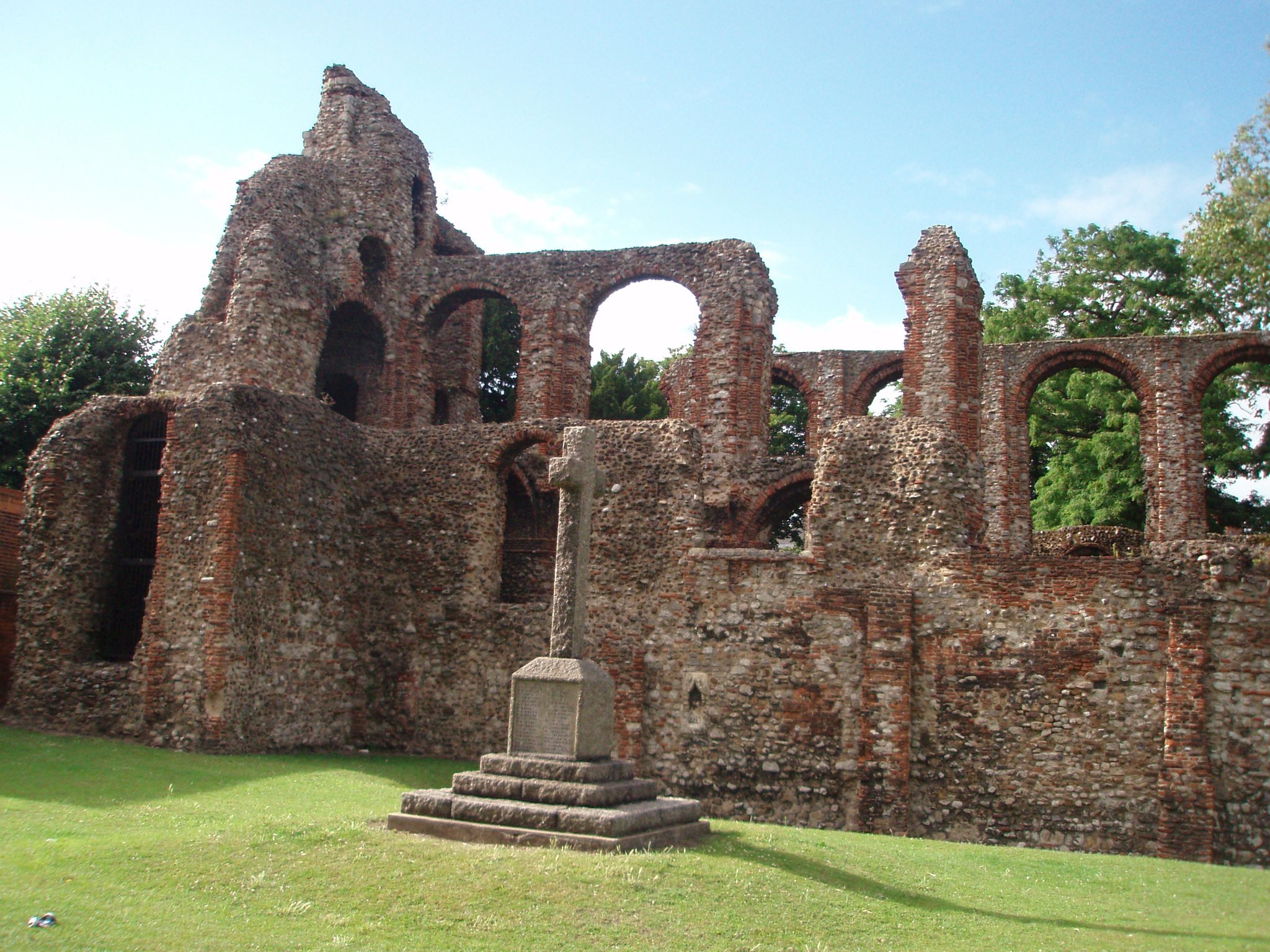
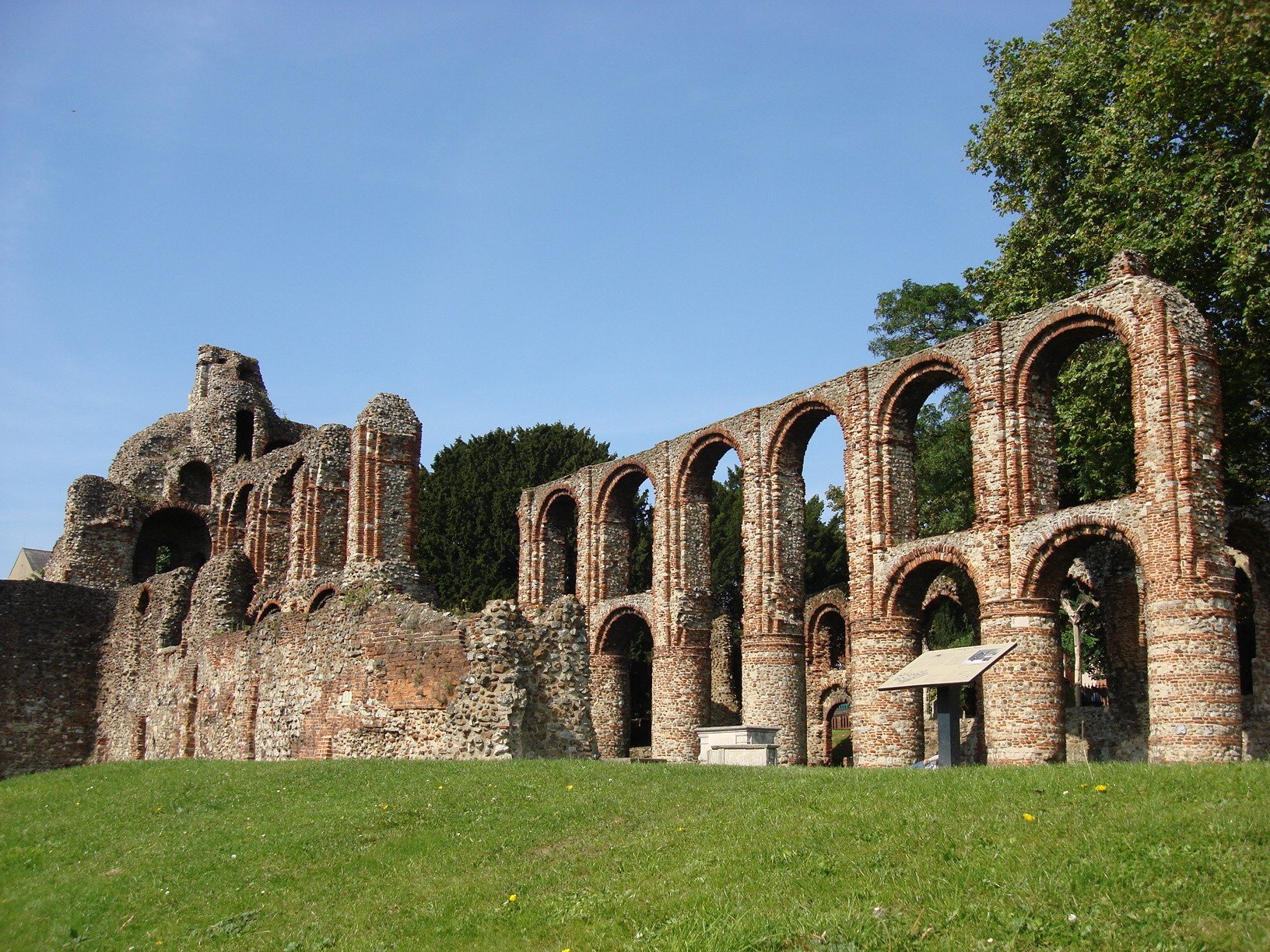
The remaining church was badly damaged during the Siege of Colchester in 1648, part of the Second English Civil War. Royalist forces occupied Colchester while the New Model Army, the reorganized parliamentary army, was commanded in the campaign by Thomas Fairfax. The assault on South Gate and the accompanying bombardment reduced the surviving church to its present ruinous state.
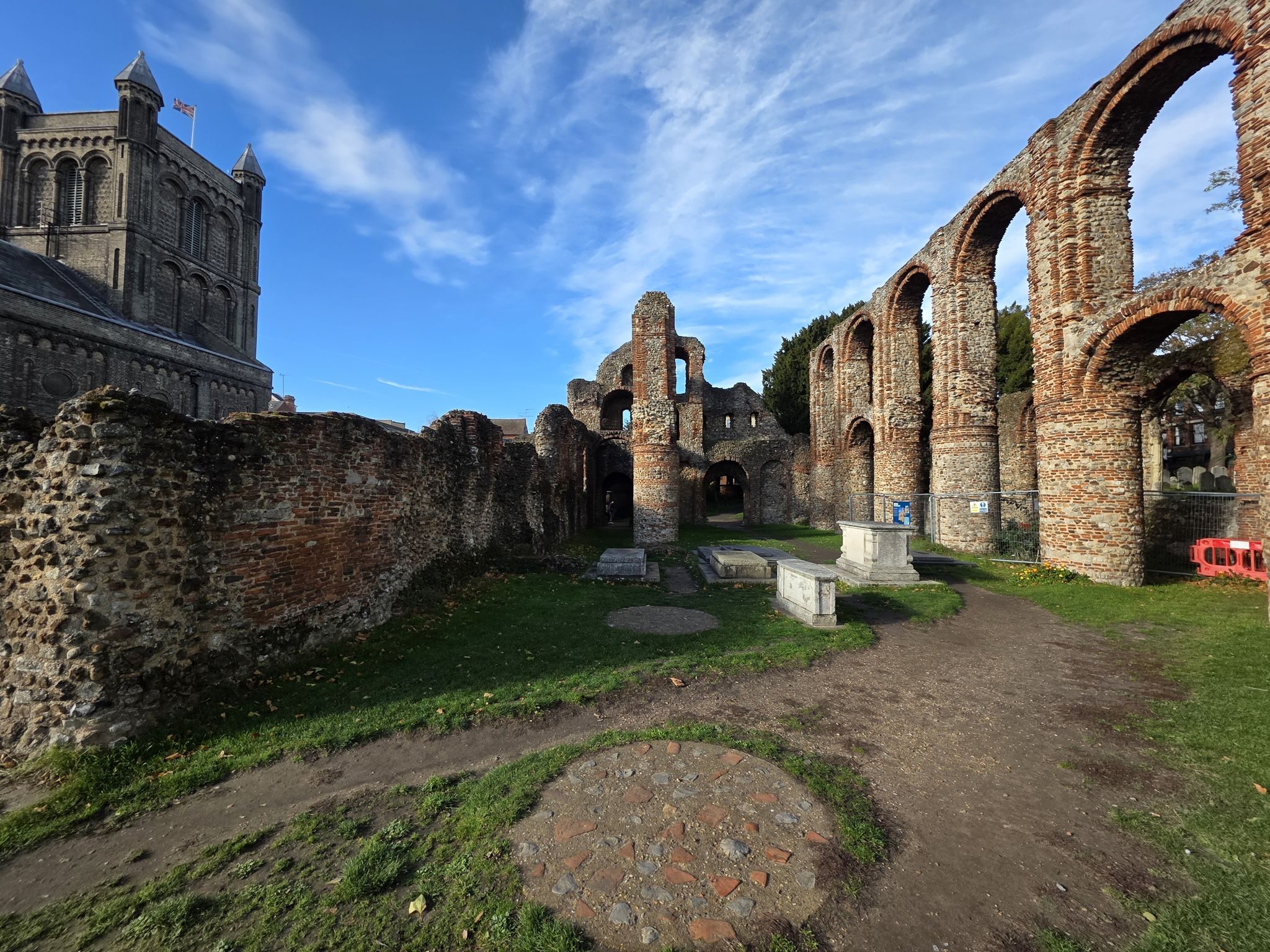
A Gothic Victorian church was built beside the ruins in 1837 and partly covered the former cloister area. The ruins later became a public park, with improvements made between 2010 and 2012 to improve their accessibility. The remains are protected as both a scheduled monument and a Grade I listed building.
Remains
The Norman church
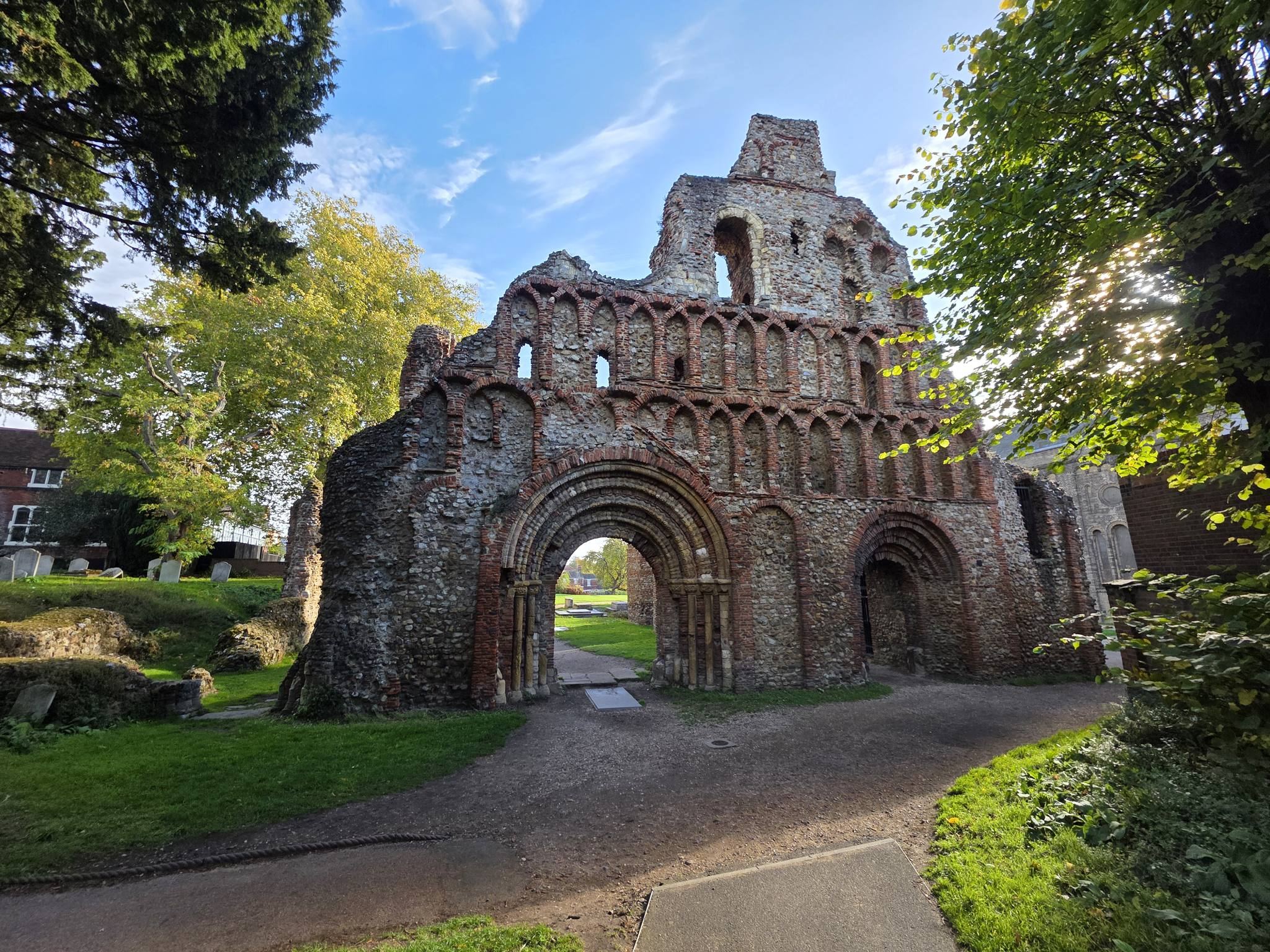
The priory church was a three-aisled basilica, meaning a church with a central nave flanked by aisles, built in the Norman or Anglo-Norman style. It extended more than 176 feet (53.7 metres), approximately twice the length of the standing ruins. The nave measured 110 feet (33.5 metres) long and 55 feet (16.75 metres) wide across the aisles. A central tower and transepts formed the main plan, with the transept arms measuring about 42 feet (12.8 metres).
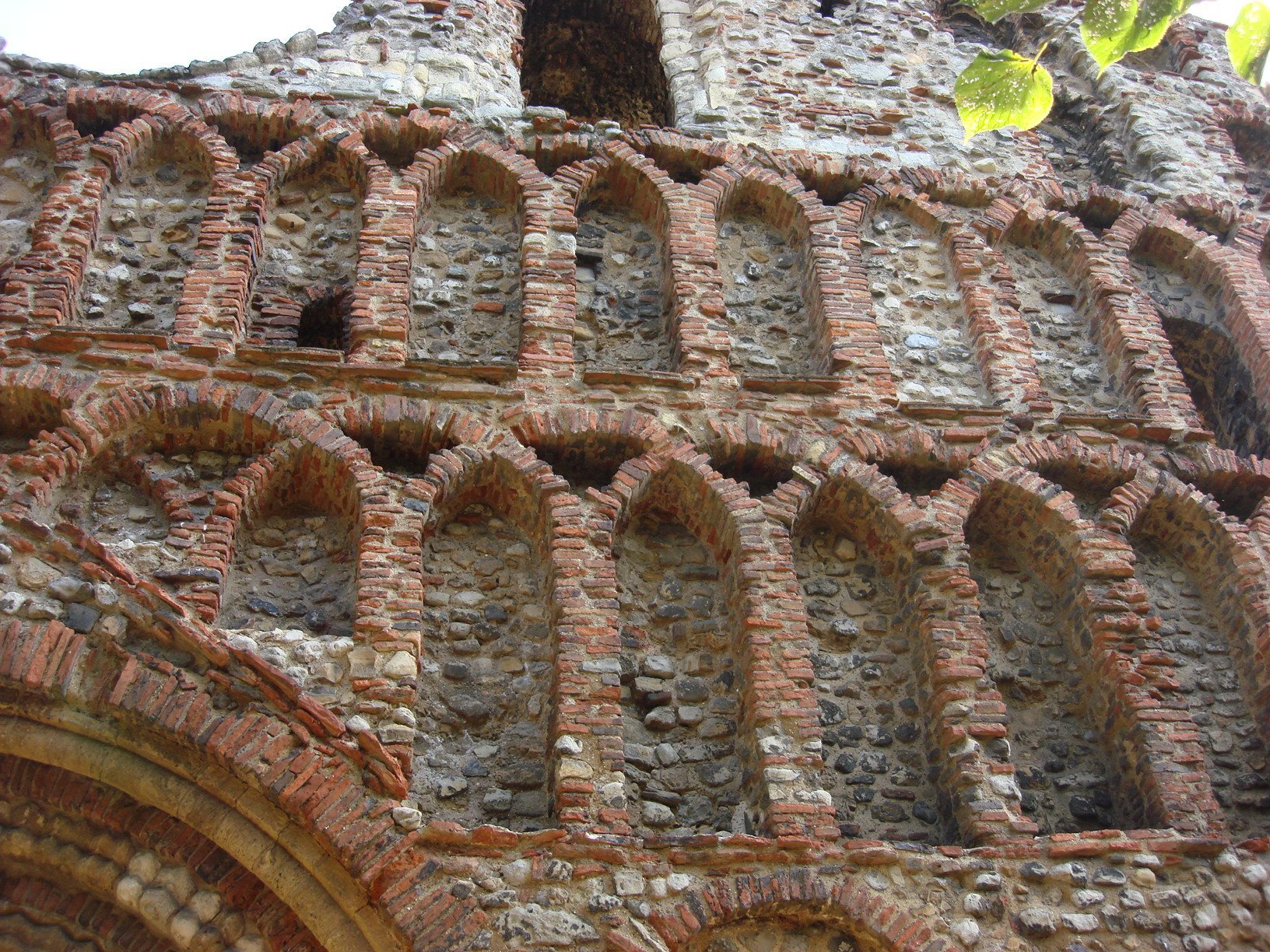
The church’s gable rose approximately 45 feet (13.7 metres), and its rose window, a large circular window with radiating tracery, is thought to be one of the earliest examples in England. Decorative use of reused brick forms part of the priory’s architectural character. The surviving ruins consist mainly of substantial portions of the nave, while the remaining church fabric bears the effects of the destruction in 1648.
Chapels and entrance
Several chapels formed part of the church. The Lady Chapel and another chapel stood on its western side. A chapel dedicated to St Catherine of Alexandria was recorded from the early fifteenth century, while the chapel of St Thomas Becket existed by 1281 and the chapel of the Holy Trinity had been added by the early sixteenth century. The Lady Chapel contained an image of the Virgin Mary with an eternal light, supported by income from land at Colchester’s Hythe port. The church also possessed at least two bells, a Sanctus bell and a requiem bell.
The principal western entrance was the Pardon Door. During the feast of St Denis on 9 October, pardons were granted there in an observance known in medieval Colchester as Pardon Day.
Cloister and conventual buildings
The cloister, a covered walkway enclosing an open courtyard, and the other conventual buildings lay south of the church. The canons’ dormitory was refurbished in 1383. The later Victorian church partly covers the former cloister area, while the choir, chapter house, and other associated buildings were demolished after the priory was dissolved.
Priory seal
The priory seal was a pointed oval made of yellow-brown wax, measuring approximately 2½ by 1¾ inches. It showed Christ seated and blessing two figures, St Julian as a bishop and St Botolph as an abbot. Its inscription identified the church of St Botolph in Colchester and linked the surviving institution to the saints who shaped its medieval religious identity.