Fort Wellington: A British Military Fortification on the St. Lawrence River
Site at a Glance
- Rating
- 4.6
- Popularity
- Low
- Country
- Canada
- Primary era
- Modern
- External website
- Open
- Eras represented
- Modern
- Civilizations
- British
- Site type
- Military
- Remains
- Fort
On this page13 sections
History
Fort Wellington is a British military fortification in Canada, on the north shore of the St. Lawrence River at Prescott, Ontario. Commissioned in 1813 during the War of 1812, the conflict between the United States and Britain that involved military operations in British North America, it was built to protect the head of the Galop Rapids and the communications hub at Prescott, which lay about one mile from Ogdensburg, New York.
Construction and the War of 1812
The fort was constructed on land owned by Major Edward Jessup, a prominent Loyalist from Connecticut who founded Prescott in 1784. George R. J. Macdonell and Thomas Pearson are identified as its architects. The first fort was built in 1813 and 1814, using earthen defenses and concealed timber buildings. It became a rallying point for local militia and, early in 1813, a base for the Glengarry Light Infantry, a light-infantry regiment raised in Upper Canada for British service during the war.
On 22 February 1813, Lieutenant Colonel George Macdonell led about 500 men across the frozen St. Lawrence River in a raid on Ogdensburg. His force destroyed military barracks and four American ships before returning with food, ammunition, cannon, and prisoners. Later that year, the fort’s guns influenced the movements of an American army commanded by General Wilkinson during its attempt to reach Montreal. Wilkinson unloaded his army upriver from Ogdensburg and moved through the town at night while his boats passed the fort empty. After Wilkinson’s decisive defeat at the Battle of Crysler’s Farm on 11 November, the attack on Montreal was abandoned.
Abandonment and Reconstruction
After the War of 1812, the British reduced the garrison and allowed the fortifications to deteriorate. The fort was abandoned in 1833, although the land remained under the British Board of Ordnance, the government body responsible for military stores, weapons, and fortifications. Its buildings and fortified chambers gradually fell into disrepair.
The Rebellions of 1837–1838, uprisings against the colonial governments of Upper and Lower Canada, gave Fort Wellington a new military purpose. The Crown made it the main militia depot in the Prescott area and began constructing a second fort in spring 1838. The work reused the original earthworks and was completed in 1839, following the Hunters’ Lodges’ seizure of the steamer Sir Robert Peel. The Hunter Patriots, also known as the Hunters’ Lodges, were cross-border insurgents who sought to overthrow British rule in the Canadas.
In November 1838, Patriot Hunters attempting to seize Fort Wellington landed instead at Windmill Point, about two miles downriver. They occupied the village and windmill, while local militia assembled at the fort and used it as their principal base for operations. After reinforcements and heavy artillery arrived, the insurgents surrendered at the windmill. Survivors were taken to Fort Henry in Kingston for trial. The associated battlefield and windmill are now separately designated as the Battle of the Windmill National Historic Site.
British and Canadian Military Use
Fort Wellington retained a regular British garrison after the Rebellion. In 1846, it held a detachment of Royal Artillery and a company of riflemen from the Royal Canadian Rifle Regiment, a British-raised unit composed largely of Army veterans who served in Canadian border fortifications. The fort’s principal task was to prevent its seizure by insurgents or other belligerents and to hold the Upper Canadian militia’s military stores for the surrounding region.
The British Army left in 1863, after which the Canadian militia assumed responsibility for the fort. It continued to serve as a regular site of militia operations and was garrisoned during the Fenian Raids of 1866. During the First World War, it became a depot for military personnel travelling between Toronto, Ottawa, and Montreal. Many Canadian soldiers travelling to Europe stayed there temporarily because Prescott was the terminus of the Canadian Pacific Railway line from Ottawa and connected northern travellers with the main Toronto to Montreal route.
Preservation and Interpretation
Fort Wellington was formally designated a National Historic Site of Canada on 30 January 1921. This federal heritage designation recognizes places of national historical importance through the program administered by Parks Canada. In 1923, the Ministry of Militia transferred the property to the Dominion Parks Branch, the predecessor of Parks Canada, ending its military use.
Parks Canada now operates the site as Fort Wellington National Historic Site and as an open-air historical museum. The fort has been restored to its 1846 condition. A visitor centre completed in 2012 includes historical exhibits and a displayed gunboat wreck associated with the site’s interpretation.
Remains
Fort Wellington occupies the north shore of the St. Lawrence River at the head of the former Galop Rapids. Before the St. Lawrence Seaway was created in the 1950s, the rapids required freight and passengers travelling between the Great Lakes and the lower St. Lawrence to transfer between large lake ships and smaller bateaux at Prescott. The surviving fort is presented in its restored 1846 arrangement, combining earthen defenses, masonry and timber buildings, underground chambers, and artillery positions.
Earthworks and Defensive Features
Ramparts and Outer Defenses
The first fort used earthen ramparts reinforced with horizontal frieze pickets. A dry ditch, a vertical palisade fence, and a glacis surrounded the eastern, western, and southern fronts. A glacis is a gently sloping bank of earth designed to expose attackers to defensive fire while reducing the effect of enemy fire against the fort. A masonry gate on the northern front provided the entrance. Timber buildings were placed inside the earthworks so that the ramparts concealed them, while casemates, fortified chambers tunnelled into the inner sides of the ramparts, supplied storage space.
Artillery Positions and Caponiere
Two 24-pounder iron cannon formed the first fort’s main armament. They stood at the southeastern and southwestern corners of the ramparts, where their range reached buildings across the river at Ogdensburg and covered vessels passing the fort. Smaller guns defended other parts of the earthworks. The reconstructed fort retained the two 24-pounders and added two 12-pounders at the northeastern and northwestern corners, a 36-pounder carronade above the gate, and two 14-inch mortars on the parade behind the southern rampart. A carronade was a short, large-calibre naval gun intended for powerful fire at relatively short range.
An enclosed stone caponiere stood in the dry ditch outside the southern palisade. A caponiere is a protected passage or position projecting into a ditch, allowing defenders to cover the ditch with fire. At Fort Wellington, a tunnel connected the structure with the interior of the fort.
Buildings and Museum Spaces
Blockhouse
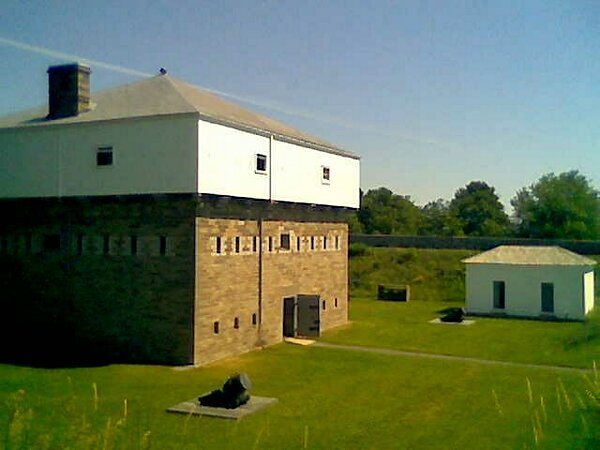
The 1838–1839 reconstruction produced a three-storey stone blockhouse, one of the principal surviving buildings. Its restored interior contains storerooms and barracks, while the third floor houses a military museum. The blockhouse forms part of the fort’s restored 1846 arrangement.
Support Buildings
Other surviving buildings from the reconstruction include officers’ quarters, a latrine, a cookhouse, and a guardhouse. Together with the blockhouse, these structures present the accommodation, storage, food preparation, and guard functions of the nineteenth-century garrison.
Visitor Centre and Gunboat Wreck
The visitor centre completed in 2012 contains historical exhibits connected with Fort Wellington and displays a gunboat wreck. These interpretive features complement the restored fortifications and buildings by presenting the fort’s relationship to military activity and transport on the St. Lawrence River.