Church of Saint John of Verdara: A Medieval Monastic Church in Padua
Site at a Glance
- Rating
- 4.3
- Popularity
- Very Low
- Country
- Italy
- Primary era
- Medieval
- Eras represented
- Medieval, Early Modern, Modern
- Civilizations
- Holy Roman Empire, Italian, Venetian
- Site type
- Religious
- Remains
- Church
On this page14 sections
History
The Church of Saint John of Verdara is a medieval Catholic church in Padua, Italy, built for a Benedictine monastic community in the early thirteenth century and shaped by Gothic and Renaissance architectural traditions. The foundation was already in existence by 1219 and served the surrounding religious community for centuries. Its name derives from the area’s abundant vegetation, described in medieval Latin as viridaria or in viridario.
From Benedictine foundation to Lateran community
The monastery became an important religious center during the fourteenth and fifteenth centuries. The monks enlarged both the church and its associated buildings, establishing the complex that later attracted artists, scholars, and religious reformers. In 1431 Pope Eugene IV, a fifteenth-century pontiff associated with ecclesiastical reform, granted the monastery in commendam to his nephew, Cardinal Antonio Correr, Bishop of Ostia. This arrangement placed the institution under the administration or income of a designated holder who was not necessarily its resident head.
In 1436 Correr entrusted the monastery to the Canons Regular of the Lateran, Catholic clerics who lived communally under a regulated rule linked to the Lateran tradition of Rome. The canons began a major restoration campaign under Lorenzo da Bologna and Giuliano da Porlezza. The institution later became an abbey in 1566.
Intellectual and artistic center
Saint John of Verdara acquired a strong intellectual reputation during the sixteenth century. Pietro Martire Vermigli, an Italian Augustinian theologian who later became an important Protestant reformer, and Reginald Pole, an English cardinal and reform-minded Catholic churchman, lived at the monastery between 1519 and 1527. The complex also attracted Pietro Bembo, a Venetian humanist, writer, and cardinal associated with Renaissance literary culture.
From the fifteenth through the seventeenth century, the Lateran canons assembled books, paintings, sculpture, antiquities, scientific instruments, and natural-history specimens. The collection expanded considerably under Abbot Ascanio Varese. In 1711, the sixteenth-century collection of Marco Mantova Bonavides became part of the monastery’s holdings. Ludovico Antonio Muratori, an Italian historian and scholar, helped care for and catalogue the library. Between the sixteenth and eighteenth centuries, the monastery was regarded as one of Padua’s principal cultural attractions and contributed to the development of Renaissance taste in northern Italy.
Suppression and secular transformation
The Republic of Venice suppressed the Lateran canons in 1783. The monastery’s holdings were then divided among several institutions. Valuable books went to the Biblioteca Nazionale Marciana in Venice, other volumes to the University Library of Padua, and paintings and sculptures became the nucleus of the Civic Museums at the Eremitani. Antiquarian, scientific, and natural-history materials were distributed among Padua’s public museum, physics cabinet, and observatory. The administrative transfer and organization of the collections were completed on 16 January 1784.
Secular priests continued to officiate in the church after the suppression, retaining its furnishings for a time. The monastic buildings first housed the Ca’ di Dio orphanage and briefly accommodated the Piarists. In 1847 they became an Austrian barracks for 3,000 soldiers and 200 horses. The Jesuits acquired the complex in 1852, converted it into a boys’ boarding school, and continued religious services until 1866.
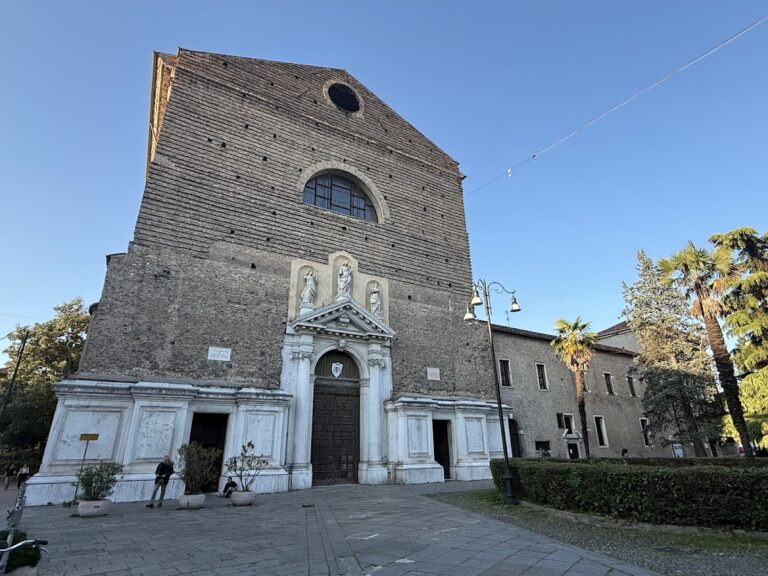
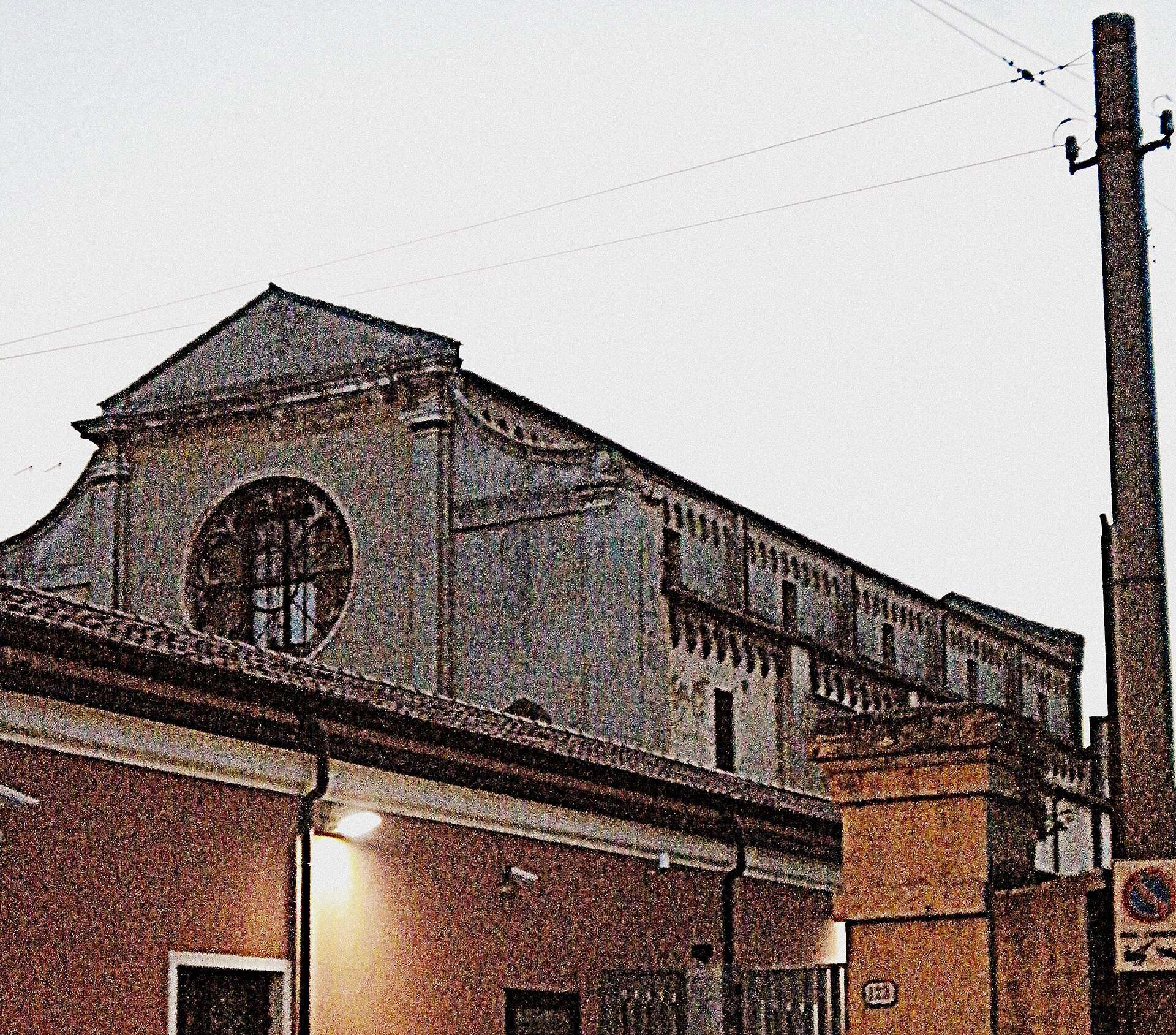
After 1866, the new Italian administration occupied and later expropriated the buildings, converting the complex into a military hospital. The church was deconsecrated, and its three naves were progressively divided for hospital functions. The former monastery and church now form part of the De Bertolini barracks of the Italian Army, which houses the Military Department of Legal Medicine of Padua. The complex is not open to the public, although part of the facade is visible from Via San Giovanni di Verdara.
The church was also a burial place for notable figures including Andrea Briosco, Lazzaro Bonamico, Giovanni Calfurnio, Giovanni da Cavino, Luca Ferrari, and Domenico Senno. Many works that once decorated the church are now preserved in museums, especially the Civic Museums at the Eremitani.
Remains
The surviving complex combines a church with a monastic group to its south. The building has a Gothic-Renaissance character, while later alterations affected the facade, interior divisions, and use of the former religious spaces. The church’s east-facing front retains medieval openings, the west end projects in a polygonal apse, and the monastery preserves two monumental cloisters.
Church exterior and monastic buildings
Gabled facade
The gabled facade faces east and retains Gothic openings, including a rose window, a large circular window filled with radiating tracery and multilobed arches. Much of the remaining front belongs to a later phase, possibly the seventeenth century. A fresco by Giacomo Ceruti showing the Virgin with Saint Joseph and Saint John the Baptist once occupied the arch above the main portal.
Side walls, apse, and bell tower
The side walls contain numerous deep blind arches, recessed arches that do not open into an interior space, and reflect the character of a fourteenth- or fifteenth-century Gothic building. At the west end, the apse projects markedly from the church and terminates in a polygonal plan. Beside the church stands the base of the bell tower, which collapsed almost entirely after 1866.
Cloisters and chapel
The monastic buildings south of the church remain substantially preserved and include two monumental cloisters. The large cloister was designed around 1492 by Pier Antonio dell’Abate. He and Benedetto Montagna frescoed a chapel within the complex, linking the surviving monastic architecture with the artistic activity that shaped Saint John of Verdara during the Renaissance.
Interior and former furnishings
Naves and funerary monument
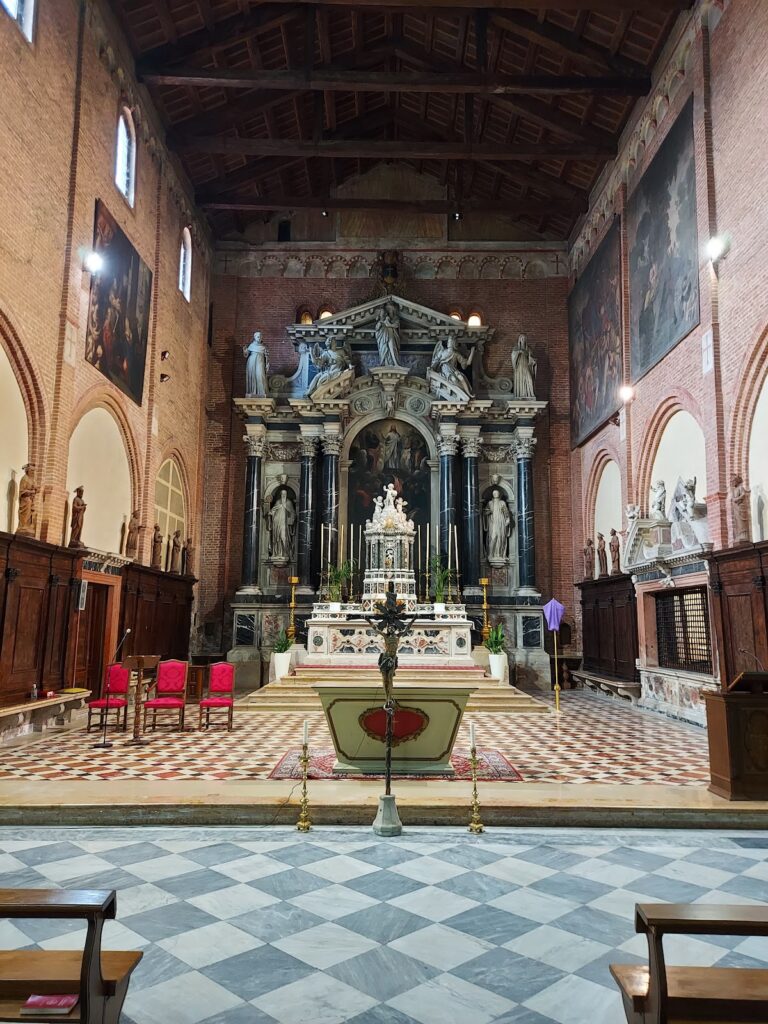
The church interior had three naves separated by broad arcades. Near the main portal stood the funerary monument of Andrea Briosco, which included a bronze roundel showing the artist. The roundel disappeared after 1797, while the monument also carried a memorial composed by Canon Girolamo Negri.
Altars and sculpture
The former furnishings included Antonio Bonazza’s marble sculpture of the Virgin of Sorrows with the dead Christ and a grieving putto. It is now displayed in the civic museums. The altar of Saint Patrick held Giovanni Battista Tiepolo’s Saint Patrick the Bishop Healing a Sick Man, which is now in the civic picture gallery. The altar of the Blessed Sacrament had an ebony tabernacle decorated with precious stones.
Renaissance tombs
Two monumental Renaissance tombs were formerly housed in the church. Antonio Minello made the tomb of Giovanni Calfurnio. The tomb of Lazzaro Bonamico followed a design by Andrea Palladio and included a bronze bust of the humanist by Danese Cattaneo. The tombs are now in the Novitiate Cloister of the Basilica of Saint Anthony, while Bonamico’s original bust is displayed in the Civic Museum of Bassano.
Dispersed artistic and scholarly collections
Paintings and panels once associated with the church included works by Pietro Bacchi da Bagnara, Stefano dall’Arzare, Pietro Ricchi, Alessandro Varotari, Pietro Rotari, and Girolamo Forabosco, as well as works by Andrea Vicentino. Piazzetta’s Supper at Emmaus is now in Cleveland. The monastery’s broader collection included books, portraits made in metal, marble, ivory, and wax, ancient and modern ivories and bronzes, vessels, idols, images, cameos, engraved stones, lamps, funerary urns, weights, seals, minerals, fossils, crustaceans, corals, marine specimens, mathematical, astronomical, and optical instruments, and medals. A wax bust of Titian was especially noted for its workmanship.
After the suppression of the Lateran community, these materials were distributed among the Marciana Library, the University Library of Padua, the Civic Museums at the Eremitani, Padua’s natural-history collections, physics cabinet, and observatory. The dispersal changed the physical character of Saint John of Verdara, but preserved parts of its artistic, scholarly, and scientific heritage in institutions across Padua and beyond.