Papraća Monastery: A Serbian Orthodox Monastic Complex in Bosnia and Herzegovina
Site at a Glance
- Rating
- 4.8
- Popularity
- Low
- Country
- Bosnia and Herzegovina
- Primary era
- Early Modern
- External website
- Open
- Eras represented
- Medieval, Early Modern, Modern
- Civilizations
- Serbian
- Site type
- Religious
- Remains
- Monastery
On this page11 sections
History
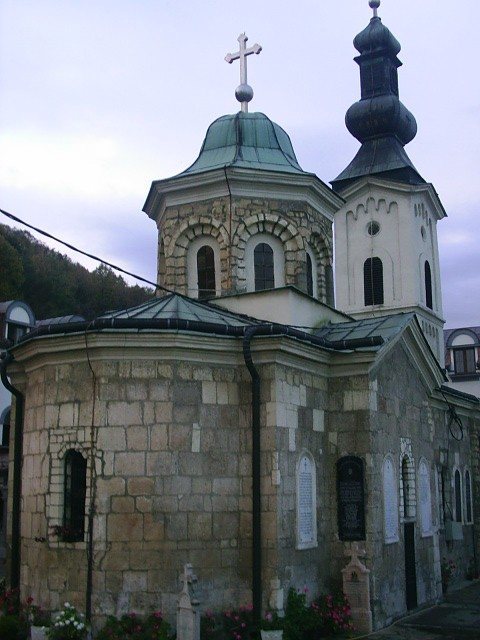
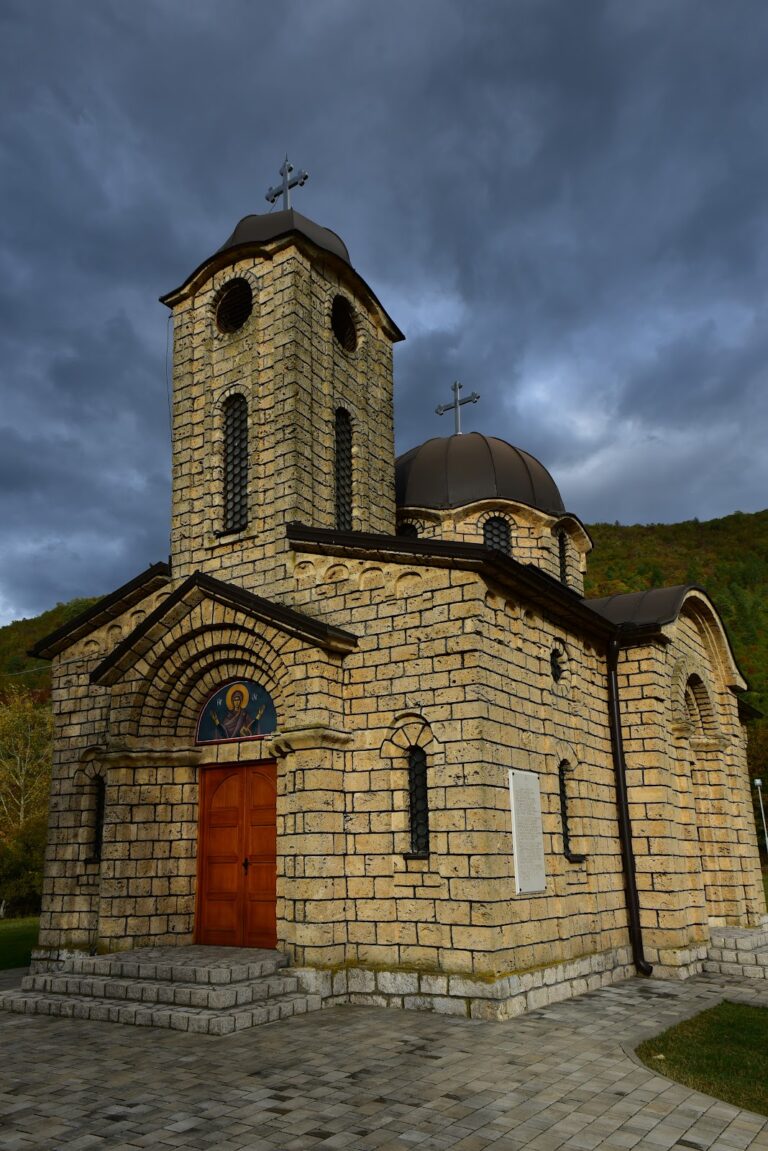
Papraća Monastery is a Serbian Orthodox monastery in Bosnia and Herzegovina, near Šekovići, dedicated to the Annunciation of the Virgin Mary and belonging to the Zvornik–Tuzla Eparchy. Its origins are uncertain, but archaeological remains beneath the present church are tentatively dated to the thirteenth or fourteenth century, during the period of Nemanjić rule. The church’s architectural conception is associated with the Morava school, a late medieval Serbian tradition known for articulated plans, polygonal forms, vaulted spaces, and rich decoration.
Uncertain Origins and Medieval Setting
Several traditions explain the monastery’s foundation. One attributes it to King Stefan Dragutin, a medieval Serbian ruler, and his sons Vladislav and Urošic. Others connect it with Vukan Nemanjić, who supposedly founded the monastery as an act of repentance, or with Grand Župan Stefan Nemanja, the twelfth-century founder of the Nemanjić dynasty. Another tradition credits four sisters of the Serbian “Emperor Šćepan” with founding churches at Tavna, Papraća, Lovnica, and Cikote. The proposed foundation dates range from the eleventh century to the thirteenth or fourteenth century.
The wider Birač region was inhabited during antiquity and the Middle Ages. Roman coins, medieval tombstones, and the medieval fortification of Perin-grad reflect that earlier history. Under Ottoman rule, the area also lay along an important communications route.
Documented Monastic Life in the Sixteenth Century
Ottoman registers from 1513 and 1528 mention a church and clergy connected with Papraća. A priest named Oliver described the Ottoman offensive in northern Bosnia, the experiences of Orthodox Christians, and the fall of the Srebrenica Banate in 1512. In 1513, he copied a Gospel Book that remained at Papraća until 1578. These references place a parish church at Papraća in the first half of the sixteenth century, with the institution becoming a monastery before 1550.
The earliest surviving written evidence specifically associated with the monastery includes a Gospel Book from 1550–1551, received by Abbot Grigorije from the Russian protopresbyter Jakov. The church traditionally dated to 1551 was probably rebuilt and possibly enlarged at this time. Financial assistance was associated with Tsar Fyodor I Ivanovich, the Russian ruler from 1584 to 1598, who was said to have donated 120 rubles during Grigorije’s visit to Russia.
Papraća maintained extensive connections with Russia and other Orthodox communities during the sixteenth and seventeenth centuries. Monks travelled to seek money, books, and other donations. In 1551, they received a manuscript Gospel Book in the Grand Duchy of Lithuania, while another group later obtained a psalter in Volhynia. In 1553, Mihajlo Zborožević Aleksandrović copied a psalter in Poland and sent it to Papraća.
In 1559, Arsenije of Papraća was invited by Abbot Pajsije of Tronoša to advise the brotherhood during construction of a new church on an older church site. Arsenije contributed both practical knowledge and material support. The monastery received money and textiles from the Russian tsar in 1588, and Abbot Longin travelled to Russia in 1592 and 1607, obtaining manuscript books from monks of the Kirillov Monastery.
In 1645, Abbot Simeon received from Tsar Aleksey Mikhailovich, who ruled Russia from 1645 to 1676, a charter allowing Papraća’s monks to remain in Russia and collect donations once every eight years. Archimandrite Mihailo travelled to Moscow in 1683 and gathered substantial assistance in money and books. Monks from Papraća continued to travel to Russia during the Great Turkish War of 1683–1699, the conflict between the Ottoman Empire and the Habsburg-led coalition.
Destruction and Revival
Papraća is associated with the sixteenth-century hieromonk Longin, a monk ordained as a priest, who made an ornamented reliquary in 1586. The monastery was also connected with Abbot Sofronije Podgoričanin, who became Bishop of Pakrac and Slavonia in 1705, although the date of his departure from Papraća is uncertain.
After the Austro-Turkish War, between 1717 and 1723, the monastery was abandoned and became the property of Ferhat-beg, an Ottoman cavalry officer from the vicinity of Buda. A local tradition says that a dispute involving Ferhat-beg’s family led the vizier Ćuprilić to arrive with 300 soldiers. The monks were reportedly killed, and the monastery was burned and looted. Orthodox inhabitants fled toward Serbia and Posavina. The church lost its roof, was later used for livestock, and had its valuables removed. Some accounts also state that better building materials were reused in a mosque.
The monastery is traditionally believed to have held estates in eastern Herzegovina. Icons at Zavala Monastery in Popovo Polje and at Mačkovac near Papraća have been attributed to the anonymous “Master of Mačkovac.”
Conditions for Orthodox Christians improved after the 1851 campaign of Omer Pasha Latas, an Ottoman military commander and governor in the nineteenth-century Balkans. Papraća’s revival is associated with 1853 and with Hadži-Zaharija Popović, a priest from Osmaci who reportedly brought a small bell from Russia concealed in a barrel. Metropolitan Dionisije of Dabar and Bosnia consecrated the church in 1869.
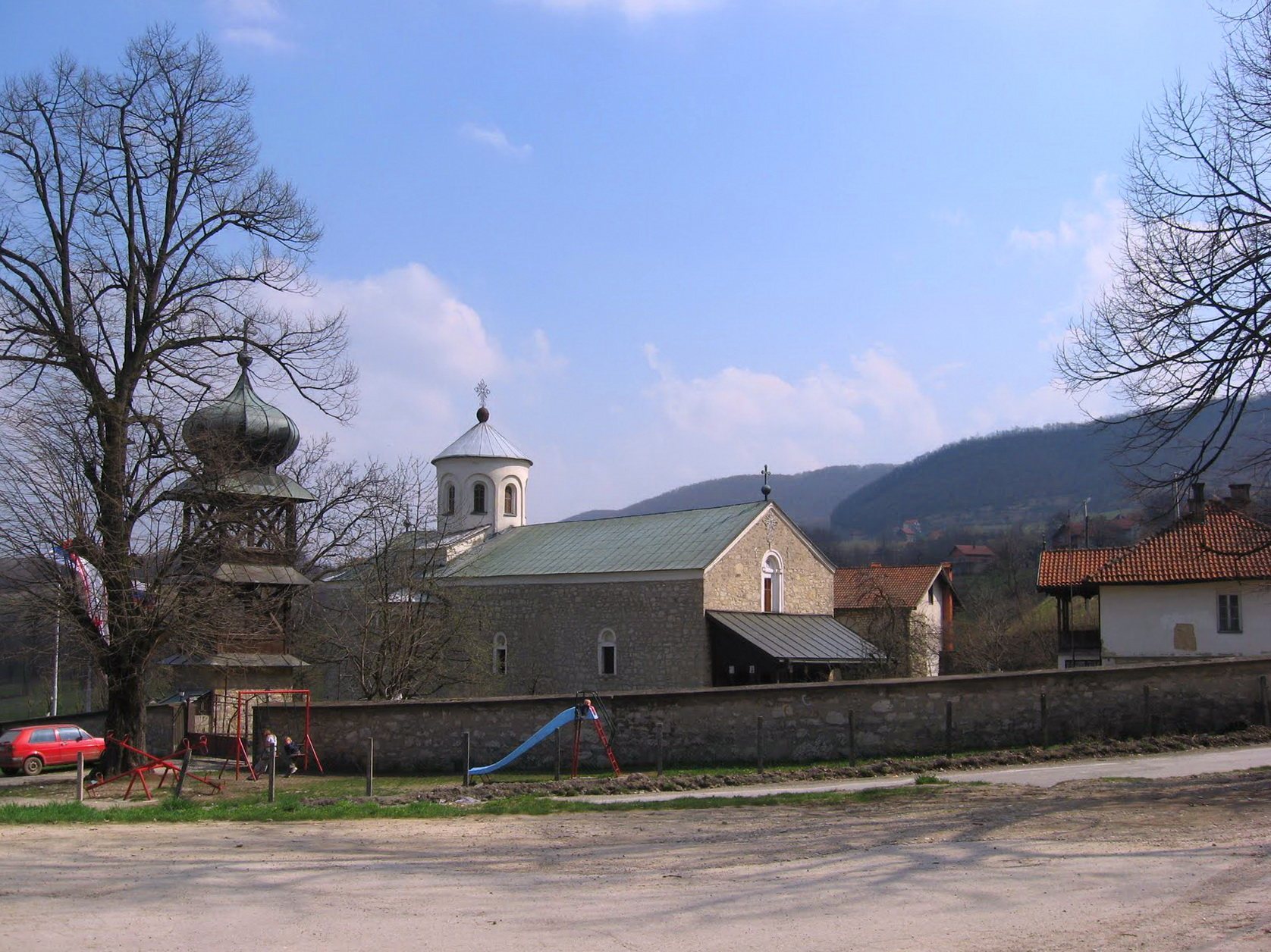
The church served as a parish church until 1880, when monastic life was restored under Abbot Pajsije Filipović. In 1892, Archimandrite Kirilo Hadžić of Moštanica became abbot, further equipped the monastery, and planted a vineyard. Archimandrite Danilo Bilbija arrived in 1901. He built a new residence, or konak, in 1905 on the site of the building destroyed by fire in 1717, followed by a new school in 1907. From 1923, Abbot Joakim Trbojević enclosed the monastery, erected a wooden belfry, and acquired a large bell.
During the Second World War, Papraća suffered persecution, devastation, damage, and the theft of valuables. The church was again used to house livestock. Partial repairs took place in 1954, largely through the efforts of Nun Varvara Božić of Tavna Monastery. Further restoration followed, and the monastery was consecrated again during the 1970s. In 2005, the architectural complex was designated a National Monument of Bosnia and Herzegovina. The protected complex includes the Annunciation church, the old konak, and the belfry. Since 2022, the monastery has been headed by Archimandrite Nektarije Tešić.
Remains
The Monastery Church
Plan and Construction
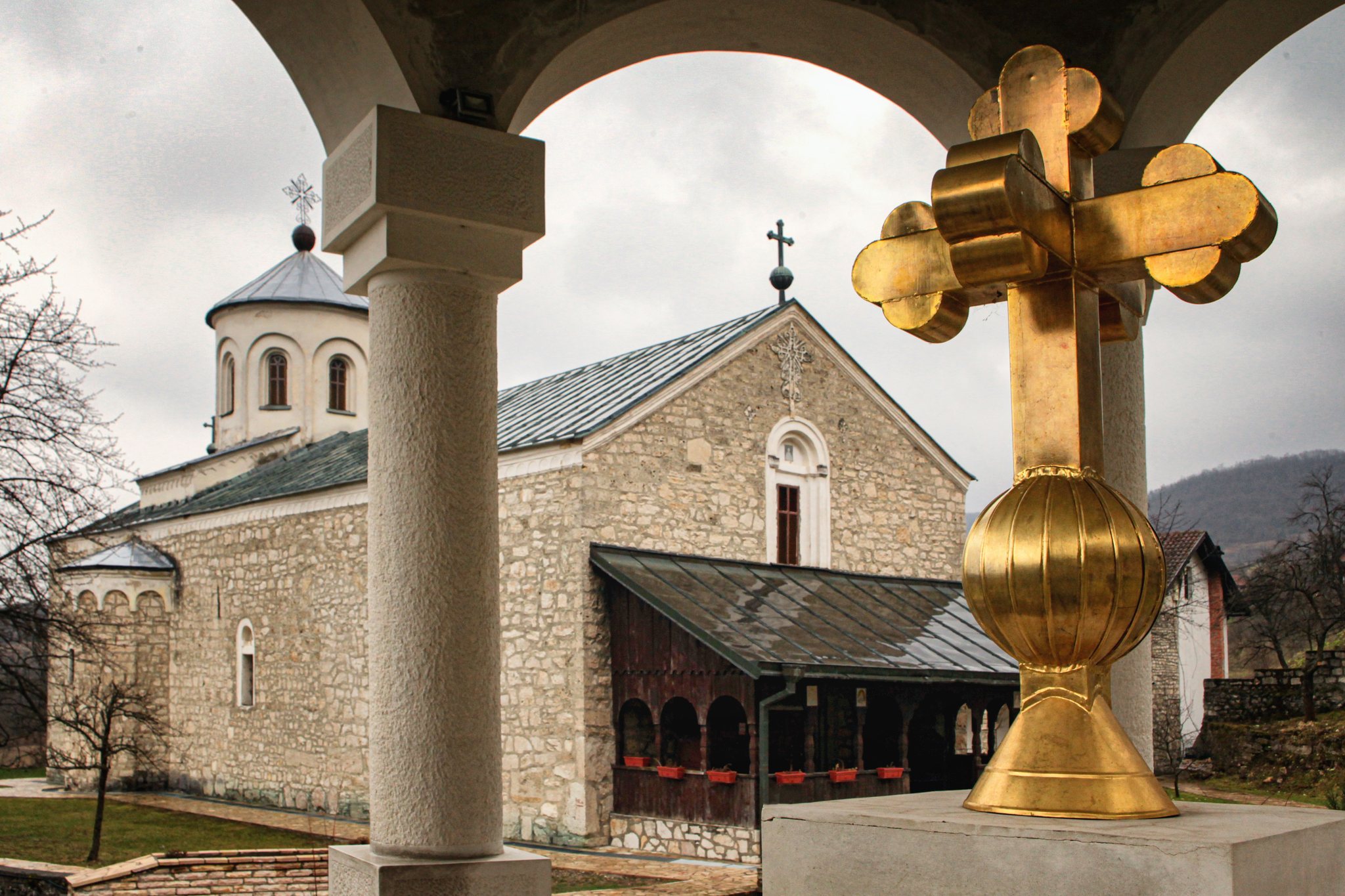
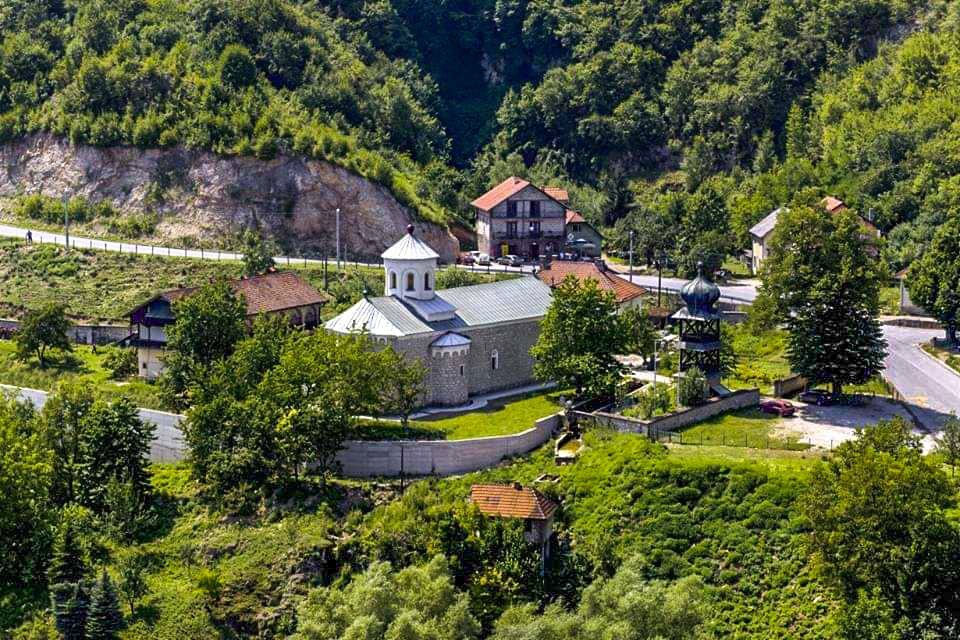
The monastery stands near the source of the Papraća River in the village of Papraća. The church is organized around a naos, the principal worship space of an Orthodox church, an altar area, and inner and outer narthexes, which are entrance or vestibule spaces. A dome rises on piers, while the side windows are covered by barrel vaults, continuous semicircular vaulted ceilings.
Inside, the altar is semicircular, while its exterior forms a polygon. The choir areas are semicircular internally and seven-sided externally. The shorter inner narthex has a longitudinal barrel vault supported by engaged arches, which are arches attached to and projecting from the walls. The overall arrangement and treatment are associated with the Morava school.
Wall Paintings
The wall paintings survive in an inadequately preserved condition but retain features associated with Morava art. The surviving imagery includes holy hierarchs in the altar area, holy warriors in the southern choir, scenes from the Passion of Christ, and a Dormition of the Virgin composition. The paintings are generally dated to the 1530s and are associated in the literature with Teofan, Bishop of Zvornik.
Icons and Ecclesiastical Objects
Nineteenth-Century Icons
The church and konak contain numerous nineteenth-century Serbian icons. The royal icons of Christ Pantocrator, the Orthodox image of Christ as the Almighty or universal ruler, and the Virgin and Child were painted in oil on canvas by Milija Marković of Belgrade. Miša Anastasijević, a nineteenth-century Serbian merchant and patron of religious institutions, donated them in 1857.
The monastery also contains an oil-on-canvas icon of the Holy Trinity with the Virgin and three large representations of Jerusalem, dating from the eighteenth or nineteenth century.
Antependium and Reliquary
An eighteenth-century antependium, a decorated altar hanging, from Papraća is preserved in the museum of the diocesan palace in Tuzla. Dating to the middle of the eighteenth century, it depicts the “Unblinking Eye,” a Christian theme expressing divine vigilance through a symbolic image associated with Christ and the Old Testament kings David and Solomon. The antependium and related icons are attributed to Stanoje Popović of Martinci in Srem.
The ornamented reliquary made by Hieromonk Longin in 1586 was formerly kept at the Old Serbian Church in Sarajevo. Russian books and manuscript Gospel Books associated with Papraća also form part of its written heritage, although some were later transferred or circulated elsewhere.